How to Convert to Islam: A Step-by-Step Guide
Converting to Islam begins with sincerely saying the Shahada — the Islamic declaration of faith — with full understanding and conviction. Before taking this step, most people spend time learning what Islam actually teaches, resolving their doubts, and understanding what the commitment involves. This guide walks you through every step of the conversion process, from your very first question to building a sustainable life rooted in faith.
What Does It Mean to Convert to Islam?
The word Islam comes from the Arabic root salam, meaning peace — and from aslama, meaning to submit. To convert to Islam means to submit willingly to God (Allah) — to acknowledge His oneness, accept Muhammad ﷺ as His final messenger, and commit to living according to the guidance He revealed.
In Islamic theology, every human being is born in a state called fitrah — a natural disposition toward belief in one God. Converting to Islam, in this framework, is not adopting a foreign religion. It is returning to the state you were born in. This is why Muslims often use the term "reverted" rather than "converted."
There is no intermediary between you and God in Islam. No priest, no confession, no institutional approval. The relationship is direct, personal, and permanent — beginning the moment you sincerely declare your faith.
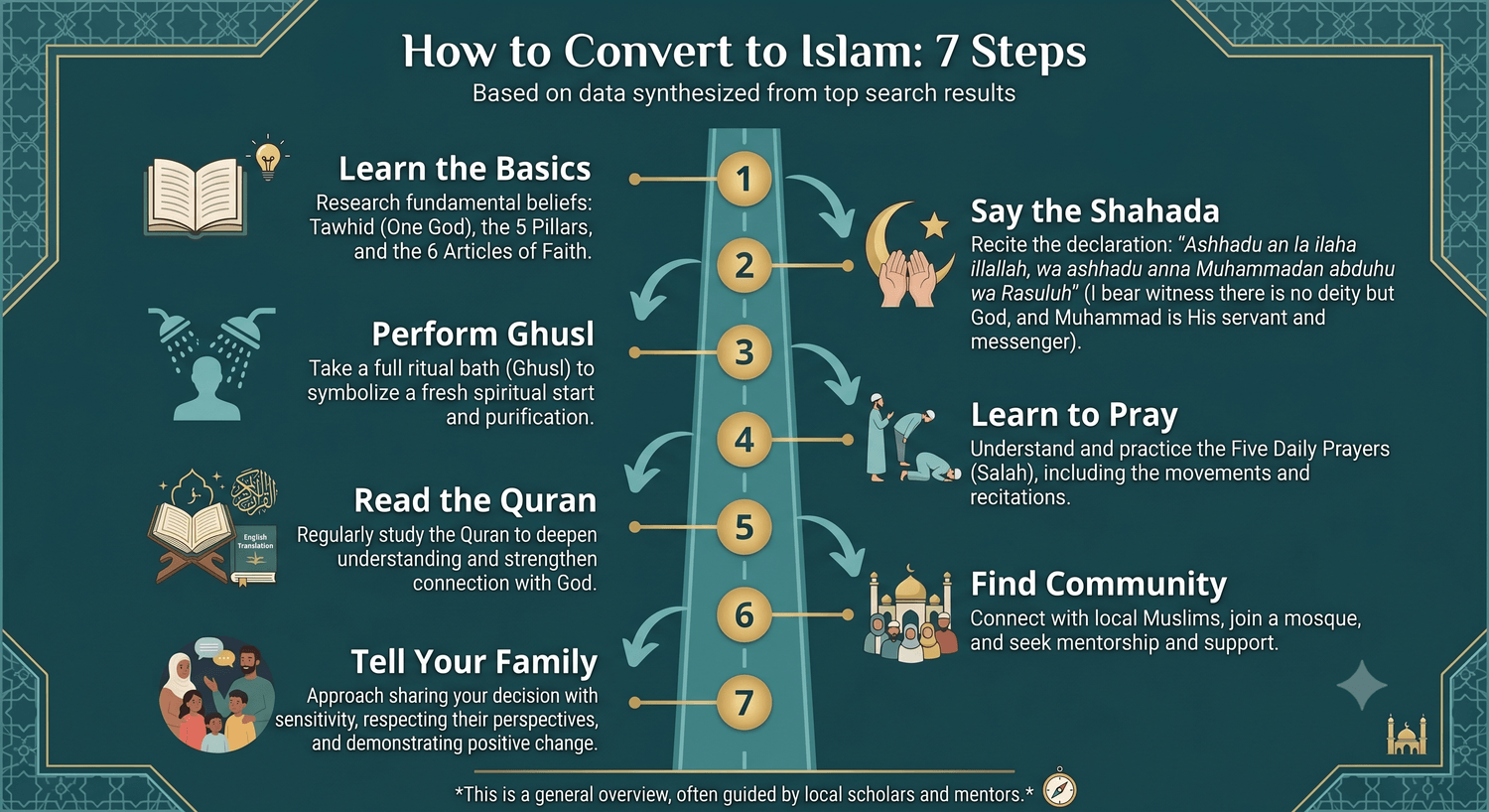
Step 1 — Learn the Basics of Islam Before Converting
You do not need to know everything before converting to Islam. But basic understanding matters. Taking the Shahada without knowing what you're committing to is like signing a contract without reading it. Islam encourages knowledge before action — in fact, the very first word revealed to the Prophet Muhammad ﷺ was Iqra — "Read."
The 5 Pillars of Islam
Lorem ipsum dolor sit amet, consectetur adipisicing elit. Autem dolore, alias, numquam enim ab voluptate id quam harum ducimus cupiditate similique quisquam et deserunt, recusandae.
Large Call to Action Headline
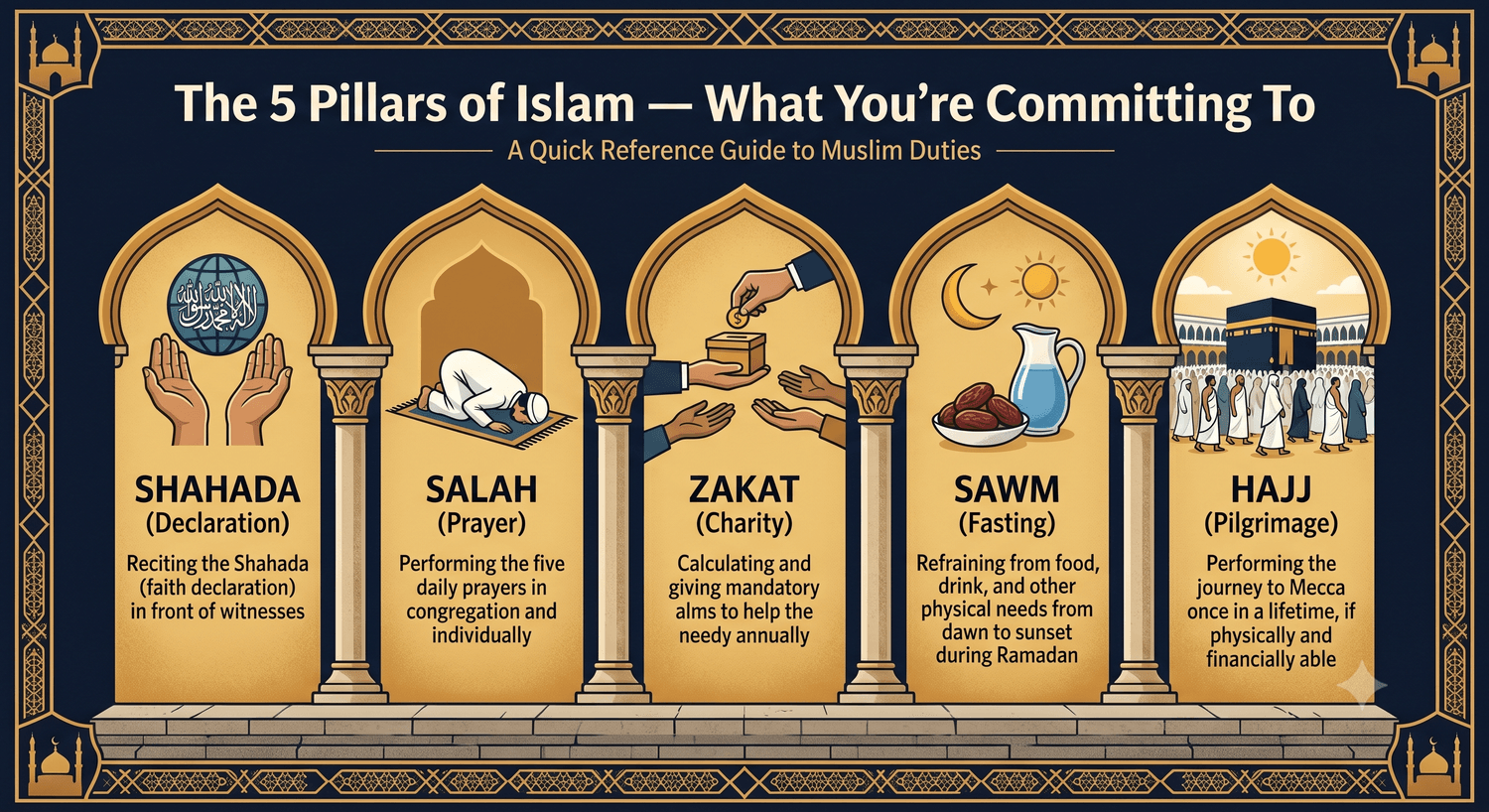
The five pillars are the foundational practices of Islamic life. Every Muslim is required to observe them:
Shahada — The declaration of faith (covered in detail in Step 2)
Salah — Five daily prayers performed at prescribed times
Zakat — Annual almsgiving (2.5% of savings above a minimum threshold)
Sawm — Fasting during the month of Ramadan
Hajj — Pilgrimage to Mecca, obligatory once in a lifetime for those who are physically and financially able
The 6 Articles of Faith
Beyond practice, Islam requires belief in six foundational truths:
Allah — Belief in the oneness of God, without partners, equals, or intermediaries
Angels — Belief in the existence of angels, created from light, who carry out God's commands
Holy Books — Belief in all divine scriptures, including the Torah, Psalms, Gospel, and the Quran as the final and preserved revelation
Prophets — Belief in all prophets sent by God, from Adam to Muhammad ﷺ, the final messenger
Day of Judgment — Belief in the afterlife, resurrection, and accountability for all deeds
Divine Decree — Belief that God has knowledge and control over all that happens, while humans retain free will and responsibility
How Long Should You Study Before Converting?
There is no mandatory waiting period. Some people convert after a week of research. Others take years. What matters is sincerity, not duration. A good benchmark: spend enough time that you can answer — honestly — the question "Why do I believe this is true?" If you can answer that with conviction, you are ready.
Your clearest starting point: Download the free 109-page guide — Steps for Converting to Islam and Maintaining Faith — written specifically for people in your exact position. It covers everything above in plain, honest language with no pressure and no agenda. [Download it free here]
Step 2 — Say the Shahada (The Declaration of Faith)
The Shahada is the most important step. It is the gateway into Islam — and the most powerful sentence a human being can speak.
What Is the Shahada?
The Shahada is the Islamic declaration of faith. It consists of two parts:
Declaring the oneness of God
Declaring the prophethood of Muhammad ﷺ
Together, these two statements form the foundation of the entire Islamic faith.
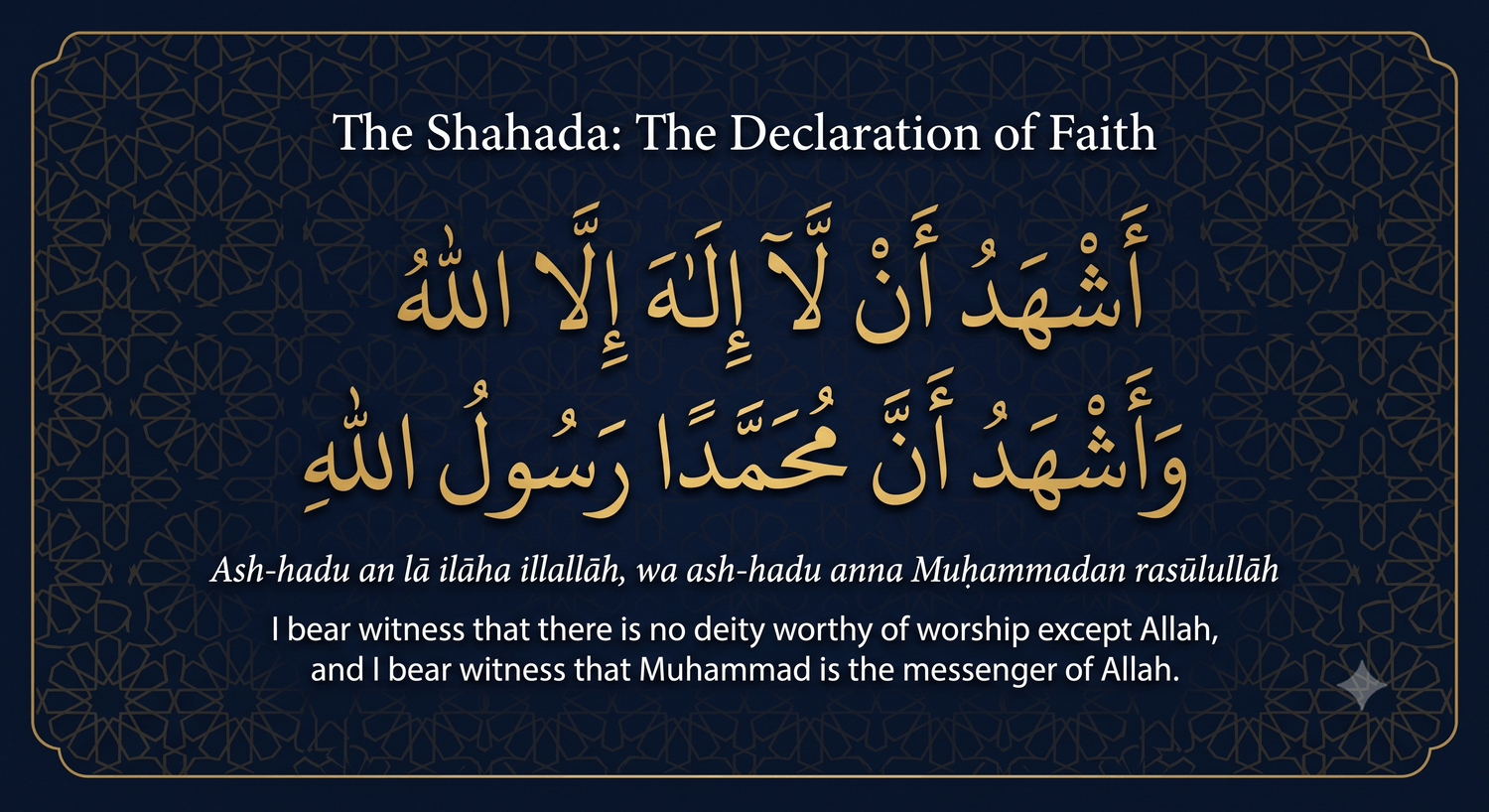
The Exact Words of the Shahada in Arabic and English
In Arabic: أَشْهَدُ أَنْ لَا إِلَٰهَ إِلَّا اللَّٰهُ وَأَشْهَدُ أَنَّ مُحَمَّدًا رَسُولُ اللَّٰهِ
Transliteration: Ash-hadu an la ilaha ill-Allah, wa ash-hadu anna Muhammadan rasul-Allah
English meaning: "I bear witness that there is no god but Allah, and I bear witness that Muhammad is the messenger of Allah."
Does the Shahada Need Witnesses?
Witnesses are recommended but not obligatory. Your conversion is valid between you and God the moment it is sincerely said — whether in private in your bedroom, or in front of a mosque full of people. The condition is sincerity (niyyah), not location or audience.
That said, saying the Shahada at a mosque or Islamic center in front of witnesses is encouraged for two reasons: it gives you immediate community connection, and in some countries, you may need a formal certificate of conversion for legal purposes (marriage, Hajj visa, etc.).
What Happens the Moment You Say the Shahada?
According to authentic Islamic teachings, the moment a person sincerely accepts Islam, all previous sins are completely forgiven. You begin with a clean slate — as if newly born. This is one of the most profound realities of conversion: the weight of everything before this moment is lifted entirely.
Step 3 — Perform Ghusl (Ritual Purification)
After taking the Shahada, Islamic scholars recommend performing Ghusl — a full ritual bath that marks the physical and spiritual cleansing that accompanies conversion.
What Is Ghusl and Why Is It Recommended?
Ghusl is the Islamic ritual of full-body purification. It is required in several circumstances in Islamic practice — and conversion is one of them. It symbolizes the washing away of the old and the beginning of something entirely new.
How to Perform Ghusl After Converting
Make the intention (niyyah) in your heart — "I am performing Ghusl for purification"
Say "Bismillah" (In the name of Allah)
Wash your hands three times
Wash your private parts thoroughly
Perform wudu (ablution) as you would before prayer
Pour water over your entire body, beginning with the right side, ensuring water reaches every part of the skin and hair
Ghusl does not need to be performed in a mosque. Any private bathroom is appropriate.
Step 4 — Learn How to Pray (Salah)
Prayer is the most consistent daily practice in Islamic life. If the Shahada is the door into Islam, prayer is the room you live in. Learning to pray is your most urgent practical priority after converting.
Why Prayer Is the First Thing to Learn
The Prophet Muhammad ﷺ said: "The first matter that the slave will be brought to account for on the Day of Judgment is the prayer." Prayer is not a suggestion — it is the pillar that holds everything else up. But it is also deeply beautiful: five moments in your day where the world stops and you stand in direct communication with your Creator.
The 5 Daily Prayers and Their Times
Fajr
From dawn until just before sunrise
Dhuhr
After midday until mid-afternoon
Asr
Mid-afternoon until just before sunset
Maghrib
Just after sunset until darkness falls
Isha
Night until midnight (or dawn)
Prayer times shift daily based on the sun's position. Use apps like Muslim Pro or Athan to get accurate times for your location.
Where to Start as a Complete Beginner
Start with Al-Fatiha — the opening chapter of the Quran, recited in every prayer. Learn it first. Then learn the basic physical movements (standing, bowing, prostrating). Build from there.
Do not let perfectionism stop you from starting. An imperfect prayer offered sincerely is infinitely better than a perfect prayer never attempted.
Structured guidance matters here. Our course walks you through Islamic prayer step by step — with phonetic transliterations, movement guides, and a 30-day prayer habit plan designed specifically for new Muslims. [Explore the course]
Step 5 — Start Reading the Quran
The Quran is the direct word of God as revealed to the Prophet Muhammad ﷺ over 23 years. It is the primary source of Islamic guidance — on theology, ethics, law, spirituality, and the nature of existence. Every Muslim's relationship with the Quran is a lifelong one.
Which Quran Translation Is Best for New Muslims?
You do not need to know Arabic to begin. Start with a clear, readable English translation:
The Clear Quran by Dr. Mustafa Khattab — The most accessible modern English translation. Written in plain language without archaic phrasing.
Saheeh International — More literal translation, excellent for serious study.
The Meaning of the Holy Quran by Abdullah Yusuf Ali — A classic with extensive commentary, good for deeper context.
Avoid starting with overly literal or archaic translations that make the Quran sound difficult — it isn't.
How to Build a Quran Reading Habit
Start small. Ten minutes daily, consistently, beats an hour once a week. Begin with the short chapters at the end of the Quran (Juz Amma — chapters 78–114). They are brief, powerful, and were among the first revealed — making them ideal starting points.
Set a consistent time: after Fajr prayer is the most recommended time in Islamic tradition. The early morning hours carry a particular clarity and spiritual weight.
Step 6 — Find Your Muslim Community
Islam is not a solitary faith. It was revealed to communities, practiced in communities, and transmitted through communities across 1,400 years. Finding your people is not optional — it is part of the practice.
How to Find a Mosque Near You
Your local mosque (masjid) is the center of Muslim communal life. To find one:
IslamicFinder.org — search by city or zip code
Google Maps — search "mosque near me"
Masjid.app — mosque locator with reviews and information
Visit for Friday Jumu'ah prayer first — it's the most communal prayer of the week and the best entry point for meeting Muslims in your area.
Online Communities for New Muslims
If you live in an area with few Muslims, or if you're not yet comfortable attending a mosque:
Start Islam Path Community — A judgment-free space for new Muslims and seekers at every stage of the journey. [Join here]
r/islam and r/convert on Reddit — active communities with experienced Muslim members
New Muslim Academy — structured learning with community support
Do not underestimate online community. Many new Muslims have built lasting relationships and found mentors through online Islamic spaces.
Step 7 — Tell Your Family (When You're Ready)
One of the most common fears about converting to Islam is family reaction. It is also one of the most individual situations — no two families are the same, and no single piece of advice applies universally.
Do You Have to Tell Anyone?
No. Your conversion is valid whether it is private or public. God knows your intention — you do not owe anyone an announcement before you are ready. Many converts practice Islam quietly for weeks or months before telling their family. This is entirely acceptable.
How to Navigate Family Reactions
When you are ready to share:
Lead with love, not confrontation. "I've found something meaningful" lands differently than "I've changed religions."
Expect confusion before acceptance. Most family members' initial reaction is based on media images of Islam, not reality. Give them time and information.
Let your character speak. The most powerful da'wah (invitation to Islam) is living as a good Muslim — being more patient, more honest, more present than before.
Set boundaries calmly. You can love your family and maintain your practice without either abandoning your faith or alienating your relationships.
Seek support. Connect with converts who have navigated this — they have experience you can learn from.
The free guide includes an entire chapter dedicated to family dynamics after conversion — one of the most practically useful sections in the book. [Download it here]
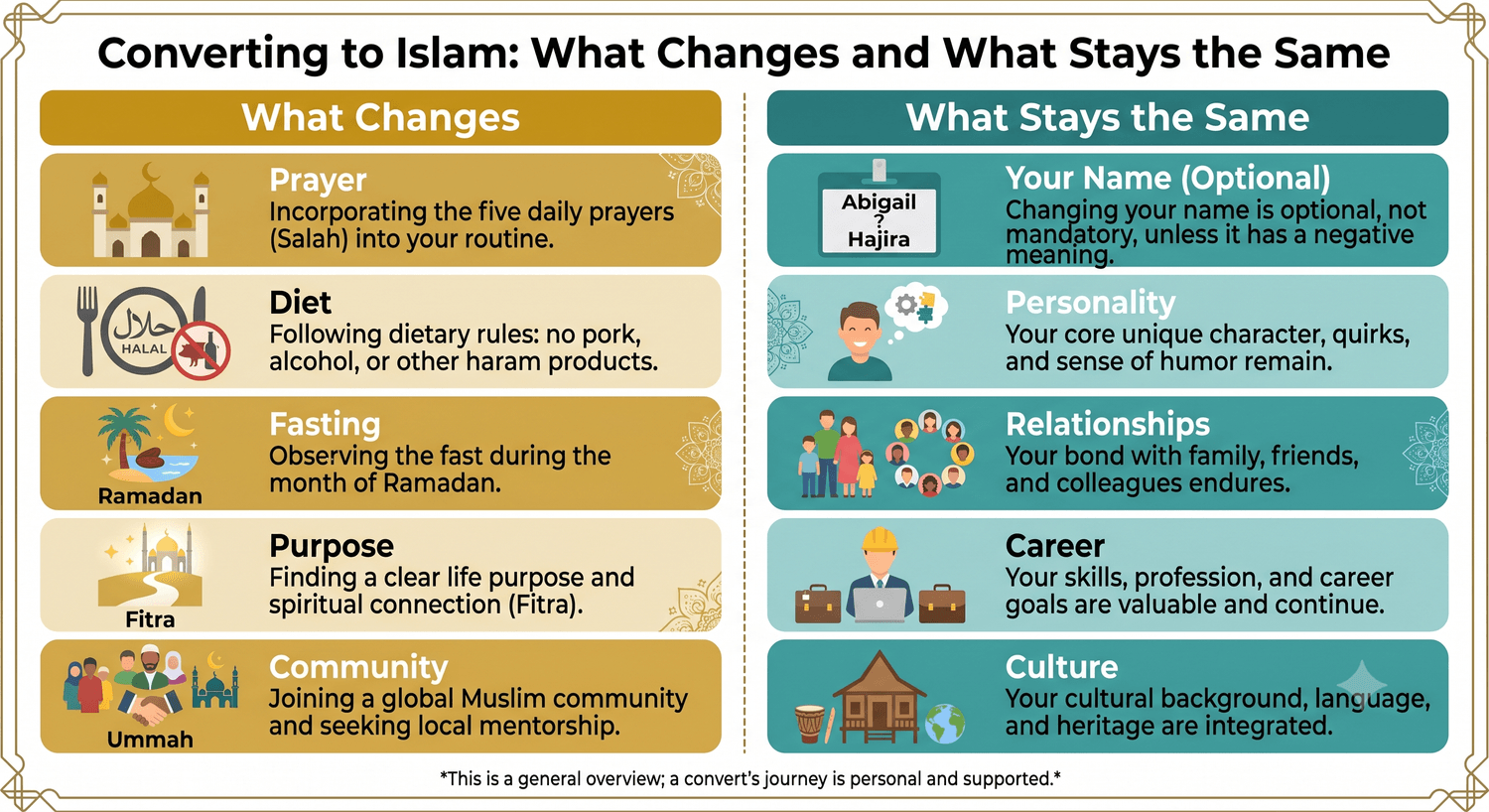
What Changes When You Convert to Islam?
When you become Muslim, some things in your life do change — and being honest about this upfront prevents confusion later.
You pray five times daily — at prescribed times, facing Mecca
Your diet shifts — halal food, no pork, no alcohol, no intoxicants
You fast during Ramadan — from dawn to sunset, for 29–30 days annually
You give Zakat — 2.5% of qualifying savings annually, once you meet the minimum threshold
Your sense of purpose deepens — daily life becomes oriented around God-consciousness (taqwa)
Your identity expands — you become part of a global community of 1.9 billion
What Does NOT Change When You Convert to Islam?
This is equally important — and often overlooked:
Your name — completely optional to change
Your personality — Islam shapes character, it does not erase it
Your relationships — with family, friends, and colleagues (unless those relationships are built entirely around prohibited activities)
Your career — most professions are entirely compatible with Islamic practice
Your culture and heritage — Islam is not Arabic culture; Muslims come from every culture on earth
Your intelligence — Islam demands you think, question, and reflect. Your mind is an asset, not an obstacle.
Common Fears About Converting to Islam — Answered
"My family will reject me." Some families do struggle initially. Most come around when they see that Islam has made you a better person — more patient, more grounded, more principled. The fear is usually worse than the reality.
"I'll have to give up my entire life." Islam is not a wrecking ball. It does not require you to burn your past down. It requires you to build something better going forward. Most of what you enjoy in life is entirely compatible with Islam.
"I don't know enough yet." You know enough to take the next step. You will learn for the rest of your life — that is the point. No one converts with complete knowledge. Sincerity and a genuine desire to learn are the only requirements.
"What if I make mistakes after converting?" You will. Every Muslim does. Islam is not a religion of perfection — it is a religion of consistent effort and sincere repentance. The Prophet ﷺ said: "Every son of Adam sins, and the best of those who sin are those who repent." Mistakes do not undo your Islam. They are opportunities to return to God.
Frequently Asked Questions About Converting to Islam
Do I need to change my name when I convert to Islam?
No. Changing your name is not required when converting to Islam. Many converts keep their original name, especially if it has a positive or neutral meaning. Some choose to adopt an Arabic or Islamic name as a personal expression of their new faith — but this is entirely optional and has no impact on the validity of your conversion.
Can I convert to Islam without going to a mosque?
Yes. You can convert to Islam anywhere — in your home, alone, or with friends. The Shahada is valid wherever it is sincerely said. Visiting a mosque is encouraged for community support and learning, but it is not a condition for a valid conversion to Islam.
Is there a minimum age to convert to Islam?
Islamic scholars generally agree that a person who has reached the age of puberty and is of sound mind can convert to Islam. For minors, parental consent may be a consideration depending on the country and local Muslim community guidelines.
What if I convert to Islam but then have doubts?
Doubt is a normal part of any sincere faith journey. Islam does not punish doubt — it encourages honest questioning and reflection. If doubts arise after conversion, the recommended approach is to seek knowledge, ask questions, and engage with Islamic scholars or teachers rather than facing uncertainty alone.
How do I convert to Islam if I live in a non-Muslim country?
Converting to Islam in a non-Muslim country requires no special process. Simply say the Shahada sincerely — in private if necessary. You can then connect with your local Muslim community through a mosque, Islamic center, or online community for support, learning, and guidance.
Do I need anyone's permission to convert to Islam?
No. Conversion to Islam is a personal decision between you and God. You do not need permission from family, friends, religious leaders, or any institution. Islam teaches that faith is a matter of personal conviction — no external authority can grant or deny your right to embrace it.
Your Next Step
Converting to Islam is not a single moment — it is the beginning of a lifelong journey. The Shahada opens the door. What comes after is a path of growth, learning, and deepening connection with your Creator.
You don't need to have everything figured out. You don't need to be perfect. You just need to take the next step honestly, sincerely, and at your own pace.
The path is clear. The door is open. And you don't have to walk it alone.
Download the free 109-page guide — Steps for Converting to Islam and Maintaining Faith — and get a clear, honest roadmap from your first question to your first year as a Muslim. No credit card. No pressure. Delivered to your inbox in 60 seconds.


