How to Pray in Islam: A Complete Beginner's Guide
Islamic prayer (Salah) is performed five times daily by 1.9 billion Muslims worldwide and consists of specific verbal recitations and physical movements performed facing Mecca. For new Muslims, learning to pray is the most immediate and important practical step after taking the Shahada. This guide walks you through every component of Islamic prayer — from ritual purification to the complete prayer sequence — in plain, clear language designed for complete beginners.
Why Prayer Is the Foundation of Islamic Life
The Prophet Muhammad ﷺ said: "The first thing a person will be held accountable for on the Day of Judgment is prayer." This is not an exaggeration — prayer is the pillar that holds everything else in Islamic practice together.
But prayer in Islam is far more than a religious obligation. It is a daily conversation with God. Five moments every day where the world stops, and you stand before your Creator with complete attention and surrender. No screen, no distraction, no intermediary. Just you and Allah.
For new Muslims, prayer can feel overwhelming at first. There are words to memorize, movements to learn, and timing to track. This guide breaks all of it down into manageable steps. Start where you are. Progress at your own pace. God accepts sincerity over perfection, every time.
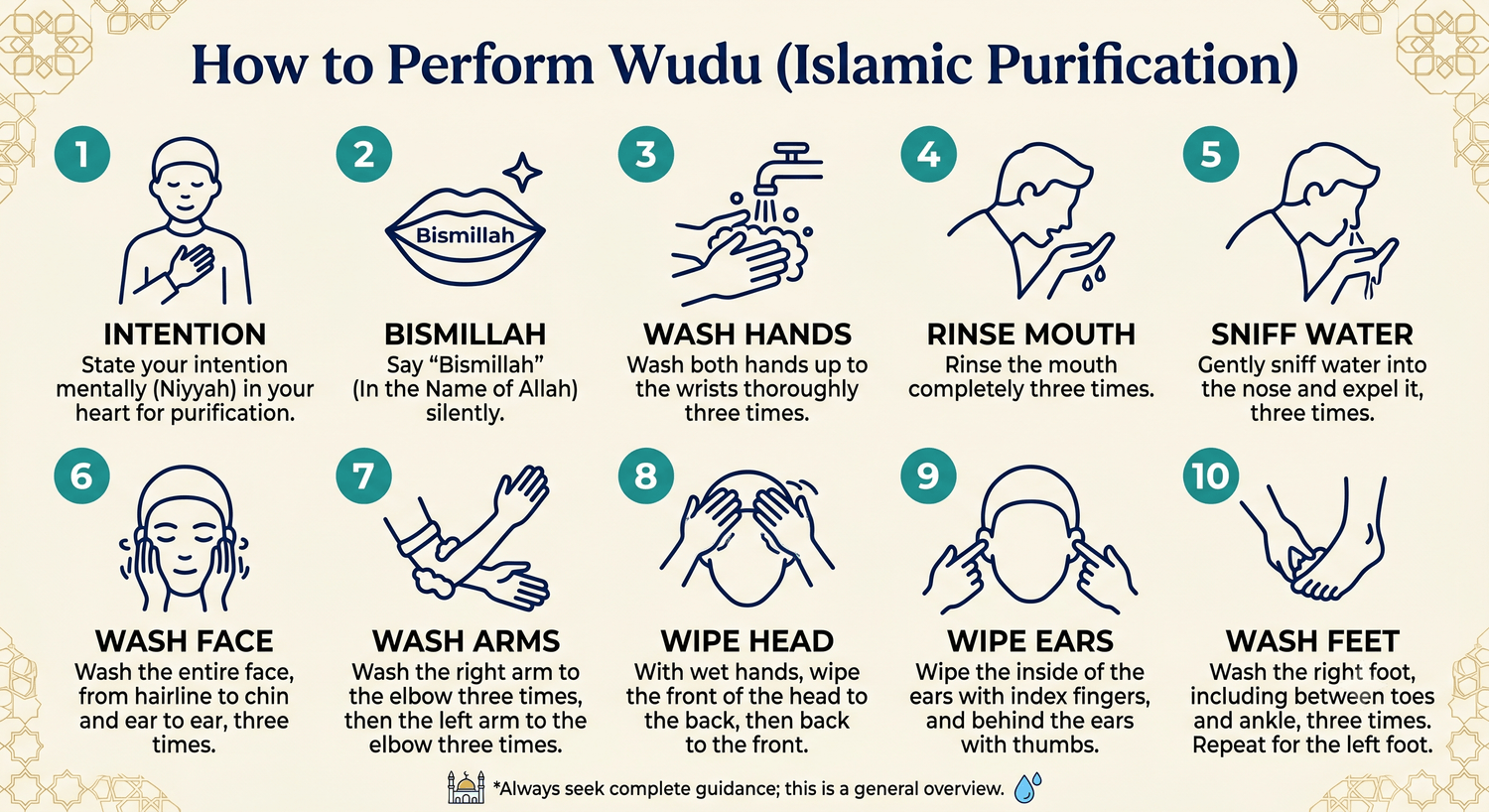
Before You Pray: Understanding Wudu (Ritual Purification)
Before performing Salah, a Muslim must be in a state of ritual purity. This is achieved through Wudu — a specific washing ritual using clean water.
What Breaks Wudu?
Wudu is invalidated by:
Using the toilet (urinating or defecating)
Passing gas
Deep sleep
Loss of consciousness
Certain other conditions (covered in advanced Islamic study)
If none of these have occurred since your last wudu, your purification is still valid and you do not need to repeat it before each prayer.
How to Perform Wudu — Step by Step
Step 1: Intention (Niyyah) Make the intention in your heart: "I am performing wudu to purify myself for prayer." Intention is internal — you do not need to say it aloud.
Step 2: Say Bismillah Begin by saying: Bismillah ("In the name of Allah")
Step 3: Wash Both Hands Wash your hands up to the wrists, three times each, ensuring water reaches between the fingers.
Step 4: Rinse the Mouth Take water into your mouth, swish it around, and spit it out. Repeat three times.
Step 5: Sniff Water into the Nose Sniff water gently into the nostrils and blow it out. Repeat three times.
Step 6: Wash the Face Wash your entire face from the hairline to the chin and from ear to ear. Repeat three times.
Step 7: Wash the Arms Wash your right arm from fingertips to elbow, three times. Then the left arm the same way.
Step 8: Wipe the Head Wet your hands and wipe them over your head once — from the front of the hairline to the back, then back to the front.
Step 9: Wipe the Ears Use wet index fingers to wipe inside the ears and wet thumbs to wipe behind them. Once each.
Step 10: Wash the Feet Wash your right foot up to and including the ankle, three times, ensuring water reaches between the toes. Then the left foot the same way.
Wudu is now complete. You may say after finishing: Ash-hadu an la ilaha ill-Allah, wahdahu la sharika lah, wa ash-hadu anna Muhammadan abduhu wa rasuluh — "I bear witness that there is no god but Allah alone, without partner, and I bear witness that Muhammad is His servant and messenger."
The 5 Daily Prayers: Names, Times, and Rakats
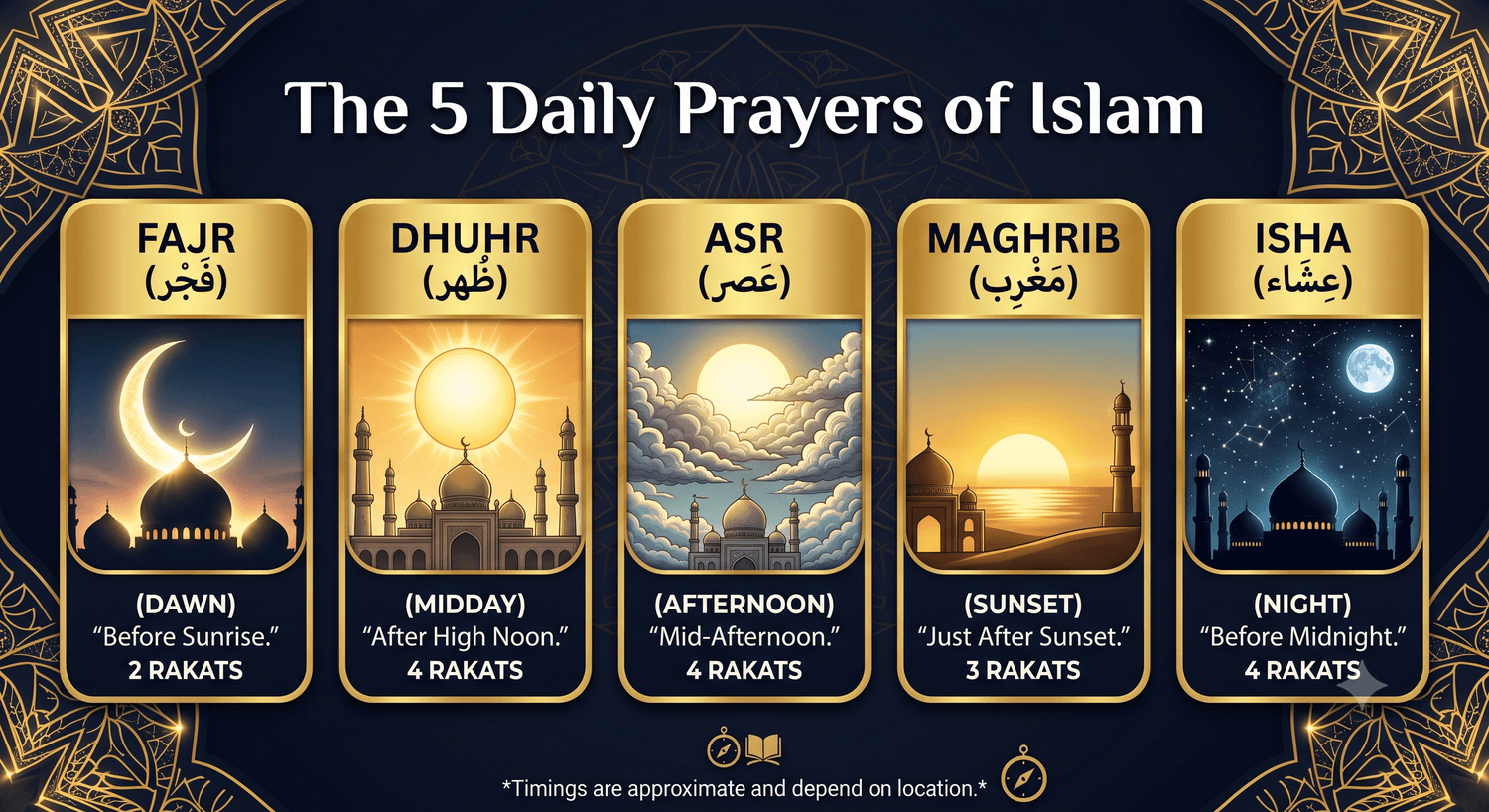
Each of the five prayers has a name, a prescribed time window, and a set number of units called Rakats.
Prayer
Time Window
Rakats (units)
Fajr
Dawn until just before sunrise
2 rakats
Dhuhr
After midday until mid-afternoon
4 rakats
Asr
Mid-afternoon until just before sunset
4 rakats
Maghrib
Just after sunset until darkness
3 rakats
Isha
Night until midnight (or dawn)
4 rakats
How to find prayer times: Prayer times change daily based on the sun's position and vary by location. Use:
Muslim Pro app (iOS/Android) — most widely used
Athan app (iOS/Android)
IslamicFinder.org — enter your city for daily times
The Direction of Prayer: Qibla
All Muslims face the Qibla — the direction of the Kaaba in Mecca, Saudi Arabia — when praying. This is obligatory.
To find your Qibla direction:
Muslim Pro or Qibla Finder app — uses your GPS to show exact direction
Qibla.com — enter your location
In most parts of North America, the Qibla faces northeast. In Europe, it faces southeast. In Australia, it faces northwest.
Understanding the Rakat: The Basic Unit of Prayer
A rakat is one complete cycle of prayer. It consists of a set sequence of positions and recitations. Every prayer is made up of a specified number of rakats performed consecutively.
The Components of One Rakat
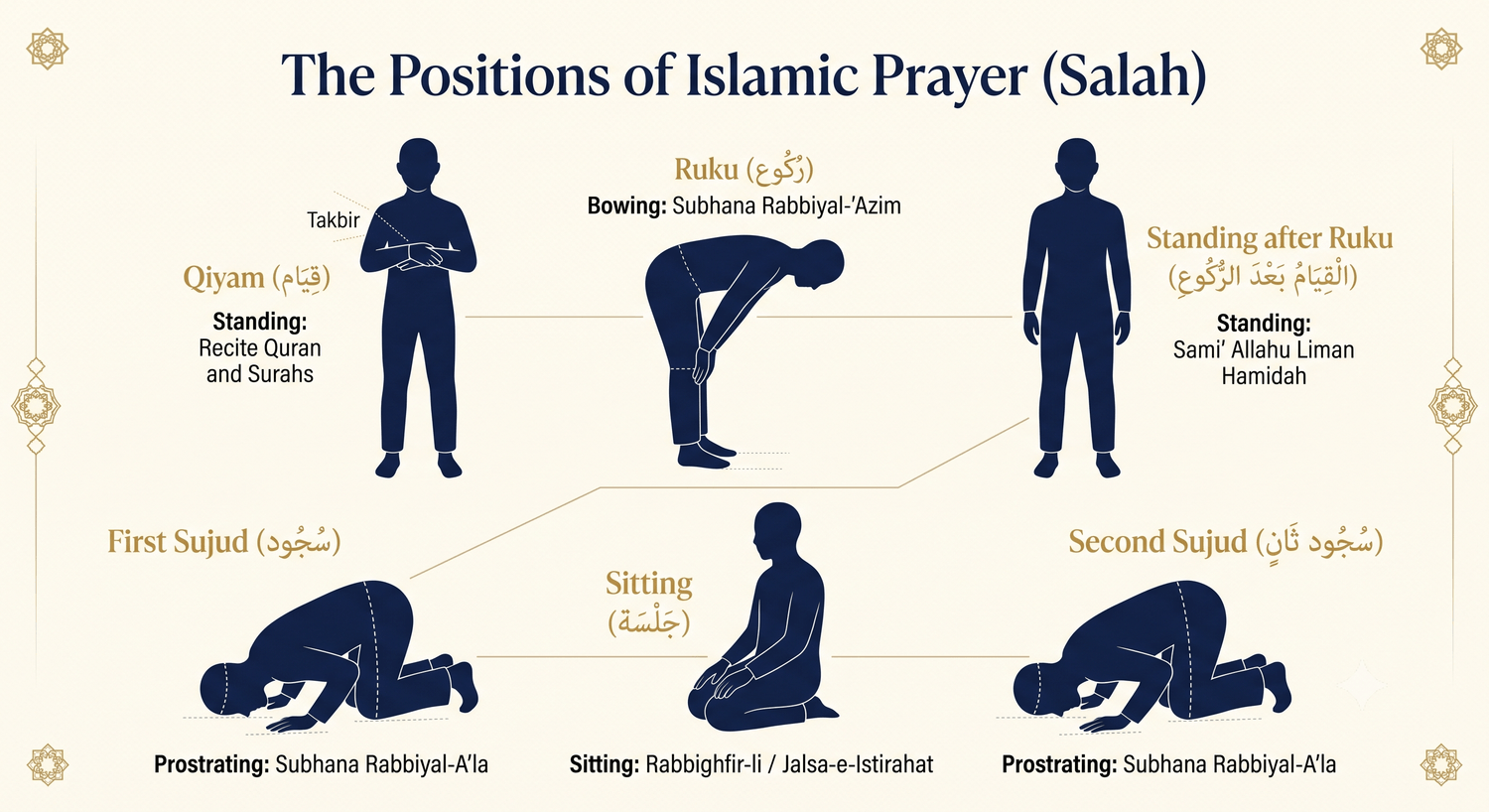
Position 1: Qiyam (Standing) You stand upright, facing the Qibla. You begin by raising both hands to ear level and saying the Takbir: Allahu Akbar — "Allah is the Greatest"
This opens the prayer. Your arms then fold across your chest (right hand over left).
Recitation in Qiyam: You begin by reciting Al-Fatiha — the opening chapter of the Quran. This is mandatory in every rakat of every prayer.
Al-Fatiha (Arabic with transliteration):
بِسْمِ اللَّهِ الرَّحْمَٰنِ الرَّحِيمِ Bismillahi r-rahmani r-rahim In the name of Allah, the Most Gracious, the Most Merciful.
الْحَمْدُ لِلَّهِ رَبِّ الْعَالَمِينَ Alhamdu lillahi rabb il-'alamin All praise is due to Allah, Lord of all worlds.
الرَّحْمَٰنِ الرَّحِيمِ Ar-rahmani r-rahim The Most Gracious, the Most Merciful.
مَالِكِ يَوْمِ الدِّينِ Maliki yawm id-din Master of the Day of Judgment.
إِيَّاكَ نَعْبُدُ وَإِيَّاكَ نَسْتَعِينُ Iyyaka na'budu wa iyyaka nasta'in You alone we worship, and You alone we ask for help.
اهْدِنَا الصِّرَاطَ الْمُسْتَقِيمَ Ihdina s-sirata l-mustaqim Guide us to the straight path —
صِرَاطَ الَّذِينَ أَنْعَمْتَ عَلَيْهِمْ غَيْرِ الْمَغْضُوبِ عَلَيْهِمْ وَلَا الضَّالِّينَ Sirata l-ladhina an'amta 'alayhim ghayri l-maghdubi 'alayhim wa la d-dallin The path of those You have blessed — not of those who have incurred anger, nor of those who are astray.
After Al-Fatiha, say Ameen (quietly or aloud depending on the prayer).
In the first two rakats, you then recite any short chapter (Surah) from the Quran. As a beginner, start with Surah Al-Ikhlas:
قُلْ هُوَ اللَّهُ أَحَدٌ اللَّهُ الصَّمَدُ لَمْ يَلِدْ وَلَمْ يُولَدْ وَلَمْ يَكُن لَّهُ كُفُوًا أَحَدٌ Qul huwa Allahu ahad. Allahu s-samad. Lam yalid wa lam yulad. Wa lam yakun lahu kufuwan ahad. "Say: He is Allah, the One. Allah, the Eternal Refuge. He neither begets nor is born. Nor is there any equivalent to Him."
Position 2: Ruku (Bowing) Say Allahu Akbar and bow forward, placing your hands on your knees, back flat and parallel to the ground. In this position, say three times: Subhana rabbi al-'azim — "Glory be to my Lord, the Magnificent."
Then rise back to standing, saying: Sami'a Allahu liman hamidah — "Allah hears those who praise Him." Then add: Rabbana wa laka l-hamd — "Our Lord, to You is all praise."
Position 3: First Sujud (Prostration) Say Allahu Akbar and lower yourself into prostration — forehead, nose, both palms, both knees, and toes touching the ground. In this position, say three times: Subhana rabbi al-a'la — "Glory be to my Lord, the Most High."
The Prophet ﷺ said: "The closest a servant is to his Lord is when he is in prostration." This position is the spiritual peak of the prayer.
Position 4: Sitting Between Prostrations (Jalsa) Rise from prostration saying Allahu Akbar, sit briefly, and say: Rabbighfir li — "My Lord, forgive me."
Position 5: Second Sujud Say Allahu Akbar and prostrate again, repeating the same as the first Sujud.
This completes one rakat.
After Two Rakats: The Tashahhud
After completing the second rakat, instead of standing for a third, you sit and recite the Tashahhud:
التَّحِيَّاتُ لِلَّهِ وَالصَّلَوَاتُ وَالطَّيِّبَاتُ، السَّلَامُ عَلَيْكَ أَيُّهَا النَّبِيُّ وَرَحْمَةُ اللَّهِ وَبَرَكَاتُهُ، السَّلَامُ عَلَيْنَا وَعَلَى عِبَادِ اللَّهِ الصَّالِحِينَ، أَشْهَدُ أَنْ لَا إِلَهَ إِلَّا اللَّهُ وَأَشْهَدُ أَنَّ مُحَمَّدًا عَبْدُهُ وَرَسُولُهُ
At-tahiyyatu lillahi was-salawatu wat-tayyibat. As-salamu 'alayka ayyuha n-nabiyyu wa rahmatullahi wa barakatuh. As-salamu 'alayna wa 'ala 'ibadillahi s-salihin. Ash-hadu an la ilaha ill-Allah wa ash-hadu anna Muhammadan 'abduhu wa rasuluh.
"All greetings, prayers, and good things belong to Allah. Peace be upon you, O Prophet, and the mercy and blessings of Allah. Peace be upon us and upon the righteous servants of Allah. I bear witness that there is no god but Allah, and I bear witness that Muhammad is His servant and messenger."
During the Tashahhud, raise your right index finger gently when saying "I bear witness that there is no god but Allah."
The Final Tashahhud: Adding Salawat on the Prophet
In the last sitting of the prayer (after the final rakat), add the Salawat on the Prophet after the Tashahhud:
Allahumma salli 'ala Muhammadin wa 'ala ali Muhammadin, kama sallayta 'ala Ibrahima wa 'ala ali Ibrahim. Wa barik 'ala Muhammadin wa 'ala ali Muhammadin, kama barakta 'ala Ibrahima wa 'ala ali Ibrahim. Innaka Hamidun Majid.
"O Allah, send prayers upon Muhammad and the family of Muhammad, as You sent prayers upon Ibrahim and the family of Ibrahim. And send blessings upon Muhammad and the family of Muhammad, as You sent blessings upon Ibrahim and the family of Ibrahim. Verily You are the Most Praiseworthy, the Most Glorious."
Ending the Prayer: Tasleem
The prayer ends with the Tasleem — turning your head to the right and then to the left while saying:
As-salamu 'alaykum wa rahmatullah — "Peace be upon you and the mercy of Allah."
The prayer is now complete.
A Full Prayer Example: Fajr (2 Rakats)
Fajr is the ideal prayer to master first — it has the fewest rakats and sets the tone for the entire day.
Stand facing the Qibla. Make intention for Fajr prayer.
Say Takbir (Allahu Akbar), fold hands on chest.
Recite Al-Fatiha, then Surah Al-Ikhlas (or any short surah).
Bow (Ruku) — say Subhana rabbi al-'azim three times.
Stand — say Sami'a Allahu liman hamidah, rabbana wa laka l-hamd.
First prostration (Sujud) — say Subhana rabbi al-a'la three times.
Sit briefly — say Rabbighfir li.
Second prostration — say Subhana rabbi al-a'la three times. (Rakat 1 complete)
Stand — say Allahu Akbar.
Recite Al-Fatiha only (no additional surah in this rakat as a new Muslim).
Bow, stand, prostrate, sit, prostrate again. (Rakat 2 complete)
Sit for Tashahhud — recite full Tashahhud + Salawat.
Tasleem right, then left.
Fajr prayer is complete.
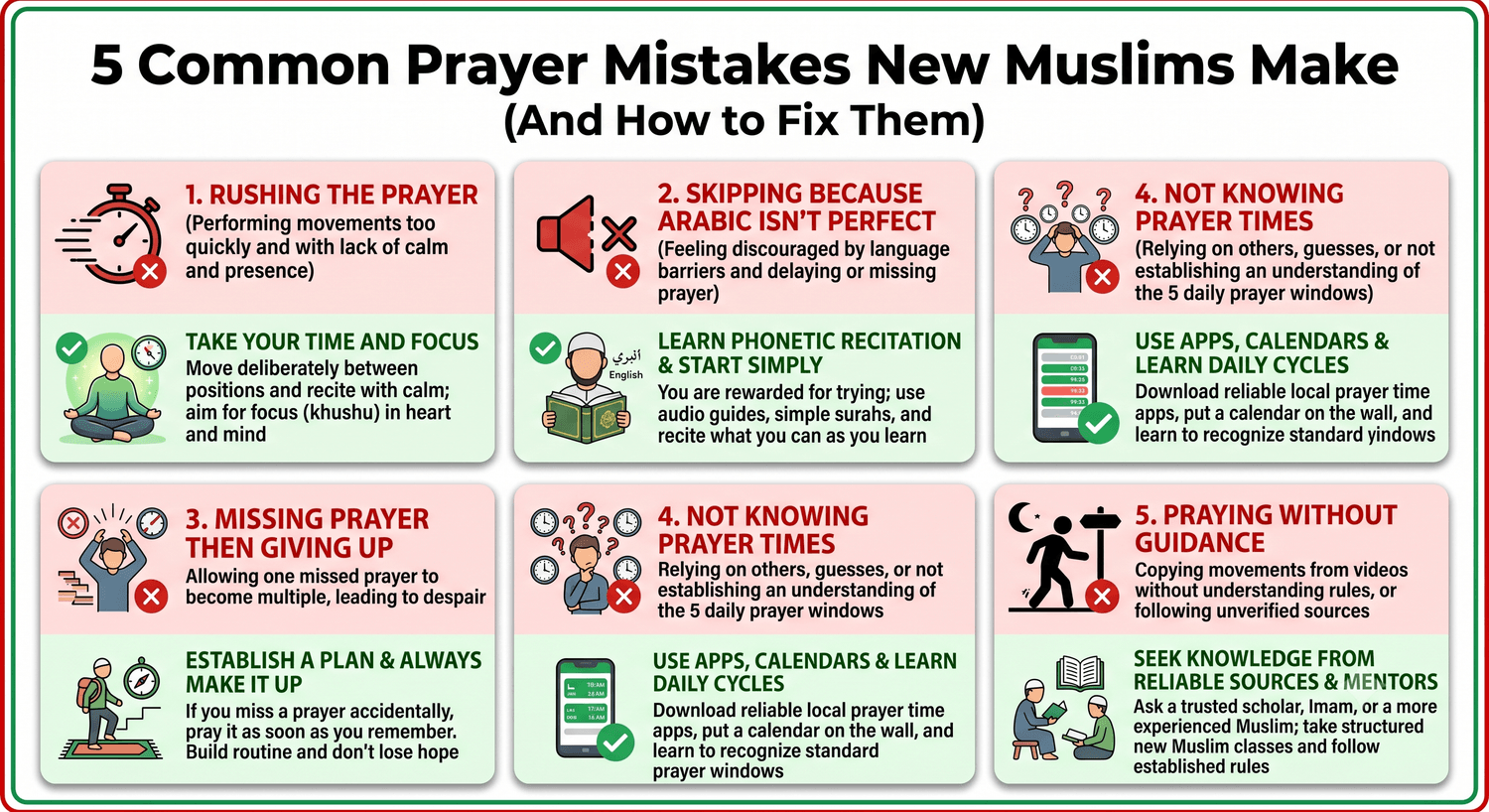
Common Mistakes New Muslims Make in Prayer
Mistake 1: Rushing Prayer is communication with God — not a race. Slow down. Let each position settle. The body and mind need time to arrive.
Mistake 2: Skipping prayer because the Arabic isn't perfect Imperfect Arabic recited sincerely is accepted. God knows your heart and your effort. Start with what you know. Add more as you learn.
Mistake 3: Missing prayer then giving up Missing a prayer is not the end. If you miss a prayer, pray it as soon as you remember. The gate is always open.
Mistake 4: Not using apps for prayer times Missing prayer times because you didn't know when they were is entirely avoidable. Install Muslim Pro or Athan today.
Mistake 5: Praying in complete isolation with no guidance Prayer has specific rules and conditions. Learning from a structured source saves months of confusion. Our course provides video-guided prayer instruction built specifically for new Muslims.
Practical Tips for Building the Prayer Habit
Start with Fajr and Maghrib — dawn and sunset prayers are easier to anchor to your existing routine
Set phone alarms for all 5 prayer times until it becomes habitual
Keep a prayer rug in a permanent, accessible location — friction kills habits
Join the community — praying at a mosque once a week accelerates habit formation dramatically
Track your prayers — a simple checkbox journal builds accountability
Be patient with yourself — 5 daily prayers is a significant lifestyle shift. Give it 66 days of consistent effort before judging your progress.
Our beginner's course walks you through every aspect of Islamic prayer with video guidance, phonetic transliterations, and a structured 30-day prayer habit plan. Built specifically for new Muslims who are learning without a teacher nearby. [Explore the course]
Frequently Asked Questions About Islamic Prayer
How many times a day do Muslims pray?
Muslims pray five times daily: Fajr (dawn), Dhuhr (midday), Asr (afternoon), Maghrib (sunset), and Isha (night). Each prayer takes approximately 5–10 minutes, making the total daily prayer commitment around 30–40 minutes.
Do I have to pray in Arabic?
The obligatory recitations of Islamic prayer — Al-Fatiha and the various supplications — are performed in Arabic. However, you can supplement your prayers with personal supplications (du'a) in any language. As a new Muslim, prioritize learning the Arabic phonetically — it is more manageable than it appears.
What if I miss a prayer?
If you miss a prayer, perform it as soon as you remember or are able. This is called Qada (making up a missed prayer). Chronic, deliberate abandonment of prayer is a serious matter in Islam — but occasional missed prayers due to forgetfulness or emergency are rectified by praying them afterward without guilt.
Can women pray during their menstrual period?
No. Women are excused from prayer during menstruation (hayd) and postnatal bleeding (nifas). This is a mercy in Islamic law — not a punishment. Prayers missed during this period are not made up.
What is Friday prayer (Jumu'ah)?
Jumu'ah is the Friday congregational prayer that replaces Dhuhr on Fridays. It includes a khutbah (sermon) and is obligatory for adult Muslim men. It is the most communal prayer of the week and the best opportunity for new Muslims to connect with their local Muslim community.
Can I pray if I don't know all the Arabic yet?
Yes. Begin with what you know. Many scholars advise new Muslims to start by learning Al-Fatiha, the Tashahhud, and the basic phrases (Allahu Akbar, Subhana rabbi al-'azim, etc.) — and to add more as they progress. Do not let incomplete knowledge keep you from starting.
Your Next Step
Prayer is the heartbeat of Islamic life. It does not come instantly, and it does not have to. What matters is that you start — with whatever you know, at whatever level you're at — and that you keep returning to it.
Every prayer you complete is a conversation with your Creator. Every prostration brings you closer to the one who knows you better than you know yourself.
Start today. With Fajr. With Al-Fatiha. With Allahu Akbar.
For structured, step-by-step prayer guidance built for new Muslims — including video demonstrations, phonetic transliterations, and a 30-day prayer habit plan — explore the Start Islam Path course. [Start learning]


