Islamic Beliefs Explained: The 6 Articles of Faith and 5 Pillars
Islamic beliefs are built on a precise theological framework — not a vague spirituality, but a clearly articulated system of conviction covering the nature of God, human purpose, prophethood, scripture, the afterlife, and divine decree. Understanding these beliefs is essential for anyone who wants to understand what Islam actually is, why Muslims live the way they do, and what distinguishes Islamic theology from other monotheistic faiths. This guide explains the complete belief system of Islam — the 6 Articles of Faith (Arkan al-Iman) and the 5 Pillars of Practice (Arkan al-Islam) — in clear, accessible language.
The Structure of Islamic Belief: Iman and Islam
Islam distinguishes between two overlapping dimensions of the faith:
Iman (faith) — what a Muslim believes internally: theological convictions about God, angels, revelation, prophets, the afterlife, and fate.
Islam (submission) — what a Muslim does externally: the five acts of worship that give the faith its physical and communal expression.
Both are essential. Iman without Islam produces a faith with no practice. Islam without Iman produces rituals without meaning. Together, they constitute what the Prophet Muhammad ﷺ described as the complete religion.
Get our course where all pillars of Islam, and articles of Iman are explained in detail, with action plans, and practical tips to get you familiar with these concepts, activate your inner believer, and set you to Start the Islam Path. Enroll Now here.
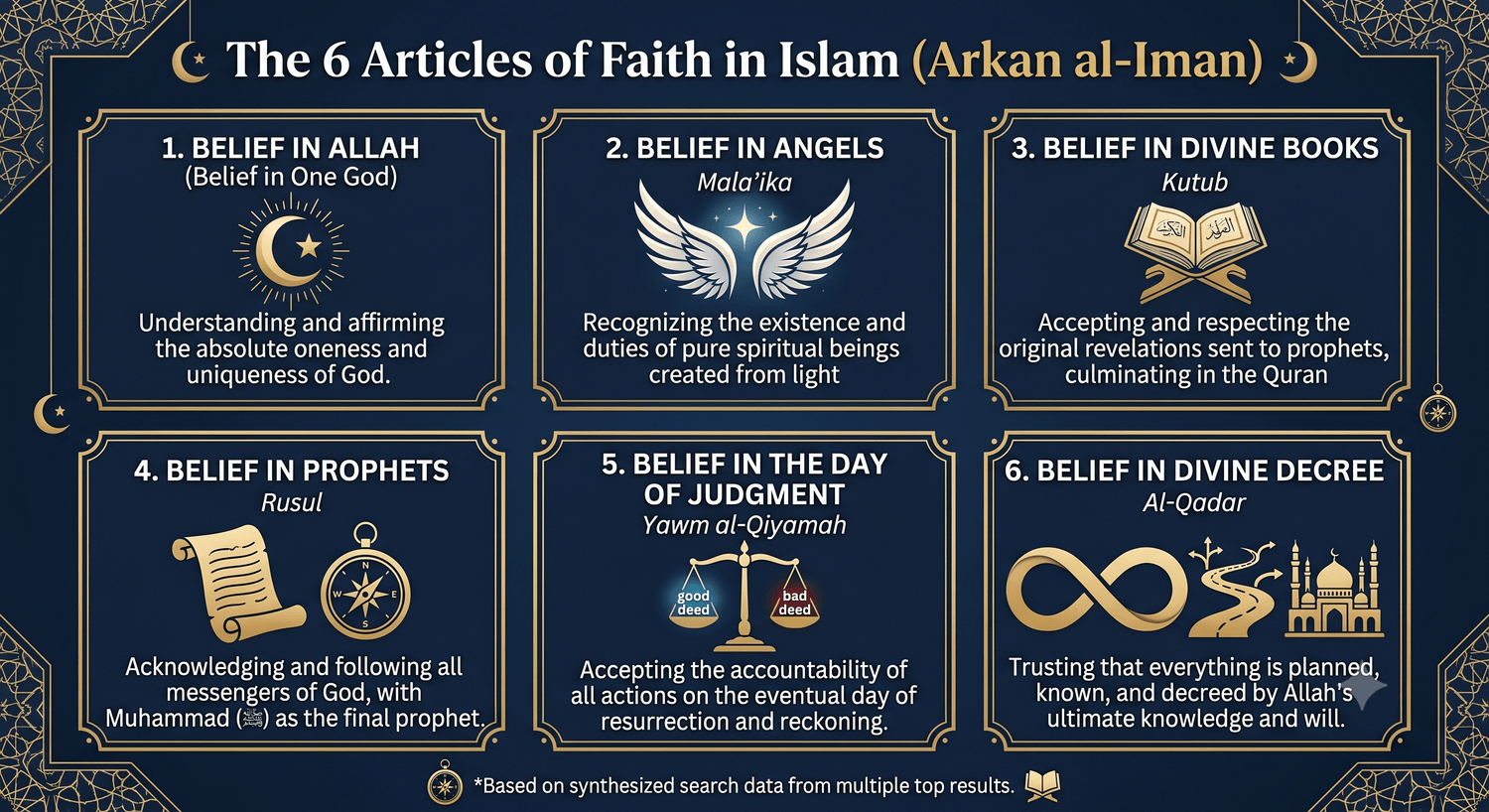
The 6 Articles of Faith (Arkan al-Iman)
The Prophet Muhammad ﷺ was asked by the angel Jibreel to define faith. His answer — recorded in the famous Hadith of Jibreel — established the six foundational beliefs of Islam:
"Faith is to believe in Allah, His angels, His books, His messengers, the Last Day, and to believe in divine decree — both its good and its evil."
Article 1: Belief in Allah (Tawhid)
The most fundamental Islamic belief is the absolute oneness of God — a doctrine called Tawhid.
Allah (the Arabic word for God, used by Arab Christians and Jews as well) is:
One — without partners, associates, equals, or children. The Quran states: "Say: He is Allah, the One. Allah, the Eternal Refuge. He neither begets nor is born. Nor is there any equivalent to Him." (Quran 112:1–4)
Creator — of everything that exists, from the smallest subatomic particle to the largest galaxy. Nothing exists independently of His will.
All-Knowing — Allah's knowledge is infinite and encompasses everything — past, present, and future.
All-Powerful — nothing happens except by His permission and power.
All-Merciful — the two names of God used most frequently in the Quran are Al-Rahman and Al-Rahim — both derived from the Arabic root for mercy. The Quran states: "My mercy encompasses all things." (Quran 7:156)
Living and Eternal — Allah was not born and does not die. He existed before creation and will exist after it ends.
Beyond human comprehension — yet intimately close: "We are closer to him than his jugular vein." (Quran 50:16)
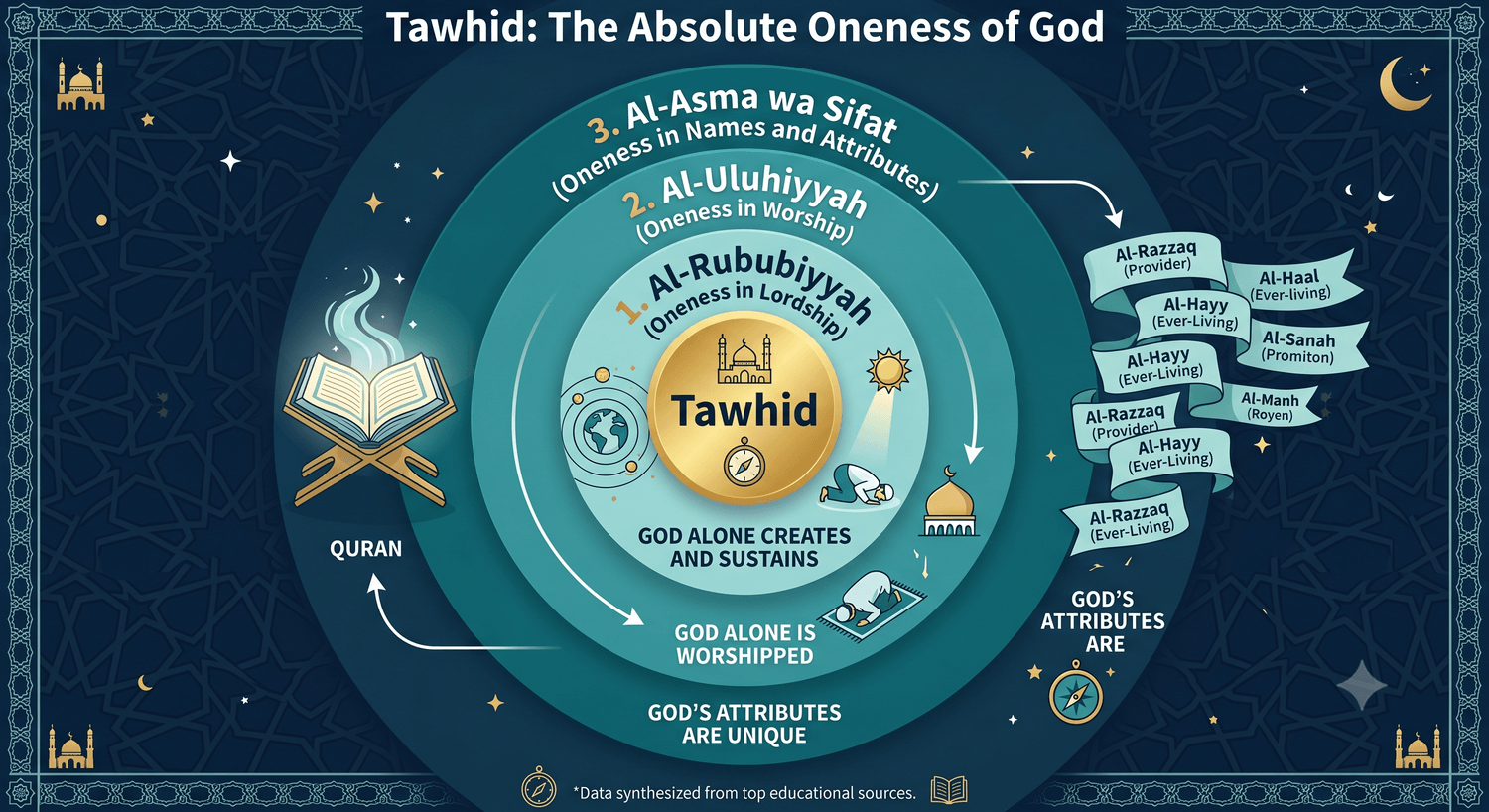
Islamic scholars categorize Tawhid into three dimensions:
Tawhid al-Rububiyyah — oneness in lordship: only Allah creates, sustains, and governs
Tawhid al-Uluhiyyah — oneness in worship: only Allah deserves to be worshipped
Tawhid al-Asma wa Sifat — oneness in names and attributes: Allah's attributes are unique and incomparable
Tawhid is not merely a theological position — it is a worldview. It means that ultimate authority belongs to God, that human life has inherent purpose, and that every action can be an act of worship when done with the right intention.
Article 2: Belief in Angels (Mala'ikah)
Islam teaches that angels are real beings — not metaphorical or symbolic, but actual created entities. They were created from light (as opposed to humans from clay and jinn from smokeless fire).
Key characteristics of angels in Islamic theology:
They are entirely obedient to God — they do not have free will to disobey
They do not eat, drink, or sleep
They are neither male nor female
They are not visible to human beings in their true form under normal circumstances
They are extraordinarily numerous — beyond human counting
Named angels in Islamic tradition:
Angel
Role
Jibreel (Gabriel)
Carries divine revelation to prophets
Mikail (Michael)
Responsible for rain and sustenance
Israfil
Will blow the trumpet on the Day of Judgment
Izra'il (Azrael)
The Angel of Death
Munkar and Nakir
Question the deceased in the grave
Malik
Guardian of Hell
Ridwan
Guardian of Paradise
Kiraman Katibin
Two angels recording every person's deeds — one for good deeds, one for sins
The theological purpose of believing in angels: it establishes that the universe is far larger than the material world, that human beings exist within a spiritual order they cannot fully perceive, and that every person is accompanied and observed by beings of immense power and precision.
Article 3: Belief in the Divine Books (Kutub)
Islam teaches that God has revealed guidance to humanity through divinely revealed scriptures — not just the Quran, but all previous authentic revelations.
The scriptures mentioned in Islamic teaching:
Scripture
Prophet
Status
Suhuf Ibrahim (Scrolls of Abraham)
Ibrahim (Abraham)
No longer extant
Tawrat (Torah)
Musa (Moses)
Original revealed; current Torah considered altered over time
Zabur (Psalms)
Dawud (David)
Original revealed; current Psalms considered altered
Injeel (Gospel)
Isa (Jesus)
Original revealed; current Gospels considered altered
Quran
Muhammad ﷺ
Final revelation; preserved in original form to this day
The Islamic position is not that previous scriptures were false — they were true revelations from God. The position is that they were not preserved with the same accuracy as the Quran, which has been memorized in its entirety by millions of huffaz and transmitted through an unbroken chain of memorization for 1,400 years.
The Quran itself confirms the divine origin of previous scriptures: "He has revealed to you the Book in truth, confirming what came before it. And He revealed the Torah and the Gospel." (Quran 3:3)
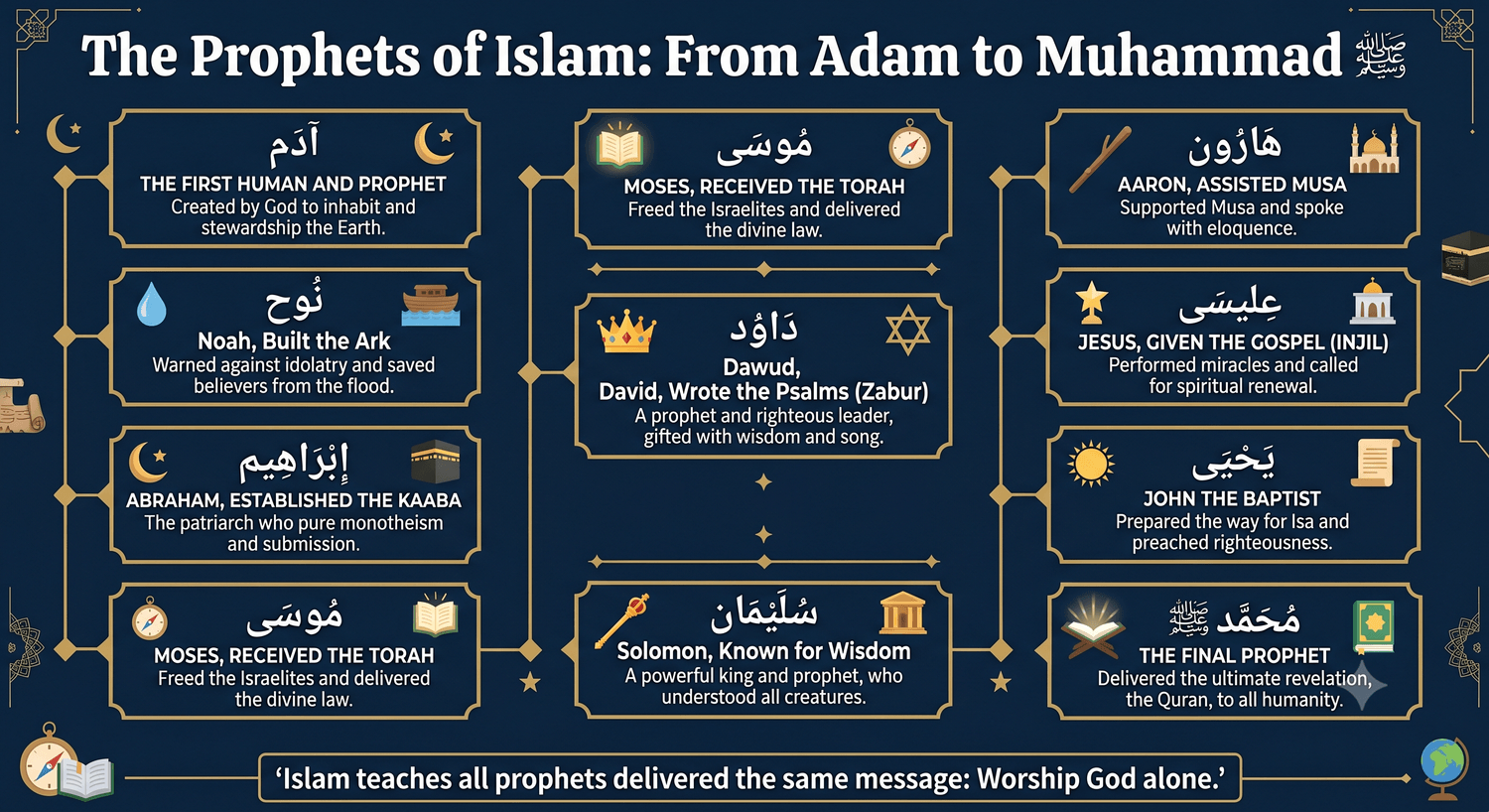
Article 4: Belief in the Prophets (Anbiya)
Islam teaches that God sent prophets to guide humanity throughout history — beginning with Adam and ending with Muhammad ﷺ.
Key points about prophets in Islamic theology:
All prophets were human beings — not divine
All prophets were sinless in matters of religion (though capable of human mistakes in other domains)
All prophets delivered the same essential message: worship God alone and live righteously
Prophets are to be respected and followed — never worshipped
The Quran names 25 prophets explicitly. Among the most significant:
Prophet (Arabic)
Known As
Key Mission
Adam
Adam
First human and prophet; taught humanity's origins
Ibrahim
Abraham
Restored pure monotheism; built the Kaaba
Musa
Moses
Delivered the Torah; led Israelites from Egypt
Dawud
David
Received the Psalms; established justice
Isa
Jesus
Revealed the Gospel; performed miracles; born of a virgin
Muhammad ﷺ
Muhammad
Final prophet; received the Quran; universal mission
The Islamic view of Jesus: Muslims revere Jesus deeply — he is considered one of the greatest prophets in Islam, born of a virgin, able to perform miracles by God's permission, and the Messiah. Where Islam differs from Christianity: Jesus was not divine. He was human — a prophet. The Quran states: "The Messiah, son of Mary, was no more than a messenger." (Quran 5:75)
Muslims believe Jesus was not crucified — God raised him before the crucifixion could take place — and that he will return before the Day of Judgment.
Muhammad ﷺ as the Seal of Prophets: Muhammad ﷺ was not simply another prophet in the series — he was the final one. The Quran states: "Muhammad is not the father of any of your men, but he is the Messenger of Allah and the last of the prophets." (Quran 33:40) No new prophet or revelation comes after him. The Quran is the final guidance.
Article 5: Belief in the Last Day (Yawm al-Qiyamah)
Islam teaches a detailed and vivid eschatology — a theology of what happens after death and at the end of time.
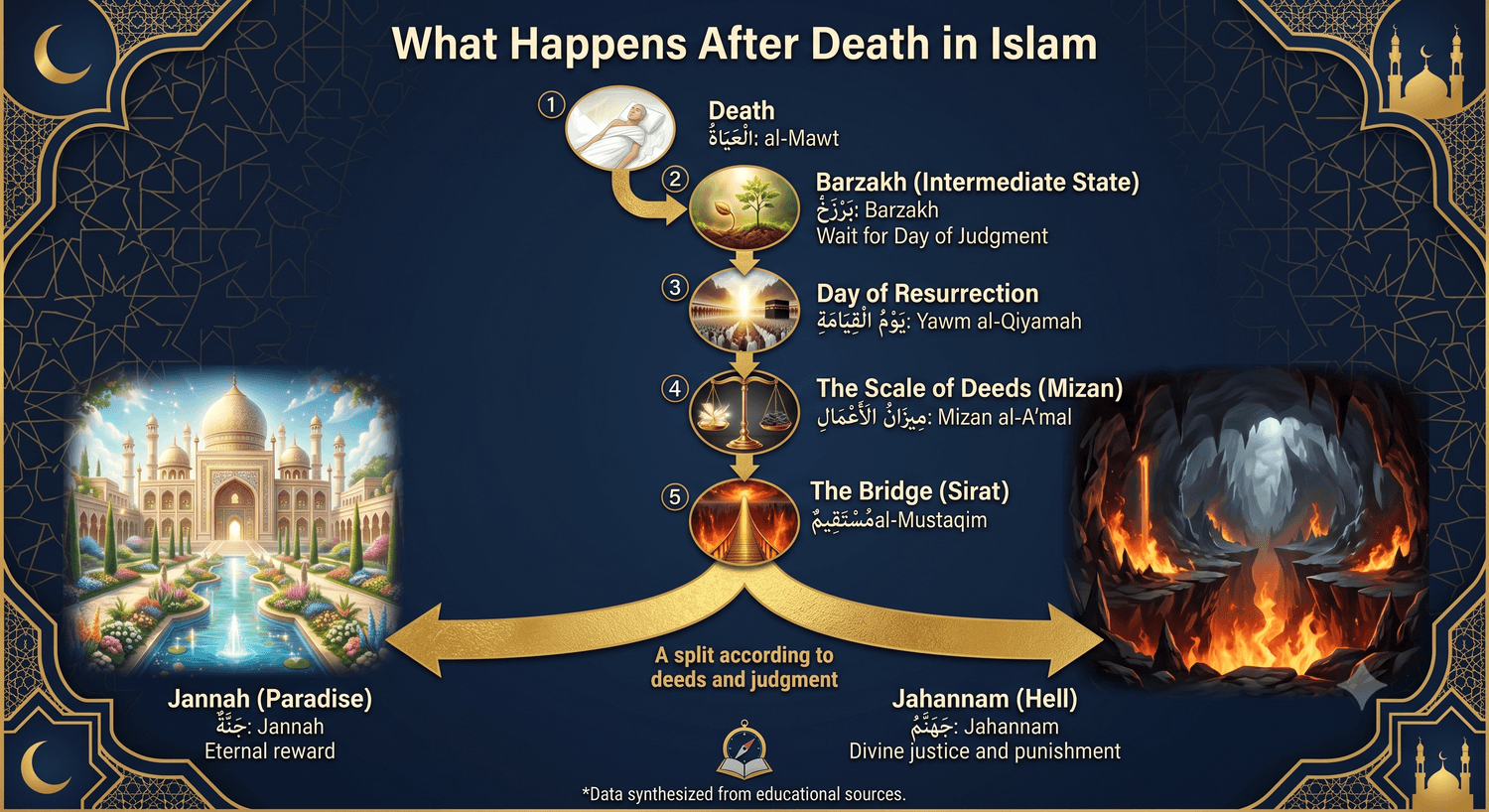
Death and the Grave: At death, the soul leaves the body and enters Barzakh — an intermediate state between death and resurrection. The soul is questioned in the grave by the angels Munkar and Nakir about its faith and deeds. The righteous experience comfort in the grave; the wicked experience suffering.
Signs of the Last Hour: Islamic tradition describes a sequence of signs preceding the Day of Judgment — including the return of Jesus, the appearance of the Dajjal (Antichrist), and the emergence of Gog and Magog (Ya'juj and Ma'juj). These are among the most studied topics in Islamic eschatology.
The Day of Judgment: Every human being who has ever lived will be resurrected and held accountable for their beliefs and deeds. The scale of justice (Mizan) will weigh every action. The Sirat — a bridge over Hellfire — will be crossed; the righteous will cross it to Paradise, the wicked will fall.
Paradise (Jannah): The Quran describes Jannah in both physical and spiritual terms — gardens, rivers, the highest pleasures — but emphasizes that the greatest reward is the pleasure of God and the direct vision of Him: "Faces that Day will be radiant, looking at their Lord." (Quran 75:22–23)
Hell (Jahannam): Hell is real in Islamic theology. Its primary purpose is justice — not eternal torture for minor failings, but accountability for deliberate, willful rejection of truth and persistent wrongdoing. Mainstream Islamic scholarship holds that Muslim sinners may eventually leave Hellfire after purification; only the permanent inhabitants are those who died in deliberate rejection of God.
The centrality of mercy: The Prophet ﷺ said: "When Allah created creation, He wrote in a book that is with Him above the Throne: 'My mercy overcomes My anger.'" The Day of Judgment, in Islamic theology, is a day of perfect justice — and God's mercy is wider than any human being's sins.
Article 6: Belief in Divine Decree (Qadar)
Qadar is the Islamic belief that God's knowledge is infinite and encompasses all of existence — past, present, and future. Nothing happens outside of His knowledge and permission.
This is not fatalism. Islamic theology carefully balances divine decree with human responsibility:
God knows what will happen — but this knowledge does not compel human choices
Human beings have genuine free will and genuine moral responsibility
Everything that happens has been permitted by God — but God does not compel wrongdoing
The four levels of Qadar:
Al-Ilm — God's knowledge encompasses everything
Al-Kitabah — Everything decreed is recorded in Al-Lawh Al-Mahfuz (the Preserved Tablet)
Al-Mashee'ah — Everything that exists does so by God's will
Al-Khalq — God is the Creator of all things
Practical impact of Qadar on a Muslim's life: Belief in divine decree produces two qualities that are difficult to find together: ambition (you act fully, knowing your efforts matter) and peace (you do not agonize over outcomes beyond your control, knowing they are in God's hands). The Prophet ﷺ said: "Know that what has befallen you was not going to miss you, and what has missed you was not going to befall you."
The 5 Pillars of Islam (Arkan al-Islam)
If the 6 Articles of Faith describe what a Muslim believes, the 5 Pillars describe what a Muslim does. They are the framework of Islamic practice — the five practices that structure a Muslim's relationship with God throughout every day, every year, and every lifetime.
Pillar 1: Shahada — The Declaration of Faith
Arabic: أَشْهَدُ أَنْ لَا إِلَٰهَ إِلَّا اللَّٰهُ وَأَشْهَدُ أَنَّ مُحَمَّدًا رَسُولُ اللَّٰهِ
Transliteration: Ash-hadu an la ilaha ill-Allah, wa ash-hadu anna Muhammadan rasul-Allah
Translation: "I bear witness that there is no god but Allah, and I bear witness that Muhammad is the messenger of Allah."
The Shahada is the gateway into Islam. Saying it sincerely, with full understanding, is the act of conversion. It is also repeated throughout the day — in the call to prayer, in the prayer itself, and as a constant reminder of the fundamental truth that orients all of Islamic life.
Pillar 2: Salah — Prayer
Five daily prayers: Fajr (dawn), Dhuhr (midday), Asr (afternoon), Maghrib (sunset), and Isha (night).
Each prayer involves:
Ritual purification (wudu)
Facing the Qibla (direction of Mecca)
Specific verbal recitations (including Al-Fatiha)
Physical movements (standing, bowing, prostrating)
Approximately 5–10 minutes per prayer
The total time commitment is 30–40 minutes daily — five deliberate pauses in which the material world stops and the Muslim stands before God.
The Prophet ﷺ compared prayer to bathing in a river five times a day — complete spiritual cleansing that leaves no spiritual dirt behind.
Pillar 3: Zakat — Obligatory Almsgiving
Zakat is the obligation to give 2.5% of qualifying wealth annually to those in need — provided the wealth has been held above the minimum threshold (nisab) for one full year.
Zakat is:
Not charity in the optional sense — it is a right of the poor over the wealth of the rich
Not a tax — it is an act of worship
A purification — the word Zakat itself means purification and growth in Arabic
Categories of eligible recipients include the poor, the destitute, those in debt, travelers in need, and those working to free themselves from slavery.
Zakat creates an economic system in which wealth circulates rather than accumulates — a built-in mechanism for reducing inequality that was remarkably sophisticated for a 7th-century revelation.
Pillar 4: Sawm — Fasting in Ramadan
During the month of Ramadan (the 9th month of the Islamic lunar calendar), Muslims fast from dawn (Fajr) to sunset (Maghrib) — refraining from food, drink, smoking, and sexual relations during daylight hours.
The fast is broken each evening with Iftar — traditionally begun with dates and water, following the Sunnah of the Prophet ﷺ — followed by the Maghrib prayer and a full meal.
Ramadan is not merely a physical discipline. It is a month of:
Intensified prayer and Quran recitation
Increased charity and community
Heightened God-consciousness (taqwa)
Night prayers (Tarawih) and seeking the Night of Power (Laylatul Qadr)
The Quran describes the purpose of fasting: "O you who have believed, decreed upon you is fasting as it was decreed upon those before you — that you may become righteous." (Quran 2:183)
Pillar 5: Hajj — Pilgrimage to Mecca
Hajj is the pilgrimage to Mecca, Saudi Arabia — obligatory once in a lifetime for every Muslim who is physically and financially able.
Performed during the Islamic month of Dhul Hijjah, Hajj is the largest annual human gathering on earth — approximately 2–3 million Muslims from every country converging on a single point in the Arabian Peninsula.
The rituals of Hajj commemorate the story of Ibrahim (Abraham), his wife Hajar, and his son Ismail — including:
Tawaf — circumambulating the Kaaba seven times counterclockwise
Sa'i — walking seven times between the hills of Safa and Marwa, commemorating Hajar's search for water
Standing at Arafah — the spiritual peak of Hajj, where pilgrims spend the afternoon in prayer and supplication
Stoning at Mina — throwing pebbles at pillars symbolizing the rejection of evil
The Prophet ﷺ described standing at Arafah: "Hajj is Arafah." It is a moment of total equality — every pilgrim wears the same white garments (ihram), with no distinction of wealth, race, or status — standing together before God in a glimpse of the Day of Judgment.
The Relationship Between Belief and Practice in Islam
Islamic theology does not treat belief and practice as separate compartments. Iman (faith) that does not produce action is considered deficient. Practice that has no faith behind it is empty ritual.
The Quran consistently pairs belief with righteous action: "Those who believe and do righteous deeds..." appears dozens of times. Faith is not a purely internal experience — it manifests in how a Muslim treats others, conducts business, raises children, engages with the environment, and carries themselves through the world.
This integration is what makes Islam a complete deen (way of life) rather than simply a religion in the narrow sense.
Frequently Asked Questions About Islamic Beliefs
What is the most important belief in Islam?
Tawhid — the absolute oneness of God — is the foundational belief from which all others derive. It is the first element of the Shahada, the first condition of a valid conversion, and the concept that, if compromised, nullifies the Islamic faith entirely.
Do Muslims believe in the same afterlife as Christians?
There are significant parallels and important differences. Both Islam and Christianity teach resurrection, judgment, paradise, and hell. The Islamic version is more detailed in its description of the intermediate state (Barzakh), the signs of the Last Hour, and the experience of paradise. The Islamic conception of God's mercy is particularly expansive — more so than in many Christian traditions.
What does Islam say about fate and free will?
Islam holds both simultaneously: God's knowledge is infinite and encompasses all human choices, but those choices are genuinely made by human beings who are genuinely accountable for them. This is not a contradiction in Islamic theology — it is a mystery that reflects the difference between divine and human understanding.
Does Islam believe in the original sin?
No. Islam does not have the concept of original sin. When Adam and Hawwa (Eve) were removed from Paradise, their individual error was forgiven — and humanity did not inherit their guilt. Every human being is born in a state of natural purity (fitrah) and is accountable only for their own choices.
Why do Muslims pray five times a day specifically?
The five daily prayers were established during the Prophet Muhammad's ﷺ night journey (Isra' wal Mi'raj), during which he was taken to the heavens and received the obligation of prayer from God. The number five was determined through a dialogue between the Prophet ﷺ and God — originally fifty prayers, reduced to five out of divine mercy, while carrying the spiritual reward of fifty.
Understanding Islam Begins With Its Beliefs
Islamic law, Islamic history, Islamic culture — all of it flows from these foundational beliefs. The five prayers make sense only if God is real and worth communicating with. Zakat makes sense only if wealth belongs ultimately to God and the community. Ramadan makes sense only if God-consciousness is worth more than physical comfort.
Understanding what Muslims believe is the necessary first step to understanding why Muslims live the way they do — and whether this faith might speak to something in your own searching.
For a comprehensive, honest introduction to Islamic beliefs and practice — written specifically for non-Muslims and new Muslims — download the free 109-page guide. [Get it delivered to your inbox in 60 seconds]


