Islam Misconception: Is the Hijab Really Required for All Muslim Women Globally?
Get the 109‑page guide delivered to your inbox
Discover the faith that 1.9 billion people live by — and why thousands of truth-seekers just like you are choosing it every single day. This free 109-page guide walks you from curiosity to clarity, step by step.
No pressure. No judgment. No strings attached. Just a clear, honest roadmap written for people who want real answers — whether you're skeptical, curious, confused, or quietly searching for something deeper.
Of all the Islam misconceptions that circulate in both Western media and sometimes within Muslim communities themselves, the question of the hijab generates some of the most heated and least nuanced conversation. People who know very little about Islam have very strong opinions about it. And the debate usually happens without the voices of the women most affected at its center.
Let us try to do this differently. The Islam misconception that the hijab is "required for all women globally" or, alternatively, "not required at all and purely cultural" both oversimplify a reality that is genuinely more complex — and more interesting — than either position admits.
Islam misconception about the hijab: What the Qur'an Actually Says
The Qur'an does not use the word "hijab" to refer to women's clothing. This is worth knowing. The word hijab appears in the Qur'an seven times, and in most instances it means a curtain or partition — a screen placed between the Prophet's household and visitors, for example.
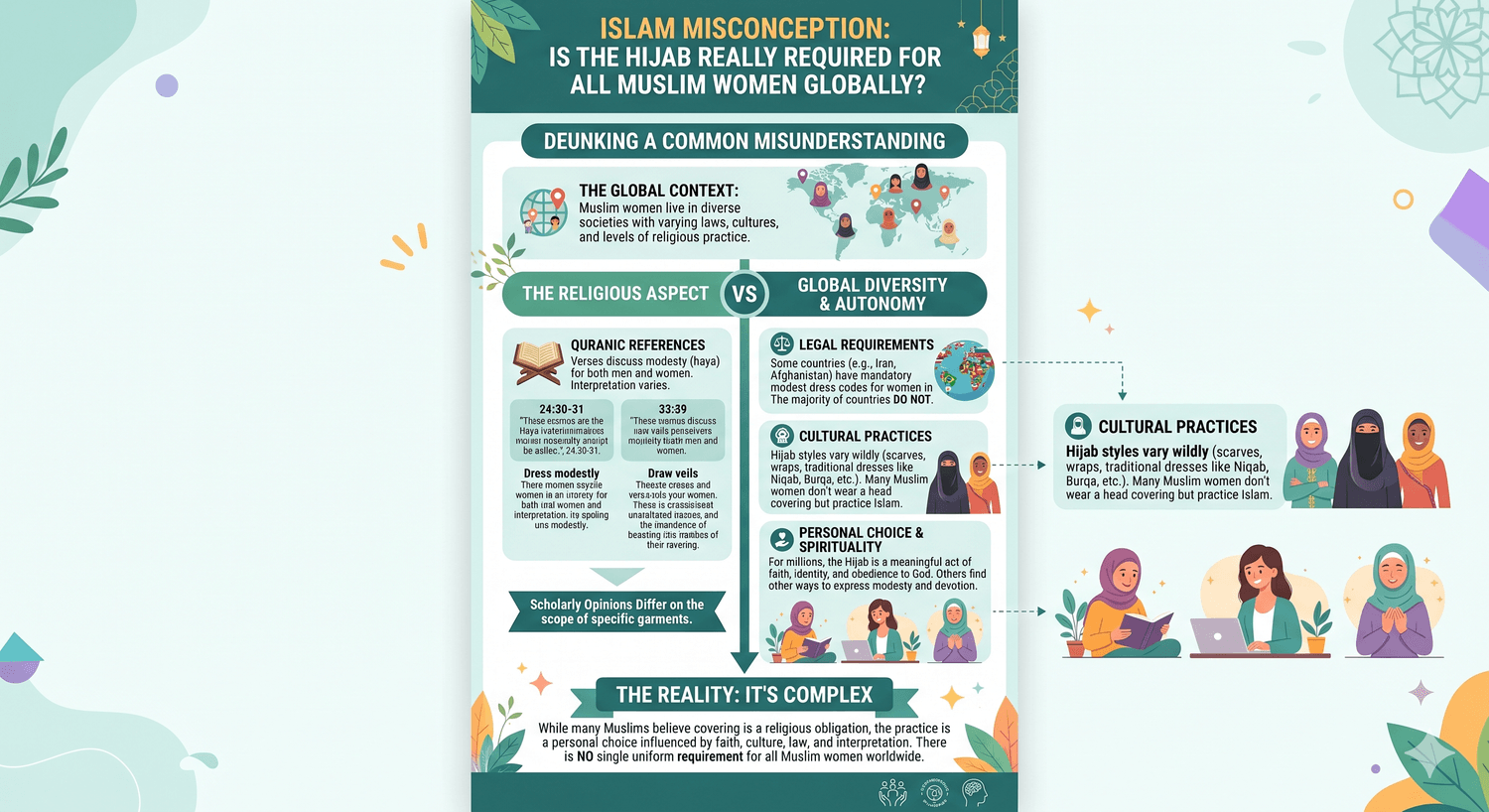
What the Qur'an does say, in Surah An-Nur (24:31), is that believing women should "lower their gaze and guard their private parts and not expose their adornment except what is apparent, and let them draw their coverings (khumur) over their chests." The verse uses the word khumur, the plural of khimar, which refers to a head-covering. Most Islamic scholars read this verse as requiring women to cover their hair.
Surah Al-Ahzab (33:59) says: "O Prophet, tell your wives and daughters and the women of believers to draw their outer garments (jilbab) close around themselves." This verse instructs women to cover themselves when in public, and most scholars have understood this as requiring a form of modest outer dress.
The majority position across the four major Sunni schools of jurisprudence — Hanafi, Maliki, Shafi'i, and Hanbali — is that it is obligatory for Muslim women who have reached puberty to cover their hair in the presence of unrelated men. This is a widely held position with strong scholarly consensus behind it, developed over centuries of Qur'anic interpretation and legal reasoning.
The Islam Misconception That "Hijab" Means Only a Headscarf
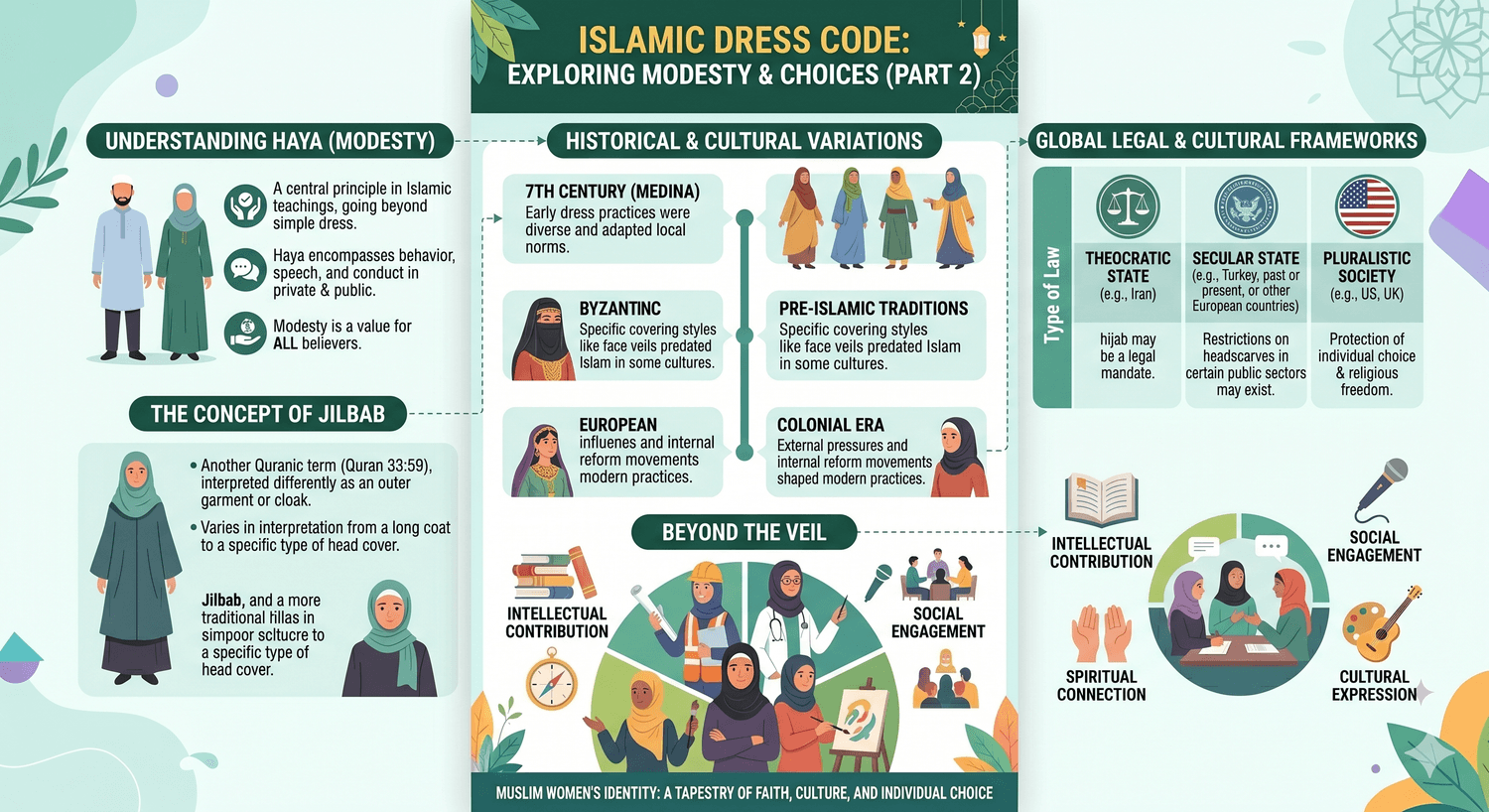
This is where one of the most common Islam misconceptions enters. Many people understand hijab as referring only to a headscarf. But in Islamic jurisprudence, the concept of hijab encompasses a broader principle of modesty in dress, behavior, and social interaction that applies to both men and women.
The Qur'an's instructions on modesty begin with men (24:30), instructing believing men to lower their gaze and guard their chastity, before addressing women in the following verse. The hijab is not a concept imposed on women by a male-dominated religion. It is a standard of modesty applied to both genders, with different physical expressions.
Men in Islamic jurisprudence are required to cover from the navel to the knee. They are required to lower their gaze. They are instructed in modesty of dress and behavior. These requirements receive far less public attention than women's dress, which itself reflects a selective reading of Islamic teaching that centers female bodies rather than the actual scope of the religion's ethical code.
The View That Hijab Is Cultural, Not Religious
There is a position held by a minority of Muslim scholars — including some contemporary academics and reformist thinkers — that the head-covering requirement for women is not a universal religious obligation derived from the Qur'an itself, but rather a cultural norm that was absorbed into Islamic jurisprudence from the 7th-century Arabian context in which it developed.
Scholars like Khaled Abou El Fadl and Javed Ahmad Ghamidi have argued that the Qur'anic verses on women's dress emphasize the principle of modesty rather than prescribing a specific garment. They contend that the application of this principle varies across times and cultures, and that the head-covering requirement belongs to cultural practice rather than religious obligation.
This minority position exists within Islamic scholarship. It is not the mainstream scholarly position, and it is important to represent it accurately — as a genuine, seriously argued scholarly view, not as permission for any woman to simply dismiss the hijab as irrelevant, and not as evidence that the question is settled in either direction.
The Islamic tradition has always contained scholarly disagreement (ikhtilaf) on many questions. The existence of a minority position does not nullify the majority, and the existence of a majority position does not mean dissent is illegitimate.
The Islam Misconception That Wearing Hijab Means You Are Oppressed
Perhaps the most persistent Islam misconception about the hijab in Western public discourse is that a woman who wears it has been coerced — that the hijab is always and only a symbol of male control over female bodies.
This narrative is contradicted by the testimony of millions of women who wear the hijab by free choice, often against significant social and professional pressure to remove it. A woman who wears hijab in France, where it is socially stigmatized and legally restricted in many contexts, is not wearing it because someone forced her to. She is wearing it at personal cost, as an act of religious conviction.
The Qur'an itself states plainly: "There is no compulsion in religion" (2:256). Islamic jurisprudence is clear that faith and its practices cannot be imposed by force. A hijab worn by coercion is not the religious practice of hijab. It is coercion. Those are two different things.
Research consistently finds that many Muslim women describe wearing hijab as empowering — as a refusal to define their worth by their appearance, as a statement of identity, as a connection to a community and a tradition. These are not the words of oppressed women explaining their oppression. They are the words of people making a considered choice about how they want to inhabit the world.
The Variations in Practice Across the Muslim World
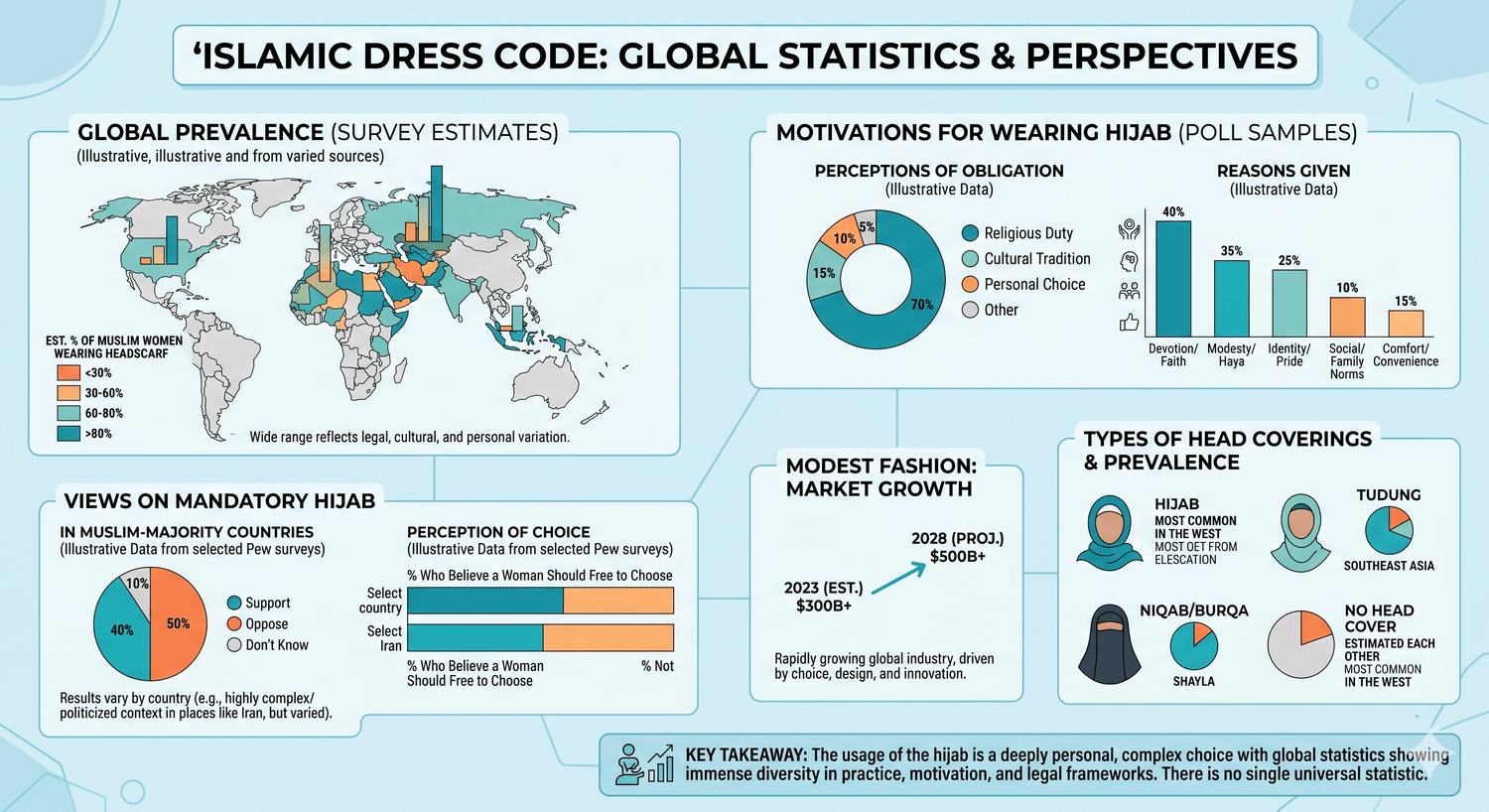
The Islam misconception that hijab is either universally required or universally practiced erases an enormous diversity of actual practice across the global Muslim community.
In Saudi Arabia, the headscarf was legally mandatory for women until recent legal reforms began changing that. In Iran, a version of it remains legally required. In Turkey, it was legally banned in government buildings and universities for decades. In Morocco and Tunisia, there have been reports of women facing social discrimination for wearing the hijab. In Indonesia, the world's largest Muslim-majority country, hijab-wearing is common but neither legally mandated nor universally practiced.
In Western countries, Muslim women practice significant diversity — some wearing full niqab, some wearing hijab, some wearing modest dress without a headscarf, and some wearing no specifically religious dress at all. All of these women may be practicing Muslims with sincere faith, navigating a set of religious, cultural, personal, and practical factors that no outsider can fully assess from the outside.
The diversity of practice does not settle the question of what Islamic law requires. It simply reflects the reality that religious law and personal practice are not always the same thing, and that Muslim women are making decisions across a wide range of circumstances and with a wide range of understandings of their obligations.
What the Islam Misconception Costs Everyone
When the conversation about hijab is reduced to either "it is oppression" or "it is mandatory for all women everywhere" — without nuance, without the voices of the women involved, and without accurate information about what Islamic scholarship actually says — several things get lost.
Non-Muslim women who might be curious about Islam receive a distorted picture of a faith that has far more to say about dignity, agency, and spiritual relationship than any debate about clothing can capture. Muslim women who wear hijab face either hostility from those who view it as oppression or rigid judgment from communities that reduce the whole of their faith to their dress. Muslim women who do not wear hijab face judgment from both directions. New Muslims navigating this question face pressure from multiple communities simultaneously, often without reliable guidance.
The truth — that this is a question with genuine scholarly complexity, that the majority Islamic position requires the head-covering, that sincere Muslims disagree on its details and scope, and that women wearing hijab deserve to be taken seriously as the authors of their own choices — is more useful to everyone than any oversimplification.
For New Muslim Women: How to Approach This Question
If you are a new Muslim woman navigating the hijab question, here is what matters most: approach it seriously, with real Islamic knowledge, and without pressure from either direction.
Study the relevant Qur'anic verses and their tafsir. Learn what the major schools of jurisprudence say and why. Talk to Muslim women who wear hijab and, if you can, Muslim women who do not, and listen honestly to how each describes her relationship to the question. Pray on it — not once, but as an ongoing practice of discernment.
This is a significant decision that deserves the full weight of your attention and the full resources of Islamic scholarship. Do not make it based on social pressure — from non-Muslims who assume it means oppression, from Muslims who assume it means compliance, or from anyone who is more interested in your answer than in your actual understanding.
The relationship between you and Allah is what this decision ultimately touches. Approach it accordingly.
Start Islam Path offers courses and resources that take questions like this seriously, with grounding in actual Islamic scholarship and respect for the real complexity of the journey you are on. Join us.


