Types of Islamophobia: From Hate Crimes to Hidden Bias
Get the 109‑page guide delivered to your inbox
Discover the faith that 1.9 billion people live by — and why thousands of truth-seekers just like you are choosing it every single day. This free 109-page guide walks you from curiosity to clarity, step by step.
No pressure. No judgment. No strings attached. Just a clear, honest roadmap written for people who want real answers — whether you're skeptical, curious, confused, or quietly searching for something deeper.
When most people hear the word Islamophobia, they picture something obvious: a mosque burning, a woman's headscarf being ripped off on a train, someone being called a terrorist on the street. Those things happen. They are serious. But limiting the types of Islamophobia to what makes the news leaves most of the picture invisible.
Islamophobia operates at several levels at once. It sits in the language of individuals, in the policies of institutions, in the assumptions baked into government programs, and in the cultural frameworks through which Muslims get represented to the rest of the world. Each of these levels reinforces the others. Together, they shape the daily experience of being Muslim in a non-Muslim majority society. Understanding the different types of Islamophobia is the first step toward seeing how they connect.
What We Mean When We Talk About Types of Islamophobia
Islamophobia is broadly defined as fear, prejudice, or hostility directed at Muslims or at Islam as a religion. The United Nations describes it as a form of discrimination that targets people based on their Muslim identity or perceived Muslim identity. In 2022, the UN General Assembly designated March 15 as the International Day to Combat Islamophobia, acknowledging the phenomenon at the level of international policy.
The term covers a wide range of experiences that look quite different on the surface but share a common root: the treatment of Muslims as a uniform threat rather than a diverse global community of 1.8 billion people. A hateful comment yelled at a woman on the street and a government surveillance program targeting Muslim neighborhoods are not the same thing. But they emerge from the same cultural soil, and they reinforce each other in ways that matter.
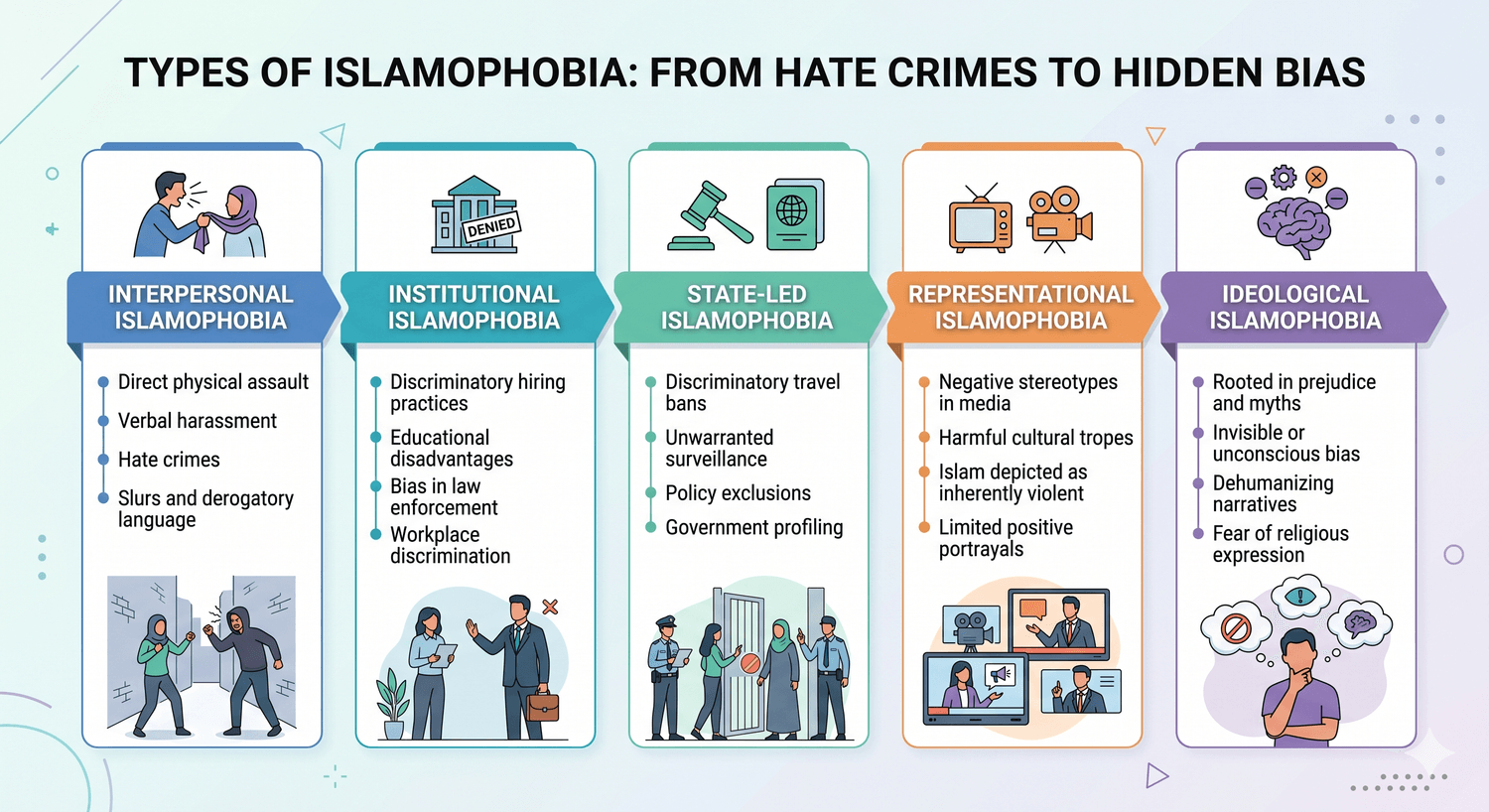
Interpersonal Islamophobia: What Happens Between People
Verbal Abuse and Harassment
This is the type most people encounter directly, or witness directly. It includes slurs, insults, being told to "go back where you came from," being called a terrorist, or being asked to personally apologize for attacks committed by strangers you have never met and with whom you share nothing except a religion.
It happens on buses, in shops, in schools, at airports, in workplaces, and in online comment sections. A 2021 survey in Scotland found that 83 percent of Muslims said they had experienced Islamophobia, including verbal or physical attacks. In the United States, about half of Muslim American adults reported experiencing some form of discrimination in 2017. Those numbers have risen since.
Verbal harassment does not always arrive with a raised voice. Sometimes it comes with a smile: the coworker who jokes that you are going to blow something up, the stranger at the grocery store who comments that your food choices seem suspicious, the neighbor who asks with apparent sincerity whether you support ISIS. These interactions are not explosions. They are erosions.
Physical Violence and Hate Crimes
Interpersonal Islamophobia can escalate to physical violence. Anti-Muslim hate crimes in the United States jumped sharply after September 11, 2001, then spiked again after the 2015 attacks in Paris. In 2019, a gunman killed 51 people during Friday prayers at two mosques in Christchurch, New Zealand. In 2017, a van driver struck Muslim worshippers leaving a mosque in London, killing one. In 2023, six-year-old Wadea Al-Fayoume was stabbed 26 times in Illinois by his family's landlord, who was shouting anti-Muslim slurs during the attack.
According to the ACLU, 69 percent of Muslim women who wore the hijab reported at least one incident of discrimination, compared to 29 percent of women who did not wear it. The visibility of the hijab makes women the most frequent targets of interpersonal anti-Muslim violence.
Institutional and Structural Islamophobia
This is where the types of Islamophobia become less visible and, in many ways, more consequential. Institutional Islamophobia refers to the policies and practices of organizations and governments that systematically disadvantage Muslims, even when no individual act of prejudice is visible or intended.
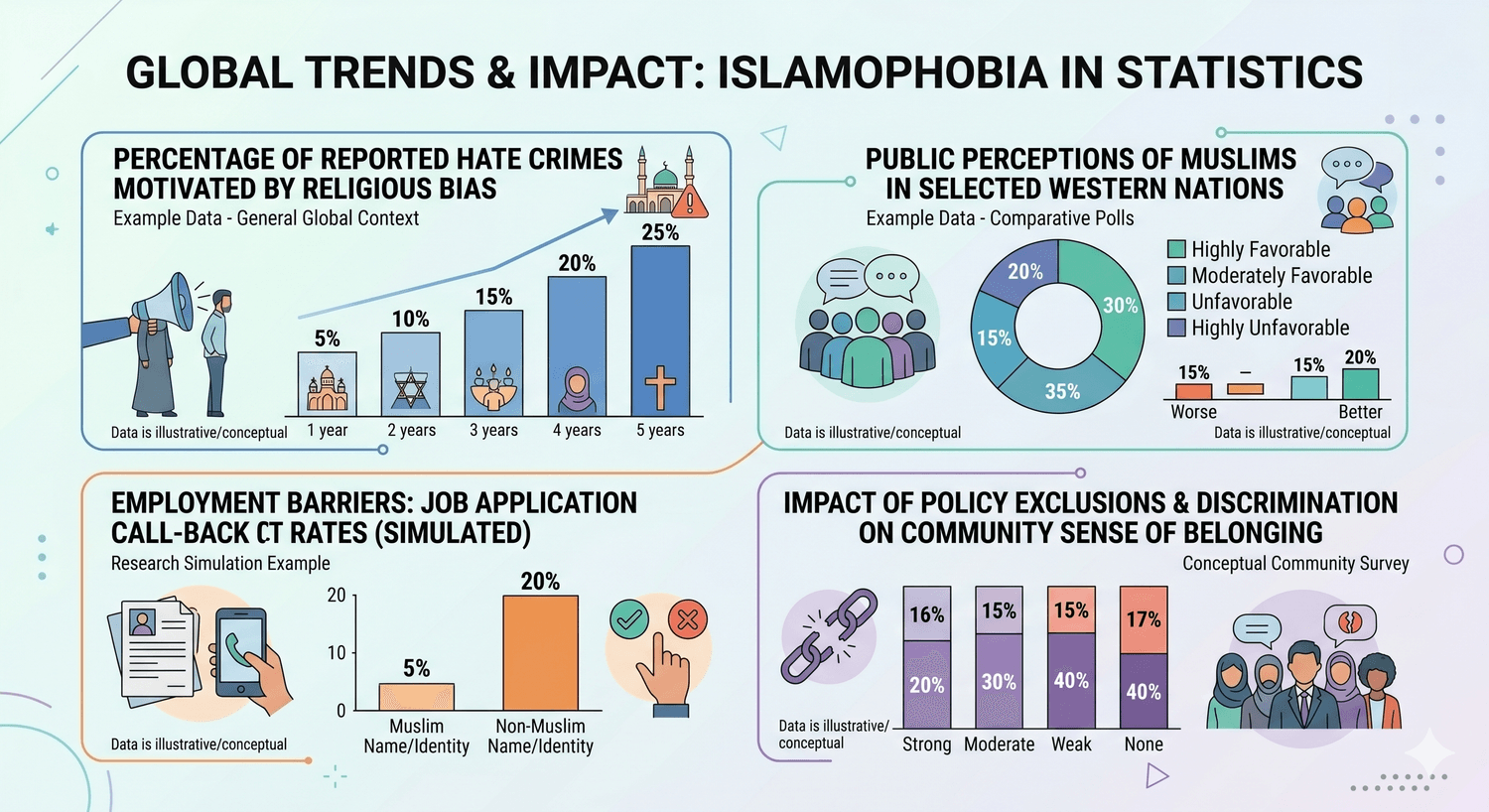
Islamophobia in Government and Policy
After September 11, US government programs began mass surveillance specifically targeting Muslim communities. FBI counterterrorism programs monitored Muslim Americans at a rate far disproportionate to any actual security threat, treating an entire religious community as a potential risk based solely on religion. The Trump administration's travel ban targeted several Muslim-majority countries by name.
In Europe, France banned religious symbols in public schools in 2004, then face coverings in all public spaces in 2011. In 2021, the French National Assembly voted on legislqation banning the hijab for women under 18 in public spaces. During the 2024 Paris Olympics, French athletes were prohibited from wearing hijabs at the opening ceremony. Switzerland voted in 2009 to ban the construction of minarets, with 60 percent of voters in favor. These are state-level policies. They are not individual acts of bigotry; they are bigotry embedded in law.
Islamophobia in Employment
Institutional Islamophobia in employment means that Muslims face measurably lower hiring rates, fewer promotions, and greater difficulty obtaining basic religious accommodations. A manager who denies a Muslim employee time for Friday prayers is engaged in institutional discrimination, whether or not they personally hold anti-Muslim views. A school dress code that bans headscarves is institutional Islamophobia written into policy, even if the people who wrote it believed they were being neutral.
The European Network Against Racism has documented that Muslim women face compounded disadvantages in the job market. They experience both gender discrimination and religious discrimination simultaneously. A headscarf visible in a job application photograph, in countries where this is standard practice, has been shown to significantly reduce callback rates in controlled studies.
Online Islamophobia
The internet gave anti-Muslim sentiment an infrastructure it never had in previous eras. Organizations dedicated to spreading misinformation about Islam operate websites, social media accounts, podcasts, and YouTube channels at scale. They produce content continuously, optimize it for search algorithms, and have built audiences of millions.
Online Islamophobia intensifies after triggering events. Studies consistently show that anti-Muslim content spikes on social media following terrorist attacks, regardless of whether the perpetrator is Muslim. This spike then correlates with increased hate crimes in the offline world. The digital and physical environments are not separate.
In online discourse, Muslims are almost always depicted as a single bloc: all violent, all Arab, all the same. Sikhs, Hindus, and other South Asians are frequently targeted as well, because the people doing the targeting cannot distinguish between religious identities. The category "Muslim" in Islamophobic discourse functions less like a religious category and more like a racial one: brown, foreign, threatening, reducible to a threat.
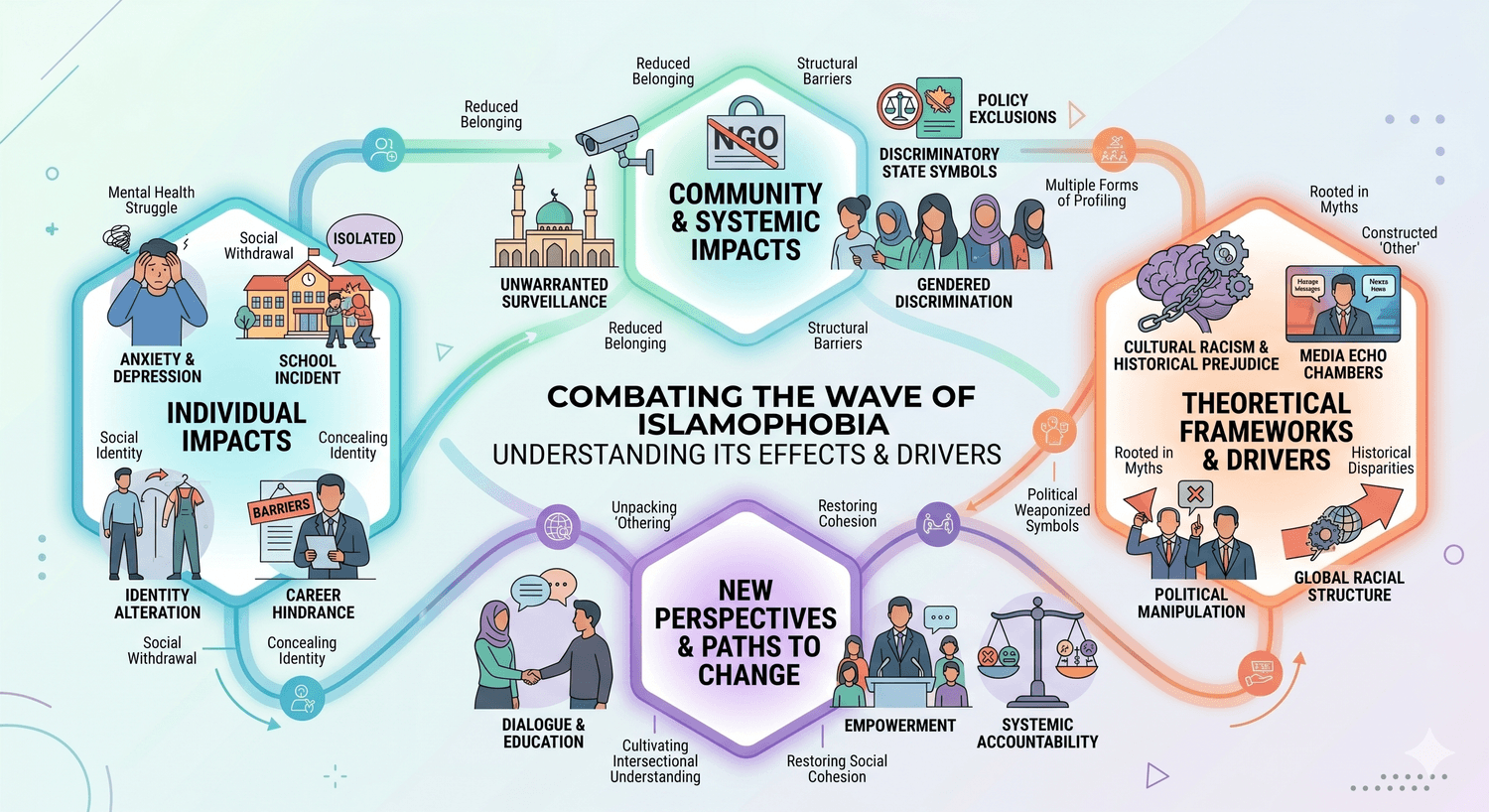
Internalized Islamophobia
This is the type that receives the least attention and is perhaps the most painful to name. Internalized Islamophobia occurs when Muslims themselves begin to absorb and act on anti-Muslim stereotypes.
A Muslim who stops using their Arabic name at work to reduce friction. A Muslim woman who removes her hijab after an attack because she fears another one. A young Muslim man who distances himself from Islamic practice because he has accepted, somewhere below conscious awareness, the premise that practicing Islam visibly marks him as a suspect. A community that learns to be apologetic about its existence.
None of this is a character failure. It is the predictable response of human beings trying to survive in an environment that persistently signals that their identity is a liability. But naming it matters because internalized Islamophobia is a form of harm as real as the hate crime, even though it never reaches a police report or a news headline.
How Understanding the Types of Islamophobia Helps
When you understand the full range of types of Islamophobia, you stop looking for only the most extreme expressions of it. You see the complete shape of a problem that operates at multiple levels simultaneously.
A policy banning religious dress and a stranger who pulls a headscarf off a woman on the street are connected. They do not emerge in isolation from each other. They grow from the same cultural environment and deliver the same message to the person on the receiving end: you do not fully belong here.
For non-Muslims trying to understand what Muslims experience, this framework moves the conversation beyond individual bad actors. Islamophobia is not primarily a story about hateful people. It is a story about systems, representations, policies, and cultures that have made it normal to view Muslim identity as a problem.
For Muslims navigating these environments, naming the types of Islamophobia is itself a form of clarity. The Quran tells us that the heavens and the earth are filled with signs for those who reflect (Quran 45:13). Seeing clearly what is in front of us, including what is unjust, is a prerequisite for responding with honesty and integrity. That is a principle with consequences well beyond religious belief.


