How Islam Promotes Peace, Justice, and Spiritual Growth
Get the 109‑page guide delivered to your inbox
Discover the faith that 1.9 billion people live by — and why thousands of truth-seekers just like you are choosing it every single day. This free 109-page guide walks you from curiosity to clarity, step by step.
No pressure. No judgment. No strings attached. Just a clear, honest roadmap written for people who want real answers — whether you're skeptical, curious, confused, or quietly searching for something deeper.
The word Islam itself contains the answer to the question it's supposed to address. The root is s-l-m: peace, safety, and completeness. Muslims don't say this as a slogan. It's built into the language. A Muslim is one who has found peace through submission to God. The state of surrendering to what is true, rather than fighting the nature of reality, is where Islam locates the beginning of both personal peace and social justice.
Words can be contradicted by practice. Any honest look at the Muslim world reveals communities that struggle with violence, injustice, and internal conflict. That gap between teaching and practice exists in every religious tradition. The question worth asking isn't whether Muslims always live up to their principles. It's what those principles actually say.
How Islam promotes peace, justice, and spiritual growth is embedded in the Quran, in the example of the Prophet, and in more than a thousand years of scholarship working to translate principle into practice.
How Islam Promotes Peace: Peace as an Internal State Before It Becomes a Social One
Islam speaks about peace in the world only after it speaks about peace inside the human being. The Quran says something that anyone who has achieved success without finding satisfaction will recognize: "Verily, in the remembrance of God do hearts find rest" (13:28).
Not in success. Not in comfort. Not even in the resolution of your problems. In the remembrance of God. The Arabic word is dhikr: conscious, sustained awareness of God's presence. When the ego stops demanding priority and the heart accepts that it is held by something larger than itself, something settles in the person.
This internal peace isn't passive. The Islamic tradition is full of people who worked tirelessly: scholars, builders, merchants, leaders, physicians. But the tradition consistently describes the effective, good-hearted person as one who acts from internal orientation rather than anxious compulsion. The peace comes first. The action follows from it.
The Five Prayers as Daily Peace Practice
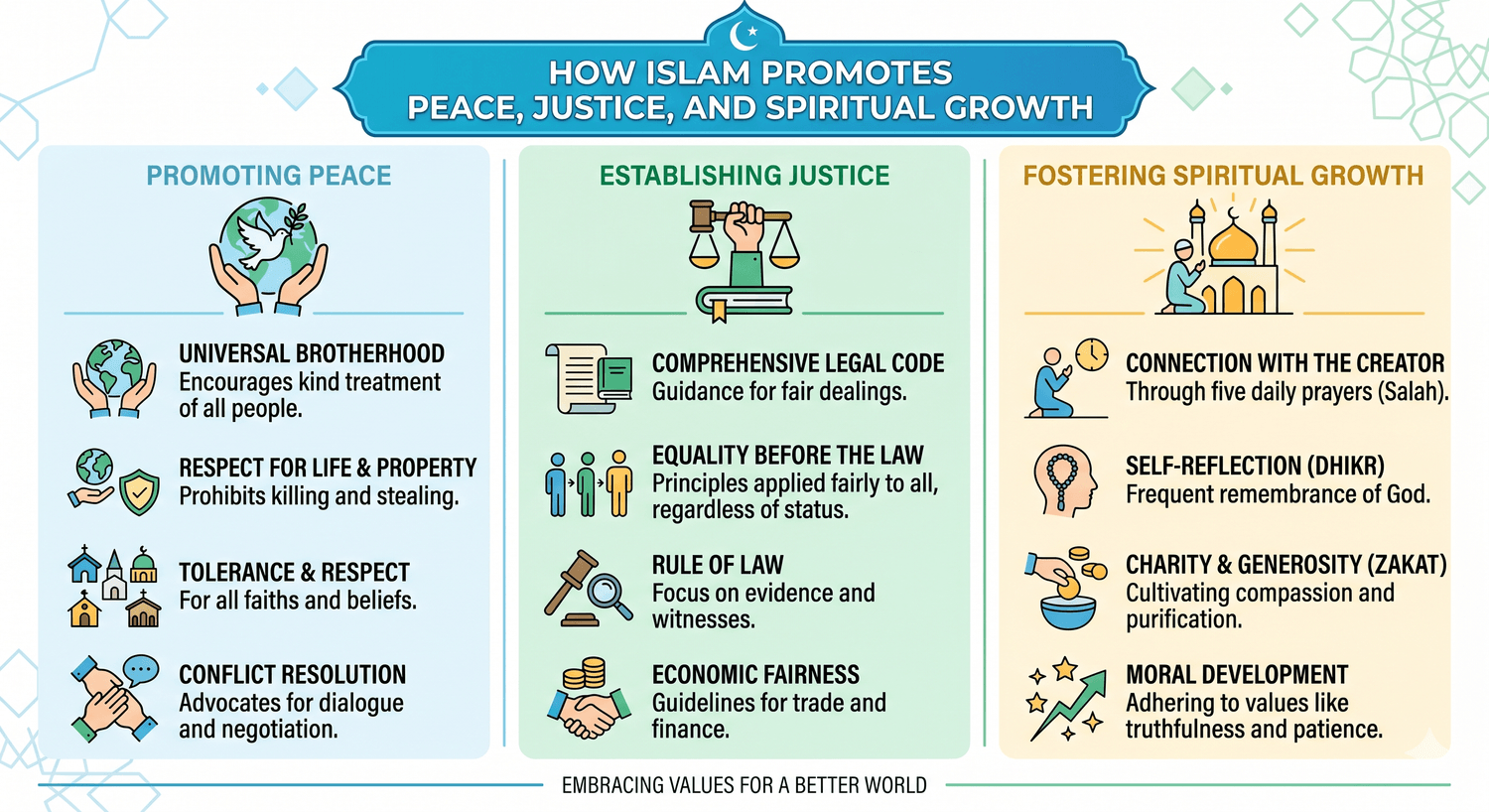
How Islam promotes peace through the five daily prayers isn't about ritual for its own sake. Each prayer interrupts. Five times between sunrise and sleep, the Muslim stops whatever has felt most urgent and replaces it with something that has an absolute priority claim.
For those five to fifteen minutes, the hierarchy corrects. The meeting you're anxious about, the bill you're worried about, the conflict you're avoiding: none of it is present during the prayer. You're in one place, doing one thing, with your attention pointing in one direction.
What this produces over years of consistent practice is a person who meets difficulty from a different position. Not immune to it. Not above it. Present to it, and grounded beneath it.
Islamic Teaching on Justice: The Social Dimension
Justice in Islam isn't a political platform or a policy preference. It's a theological obligation that cannot be separated from worship.
The Quran commands Muslims to "stand firmly for justice, as witnesses for God, even if it is against yourselves, your parents, or your close relatives" (4:135). That phrase, "even if it is against yourselves," is unusual in any ethical system. Most codes allow self-interest and family loyalty to bend the rules. The Quran explicitly removes that exemption. You are required to uphold justice even when it costs you personally.
Equality Before God
"O mankind, We have created you from a single male and female and made you into peoples and tribes that you may know one another. The most noble of you in the sight of God is the most righteous of you" (49:13). This verse dismantles the logic of racial, national, and tribal hierarchies with a single statement. You were not created diverse so that the diverse could rank themselves. You were created diverse so that you could know each other.
The most honored person is the most righteous person. That's the only ranking the Quran recognizes. The Prophet made this personal in his final sermon: no Arab has superiority over a non-Arab, no white over a black, no black over a white, except in righteousness. This was said in 7th-century Arabia, where tribal supremacy was the operating logic of social life. It was a direct challenge to the social order then. It remains one today.
The Economics of Justice
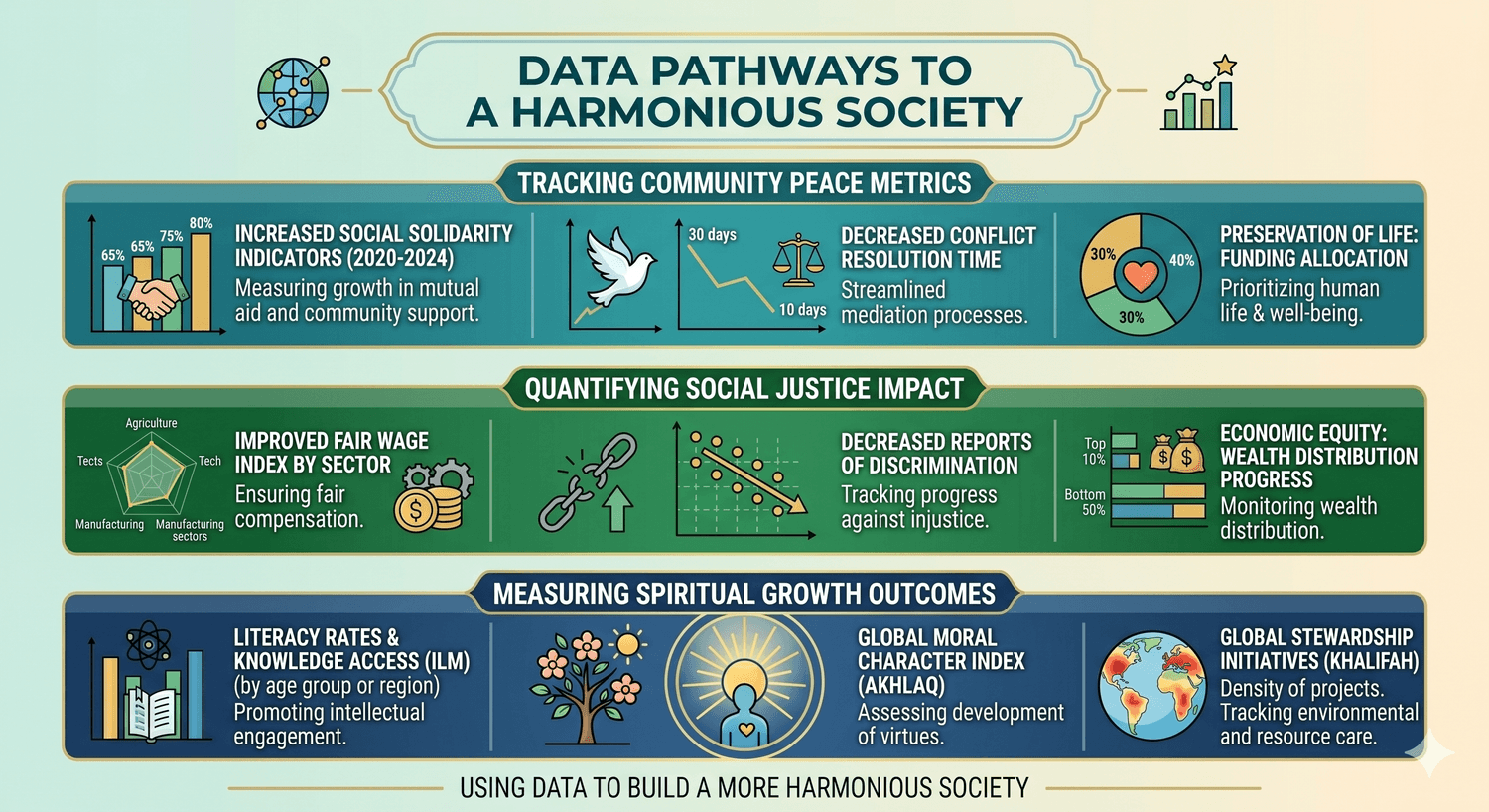
Islamic economic principles are designed to prevent wealth from concentrating indefinitely. Zakat, the annual 2.5% contribution from accumulated savings, redistributes wealth from those who have above a threshold to those who have less. This isn't voluntary charity made to feel good. It's a legal obligation with a specific calculation and specific categories of recipients defined in the Quran.
The prohibition on riba, interest on loans, removes one of the primary mechanisms by which poverty perpetuates itself. When the poor person who needs a loan must pay back more than they borrowed, the cycle compounds. Islamic finance, built on risk-sharing models, attempts to break that cycle structurally.
The Prophet said that the one whose neighbor goes to sleep hungry while he has food is not fully a believer. Personal wealth carries a permanent moral responsibility to the people within your reach.
Justice for Those Outside the Community
The Quran makes explicit what some might expect to be left ambiguous: "God does not forbid you from being kind and just to those who have not fought you over religion or expelled you from your homes. Indeed, God loves those who act justly" (60:8).
Kindness and justice toward peaceful non-Muslims is commanded. God loves the person who extends just treatment regardless of faith. Under classical Islamic governance, non-Muslim communities were protected by law: rights to practice their religion, maintain their places of worship, and govern their internal community affairs. That standard wasn't always achieved in practice. But it was the standard the law aimed for.
Spiritual Growth in Islam: Built for the Long Run
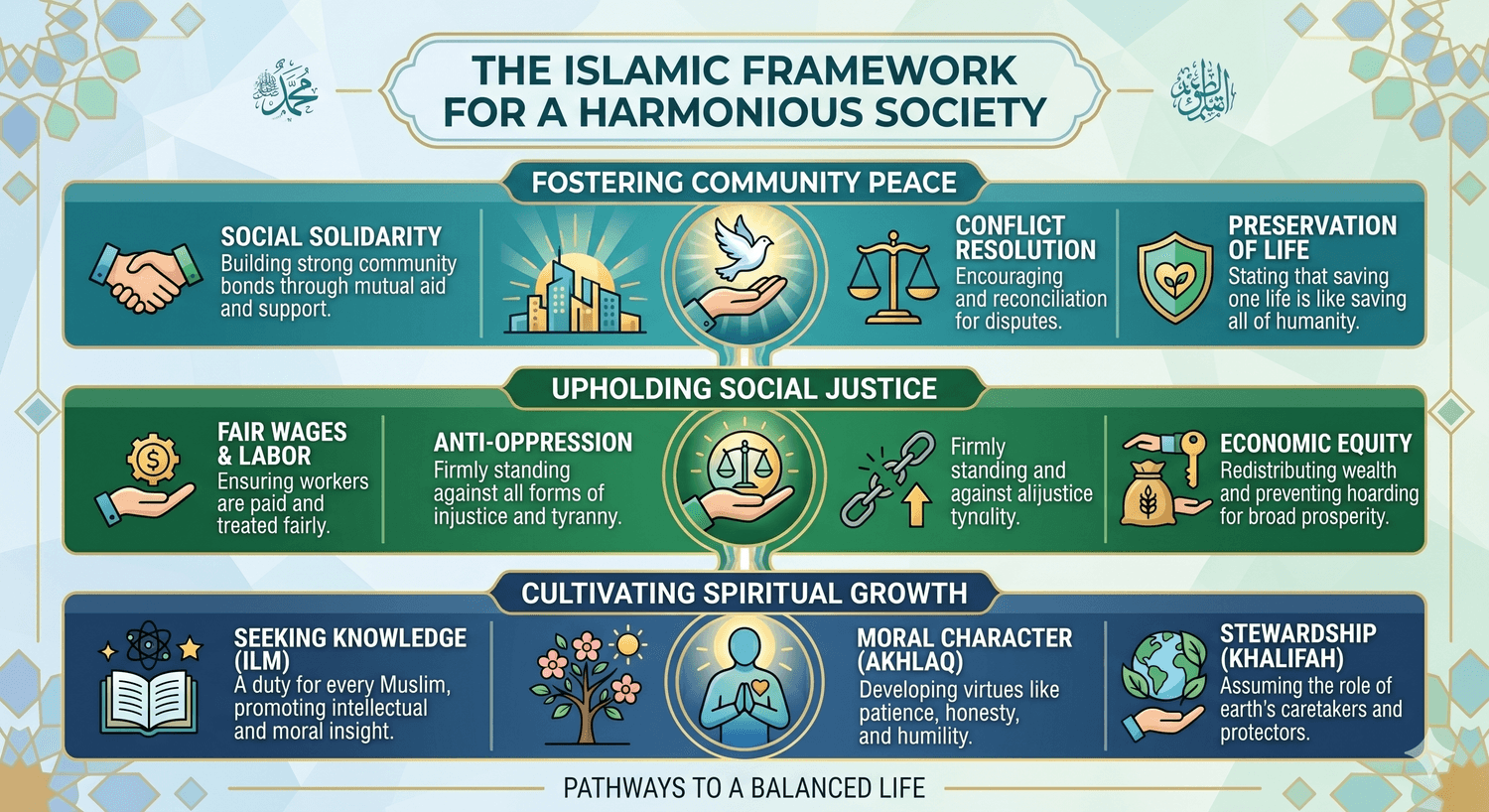
How Islam promotes spiritual growth is cumulative and structural. It doesn't happen in a single dramatic experience, though the moment of commitment matters. It happens through years of repeated practice that gradually reshape what you are from the inside.
Fasting as Annual Recalibration
Ramadan does something unusual. For 29 or 30 days, the most basic physical comforts are removed during daylight hours: food, water, and physical pleasures. Every year.
By the second week, the hunger becomes background. What clears is attention. The things that usually drive a large proportion of daily decisions, appetite, comfort, the low-level hum of desire, are removed from the equation. You're left with a clearer sense of who you actually are and what actually matters to you.
The last ten nights of Ramadan are the most intense. Muslims seek the Laylat al-Qadr, described in the Quran as better than a thousand months. Muslims in these nights sometimes pray from after breaking the fast until before the pre-dawn meal, reading Quran, making supplication, sitting in the kind of stillness that ordinary life rarely permits.
People who observe Ramadan seriously and consistently describe the cumulative effect over years as a permanent shift in what they're attached to. The month takes something away every year and doesn't always give it back. That's the point.
Hajj: The Great Leveling
The pilgrimage to Mecca is deliberately designed to strip away the categories that normally define a person. Two plain white cloths. No jewelry. No perfume. No symbols of status, nationality, or wealth. Two million people dressed identically, circling the same structure, praying the same prayers.
The visual makes a theological statement that could take years to arrive at intellectually: in front of God, you are one person among millions, equally a servant, equally dependent, equally returning. What you've achieved in the world doesn't change your position in that moment.
Muslims who return from Hajj describe it as transformative in a way that's difficult to articulate. The content of the transformation is usually the same: the world looks different in its scale, and you look different in yours. The normal anxieties about status and security feel smaller. The things that actually matter feel clearer.
The Inner Struggle as the Greatest Jihad
The Prophet Muhammad, returning from a military expedition, told his companions that they had returned from the lesser jihad to the greater jihad. They asked what the greater jihad was. He said: the struggle against the self.
This is the primary spiritual project in Islamic tradition. The nafs al-ammara, the commanding ego-self, constantly pulls toward ease, pride, self-interest, and deception. The practices of Islam, prayer, fasting, giving, remembrance, are all tools in a permanent effort to redirect that pull.
The scholars of Islamic spirituality describe this as a gradual process, not a sudden transformation. You pray consistently for years, and the prayer slowly shapes your reactions. You fast annually, and the fasting slowly weakens the grip of appetite over your decisions. You give regularly, and the giving slowly loosens the fear of not having enough.
The commanding self doesn't disappear. But it loses its authority. Something quieter emerges in its place, what the Quran calls the nafs al-mutma'inna, the soul at peace. It's the destination that Islamic spiritual practice points toward.
The Connection Between Justice and Worship
One of the most important things the Quran says about how Islam promotes peace, justice, and spiritual growth is that these three cannot be separated. The person who worships sincerely becomes more just. The community that pursues justice creates conditions for genuine spiritual growth. The individual who grows spiritually becomes less self-centered and more willing to give.
The Quran describes the person who prays but then pushes the orphan aside and neglects the poor as giving the lie to the religion itself (107:1-7). Prayer is supposed to produce the generosity. Fasting is supposed to produce the empathy. Giving is supposed to produce liberation from attachment. If the ritual produces nothing in behavior, something has gone wrong in the practice.
The Prophet described this connection in a single statement: "The best of you are those who are best to their families." After 23 years of prophethood, multiple major battles, the establishment of a community, and the revelation of the Quran through him, his summary of the best Muslim is the one who is best in the closest, least glamorous relationships.
How Islam promotes peace, justice, and spiritual growth is, in the end, this ordinary: pray honestly, fast genuinely, give actually, and treat the people in front of you well. Over a lifetime, that builds something worth being.
If you're ready to explore a tradition built around peace, justice, and real spiritual growth, start where every worthwhile journey starts: with real knowledge. Our courses at Start Islam Path are designed for you, wherever you're beginning from.


