How to Counter Islamophobia: Building Long-Term Change That Lasts
Get the 109‑page guide delivered to your inbox
Discover the faith that 1.9 billion people live by — and why thousands of truth-seekers just like you are choosing it every single day. This free 109-page guide walks you from curiosity to clarity, step by step.
No pressure. No judgment. No strings attached. Just a clear, honest roadmap written for people who want real answers — whether you're skeptical, curious, confused, or quietly searching for something deeper.
There is a moment in every serious effort to know how to counter Islamophobia when you realize that responding to individual incidents, while necessary, is not enough. The incidents keep coming because the conditions that produce them have not changed. Hate crimes spike after election cycles because the rhetoric of those cycles has been left unchallenged. Employment discrimination persists because the assumptions behind it have never been directly confronted in hiring systems. School bullying continues because teachers were never trained to recognize it.
Countering Islamophobia at a level that produces durable change requires working on the conditions, not just the incidents. This article is about that longer, harder, more essential work.
How to Counter Islamophobia: Start with Definitions and Documentation
You cannot counter what you cannot name, and you cannot name what you cannot measure. One of the most consistent recommendations from researchers studying Islamophobia is that communities and institutions invest in defining and documenting the problem with specificity.
This means tracking incidents consistently. It means Muslim community organizations maintaining records of discrimination complaints that are detailed enough to reveal patterns — which institutions, which job categories, which types of incidents, which communities are most affected. It means advocating for law enforcement agencies and schools to accurately classify and report religiously motivated incidents, which many currently do not.
When Islamophobic incidents are documented thoroughly, they become harder to dismiss as exceptional. The pattern becomes visible. And visible patterns attract the political and legal attention that isolated incidents rarely do.
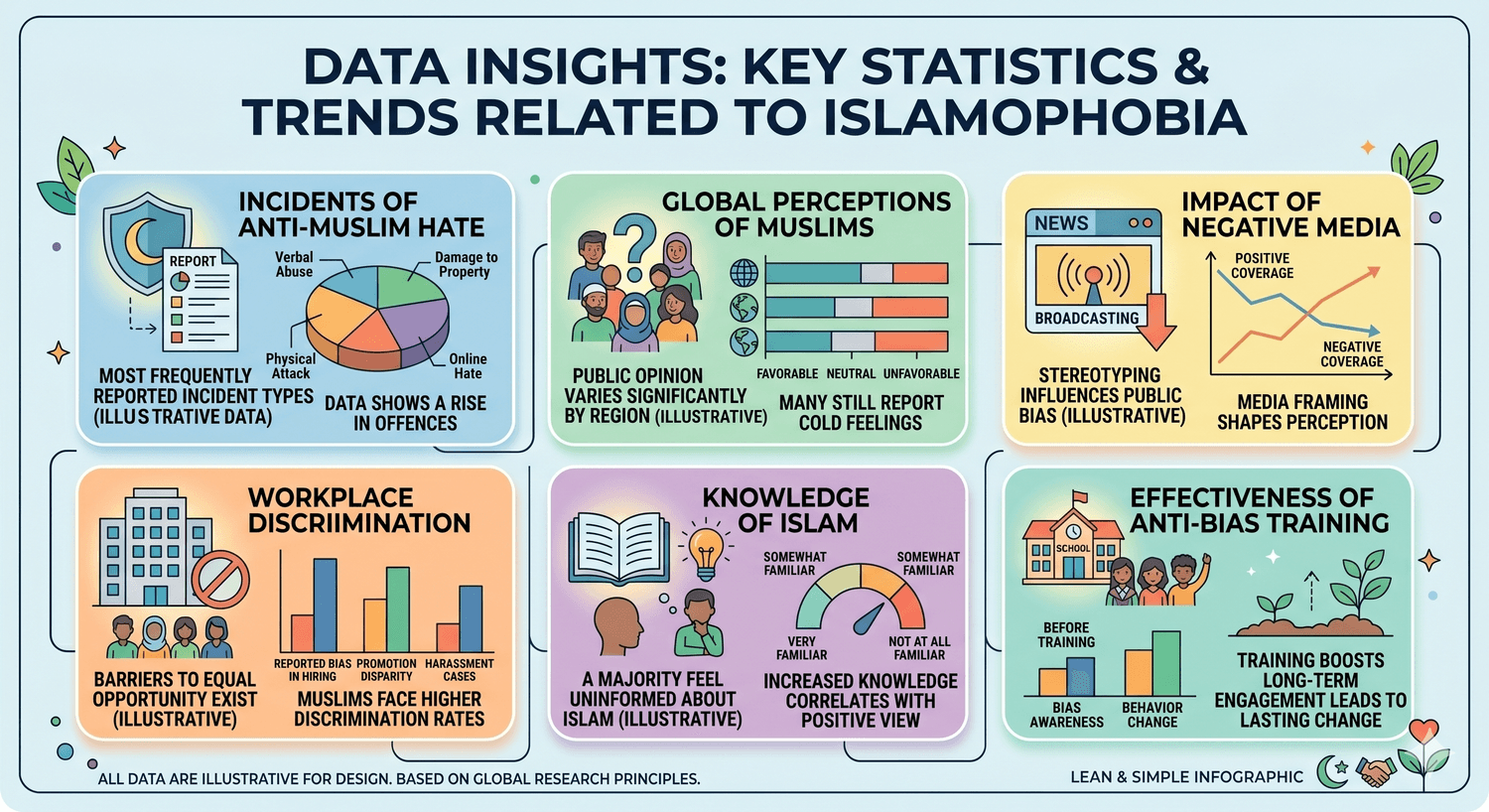
CAIR's annual civil rights reports do exactly this, and the influence of those reports on policy conversations has been significant. When the data showed that employment discrimination had become the single largest category of anti-Muslim complaints in 2024, that finding shaped advocacy efforts in ways that anecdote alone could not.
Dismantle the Narratives, Don't Just Defend Against Them
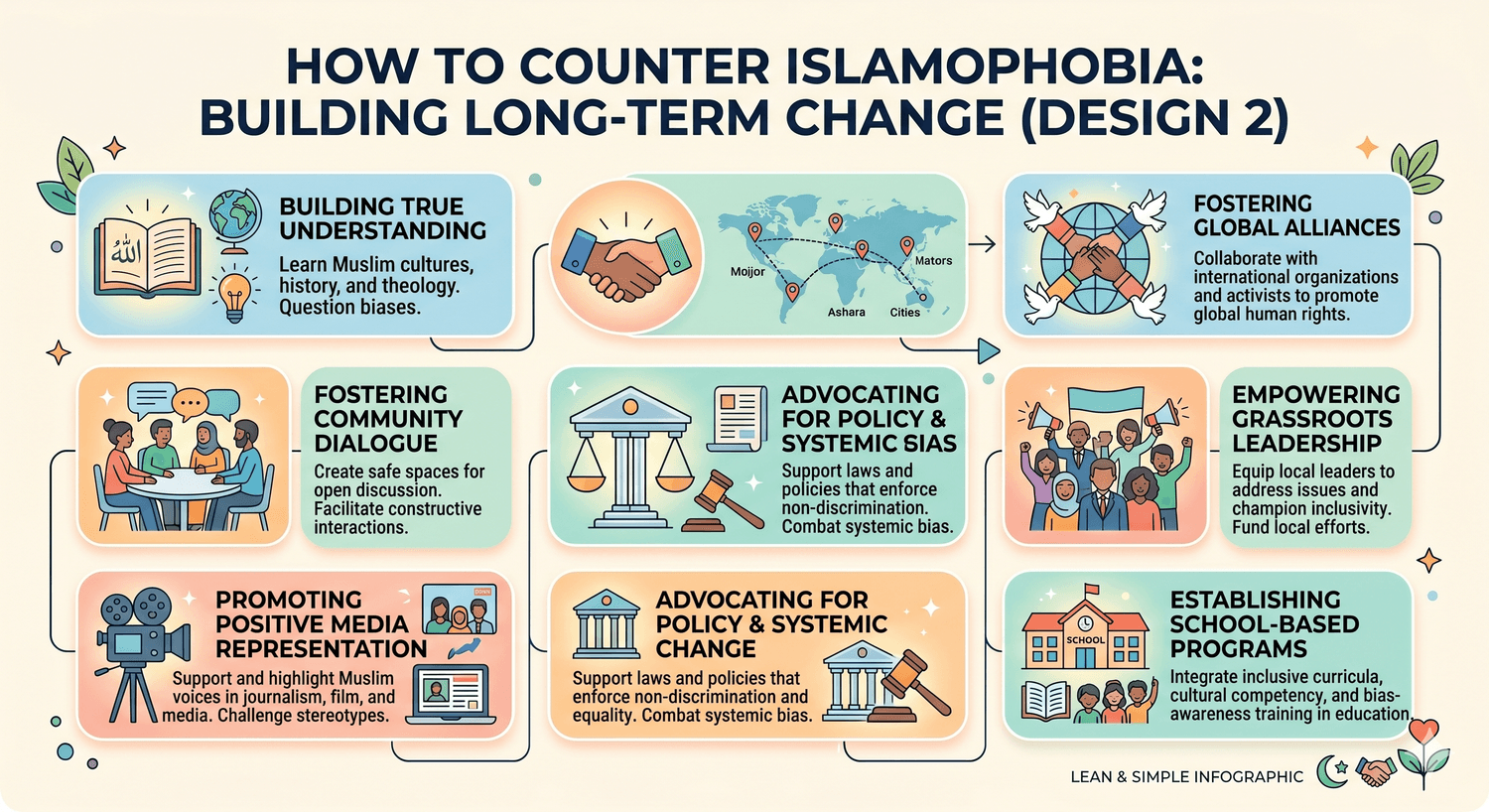
Researchers studying Islamophobia across eight European countries identified a four-step framework that is effective in countering it: define the problem, document it, deconstruct the narratives that sustain it, and reconstruct new narratives that reflect the actual diversity of Muslim experience.
The deconstruction step is the one most often skipped. It is not enough to say "not all Muslims are terrorists" — that framing concedes too much. The more effective counter is to examine the narrative itself: where did it come from, who funded it, what purpose does it serve, and what evidence contradicts it?
The narrative that Islam is inherently violent, for example, collapses under contact with Islamic intellectual history. Muslim scholars in the 8th through 14th centuries were doing advanced work in mathematics, astronomy, medicine, philosophy, and law while Europe was navigating the Dark Ages. The concept of the just war in Islamic jurisprudence was developed with more nuance and more explicit constraints than most of its Western equivalents. The Qur'an's prohibition on harming non-combatants in warfare predates the Geneva Conventions by over a millennium.
These are not defensive claims. They are facts that reshape the conversation entirely when introduced clearly and specifically. Countering Islamophobia through narrative reconstruction means telling accurate, specific, positive stories about Islam and Muslim communities — not just denying negative ones.
Invest in Education at Every Level
Education is where narratives are formed most durably, and it is where counter-Islamophobia work has some of its strongest evidence of impact.
At the school level, curriculum reform that accurately represents Muslim contributions to history, science, and culture is a structural change with generational reach. When students learn that algebra came from Islamic scholarship, that the first university was founded by a Muslim woman in Morocco in 859 CE, that the translation movement in Baghdad preserved and transmitted Greek philosophy to Europe — the picture of what "Muslim" means becomes impossible to reduce to a threat.
At the teacher level, training on recognizing and responding to religious discrimination changes institutional behavior. Teachers who have been trained specifically on anti-Muslim bias handle incidents differently than those who have not — more effectively, more consistently, and with less inadvertent reinforcement of the problem.
At the community level, interfaith education programs that bring non-Muslims into direct, positive contact with Muslim communities and Islamic thought have consistent evidence of reducing Islamophobic attitudes. The key ingredient is not information alone — it is the human contact that makes the information feel real rather than abstract.
Change Policies and Institutions
Individual attitudes change slowly. Institutional policies can change more quickly when there is organized pressure, clear legal grounds, and sustained advocacy.
Several specific policy changes have a documented record of countering Islamophobia:
Anti-hate-crime legislation that specifically includes religious discrimination, combined with training for law enforcement on how to identify and classify religious hate crimes, changes what incidents get recorded and prosecuted. Without that, the data stays invisible and the accountability stays minimal.
Religious accommodation policies in workplaces and schools, enforced consistently and communicated clearly, reduce the daily friction that Muslim employees and students face when trying to practice their faith. Employers who have clear, enforced policies on accommodation report fewer discrimination complaints and higher retention of Muslim employees.
Oversight mechanisms for government programs that have been used for religious profiling — airport screening, law enforcement surveillance, "countering violent extremism" initiatives — are essential for ensuring that anti-Muslim bias does not operate as official policy. When communities can monitor and challenge how these programs function, the programs change.
The U.S. National Strategy to Counter Islamophobia, released in 2024, included more than 100 specific government commitments to address anti-Muslim discrimination across employment, education, law enforcement, and other sectors. Holding the government accountable for those commitments is itself a counter-Islamophobia strategy.
Build Coalitions That Cross Community Lines
Islamophobia does not exist in isolation. It shares roots with antisemitism, anti-Black racism, anti-immigrant sentiment, and other forms of bigotry that operate through the same mechanisms: othering, dehumanization, stereotyping, and the attribution of collective guilt.
Muslim communities that build strong relationships with Jewish communities, Black communities, immigrant communities, and other religious minorities create something more durable than any single advocacy campaign. They create a political coalition with overlapping interests, shared experience, and combined influence that each group alone cannot produce.
This is not about minimizing the specific experiences of any group. It is about recognizing that the tree of Islamophobia, as one researcher put it, shares roots with the tree of other forms of bigotry. Countering one effectively means working with those who know the tree from different angles.
Interfaith coalitions that have come together to challenge discriminatory legislation, oppose hate crime incidents, and advocate for inclusive policies have succeeded in ways that community-specific efforts have not, precisely because of that breadth. There is strategic wisdom in coalition, beyond the ethical case for solidarity.
The Islamic Framework for Long-Term Resistance
The Qur'an addresses sustained, organized opposition to truth with a clarity that is worth sitting with. Surah Al-Baqarah (2:177) describes righteousness not as ritual correctness, but as sustained ethical action in the world: giving wealth to those in need, freeing those who are enslaved, keeping commitments. The Qur'an consistently links faith to action in the world, not faith as a private shelter from the world.
The Prophet Muhammad's own history is a twenty-three-year project of counter-narrative — taking a community shaped by tribal hierarchy, class distinction, and the exploitation of the vulnerable, and rebuilding it around the principles of tawhid (divine unity), human dignity, and accountability before God. That is a project for the long term, not a reaction to individual incidents.
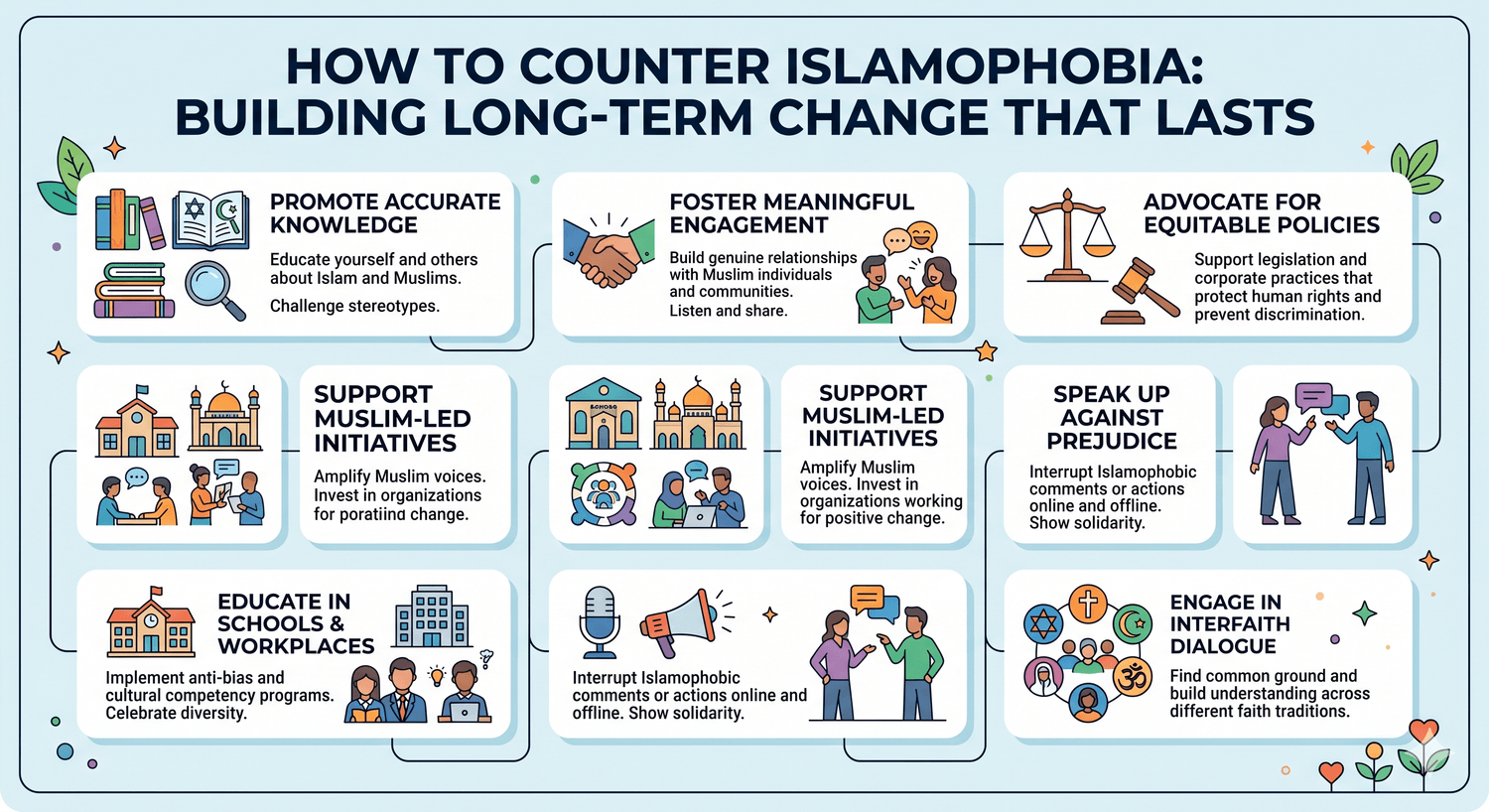
For those working to counter Islamophobia today, that tradition offers both inspiration and method. Work consistently. Build institutions that outlast individual leaders. Document what is happening. Tell accurate stories. Build coalitions. Hold power accountable. And do not expect the world to change because of one good argument.
For New Muslims: You Have Something to Offer
If you are new to Islam, you might wonder what role you have to play on How to Counter Islamophobia. More than you think. Your questions, your curiosity, your presence in Muslim communities and in public spaces — all of it contributes to the broader project of making Islam visible and human in a world that has been given reasons to fear it.
Ask your questions out loud. Share what you are learning. Be willing to say "I am exploring Islam" to the people in your life who might not have expected it. You will have conversations you did not anticipate, and some of those conversations will shift something in someone who needed it shifted.
Start Islam Path offers the education, community, and tools you need to not just be Muslim, but to be a Muslim who understands your faith deeply enough to share it clearly. Start that journey with us today.
Know how to counter-argue all misconceptions related to Islam, find more info here


