How to Address Islamophobia When It Happens to You or Someone Nearby
Get the 109‑page guide delivered to your inbox
Discover the faith that 1.9 billion people live by — and why thousands of truth-seekers just like you are choosing it every single day. This free 109-page guide walks you from curiosity to clarity, step by step.
No pressure. No judgment. No strings attached. Just a clear, honest roadmap written for people who want real answers — whether you're skeptical, curious, confused, or quietly searching for something deeper.
The moment it happens, there is often a pause. A comment, a refusal, a slur, an act of violence — and then a split second of disorientation while you decide what to do next. Most people have not thought through in advance how to address Islamophobia when they encounter it, which means they often default to absorbing it in silence and carrying that silence home.
This article will not do that to you. It will give you concrete tools — for the moment it happens, for the days after, and for the longer effort of building a world where these moments happen less often.
How to Address Islamophobia and Know What You Are Dealing With Before You Respond
Not all Islamophobia looks the same, and how to address Islamophobia depends significantly on the context.
There is what researchers call interpersonal Islamophobia: a neighbor who makes a comment, a colleague who asks whether you support terrorism, a stranger who follows you around a store. There is institutional Islamophobia: an employer who denies a prayer accommodation, a school that refuses to allow a student to wear hijab, an airport security system that routinely singles out Muslim passengers. And there is structural Islamophobia: laws, policies, and practices that embed anti-Muslim bias into the functioning of institutions without any individual needing to make a conscious prejudiced decision.
Each of these requires a different response. You do not argue with a federal screening policy the same way you address a comment from a coworker. You do not handle a hate crime the same way you handle a microaggression at a dinner party. Knowing which type you are dealing with is the first step in figuring out what to do.
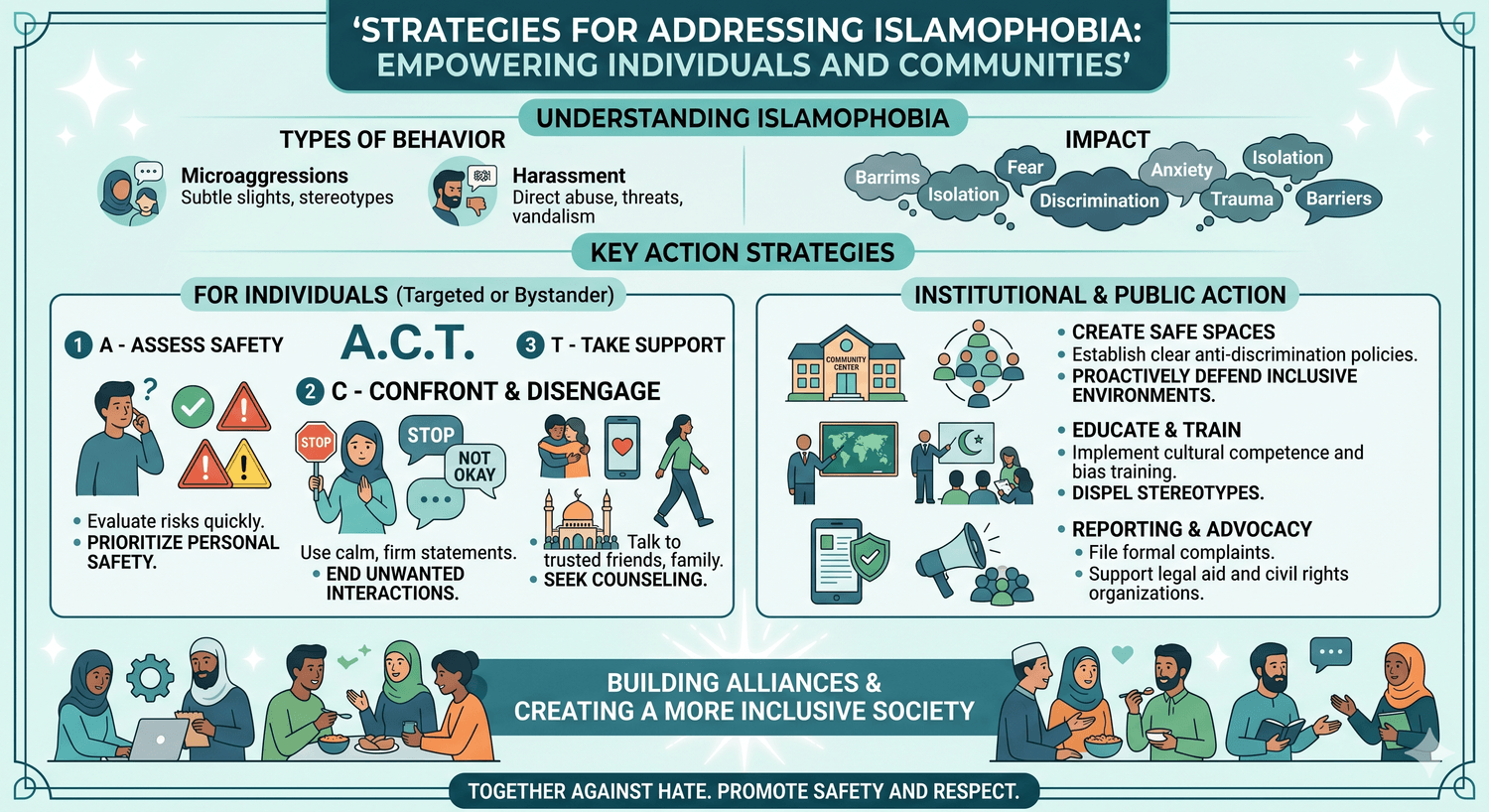
How to Address Islamophobia in the Moment
When anti-Muslim discrimination or hostility happens directly to you, you have several options — none of which is automatically the right choice. Context matters.
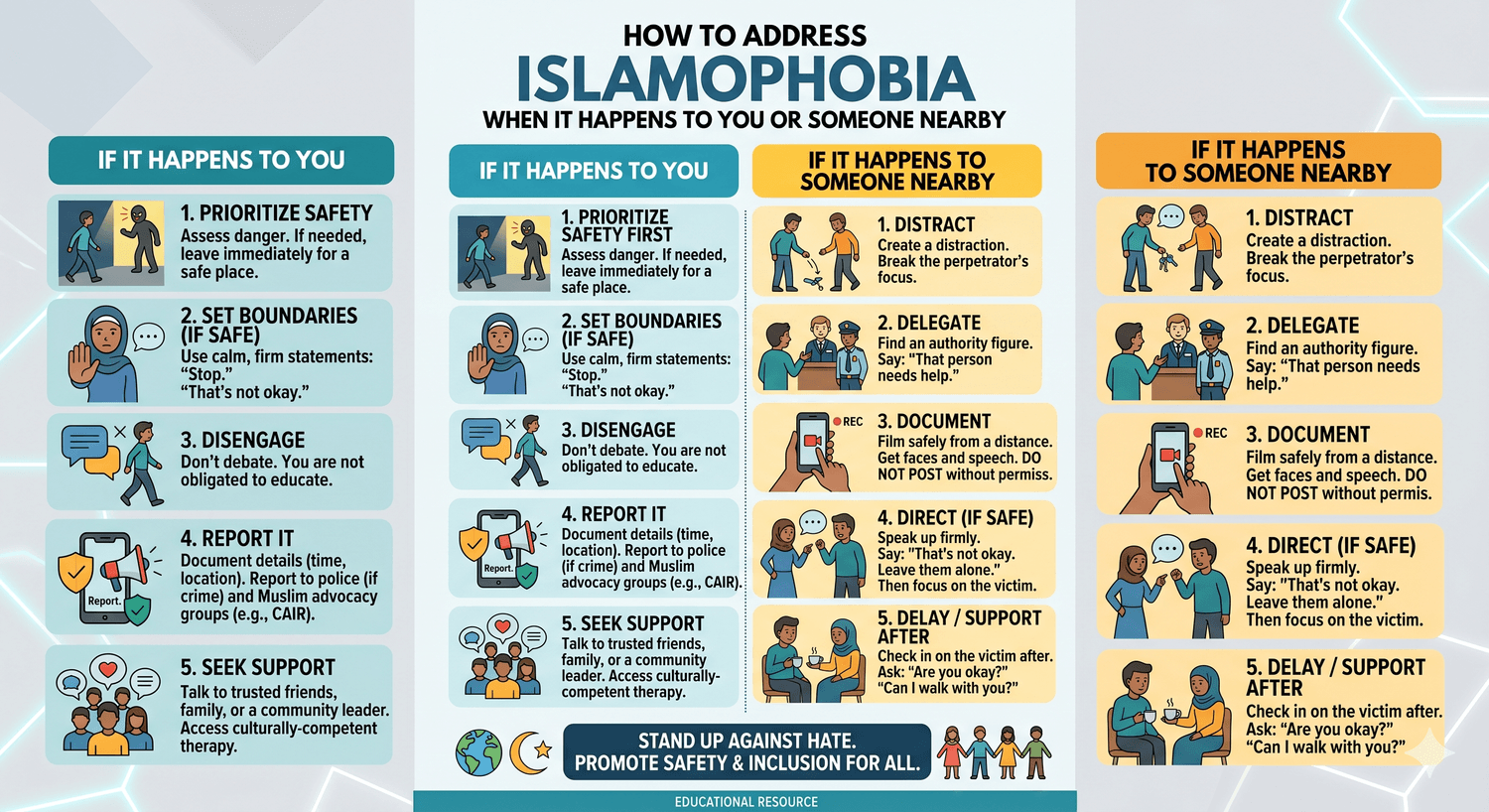
Your safety comes first. If an incident is physically threatening, leave the situation. Document what you can after the fact, but do not stay in a dangerous environment to gather evidence. If someone becomes aggressive in a public space, get to a safe location and, if the incident rises to the level of a hate crime, call law enforcement and document everything you remember immediately.
If the situation is verbally hostile rather than physically threatening, you have a choice: respond or disengage. There is no moral requirement to educate every person who expresses prejudice toward you. You do not owe anyone a teachable moment at the cost of your own wellbeing. But if you feel safe, clear, and ready, a calm, direct response can sometimes shift the dynamic. Something as simple as: "That assumption is not accurate. Here is what is actually true." No heat. No lengthy argument. Just a correction and an exit.
The Prophet Muhammad, peace be upon him, modeled a particular kind of response to hostility that the Qur'an calls "warding off with what is better" (Qur'an 41:34). This is not the same as passive acceptance. It is a deliberate choice to respond to poor behavior with something that does not replicate it, while still standing your ground. There is wisdom in that strategy.
How to Address Islamophobia in the Workplace
Workplace Islamophobia is one of the most commonly reported forms of anti-Muslim discrimination, and it is also one of the most legally addressable.
If you are denied a religious accommodation — prayer time, religious dress, dietary considerations — start by making the request formally, in writing. This creates a paper trail. Your employer is legally required to provide reasonable accommodations for sincere religious practices under Title VII of the Civil Rights Act, unless doing so would create an undue hardship. If the request is denied without a legally defensible reason, you have grounds to escalate.
Document everything. Keep a log of dates, incidents, names of people present, and exact language used. If you report something to HR and nothing changes, document that too. This documentation becomes your case if you decide to file a formal complaint with the Equal Employment Opportunity Commission (EEOC). There are strict time limits for filing — usually 180 or 300 days from the date of discrimination, depending on your state — so act promptly.
If you experience harassment from colleagues — comments, jokes, exclusion, or hostile behavior based on your religion — this can also constitute illegal workplace discrimination. You are not required to prove that the behavior was intentional, only that it was severe or pervasive enough to create a hostile work environment.
Organizations like CAIR offer free legal assistance for workplace discrimination cases and can help you decide whether and how to file.
How to Address Islamophobia in Schools
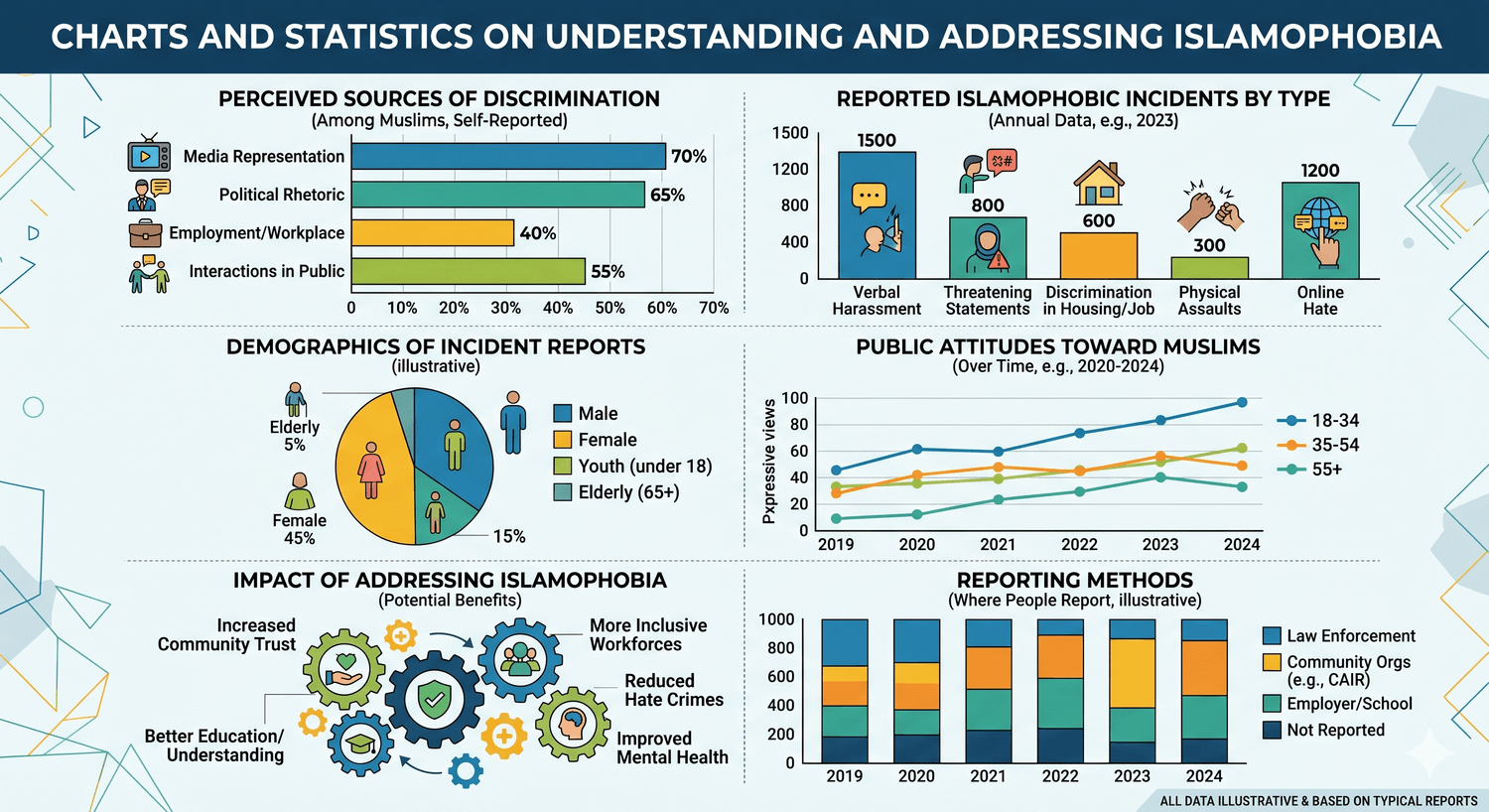
For Muslim students and their parents, knowing how to address Islamophobia in educational settings is urgent because the impact on children is particularly significant.
Start by documenting the incident: what happened, when, who was involved, what the school's response was (or was not). Put your communication with school officials in writing — email, not just verbal conversations — so there is a record.
If the school fails to address the situation, escalate to the school district. If the district does not act, both the Department of Justice's Educational Opportunities Section and the Department of Education's Office for Civil Rights accept complaints about religious discrimination in schools. Schools that permit sustained bullying or harassment on the basis of religion may be in violation of federal civil rights law.
The Council on American-Islamic Relations has a dedicated team for education-related civil rights cases and can advise on the most effective path forward in your specific situation.
How to Address Islamophobia as a Bystander
If you are not Muslim but you witness anti-Muslim discrimination or hostility, you have a role to play in addressing it too.
The research on bystander intervention is consistent: the presence of someone who speaks up, acknowledges the target, and refuses to normalize the behavior significantly changes the dynamic — both for the person being targeted and for the person acting badly. You do not need to get into a long argument. A simple, calm statement — "That comment is not okay" or turning to the person being targeted and saying, "Are you all right?" — can make an immediate difference.
After the incident, amplifying Muslim voices rather than speaking over them matters. Share accurate information about Islam when you see misinformation spreading. Support Muslim-owned businesses, Muslim community organizations, and political candidates who are committed to civil rights without exception.
Build Structures Before the Crisis
The most durable approach to addressing Islamophobia is not reactive — it is structural. Individual incidents matter less when communities have organized, relationships are built across faith lines, and institutions have been held accountable.
This means Muslim communities connecting with other communities of faith, other communities facing discrimination, and civil rights organizations before an incident occurs. It means knowing the local CAIR contact, the interfaith council, and the community organizers who have experience navigating these situations. It means having a plan.
The Qur'an instructs believers: "O you who believe, be persistently standing firm for Allah, witnesses in justice" (Qur'an 5:8). Standing firm is not the same as standing still. It requires preparation, community, and sustained effort — not just the courage of an individual moment.
For New Muslims: You Are Not Alone in This
If you are new to Islam and you are reading this because you want to be prepared for what might come, that is exactly the right instinct. You do not have to figure out how to address Islamophobia alone. You are joining a community with decades of legal, organizational, and spiritual experience navigating this terrain.
Use that experience. Connect with your local Muslim community. Reach out to CAIR if you experience discrimination. Find a mosque, an Islamic center, or an online community that can support you. And know that every Muslim who has faced hostility because of their faith and kept going has added something to the tradition you are entering.
Start Islam Path exists precisely for moments like this — when you need more than an answer to a theological question, but a community and resources to support your full journey. Explore our courses and join a growing network of Muslims who are walking this path together.


