The Real Impact of Islamophobia on Muslim Lives, Families, and Communities
Get the 109‑page guide delivered to your inbox
Discover the faith that 1.9 billion people live by — and why thousands of truth-seekers just like you are choosing it every single day. This free 109-page guide walks you from curiosity to clarity, step by step.
No pressure. No judgment. No strings attached. Just a clear, honest roadmap written for people who want real answers — whether you're skeptical, curious, confused, or quietly searching for something deeper.
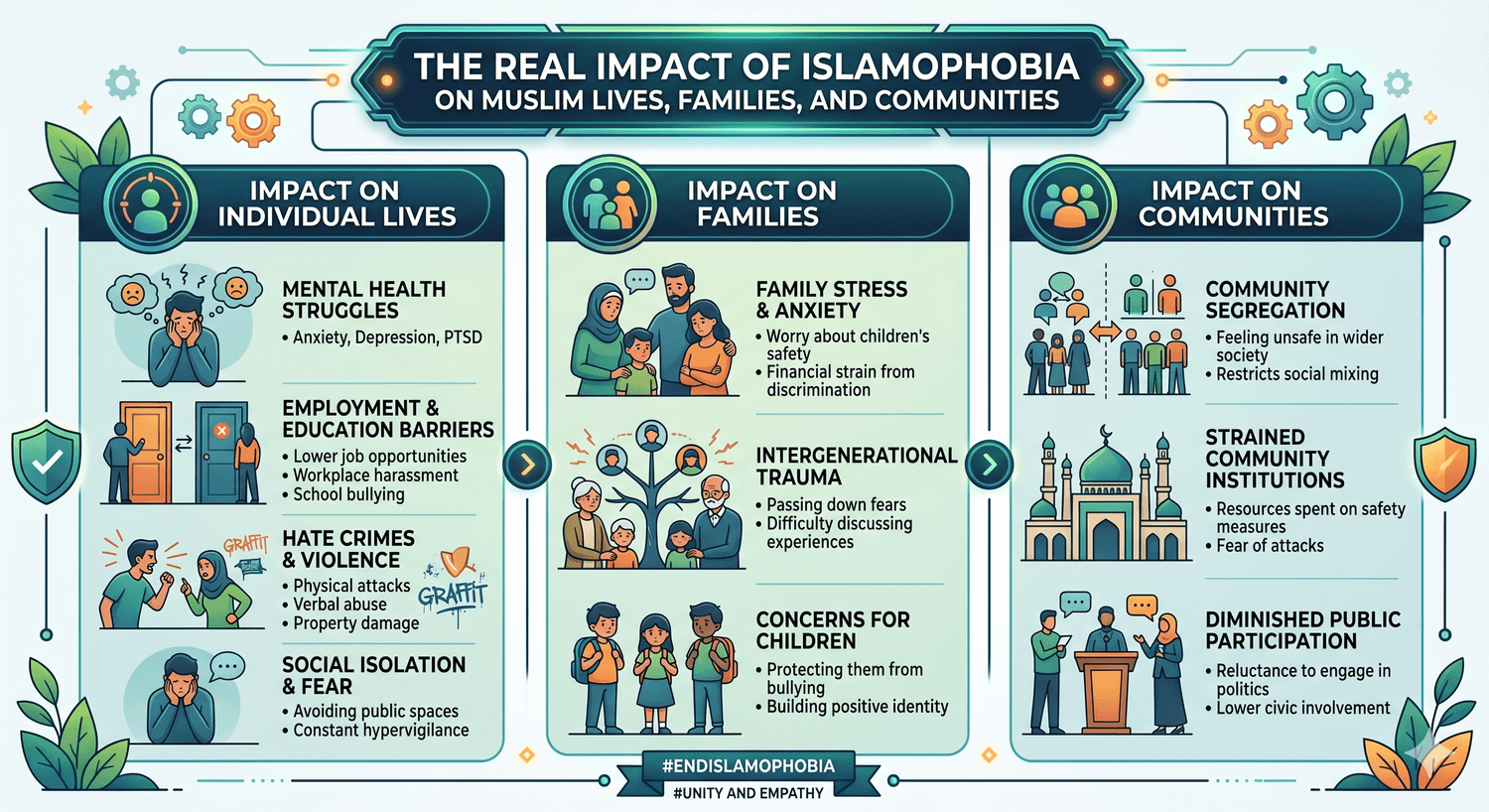
When the conversation about Islamophobia focuses only on hate crimes — the burned mosques, the physical assaults, the slurs — it misses most of what actually happens to Muslims navigating a world that has been taught to fear them. Hate crimes are the visible edge of something much larger. The impact of Islamophobia on Muslim lives runs deeper, touches more people, and causes more lasting damage than any single incident can capture.
This article is for people who want to understand that full picture. Whether you are new to Islam, exploring it seriously for the first time, or simply someone who believes that no faith community should be treated this way, the impact of Islamophobia deserves your full attention.
The Impact of Islamophobia on Mental Health
Let us begin with the body, because that is where discrimination lands first.
Research consistently shows that experiencing discrimination is a chronic stressor — not just an unpleasant moment, but a physiological burden that activates the same stress response pathways as physical danger. For Muslims who experience repeated discrimination, the result is a sustained state of vigilance that the body was not designed to maintain indefinitely. The medical literature connects this chronic stress to elevated rates of anxiety, depression, cardiovascular disease, sleep disruption, and other measurable health outcomes.
A study published in a leading public health journal found that Muslim Americans who reported higher levels of discrimination also reported significantly worse mental and physical health outcomes than those who experienced less. This was true even after accounting for income, age, and other variables. The discrimination itself was the factor that predicted poorer health.
The impact of Islamophobia on children deserves its own attention. Muslim children who experience bullying and hostility at school — being called terrorists, having their faith mocked, watching adults treat their families with suspicion — carry those experiences into their developing sense of self. Research shows that children who experience religious discrimination are more likely to internalize negative messages about their identity, more likely to withdraw from school activities, and more likely to struggle academically. A thirteen-year-old who learns to hide her faith to avoid being harassed is not just managing a social problem. She is also being taught that who she is must be concealed.
The Impact of Islamophobia on Employment
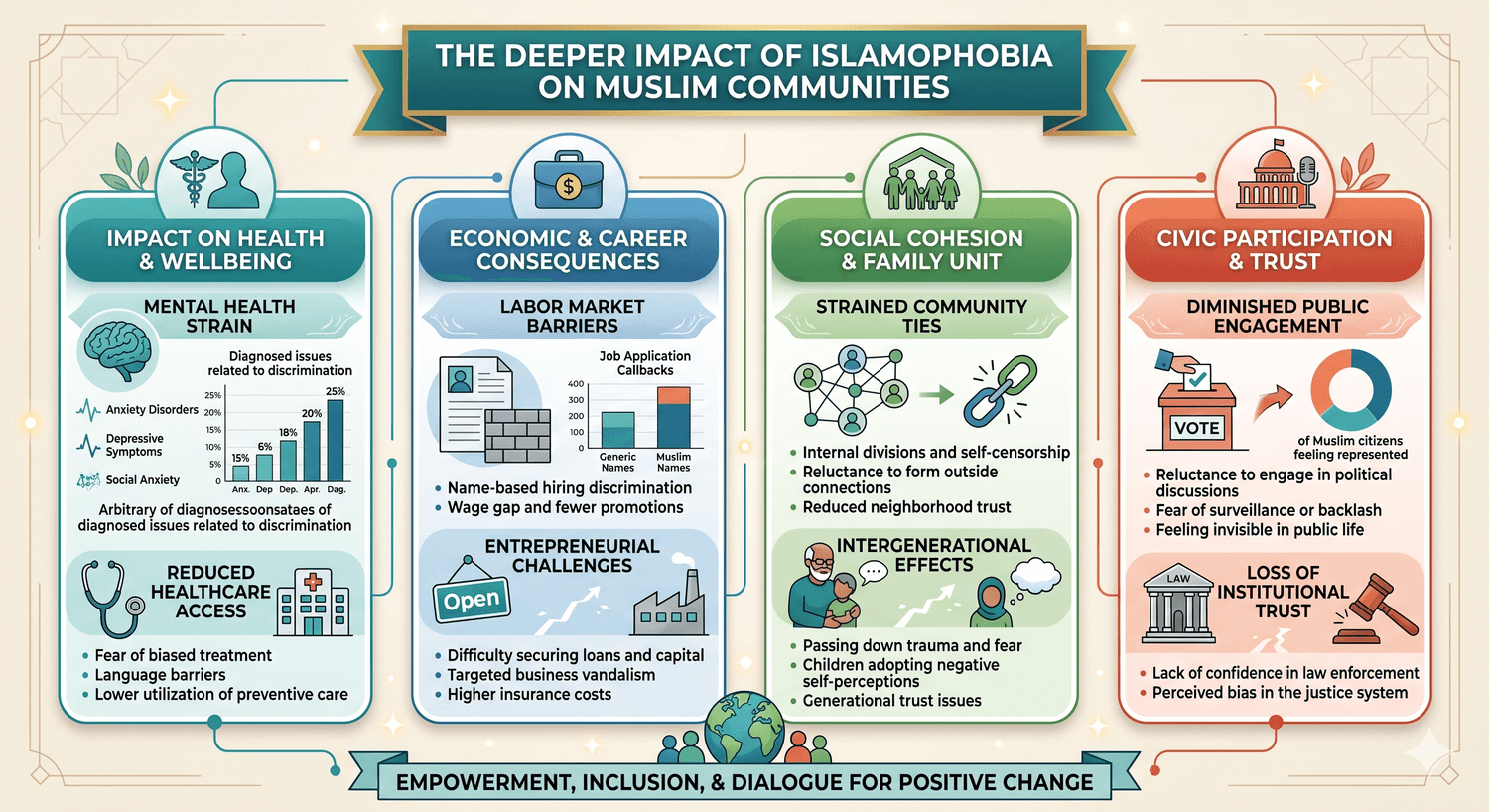
The data on employment discrimination against Muslims is clear and it is consistent: Muslim job applicants, particularly those with visibly Muslim names or who wear religious dress, face measurable disadvantages in hiring.
Studies using resume testing — where identical applications are submitted with different names — have found that applicants with Muslim-sounding names receive significantly fewer callbacks than applicants with non-Muslim names, even when qualifications are identical. In the Netherlands, research found that 73 percent of Muslim women who wore the hijab reported employment discrimination, compared to 11 percent of Muslim women who did not. In the UK, 50 percent of hijab-wearing women said they had missed promotion opportunities because of religious discrimination.
In the United States, employment discrimination complaints made up the single largest category of discrimination reports filed with CAIR in 2024 — the first time that category had topped the list. Muslims report being passed over for promotions, excluded from meetings, denied accommodations for prayer times, and told to remove religious dress as a condition of employment. All of these violate federal law. Most go unreported.
The economic impact of Islamophobia compounds over time. When qualified professionals are systematically excluded from advancement, the effect is not just on those individuals — it is on their families, their communities, and on the broader economy that loses their contributions. It is also a signal: your presence is tolerated but not valued. That signal does not stay at work. It comes home.
The Impact of Islamophobia on Education
Muslim students at every level — from elementary school through graduate programs — report that Islamophobia shapes their educational experience in concrete ways.
At the K-12 level, Muslim students experience bullying, exclusion, and teacher bias at rates higher than most other religious groups studied. Research from CAIR's California surveys documented widespread reports of teachers making anti-Muslim comments, classmates using slurs, and school administrators dismissing complaints. Muslim students describe learning to be strategic about when and where they practice their faith — not praying in visible spaces, not wearing religious clothing certain days, not discussing Ramadan with classmates.
At the university level, the climate shifted dramatically in 2023 and 2024 as campus protests related to the conflict in Gaza led to sweeping disciplinary actions that disproportionately targeted Muslim and Arab students. Law enforcement was called onto campuses at unprecedented levels. Muslim student organizations were suspended. Pro-Palestine student protests — in which many Muslim students participated — were met with arrest, suspension, and expulsion. CAIR documented a 71.5 percent surge in law enforcement encounters in 2024, much of it tied to campus activism.
The impact of Islamophobia on education is also about what is not taught. When school curricula exclude the contributions of Muslim scholars to mathematics, astronomy, medicine, and philosophy, students graduate with a distorted picture of human history. When Muslims are only visible in educational materials as historical aggressors or modern-day threats, Muslim students have no narrative framework for pride in their tradition, and non-Muslim students have no framework for recognizing Muslims as full participants in the human story.
The Impact of Islamophobia on Family Life
The impact of Islamophobia does not stay at work or at school. It enters homes, alters decisions, and reshapes family life in ways that are rarely visible to outsiders.
Muslim families describe making location decisions based partly on safety. Choosing neighborhoods where there are other Muslims, where mosques are accessible, where their children will not be isolated in their faith. Some families have moved cities or states after a discrimination incident made their current environment feel untenable.
Muslim parents describe having "the talk" with their children — not just the general talk about racism that many families of color have, but a specific conversation about what to do if you are targeted for being Muslim. How to respond. When to record. Who to call. Muslim children as young as six and seven years old know, in some form, that their faith makes them a target.
Muslim women describe calculating before they leave the house — whether this is the right day to wear hijab, whether the neighborhood is safe, whether the people around them seem hostile. That calculation is a tax on cognitive and emotional resources that non-Muslims rarely pay.
Research from ISPU found that nearly 80 percent of American Muslims said they feel at least somewhat worried about the safety of their family in the United States. That is not anxiety without cause. It is a rational response to a documented pattern of hostility.
The Impact of Islamophobia on Religious Practice
One of the subtler and more painful impacts of Islamophobia is how it can erode the practice of the faith itself.
When a Muslim man stops making Jumu'ah prayer because the commute from the office leaves him exposed to comments from colleagues who "clock" his absence, that is Islamophobia shaping religious practice. When a Muslim woman leaves her hijab at home during a job interview because she cannot afford another rejection, that is Islamophobia extracting a cost from her faith. When a teenager stops identifying openly as Muslim to survive the school day, that is Islamophobia doing what sustained pressure does — causing retreat.
The Prophet Muhammad, peace be upon him, said that the strong believer is better and more beloved to Allah than the weak believer, and that there is good in both. This is not a hierarchy of blame. It is an acknowledgment that external pressure tests internal conviction, and that maintaining faith under that pressure is itself an act of worship.
But let us be clear about what is happening when Muslims modify their practice to avoid discrimination: they are not being weak. They are surviving a system that was not built with their safety in mind. The moral weight of that belongs to the system, not to the individual making survival decisions.
Why Understanding the Impact of Islamophobia Matters
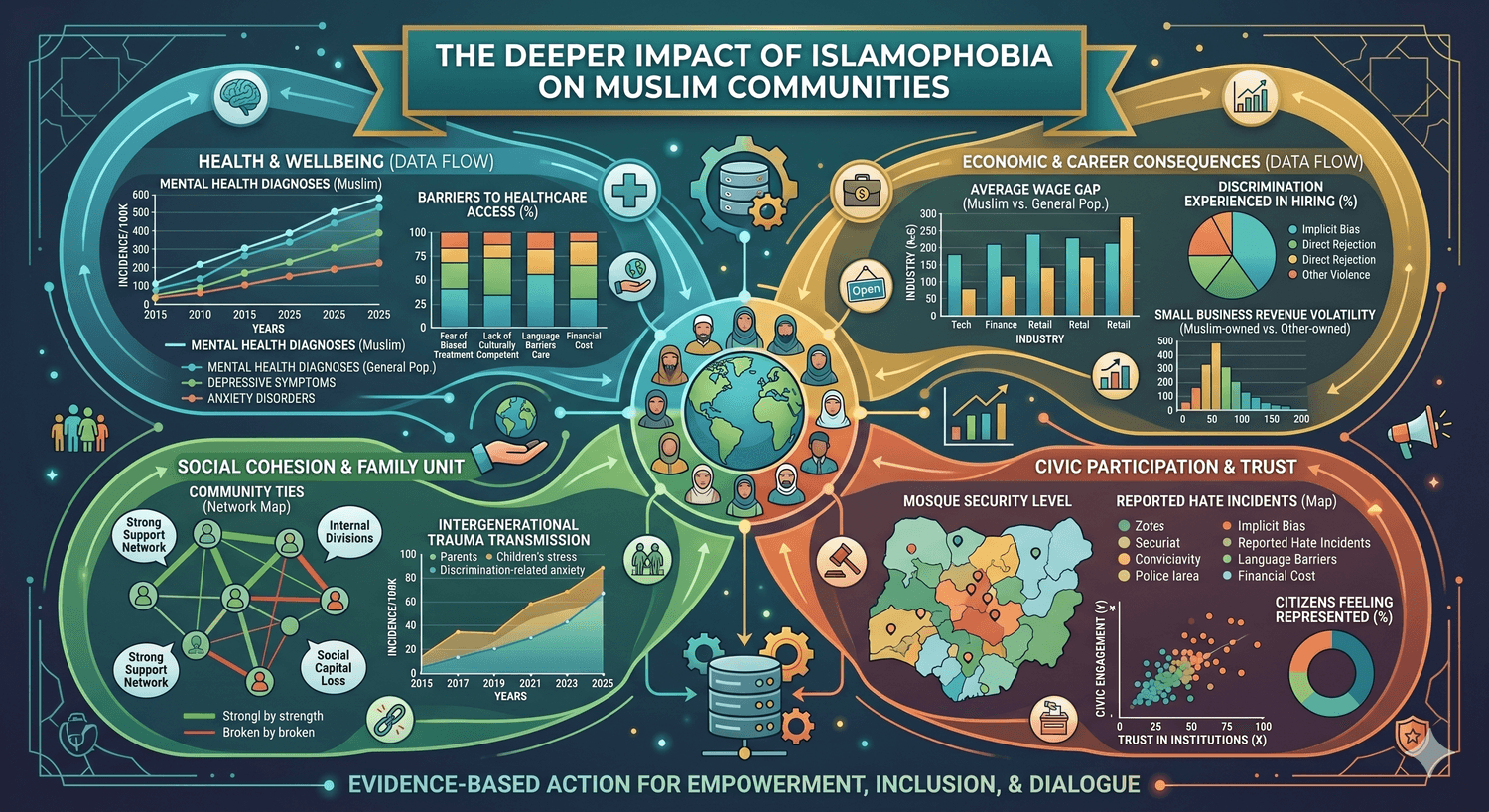
For non-Muslims reading this, the impact of Islamophobia is not a Muslim problem that Muslims need to solve. It is a justice problem that belongs to everyone who believes in the dignity of human beings regardless of faith. When any religious community is systematically excluded from economic opportunity, subjected to surveillance without cause, and taught to hide their identity to be safe — that is a failure of the values most societies claim to hold.
For new Muslims, understanding the impact of Islamophobia means understanding the full weight of the path you are choosing. It is not a path without cost. It is a path with specific costs that are real, documented, and not your fault. Knowing that matters. It is the difference between being blindsided by difficulty and being prepared to meet it with your faith intact.
The Qur'an tells believers that Allah does not burden a soul beyond what it can bear (2:286). This is not a platitude. It is a theological claim about the nature of the tests that believers face — that they are calibrated, and that they are survivable, and that in surviving them something is forged that could not have been forged another way.
The impact of Islamophobia is real. So is the resilience of those who live through it.
To learn more about Islam and build your foundation on solid ground, explore the courses at Start Islam Path. We built them for people who are serious about understanding this faith and everything that comes with it.


