What Is Anti-Muslim Bias and How Does It Affect Muslims?
Get the 109‑page guide delivered to your inbox
Discover the faith that 1.9 billion people live by — and why thousands of truth-seekers just like you are choosing it every single day. This free 109-page guide walks you from curiosity to clarity, step by step.
No pressure. No judgment. No strings attached. Just a clear, honest roadmap written for people who want real answers — whether you're skeptical, curious, confused, or quietly searching for something deeper.
In 2023, the Council on American-Islamic Relations received 8,061 reports of anti-Muslim discrimination and hate incidents. That is the highest number in the organization's 30-year history. It surpassed even the immediate aftermath of September 11, 2001. The number represented a 56 percent increase from the year before, and nearly half of those reports came in the final three months of the year, after the start of the Israel-Hamas war.
These are not abstract statistics. Behind each report is a person: someone harassed at work, threatened on public transport, told they did not belong, or physically attacked because of their religion. Anti-Muslim bias is not a fringe issue happening at the edges of society. For millions of Muslims in the United States and Europe, it is the background noise of ordinary life.
What Anti-Muslim Bias Actually Means
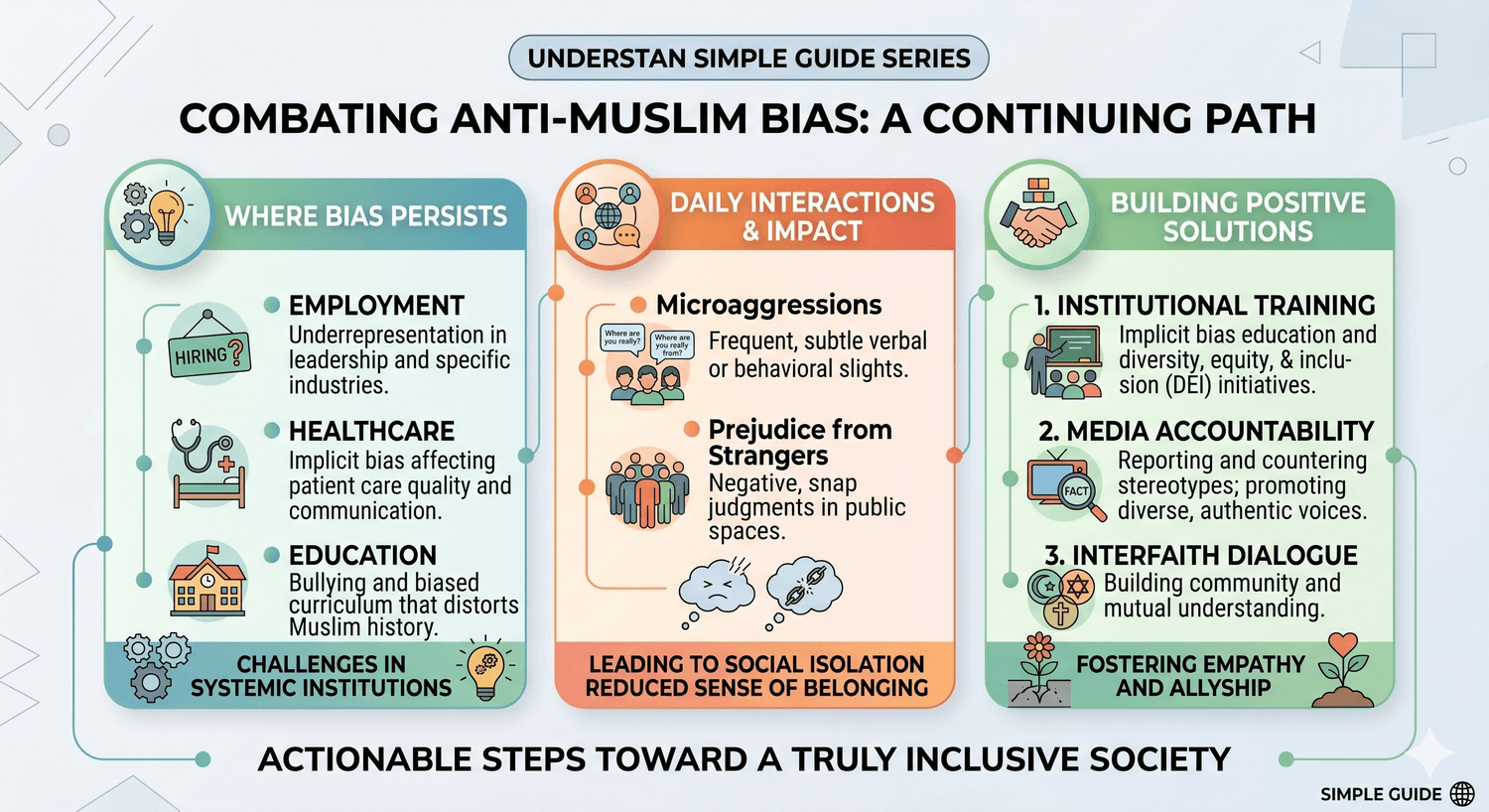
Anti-Muslim bias is the marginalization and mistreatment of people who are Muslim, or who are perceived to be Muslim, based on false beliefs about who Muslims are and what Islam actually teaches. It shows up in obvious forms and in subtle ones. From deliberate hate crimes to assumptions people carry without ever examining them.
It helps to be clear about what anti-Muslim bias is not. Criticizing specific religious doctrines is not the same as targeting people. Disagreeing with an interpretation of Islamic jurisprudence is not the same as treating human beings as threats. Anti-Muslim bias is specifically about treating Muslims as dangerous, inferior, foreign, or suspicious because they are Muslim. Collapsing that distinction shuts down honest conversation and makes the real problem harder to address.
Anti-Muslim bias can be intentional. A person shouting slurs at a woman wearing a hijab knows exactly what they are doing. It can also be unintentional. A hiring manager who unconsciously ranks a candidate with a Muslim name lower, or a teacher who presents Muslims as a monolith with no internal diversity, may not consider themselves biased. The impact is real in either case.
Where Anti-Muslim Bias Comes From
Anti-Muslim bias in modern Western societies did not appear spontaneously. It has specific origins and has been actively constructed over decades. Understanding where it comes from matters because it changes how we respond to it.
How Media Shaped Public Perception of Muslims
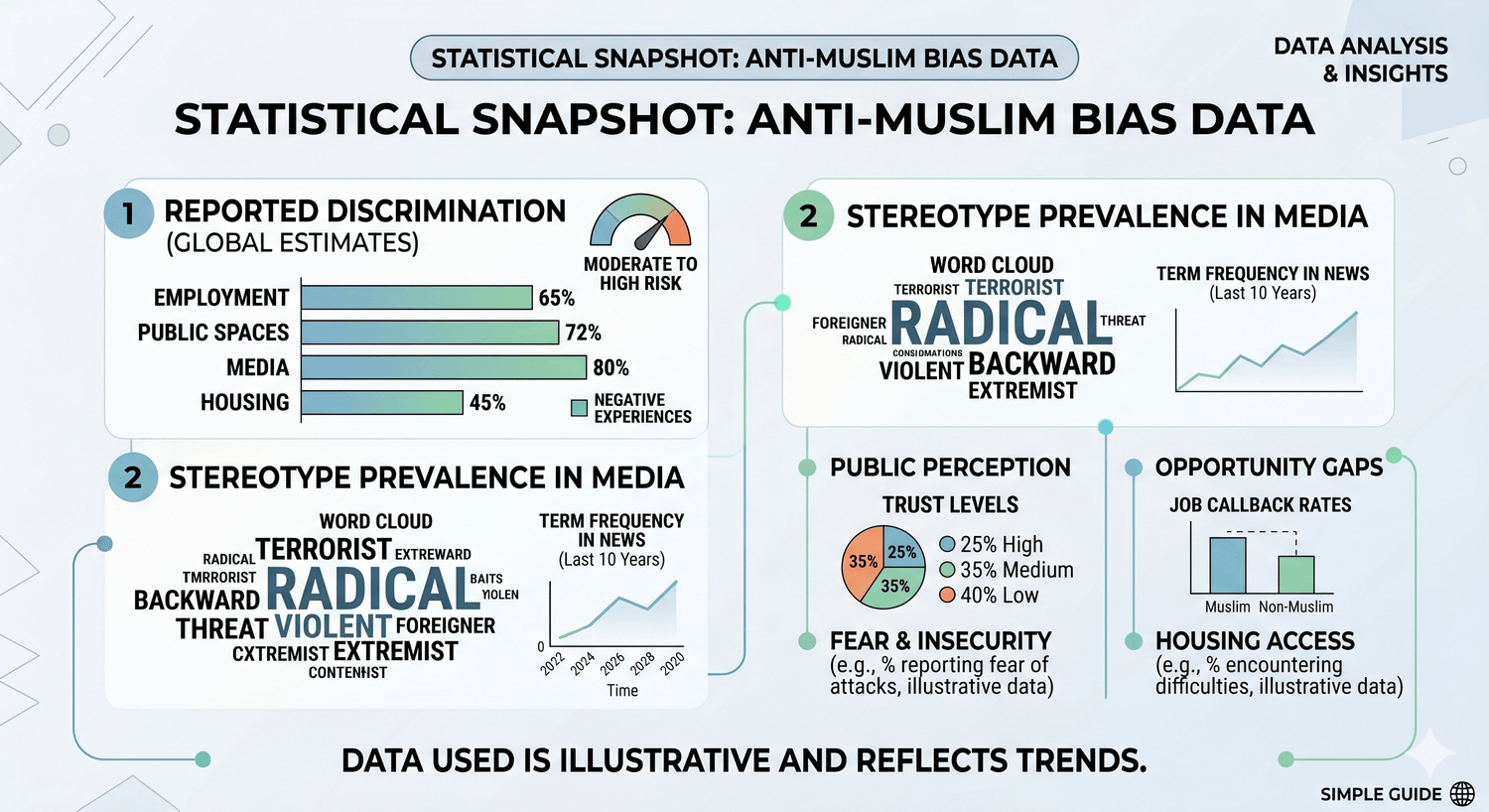
Muslim characters in Western film and television have historically appeared in a narrow set of roles: the terrorist, the oppressed woman, the angry crowd, the fanatic. Research spanning 35 years of coverage by the New York Times and Washington Post found that journalists were significantly more likely to report on Muslim-majority countries when rights violations occurred, while comparable violations in non-Muslim societies received less attention. The cumulative effect is that readers formed associations between Islam and violence without ever consciously deciding to.
Hollywood accelerated this pattern. Films from the 1980s onward used Arab and Muslim characters as stand-in villains. After the Iranian revolution and the 1979 hostage crisis, Americans spent 444 days watching news coverage of Ayatollah Khomeini and his followers. Those images, of bearded men and black turbans, became the visual vocabulary through which an entire generation learned to picture Muslim identity. That image preceded Osama Bin Laden by two decades.
After September 11, a deliberate network of organizations formed with the specific goal of producing anti-Muslim content and lobbying for anti-Muslim policy. Groups led by figures like Pamela Geller and Robert Spencer built large audiences by arguing that Islam is not a religion but a dangerous political ideology incompatible with Western democracy. The Southern Poverty Law Center tracked 31 active anti-Muslim hate groups in the United States in 2024.
Political Rhetoric and Real Consequences
Research found a direct statistical correlation between anti-Muslim statements from then-candidate Donald Trump during the 2015 and 2016 campaign season and the number of anti-Muslim hate crimes in the days that followed. This is not a statement about one politician. It is a documented pattern: when public figures use dehumanizing language about a group, violence against that group increases. Anti-Muslim bias does not exist only in private hearts. It feeds on the signals that political environments send.
How Anti-Muslim Bias Shows Up Every Day
In the Workplace
A Muslim woman who wears the hijab faces discrimination in hiring at measurably higher rates than candidates without visible religious markers. A man with a Muslim name on his resume receives fewer callbacks than an identical resume with a non-Muslim name, even when skills and experience are equivalent. These patterns have been confirmed in multiple studies across the United States and Europe.
The majority of workplace discrimination complaints filed with CAIR in 2023 involved employees being denied basic religious accommodations: time off for Friday prayer, a space to pray, or the right to wear religious clothing. These are legally protected rights in most countries. But the process of claiming them often requires Muslim employees to fight battles that other workers never encounter.
In Schools
Muslim students report harassment from both peers and, in some cases, teachers. Being called a terrorist. Being asked to personally account for attacks carried out by strangers halfway around the world. Being told their religion is primitive. These are common enough experiences that they affect learning, belonging, and mental health in measurable ways.
CAIR's 2023 report specifically noted that children and students were disproportionately affected by the Islamophobia spike that followed October 7, 2023. The most widely reported example was the murder of Wadea Al-Fayoume, a six-year-old Palestinian American boy in Illinois, stabbed 26 times by his family's landlord while the attacker shouted anti-Muslim slurs. A six-year-old.
In Public Spaces
Women who wear the hijab carry a particular exposure to anti-Muslim bias in public. Headscarves are pulled off on buses and trains. Women are told to go back where they came from, followed through shopping centers, and subjected to unsolicited lectures about their own liberation. Data from the Tell MAMA organization in the UK found that 61 percent of Islamophobic incidents in 2015 targeted women, and 75 percent of those victims were visibly Muslim.
Mosques in the United States and Europe have been vandalized, bombed, and set on fire. In 2019, a gunman killed 51 people during Friday prayers at a mosque in Christchurch, New Zealand, and live-streamed the attack. The victims were people gathered for the same act of worship Muslims perform every Friday across the world.
The Real Cost of Anti-Muslim Bias
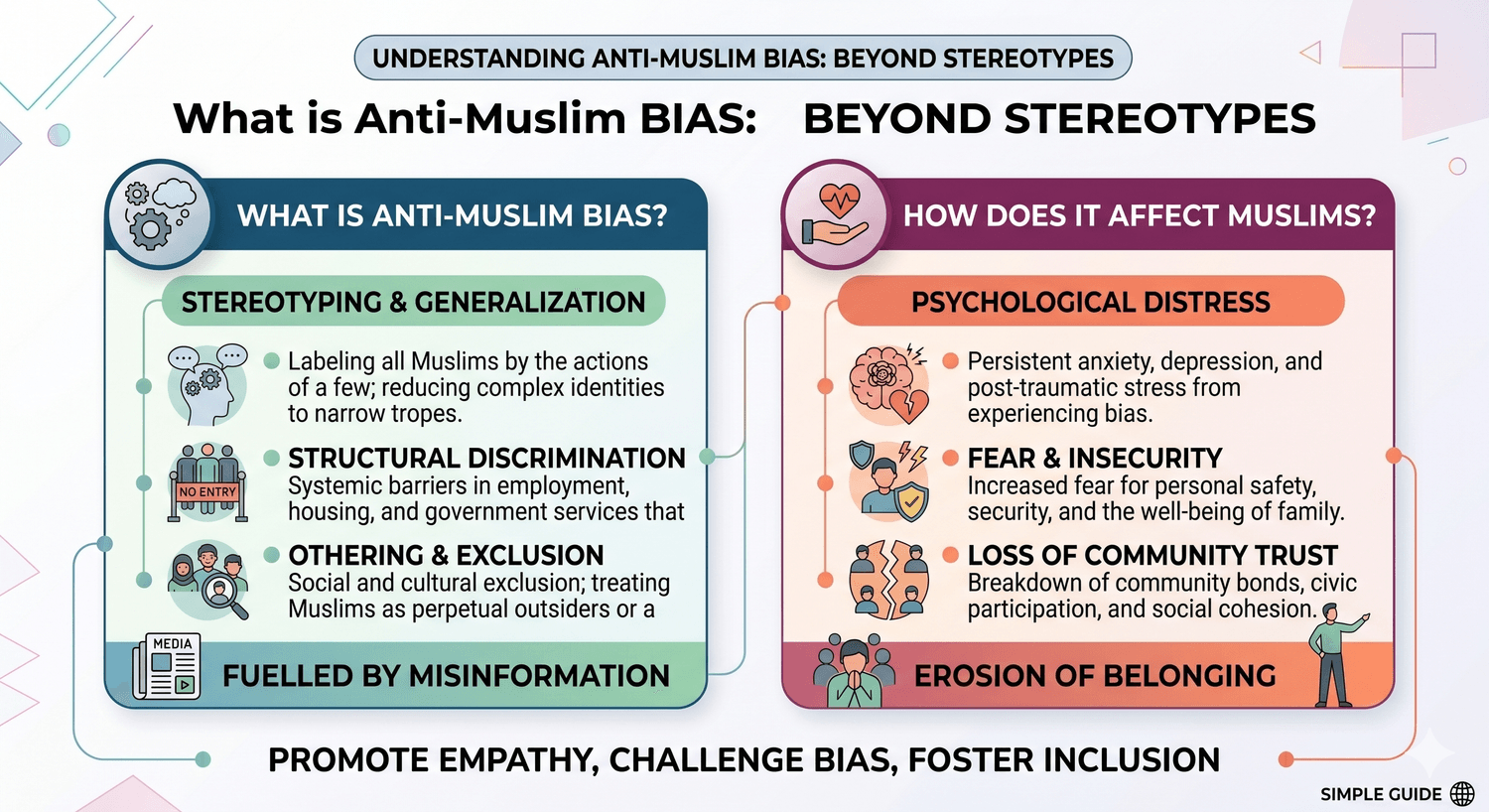
Anti-Muslim bias is not only a political problem. It is a health problem. Research consistently documents that Muslims who experience discrimination show higher rates of depression, anxiety, and post-traumatic stress. Children who grow up under constant suspicion absorb the message over time. Some distance themselves from their religious identity to reduce risk. Some stop wearing traditional dress. Some change their names. Many carry a chronic awareness of how they appear to others that becomes a permanent part of how they move through the world.
This is not weakness. It is the predictable response of a human being to a sustained, low-grade threat environment. And it has costs that extend beyond the individual: communities that feel under constant suspicion turn inward, which makes the misunderstanding deeper for everyone.
What You Can Do About Anti-Muslim Bias
The United Nations has stated clearly that combating anti-Muslim bias requires governments to protect religious freedom, online platforms to address hate speech, and ordinary individuals to push back against bigotry in their own circles. All three are true. The piece any individual has the most direct access to is the last one.
If you are not Muslim, start by examining where your assumptions about Muslims and Islam actually came from. A news cycle? A film? A political speech? Have you ever had a real conversation with a Muslim person about their faith? The gap between what many people think Islam is and what Muslims actually practice is large, and anti-Muslim bias thrives in that gap.
If you are exploring Islam or are a new Muslim, knowing that anti-Muslim bias exists protects you from mistaking the ignorance of strangers for a reflection of the faith itself. What many people are hostile toward is not Islam. It is a distorted version of Islam that they have never actually encountered. The real thing, the living, diverse, globally practiced faith, is worth knowing on its own terms.


