Islam and the Gig Economy: What Your Faith Says About Freelance Work
Get the 109‑page guide delivered to your inbox
Discover the faith that 1.9 billion people live by — and why thousands of truth-seekers just like you are choosing it every single day. This free 109-page guide walks you from curiosity to clarity, step by step.
No pressure. No judgment. No strings attached. Just a clear, honest roadmap written for people who want real answers — whether you're skeptical, curious, confused, or quietly searching for something deeper.
There is a good chance that someone you know — maybe you yourself — earns a living in the gig economy. A graphic designer picking up projects on Fiverr. A driver navigating the city for Uber. A writer delivering content for a dozen different clients who will never know their name. A tutor teaching students in Singapore from a room in Cairo.
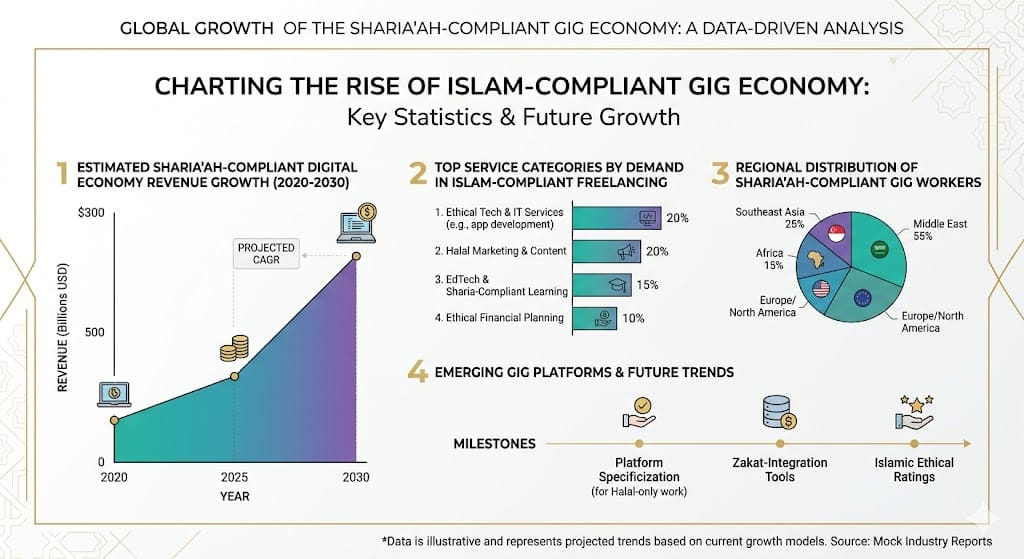
By some estimates, over 1.5 billion people globally participate in some form of gig work. In Muslim-majority countries, where youth unemployment runs high and digital connectivity has outpaced formal job creation, the gig economy has become a serious economic option for millions of people.
So what does Islam say about this? The question of Islam and the gig economy turns out to be well-addressed by a tradition that was built around trade, independent labor, and commercial ethics long before the word "freelance" existed.
Islam and the Gig Economy: The Prophet ﷺ Was in the Gig Economy
This is not a stretch. The Prophet Muhammad ﷺ, before the revelation began, was a merchant. He worked in trade, managing goods on behalf of Khadijah رضي الله عنها before they married. He was, in modern terms, an independent contractor — skilled, trustworthy, and paid for specific work rather than employed in a fixed arrangement.
The Prophet ﷺ praised a particular kind of labor with his own hands: "The best of earnings is from a man's own hand, provided he acts with sincerity." He also said: "The trustworthy merchant will be with the prophets, the truthful, and the martyrs." These statements were not made in the context of salaried employment. They were made about the kind of transactional, project-based work that gig workers recognize immediately.
Islam does not have a preference for one economic arrangement over another — permanent employment versus freelance, in-person versus remote. What it has is a set of ethical principles that apply across all arrangements. Islam and the gig economy, then, is really a question of how those principles map onto a new set of platforms and contracts.
Is Gig Work Halal?
The short answer, from scholars including Sheikh Yusuf al-Qaradawi and institutions like the Islamic Organization for Medical Sciences, is that the nature of the work determines its permissibility, not the employment structure itself.
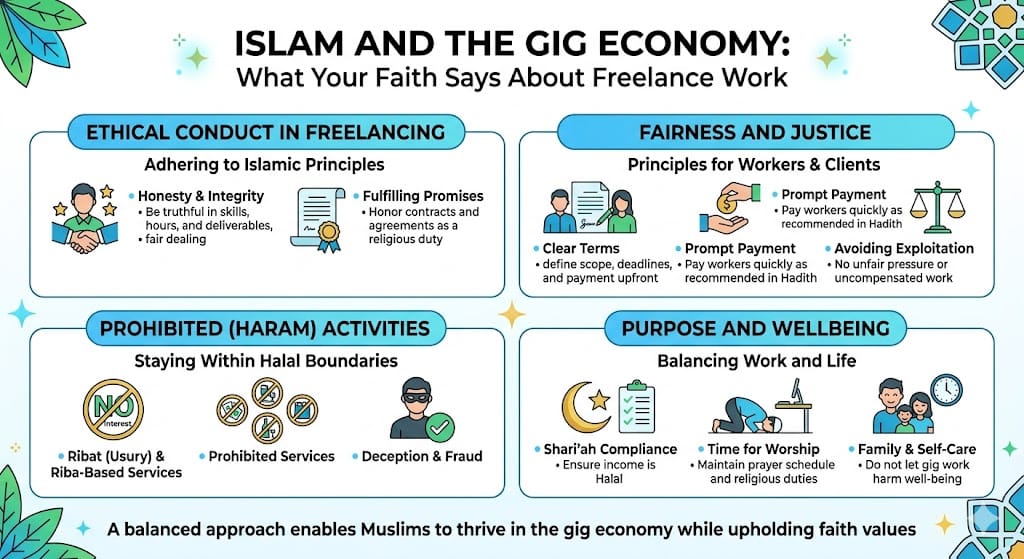
Working as a freelancer for a software company is not inherently different, in Islamic terms, from being hired by that company permanently. What matters is whether the work itself is permissible, whether the contract is honest and clear, and whether wages are paid fairly and promptly.
The Islamic concept that governs independent contracted labor is ijarah al-amal — the rental of work or service. You are, in effect, renting your skill and time to a client in exchange for payment. This is a well-established category of Islamic commercial law. The conditions for a valid ijarah contract are simple: the work must be clearly specified, the payment must be known and agreed upon, and neither party should be deceived.
If those conditions are met, and the work itself is permissible, gig work is halal. A Muslim graphic designer, web developer, content writer, translator, tutor, or logistics worker operating in the gig economy is doing nothing that Islam objects to. The Quran says: "Allah has permitted trade." (Quran 2:275) That permission is broad, not narrow.
What Makes Gig Work Haram
Since the principle in Islamic jurisprudence is that permissibility is the default, the more useful question is: what makes gig work impermissible?
The clearest category is work that produces something forbidden. A Muslim should not take on freelance work designing logos for alcohol brands, creating content that promotes gambling, writing copy for interest-based financial products, or producing adult content. The prohibition on these activities does not change because the work is freelance rather than salaried. You are still contributing to something Islam forbids.
There is also the question of honesty in the work itself. If a client hires you to write reviews, and those reviews are fabricated, the work is dishonest regardless of the platform. The Prophet ﷺ said: "Leave what makes you doubt for what does not make you doubt." This applies to writing that misleads, to data that is manipulated, and to any professional service where the client is being given something other than what they contracted for.
Social media buzzers — people paid to promote a product or political position without disclosing that they are being paid — present a specific case. Islamic scholars who have examined this category have generally found it permissible only when the content is truthful and the arrangement is disclosed. Paid promotion that misleads the audience violates the Islamic prohibition on deception, regardless of how minor the individual deception seems.
Fair Pay and the Muslim Freelancer
One of the most frequently overlooked Islamic principles in gig work is the right of workers to timely, fair payment. The Prophet ﷺ said: "Give the worker his wages before his sweat dries." This is not metaphorical. It is a direct instruction about how quickly payment should follow completed work — and it was delivered in a 7th-century context where the same delayed-payment dynamics that gig workers face today were already causing harm to laborers.
Platforms like Upwork, Fiverr, and Toptal hold payment in escrow and release it after work is approved. For many Muslim freelancers, this is an acceptable arrangement — the worker has assurance of payment, and the client has assurance of delivery. The question to ask is whether the payment terms are clearly communicated before work begins, and whether the platform structure allows for the kind of prompt, fair payment the Islamic tradition requires.
If a client consistently delays payment, reduces it without justification, or changes the scope of work after agreement, these are not just business inconveniences. They are violations of the trust that the Islamic commercial framework places at the center of every transaction.
Islam and the Gig Economy: The Spiritual Dimension of Work
There is something in the gig economy's structure that Muslims should pay attention to, beyond the jurisprudential checklist. The gig economy, at its best, gives workers flexibility, autonomy, and the ability to earn in ways that fit around prayer times, Ramadan, and family obligations. These are not trivial benefits.
At its worst, the gig economy strips workers of protections, creates constant economic anxiety, and trains people to see their time purely in terms of billable units. Islam and the gig economy collide most sharply here, because Islam does not view work as the primary purpose of a human being.
The Quran says: "I have not created jinn and mankind except to worship Me." (Quran 51:56) Work is a means. It is how you care for your family, contribute to your community, and occupy the time Allah gave you in a productive way. It is not the answer to the question of who you are or what your life is for. A gig worker who is so absorbed in chasing income that prayer becomes a disruption, family becomes a secondary consideration, and their own spiritual state is perpetually deferred — that worker has adopted the gig economy's worst values without realizing it.
The Prophet ﷺ said: "The best of deeds is the one done consistently, even if it is small." Consistent prayer. Consistent family engagement. Consistent giving. These are not possible if work expands to fill every available hour. The flexibility the gig economy offers can be used to protect these obligations — or to abandon them.
Practical Guidelines for Muslim Gig Workers
If you are navigating the gig economy as a Muslim, or considering it, here is what the Islamic tradition offers as practical guidance:
Choose work whose content you can stand behind before Allah. If you would be uncomfortable describing the work to your imam or your parents, that discomfort is worth examining. Work that is permitted is broad. There is almost always a permissible alternative.
Be transparent with your clients. State clearly what you can deliver, when, and for what price. The Prophet ﷺ said: "The two parties to a transaction have the right to annul it as long as they have not separated, and if they are honest and make things clear, they will be blessed in their transaction." If you cannot meet a deadline, say so early. If the scope has changed and the price needs to change with it, negotiate openly.
Protect your prayer times. Gig work does not have a manager telling you when to log off. That makes it easy to let a deadline push you through Dhuhr and then Asr. Your prayer is not negotiable. It is the framework your day is built around, not an interruption to your work.
Pay your zakat on earnings. If your gig income reaches the nisab threshold — approximately the value of 85 grams of gold — zakat applies. Many gig workers overlook this because their income feels informal or irregular. The obligation is not affected by the formality of the arrangement.
Conclusion: Islam and the Gig Economy Call for Moral Clarity in a New Context
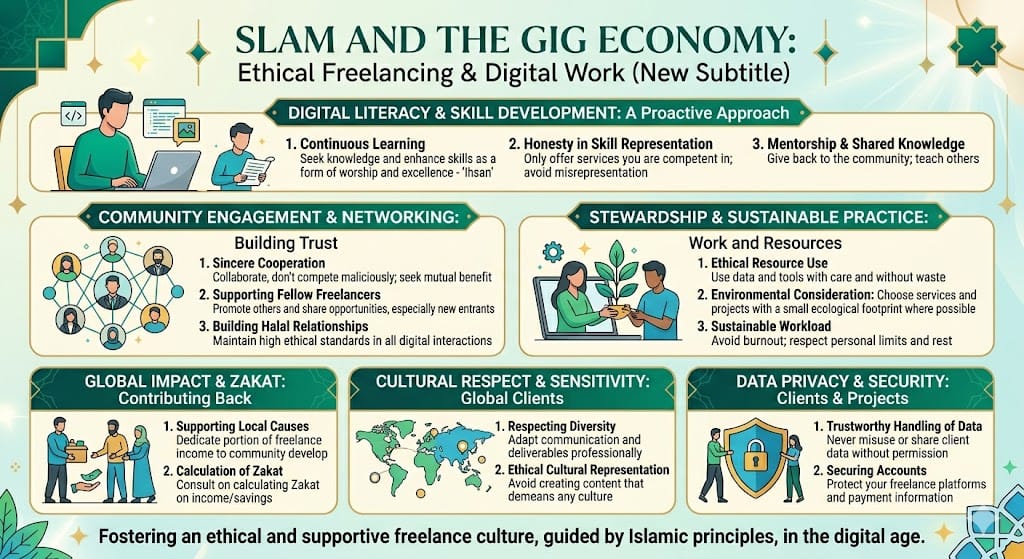
Islam and the gig economy are not in conflict. The Islamic tradition has the conceptual tools to engage with freelance work, platform-based labor, and independent contracting — because it was built, in part, by traders and craftsmen who operated in exactly that kind of economic environment.
What Islam asks of the Muslim gig worker is the same thing it asks in every economic context: be honest, do work that is permitted, pay and be paid fairly, and do not let earning money become the purpose of your life.
The gig economy will keep growing. Platforms will come and go. But the principle the Prophet ﷺ left does not change: "A person's earnings from the labor of his own hands is the best of earnings." Put your hands to work that is honest, and keep your heart oriented toward the One who provides.
Ready to understand how Islam speaks to your actual life — your work, your finances, your daily choices? Start Islam Path offers courses designed for people exactly where you are, at whatever stage of your journey with Islam.


