New Muslim Guide: Everything You Need to Know After Converting
Get the 109‑page guide delivered to your inbox
Discover the faith that 1.9 billion people live by — and why thousands of truth-seekers just like you are choosing it every single day. This free 109-page guide walks you from curiosity to clarity, step by step.
No pressure. No judgment. No strings attached. Just a clear, honest roadmap written for people who want real answers — whether you're skeptical, curious, confused, or quietly searching for something deeper.
Taking the Shahada is the most significant moment of your life — and then everyone disappears. The mosque celebration ends, the congratulations fade, and you are left standing alone with a faith you have just committed to and very little idea of what to do next. This guide exists for that exact moment. This New Muslim Guide covers everything a new Muslim needs to know in the weeks, months, and first year after converting — from the immediate practical steps to the long-term spiritual foundation.
New Muslim Guide: The First 24 Hours After Taking the Shahada
The moment you say the Shahada sincerely, three things happen simultaneously in Islamic theology:
All previous sins are completely forgiven — you begin with an entirely clean slate
You become part of the global Muslim community (ummah) of 1.9 billion
The journey begins
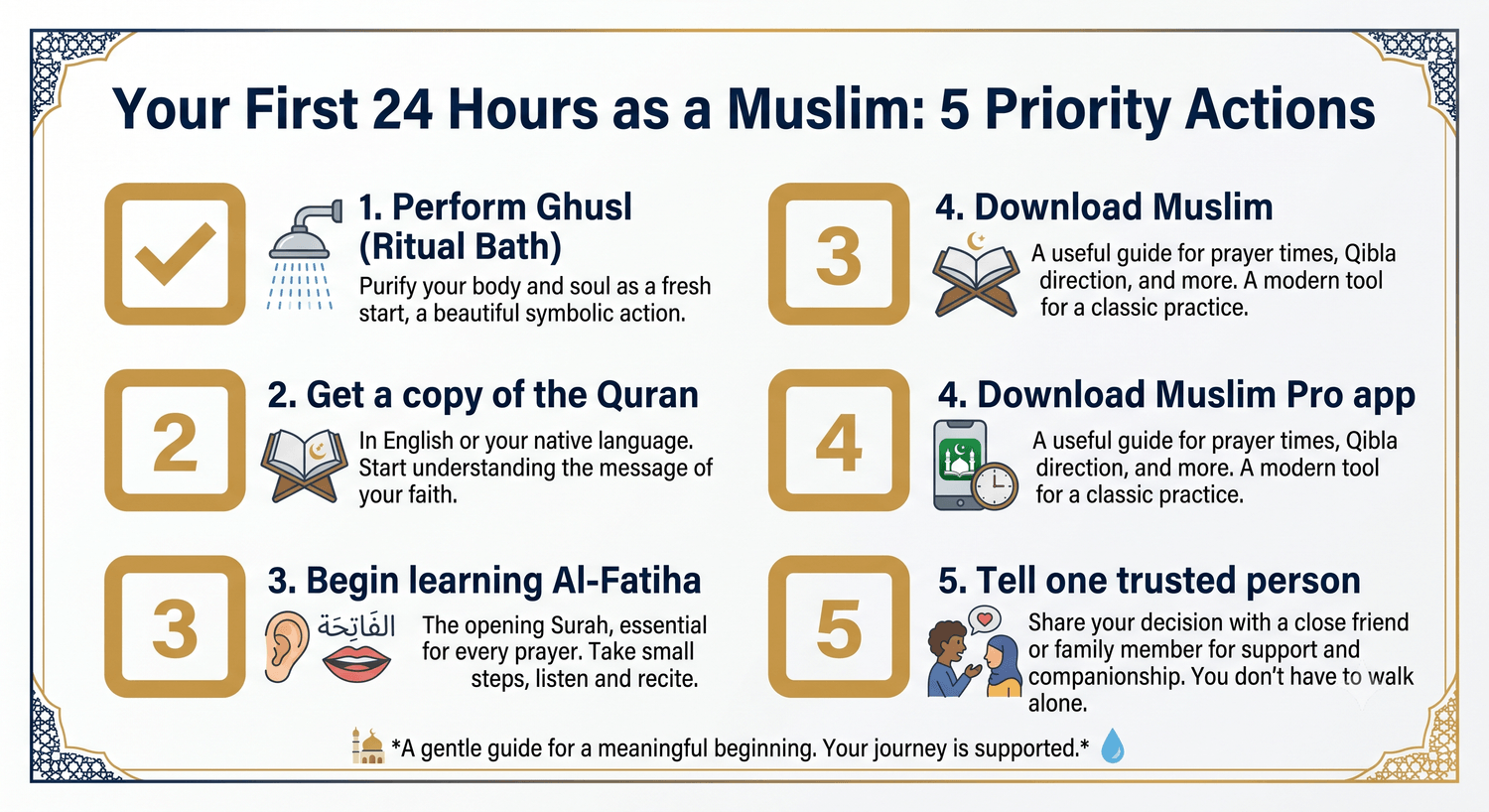
Here is what to do in your first 24 hours as a Muslim:
1. Perform Ghusl (ritual purification bath) A full-body ritual bath is recommended after conversion. It is a symbolic and spiritual cleansing — the physical manifestation of the new beginning that has just taken place.
2. Obtain a copy of the Quran in English You do not need Arabic yet. Get The Clear Quran by Dr. Mustafa Khattab — the most accessible modern English translation. Begin with Surah Al-Fatiha (Chapter 1) and Surah Al-Ikhlas (Chapter 112).
3. Begin learning Al-Fatiha Al-Fatiha is recited in every rakat of every prayer. Learning it is your first practical step toward Salah. Use phonetic transliteration if needed — there is no shame in learning step by step.
4. Download Muslim Pro or Athan app These apps give you accurate prayer times for your location, a Qibla compass, and basic Islamic reference content. Essential tools for a new Muslim's phone.
5. Tell one person you trust You do not have to announce your conversion to the world. But having one person who knows — a Muslim friend, a convert support group, or an online community — grounds your new identity in real connection.
Your First Week as a Muslim: Priorities
Do not try to transform your entire life in seven days. Islam was not revealed all at once — it came gradually over 23 years. The same principle applies to you: build one practice at a time, build it solidly, then add the next.
Priority 1: Learn to pray Salah is the first pillar to implement after Shahada. Begin with Fajr (dawn prayer) and Maghrib (sunset prayer) — two of the five daily prayers. Learn the movements and recitations in stages. Imperfect prayer offered consistently is worth more than perfect prayer never attempted.
Priority 2: Stop what Islam prohibits The most obvious prohibitions — alcohol, pork, sexual relations outside of marriage — should be stopped immediately. Do not try to address every grey area at once. Start with the clear ones.
Priority 3: Introduce yourself to the local Muslim community Visit a mosque. Attend Friday Jumu'ah prayer. Introduce yourself as a new Muslim. Most Muslim communities are extraordinarily warm toward converts — and you need community more than you realize right now.
Priority 4: Find a learning resource You need a structured source of Islamic knowledge — not random Google searches that lead to contradictory information. A book, a course, or a qualified teacher. This is not optional.
Priority 5: Be patient with yourself You will make mistakes. You will forget prayers. You will eat something and realize afterward it wasn't halal. None of this undoes your Islam. Repentance (tawbah) is always available. God's mercy is always wider than your mistakes.
Building Your Five Daily Prayers
Prayer is the most consistent transformative practice in Islamic life. Miss it consistently and your faith weakens. Protect it and your entire spiritual life becomes anchored.
The 5 Daily Prayers
Prayer
Time
Rakats
Fajr
Before sunrise
2
Dhuhr
After midday
4
Asr
Afternoon
4
Maghrib
After sunset
3
Isha
Night
4
A Realistic Prayer Plan for New Muslims
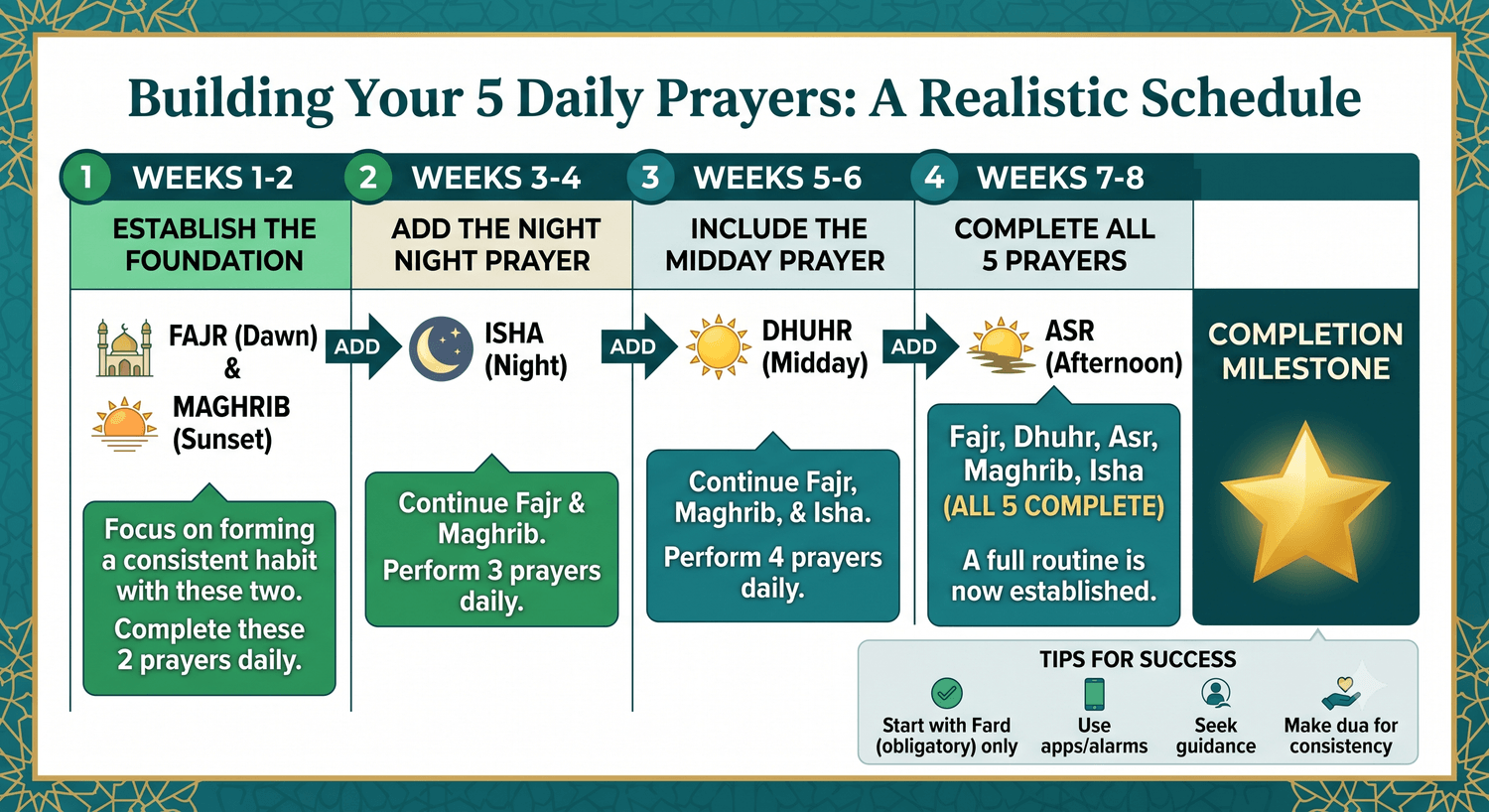
Week 1–2: Learn and pray Fajr and Maghrib consistently. Week 3–4: Add Isha to your established Fajr and Maghrib routine. Week 5–6: Add Dhuhr — set a midday alarm to remind you. Week 7–8: Add Asr — the afternoon prayer, which is easiest to miss during busy workdays. Month 3: All 5 prayers established as daily non-negotiables.
This gradual approach is more sustainable than forcing all 5 prayers from day one and collapsing under the pressure after two weeks.
How to Never Miss a Prayer
Set a dedicated alarm for each prayer time with the prayer name as the alarm label
Keep a prayer rug in a permanent, visible location at home and at work
When you cannot pray at the exact time, pray as soon as you can — do not skip it
Use the mosque for Jumu'ah (Friday prayer) weekly — community prayer is enormously motivating
Learning to Read the Quran
Your relationship with the Quran will be the most spiritually defining element of your Islamic life. It is not a book you read once — it is a book you live with for the rest of your life.
Where to Start
As a new Muslim, begin with:
Surah Al-Fatiha (Chapter 1) — recited in every prayer, learn it first
Surah Al-Ikhlas (Chapter 112) — a three-verse declaration of God's oneness, the most frequently recited chapter
Surah Al-Falaq (Chapter 113) and Surah An-Nas (Chapter 114) — short, powerful chapters for seeking God's protection
Juz Amma (the 30th section, Chapters 78–114) — the shortest chapters, ideal for new learners
Which Translation to Use
The Clear Quran by Dr. Mustafa Khattab — Best for beginners. Modern English, highly readable.
Saheeh International — Precise and widely trusted. Slightly more formal language.
Avoid translations that use archaic "thee/thou" language — they make the Quran unnecessarily difficult.
Building a Quran Habit
Ten minutes daily, consistently, is worth more than an hour once a week. The best time, according to Islamic tradition, is after Fajr prayer — early morning carries a spiritual clarity that makes Quran reading especially powerful.
Use a physical Quran with the Arabic text alongside the English translation. Even if you cannot read Arabic yet, having the original text present builds familiarity over time.
Understanding Islamic Law: What Is Halal and Haram?
Islam provides clear guidance on what is permitted (halal) and what is prohibited (haram). As a new Muslim, you do not need to master Islamic jurisprudence immediately — but you need to understand the basics.
Food
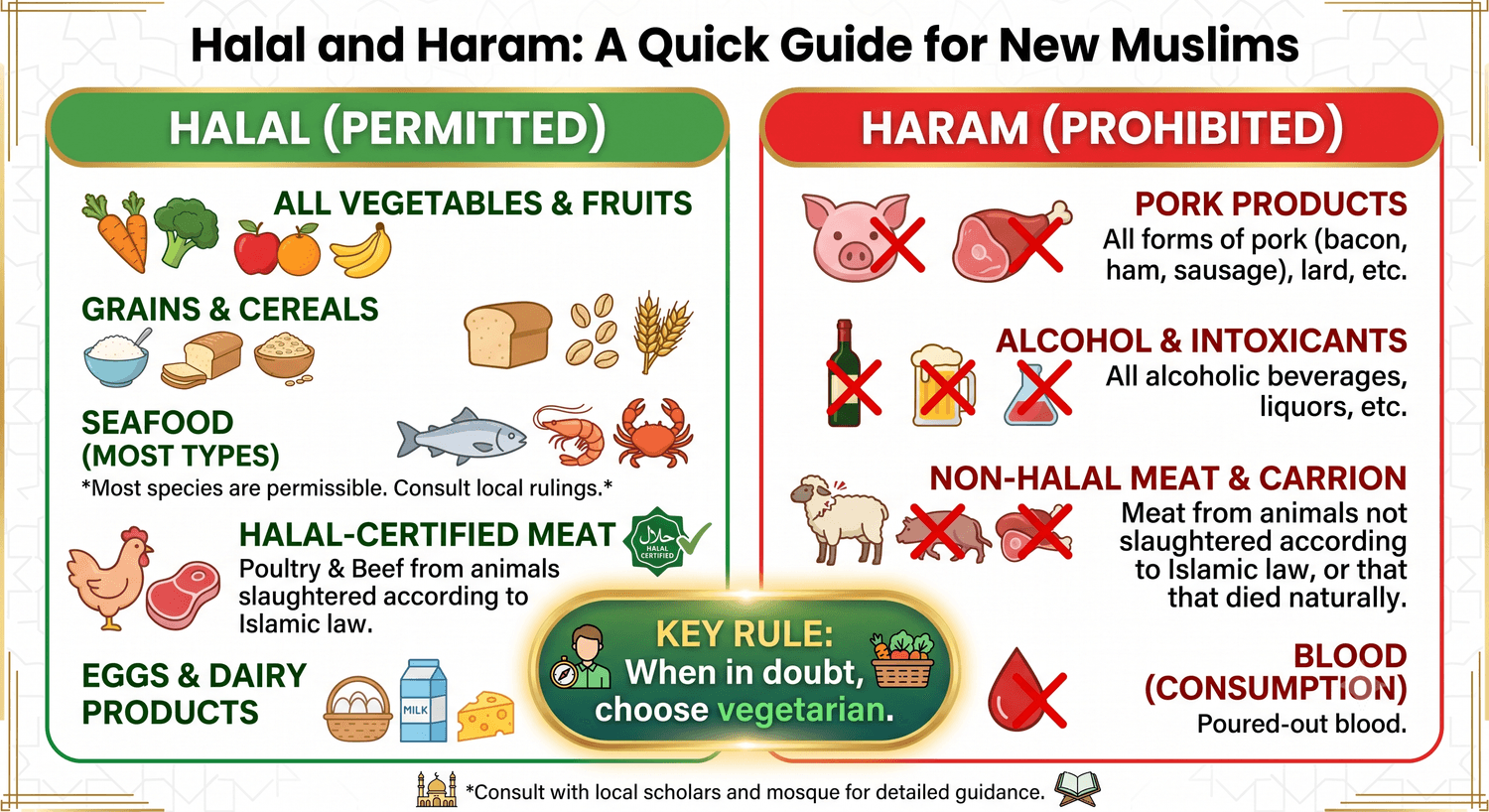
Halal:
All vegetables, fruits, grains, legumes
Seafood (fish, shellfish — with some scholarly differences)
Meat slaughtered according to Islamic guidelines (animals slaughtered by a Muslim, Christian, or Jew, with the name of God mentioned)
Eggs, dairy
Haram:
Pork and all pork products (including gelatin from pork, lard, etc.)
Alcohol and intoxicants
Meat slaughtered without mentioning the name of God
Blood
Predatory animals and birds with talons
Practical approach: Look for halal certification on packaged foods. Eat vegetarian or seafood options when halal meat is not available. Avoid alcohol in all forms — including cooking wine and food prepared with alcohol.
Financial Ethics
Islam prohibits riba — interest-based transactions. This is a complex area with many scholarly opinions on how it applies to mortgages, credit cards, and conventional banking in non-Muslim countries. For a new Muslim, the priority is awareness, not immediate resolution. Consult a knowledgeable Islamic scholar for guidance specific to your situation.
Relationships
Islam prohibits sexual relations outside of marriage. Dating in the Western sense — physical relationships with no commitment — is not compatible with Islamic ethics. This is one of the areas where Islamic values most visibly differ from secular Western norms, and it is an area where new Muslims often need the most support and clarity.
Navigating Social Challenges as a New Muslim
The social dimension of conversion is often the hardest. The faith itself makes sense to you — but the world around you has not changed.
Telling Your Family
There is no obligation to announce your conversion immediately. Many new Muslims practice privately for weeks or months before telling family members. When you do tell them:
Lead with love, not confrontation
Expect initial confusion or resistance — it usually comes from fear, not malice
Let your character speak: be more patient, more honest, more present than you were before
Give them time — most families come around when they see Islam has made you better, not worse
Dealing with Friends Who Don't Understand
Some friendships will deepen after you convert. Others will require renegotiation. Friends who respected you before will respect your faith if you carry it with confidence and without self-righteousness. Friends who only valued you in contexts that are now incompatible with your faith (bar nights, etc.) may naturally drift — and that is okay.
Workplace and Social Settings
You are not obligated to announce your faith at work
When alcohol is offered at social events, a simple "No thank you, I don't drink" requires no explanation
Prayer accommodation at work: most countries have legal provisions for religious practice. A quiet corner for 5-minute prayer breaks is a reasonable accommodation to request.
Ramadan fasting at work is manageable with slight scheduling adjustments — many non-Muslim colleagues are curious and respectful once they understand what Ramadan is.
Islamophobia and Ignorance
You will encounter people with misconceptions about Islam. Your response matters:
Do not argue — demonstrate
Answer sincere questions with patience and information
Ignore bad-faith provocation
Remember: every Muslim who lives their faith with integrity is a form of da'wah (invitation)
The Emotional Reality of Conversion
No one talks about this enough: conversion to Islam is emotionally complex. It is not only joy and clarity — though there is plenty of that. It is also:
Spiritual euphoria followed by ordinary days. The initial high of conversion — the clarity, the peace, the sense of arriving home — does not last at the same intensity forever. This is normal. Faith is a practice, not a feeling.
Loneliness. Especially if you are converting without a Muslim support network. The solution is community — find it actively, even if it requires effort.
Doubt. Questions will come, sometimes at unexpected moments. Doubt is not the opposite of faith — it is part of honest faith. Islam does not ask you to suppress doubt but to seek knowledge in response to it.
Overwhelm. There is so much to learn. The temptation is to either rush everything or abandon the effort entirely. Neither is the answer. One practice at a time, built with consistency.
Identity reconstruction. Your self-concept is changing. This is profound and disorienting, even when it is also liberating. Give yourself grace during this period.
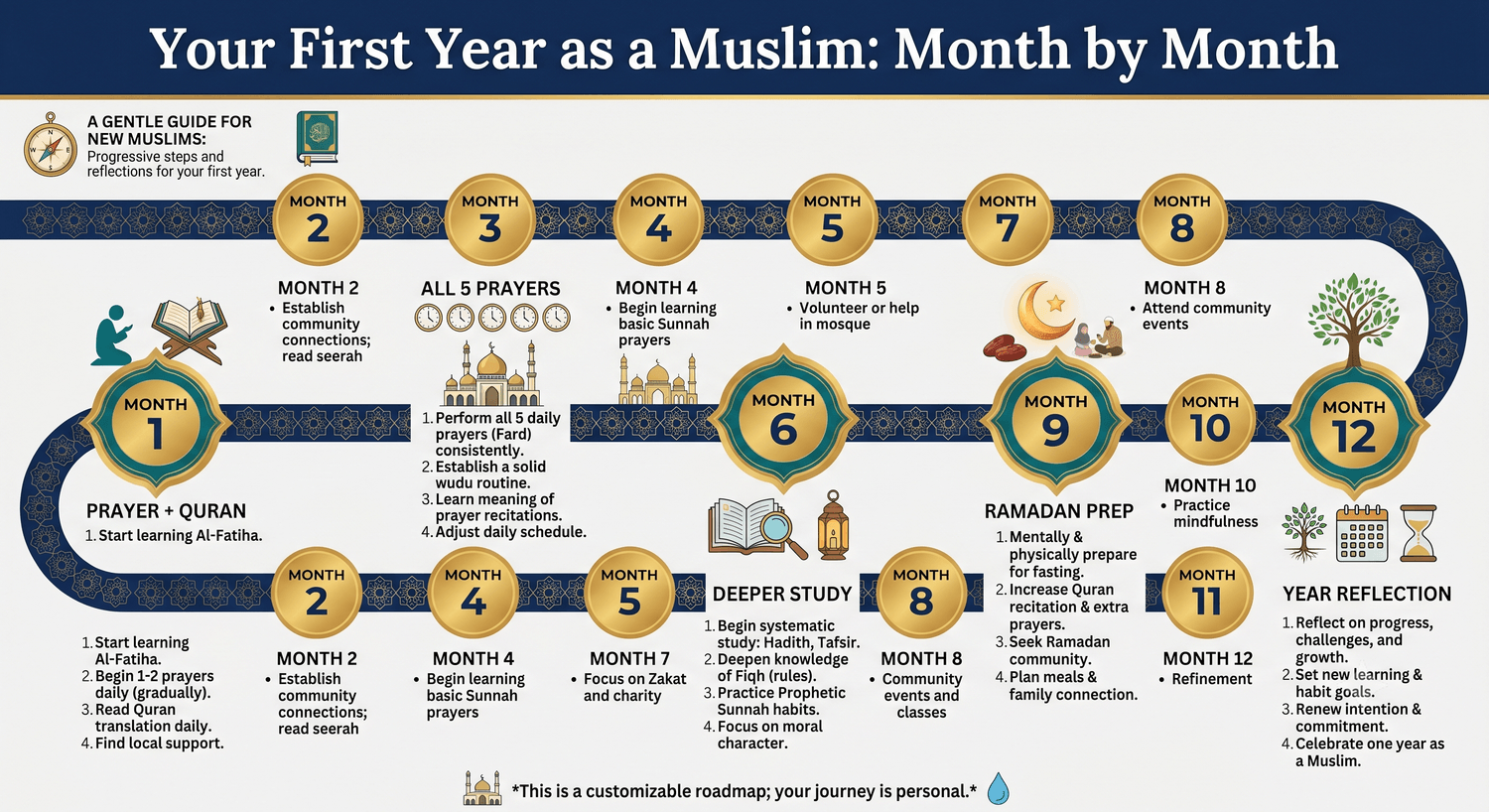
The First Year: A Month-by-Month Roadmap
Month 1: Learn Fajr and Maghrib prayer. Get a Quran. Read Al-Fatiha and Juz Amma. Tell at least one person you trust.
Month 2: Add Isha prayer. Attend Friday Jumu'ah. Begin reading Quran daily for 10 minutes.
Month 3: All 5 prayers established. Begin learning the meaning of the words you recite in prayer.
Month 4: Begin a structured Islamic education course or book study. Deepen your understanding of Tawhid and Islamic ethics.
Month 5–6: Explore Islamic history. Understand the context of the Quran's revelation. Connect with other new Muslims.
Month 7–8: Begin saving for Zakat (if applicable). Learn the fundamentals of fasting in preparation for Ramadan.
Month 9–10: If Ramadan is approaching, prepare — spiritually and practically. Plan your Suhoor (pre-dawn meal) and Iftar (breaking fast) routines.
Month 11–12: Reflect on your first year. What has strengthened? What needs more work? Write a personal growth plan for year two.
Resources Every New Muslim Needs
Books:
In the Early Hours by Khurram Murad — spiritual development
Don't Be Sad by Dr. 'Aid al-Qarni — emotional resilience from an Islamic perspective
Purification of the Heart by Hamza Yusuf — Islamic character development
Apps:
Muslim Pro — prayer times, Quran, Qibla
Athan — prayer times and adhan reminders
Quran Companion — gamified Quran memorization
Online:
Start Islam Path blog — articles on every aspect of new Muslim life
Start Islam Path course — structured Islamic education for new Muslims [Explore here]
Start Islam Path community — a judgment-free space for converts at every stage [Join here]
Frequently Asked Questions for New Muslims
How long does it take to feel like a "real" Muslim?
There is no threshold you cross that makes you suddenly feel fully Muslim. The feeling grows with practice, knowledge, and community. Most converts report that by 6–12 months of consistent practice, Islam feels genuinely integrated into their identity — not something they are performing, but something they are.
What if I convert but my spouse or partner is not Muslim?
Islamic law has specific rulings on this — a Muslim man may marry a Christian or Jewish woman; a Muslim woman is required to marry a Muslim man. If you are in a relationship that is complicated by this, seek guidance from a knowledgeable Islamic scholar who can advise based on your specific situation.
Do I need to be circumcised if I convert as a male adult?
Male circumcision is a strongly recommended Sunnah in Islam, but the majority of Islamic scholars agree it is not obligatory for adult male converts — particularly if it poses a health risk. Consult a Muslim doctor and an Islamic scholar together.
How do I make up prayers I missed before converting?
You do not. In Islam, the Shahada wipes the slate completely clean. Prayers missed before you became Muslim are not your responsibility — they belong to a life that has been forgiven. Begin counting from the moment of your Shahada.
Is it normal to feel like I made the wrong decision after converting?
Yes — this is a known phenomenon sometimes called "post-Shahada doubt." It is usually a product of spiritual exhaustion, social pressure, or the emotional weight of change — not a genuine change of conviction. Connect with other converts who have been through this. Seek knowledge. Give the feeling time before making any decisions.
What is the best Islamic course for new Muslims?
The best course for a new Muslim is one that is structured, authentic, and designed with your specific experience in mind — not repurposed content for born Muslims. The Start Islam Path course was built specifically for converts and curious non-Muslims. [Learn more here]
You Are Not Walking This Alone
The path of a new Muslim is one of the most extraordinary journeys a human being can take. It asks you to rebuild your understanding of existence, reshape your daily life, and stand with conviction in a world that may not understand your choice.
It is also one of the most rewarding.
You are part of a community that spans every country on earth. You have access to 1,400 years of accumulated wisdom. You have a direct relationship with the Creator of everything — no intermediary, no hierarchy, no waiting list.
Take it one prayer at a time. One page of Quran at a time. One day at a time.
The Start Islam Path course was built for exactly where you are right now — providing the structured guidance, community, and personal support that
every new Muslim deserves. [Explore the course and start your journey]


