Islam vs Muslim: The Simple Difference You Need to Know
Get the 109‑page guide delivered to your inbox
Discover the faith that 1.9 billion people live by — and why thousands of truth-seekers just like you are choosing it every single day. This free 109-page guide walks you from curiosity to clarity, step by step.
No pressure. No judgment. No strings attached. Just a clear, honest roadmap written for people who want real answers — whether you're skeptical, curious, confused, or quietly searching for something deeper.
People ask me this question more often than you might expect. There's nothing embarrassing about asking it. The words get used interchangeably in conversation, in news coverage, and in everyday speech — sometimes even by Muslims themselves. So let's settle it clearly.
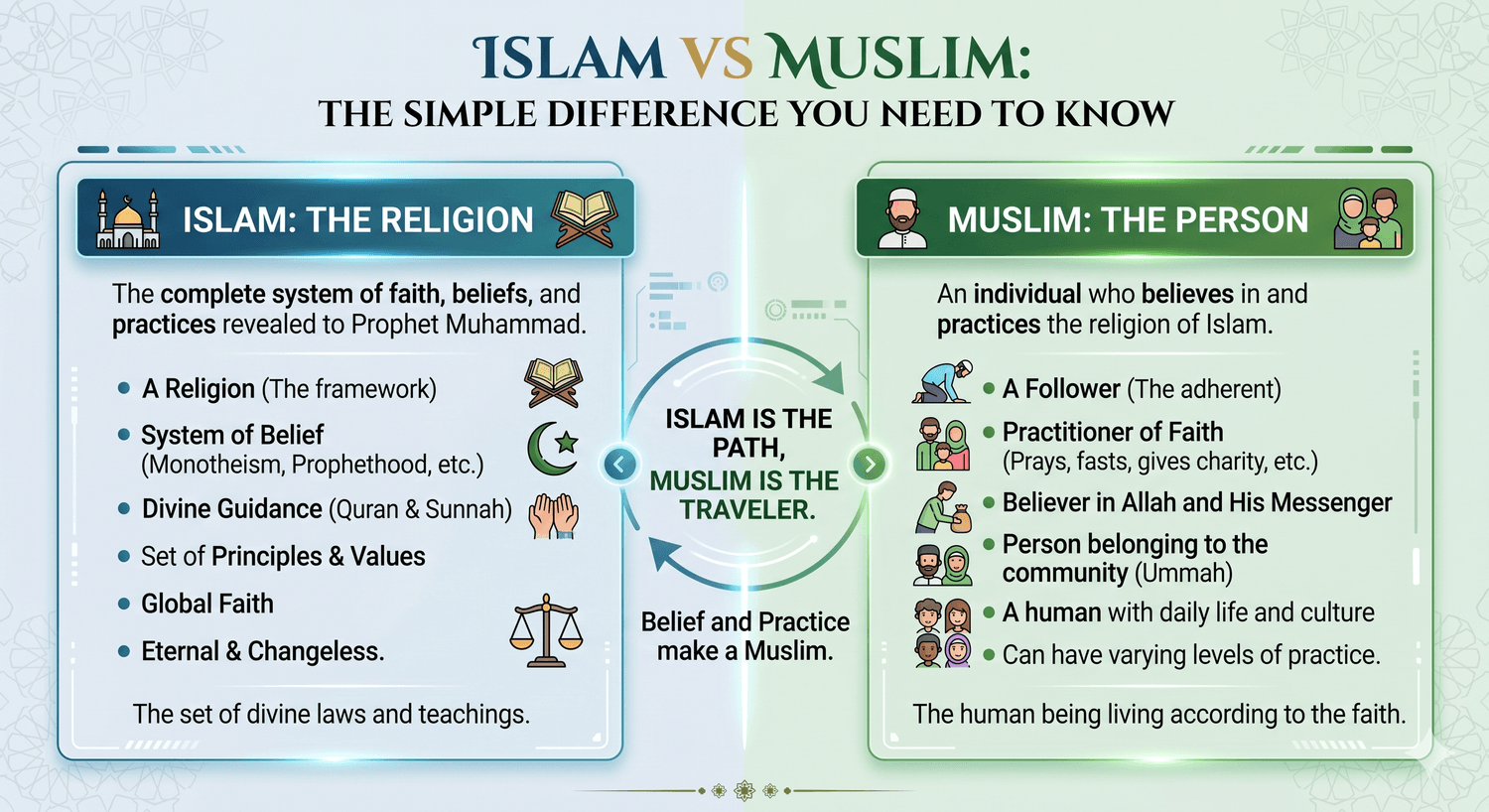
Islam is the religion. A Muslim is a person who follows that religion. That's the short answer. But the short answer doesn't carry the weight that these words actually hold, and understanding the difference at a deeper level changes how you see a lot of things — news coverage, history, the behavior of 1.8 billion people, and the religion itself.
What "Islam" Actually Means
The word Islam comes from the Arabic root s-l-m. This root appears across the Arabic language in words that carry meanings of peace, wholeness, safety, completeness, and surrender. The specific verbal form that gives us "Islam" means submission — the act of submitting or surrendering oneself. Islam, as a religious term, means submission to God.
This is not submission in the sense of defeat or loss. It is submission in the sense of alignment — choosing to stop fighting against what is true and instead orienting yourself toward it. A musician who finally plays with the rhythm of a piece rather than against it is not losing. Something freer begins.
Islam, in the Quranic usage, is also older than the Prophet Muhammad ﷺ. The Quran uses the word to describe the posture of all the prophets who came before. Abraham, in the Quran (3:67), is described not as a Jew or a Christian — because neither label existed in his time — but as someone who submitted to God. The Arabic word used is muslim, the active form of the same root. This tells you how the tradition understands itself: not as a new invention in 7th-century Arabia, but as the original and continuing call to surrender to the one God who created the world.
As an institutional name — the name of the specific religion that Muslims follow today — Islam refers to the revelation given to the Prophet Muhammad ﷺ beginning around 610 CE, recorded in the Quran, and elaborated through the teachings and practice of the Prophet himself.
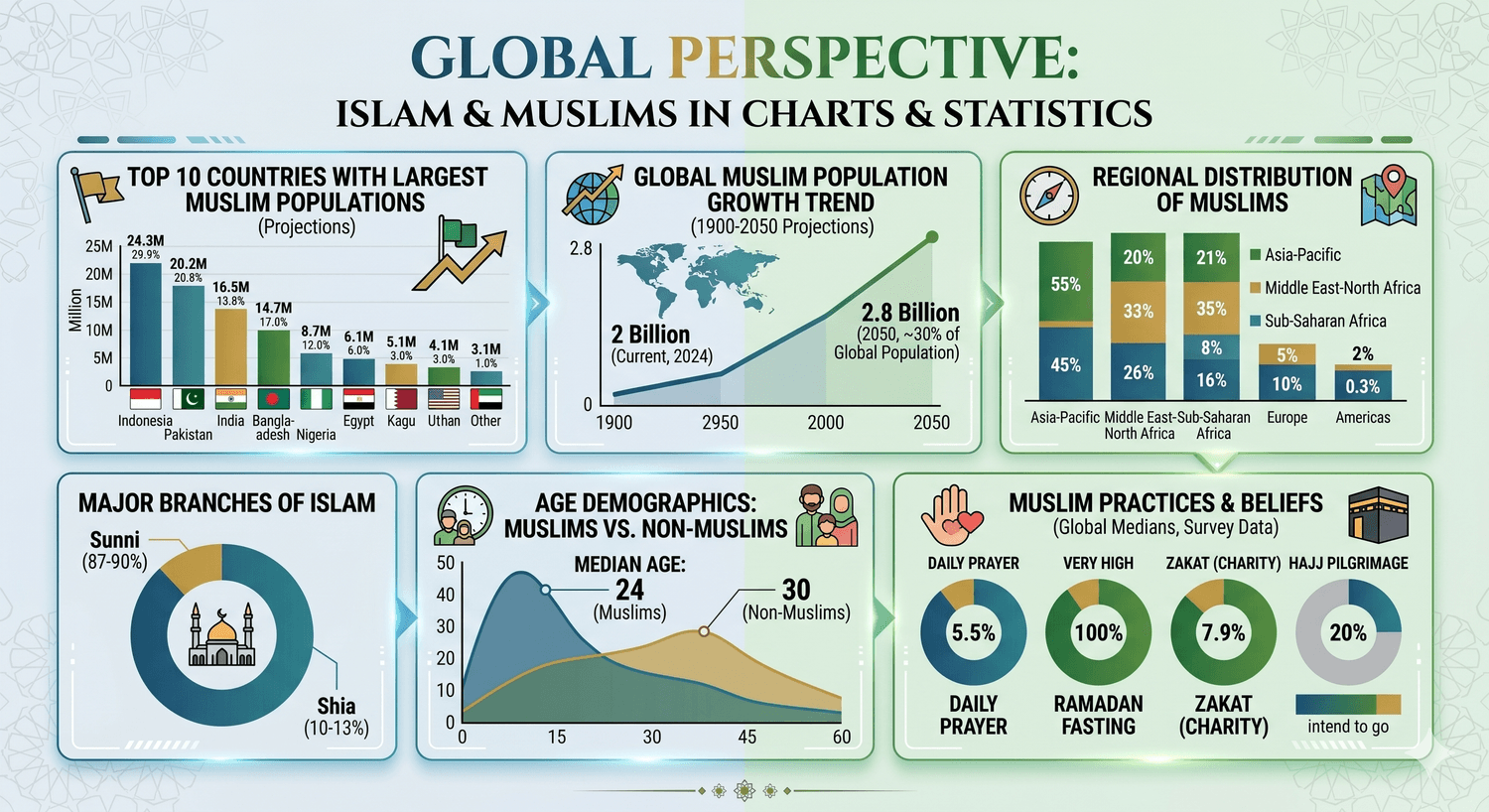
What "Muslim" Actually Means
A Muslim is the active participant in Islam. The word is the active participle of the same Arabic root s-l-m — one who submits, one who surrenders, one who is in the state of submission to God.
A Muslim is someone who declares the shahada — the testimony that there is no god but God and that Muhammad is His messenger — and organizes their life around that belief. The declaration is the entry point. What follows is a lifetime of attempting, imperfectly, to live up to it.
The feminine form of the word is muslima. The plural in Arabic is muslimun or muslimin. In English, "Muslim" functions both as a noun and as an adjective: "She is Muslim" and "Muslim communities."
Here is where the practical distinction between Islam and Muslim becomes important: Islam is the ideal. A Muslim is a person attempting to reach it. The two are related but not identical. The actions of any given Muslim — or of any group of Muslims — may or may not reflect what Islam actually teaches. A person who calls themselves Muslim and behaves dishonestly is failing to live up to Islam, not demonstrating what Islam is.
This is not a loophole. It is simply an accurate description of how any religion and its followers relate. Christianity describes specific values of love, forgiveness, and humility. Christians fail to live up to them at various points in time and in various historical periods. The religion is not the same thing as the people who practice it imperfectly, and neither is Islam.
Why This Distinction Matters in Practice
When people conflate Islam and Muslim — treating every Muslim's action as Islam and every claim about Islam as automatically representative of all Muslims — the thinking goes wrong in two directions simultaneously.
The first problem is that you end up judging a religion by the worst behavior of some of its 1.8 billion adherents. By that standard, no religious tradition would survive scrutiny, including those most people in Western countries identify with. If Christianity is to be judged by the Crusades, the Inquisition, or contemporary crimes committed by people who identify as Christian, then the picture is very different from the tradition's own account of itself. The same logic applies to Islam.
The second problem is that you end up judging individual Muslims by abstract theological positions they may not hold, or by actions of people they may personally oppose, simply because of a shared label. The French Muslim woman in a headscarf has no more connection to an extremist group operating in another continent than a Norwegian Christian has to white nationalist violence. The shared label does not imply shared responsibility.
The Islam vs Muslim distinction is not pedantic. It is the minimum required for accurate thinking about over a billion people and the tradition that shapes their lives.
The Grammatical Distinction for Islam vs Muslim That Helps
English also gives us "Islamic" as an adjective — and this word behaves differently from "Muslim." Understanding the three terms together clarifies how to use them accurately.
"Islamic" describes things that belong to, or are shaped by, the religion itself. You say "Islamic law," "Islamic architecture," "an Islamic university," "Islamic ethics." You would not naturally say "an Islamic person" — you'd say "a Muslim person." A Muslim is a follower of Islam. Something described as Islamic is directly connected to the religion.
So: Islam is the religion. Muslim is the follower. Islamic is the adjective for things connected to the religion. Three distinct words with a shared root, each with a specific job.
This matters in practice because using "Muslim" where you mean "Islamic" and vice versa changes what you're saying. "Muslim violence" implies something about the people. "Islamic teaching on violence" implies something about the tradition. These are different claims that require different evidence and should be evaluated separately.
How the Quran Uses These Words
The Quran addresses its followers as al-muslimun — those who submit — far more often than it gives them a tribal or national identity. The emphasis is always on the action, the ongoing choice to align your will with God's, rather than a fixed membership category.
Abraham and Ishmael, in the Quran, pray: "Our Lord, make us Muslims to You and from our descendants a Muslim nation to You" (Quran 2:128). The word is being used in its original sense — a description of an orientation toward God, not a label for a particular community.
Islam is also described in the Quran as a state of completion: "This day I have perfected for you your religion and completed My favor upon you and have approved for you Islam as religion" (Quran 5:3). This was revealed during the Prophet's final pilgrimage. The implication is that Islam is not merely a set of rules but a complete account of what human beings are, what they owe God, and how a good life is lived.
One God, Many Faces
Understanding Islam vs Muslim at this level makes something else clearer. The 1.8 billion people who call themselves Muslim are not a monolith. They are not a single culture, a single race, or a single political group. They speak thousands of languages. They come from every climate and every level of economic development. There are Muslim farmers in sub-Saharan Africa and Muslim technology executives in Silicon Valley. Muslim poets in Iran and Muslim fishermen in Indonesia. Muslim converts in American suburbs and Muslim scholars in ancient Egyptian institutions.
What connects them is not ethnicity — Islam has no racial requirement. Not politics — Muslims hold every position across the political spectrum in every country where they exist. Not a single cultural practice — a wedding in Morocco and a wedding in Malaysia look almost nothing like each other.
What connects them is the declaration. La ilaha illa Allah, wa Muhammadun rasulullah. There is no god but God, and Muhammad is his messenger. That statement, made sincerely, is what makes someone a Muslim. Everything built around it — the prayers, the fasting, the charity, the pilgrimage — is the practice of living up to what the statement means.
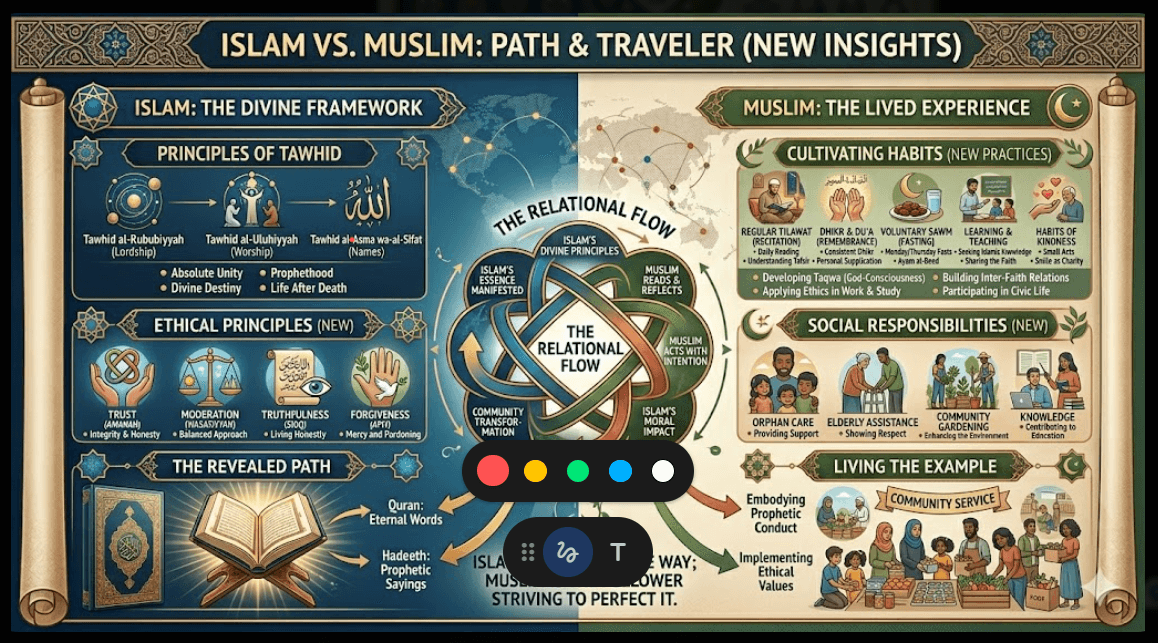
Islam is the name for the path. Muslim is the name for the person walking it. The path remains consistent. The walkers are human, various, and imperfect in the ways that human beings everywhere are.
If you're exploring either word because you're genuinely curious about what this religion is and who follows it, you're already asking better questions than most. The distinction between Islam and Muslim is where honest understanding of this tradition begins — and where a lot of unnecessary confusion can be cleared up quickly.
What the Five Pillars Tell You About the Relationship
One of the clearest ways to see the Islam vs Muslim distinction in practice is through the Five Pillars of Islam. These are the five foundational acts that structure Muslim life: the declaration of faith (shahada), the five daily prayers (salah), the giving of charity (zakat), fasting during Ramadan (sawm), and the pilgrimage to Mecca (hajj) at least once in a lifetime for those who are able.
These pillars belong to Islam — they are the religion's structure, its skeleton. A Muslim is the person who attempts to fulfill them. But the pillars remain what they are regardless of how imperfectly any individual Muslim practices them. A Muslim who misses prayers is still a Muslim who is failing at salah. Islam's description of what salah is, and what it's for, doesn't change because of that individual failure.
This is the same logic that applies in any meaningful relationship between an ideal and a person attempting to live up to it. A doctor who makes a mistake is still accountable to the standards of medicine. The standards don't change because the doctor fell short. The same is true for a Muslim and Islam. The religion is the standard; the Muslim is the person accountable to it.
The Confusion in Daily Speech
In everyday conversation, people use Islam and Muslim loosely, and there are contexts where this causes no real problem. Saying "the Muslim community" and "the Islamic community" are often interchangeable in casual usage, and most fluent speakers understand both.
The confusion becomes more consequential in certain specific contexts. When someone says "Islam teaches violence," they are making a claim about the religion — about what the texts say, what the tradition holds, what scholars across fourteen centuries have argued. That claim requires evidence from the religion itself. When someone says "some Muslims have committed violent acts," they are making a claim about the behavior of specific people. That claim requires different evidence. Treating these as the same claim is where the confusion between Islam and Muslim does real harm.
On the other side, when someone defends the actions of a particular government or political movement by calling those actions "Islamic," the same distinction applies. A government that calls itself Islamic is making a claim. Whether that claim is accurate requires examining what Islam actually teaches, not just what the government says about itself.
The Islam vs Muslim distinction, in other words, is not just a grammatical nicety. It's a tool for thinking clearly about a religion followed by 1.8 billion people across every conceivable cultural, political, and historical context.
A Practical Note for People Exploring Islam
If you are in the early stages of learning about this religion, one thing worth knowing is that the Muslims you encounter are not perfect representatives of Islam — just as no Catholic is a perfect representative of Catholicism and no Buddhist is a perfect representative of Buddhism. You will encounter Muslims who are generous, principled, and deeply thoughtful. You will also encounter Muslims who are petty, inconsistent, or simply ordinary human beings with ordinary human failings.
Neither category should determine your understanding of the religion. Islam, like any serious tradition, must be evaluated on its own terms — on its texts, its scholars, its internal logic, its history at its best. The people who follow it are, at various points, reaching toward something larger than themselves and falling short of it, exactly as people in every tradition do.
The invitation in Islam is to the religion itself, not to any particular community of its imperfect followers.
Ready to go deeper? At Start Islam Path, we have courses designed for people who are new to Islam or genuinely curious. Clear, honest, and judgment-free.


