Islam and Science: What the Quran Says About the Universe
Get the 109‑page guide delivered to your inbox
Discover the faith that 1.9 billion people live by — and why thousands of truth-seekers just like you are choosing it every single day. This free 109-page guide walks you from curiosity to clarity, step by step.
No pressure. No judgment. No strings attached. Just a clear, honest roadmap written for people who want real answers — whether you're skeptical, curious, confused, or quietly searching for something deeper.
Islam and science are not adversaries. They never were. The claim that religion and scientific inquiry are inherently in conflict is a product of European history — specifically, the conflict between the Catholic Church and early European scientists — that has been incorrectly generalized to all religions. Islam's relationship with science is categorically different: the Quran commands empirical observation, Islamic theology celebrates knowledge, and the Islamic Golden Age produced centuries of scientific achievement that formed the foundation of modern science. This guide examines the Quran's statements about the natural world, the history of Islamic science, and why Islam has always understood faith and knowledge as complementary rather than contradictory.
Check out our book (1000 proofs Islam is the true religion of the Creator of The Universe, where we explain in details and examples proofs from Quran and Sunnah mentioned 1440 years ago that today's science proves they are correct. GET IT NOW
The Islamic Mandate for Knowledge
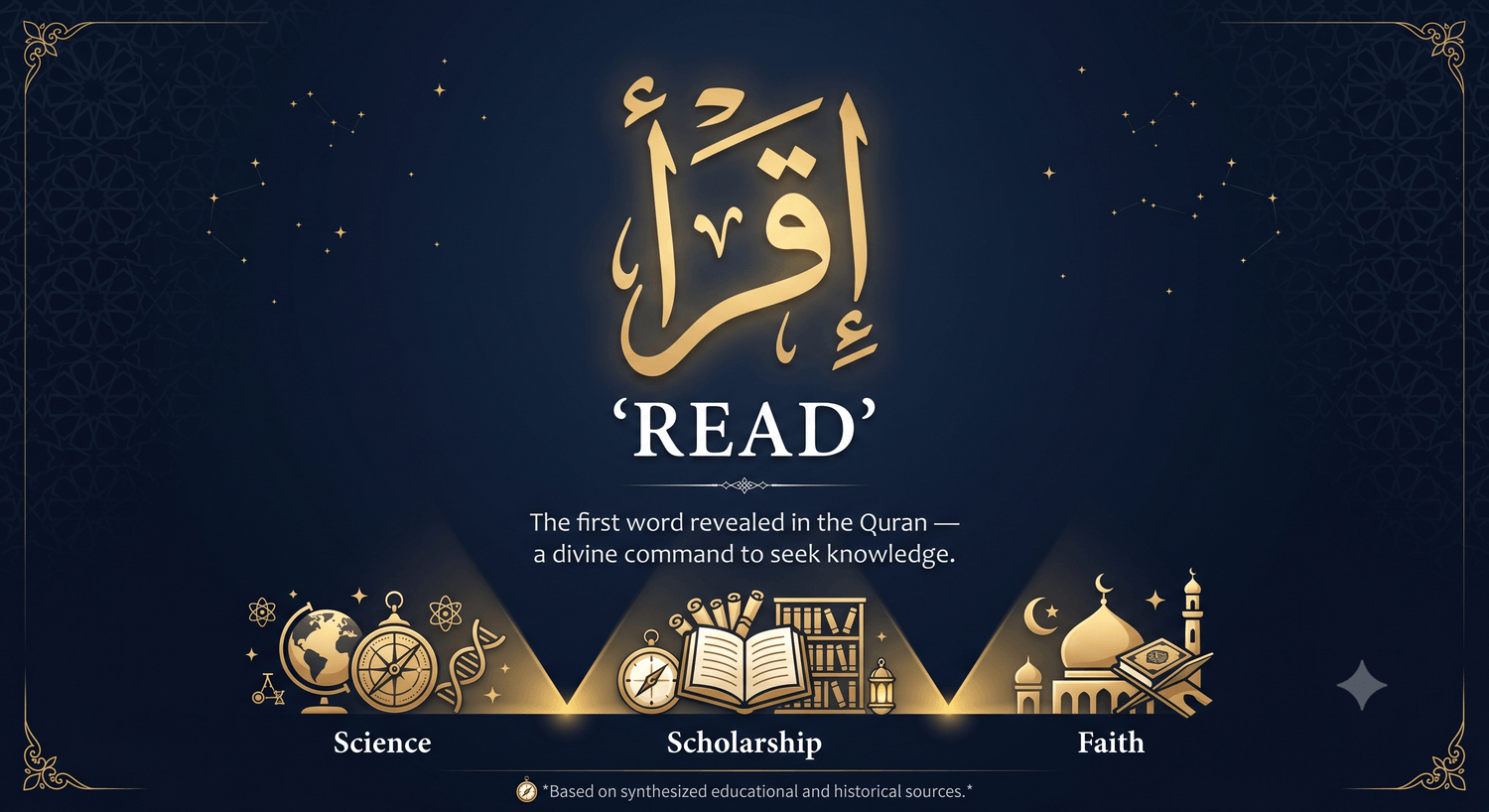
The very first word revealed in the Quran was not "believe" or "submit" or "pray." It was Iqra — "Read."
"Read in the name of your Lord who created. Created man from a clinging clot. Read, and your Lord is the Most Generous — who taught by the pen. Taught man that which he knew not." (Quran 96:1–5)
This was not coincidental. The opening of divine revelation to humanity was a command to seek knowledge. The Quran then consistently reinforces this throughout its 114 chapters — instructing believers to observe, reflect, investigate, and reason.
"Do they not look at the camels — how they are created? And the sky — how it is raised? And the mountains — how they are erected? And the earth — how it is spread out?" (Quran 88:17–20)
"Indeed, in the creation of the heavens and the earth and the alternation of night and day are signs for those of understanding." (Quran 3:190)
The Quran frames the natural world as ayat — signs. Studying the universe is not a secular activity that competes with faith. In Islamic theology, it is an act of faith — each discovery revealing another dimension of the Creator's design.
The Prophet Muhammad ﷺ reinforced this: "Seeking knowledge is an obligation upon every Muslim." "Seek knowledge, even if you must go to China." "The ink of the scholar is holier than the blood of the martyr."
The Islamic Golden Age: Islam and Science as Worship
Between the 8th and 13th centuries, while Europe was in the Middle Ages, the Islamic world was experiencing an extraordinary scientific renaissance. Muslim scholars were not merely preserving Greek knowledge — they were expanding it, correcting it, and building entirely new disciplines.
Mathematics
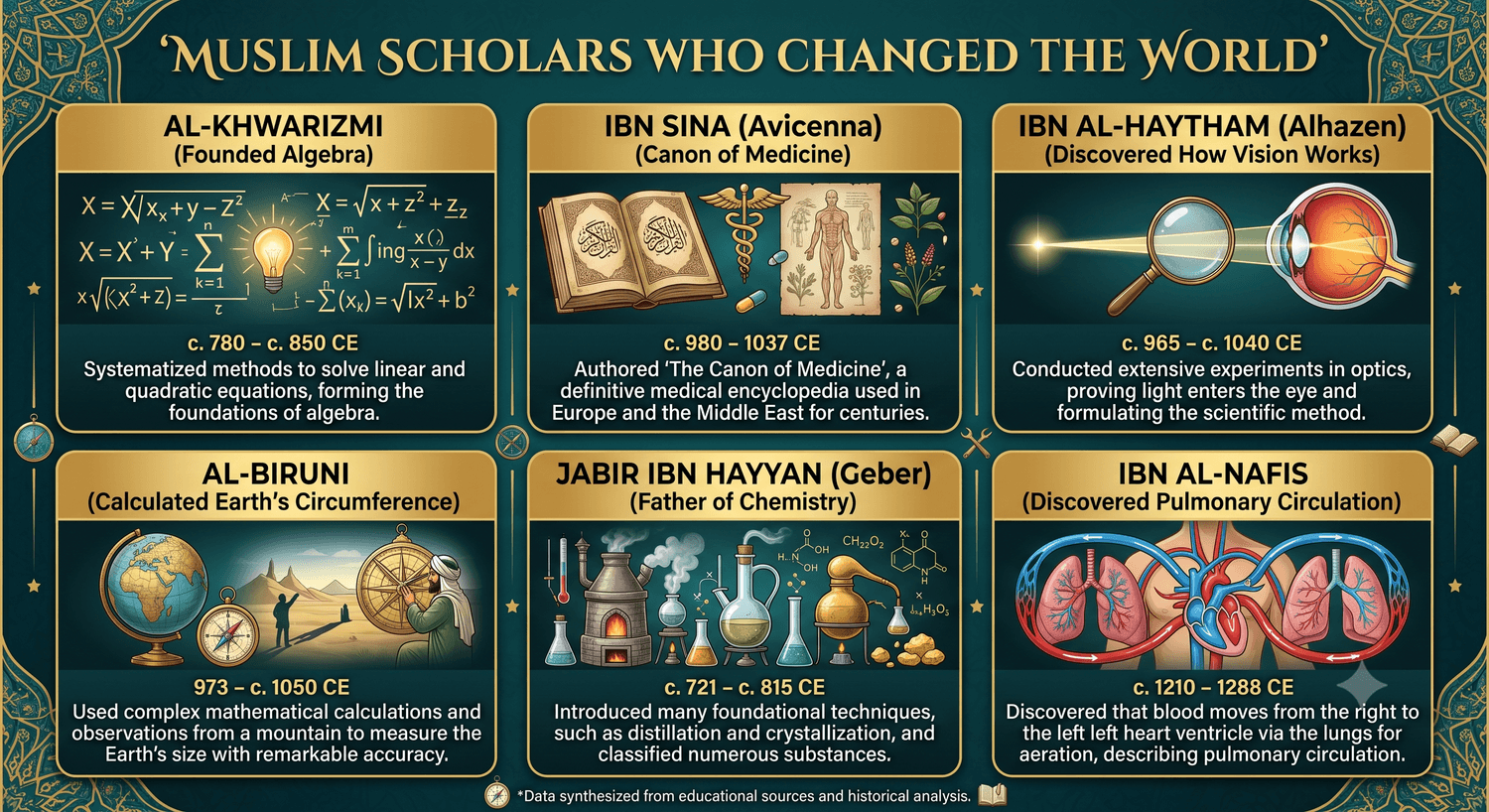
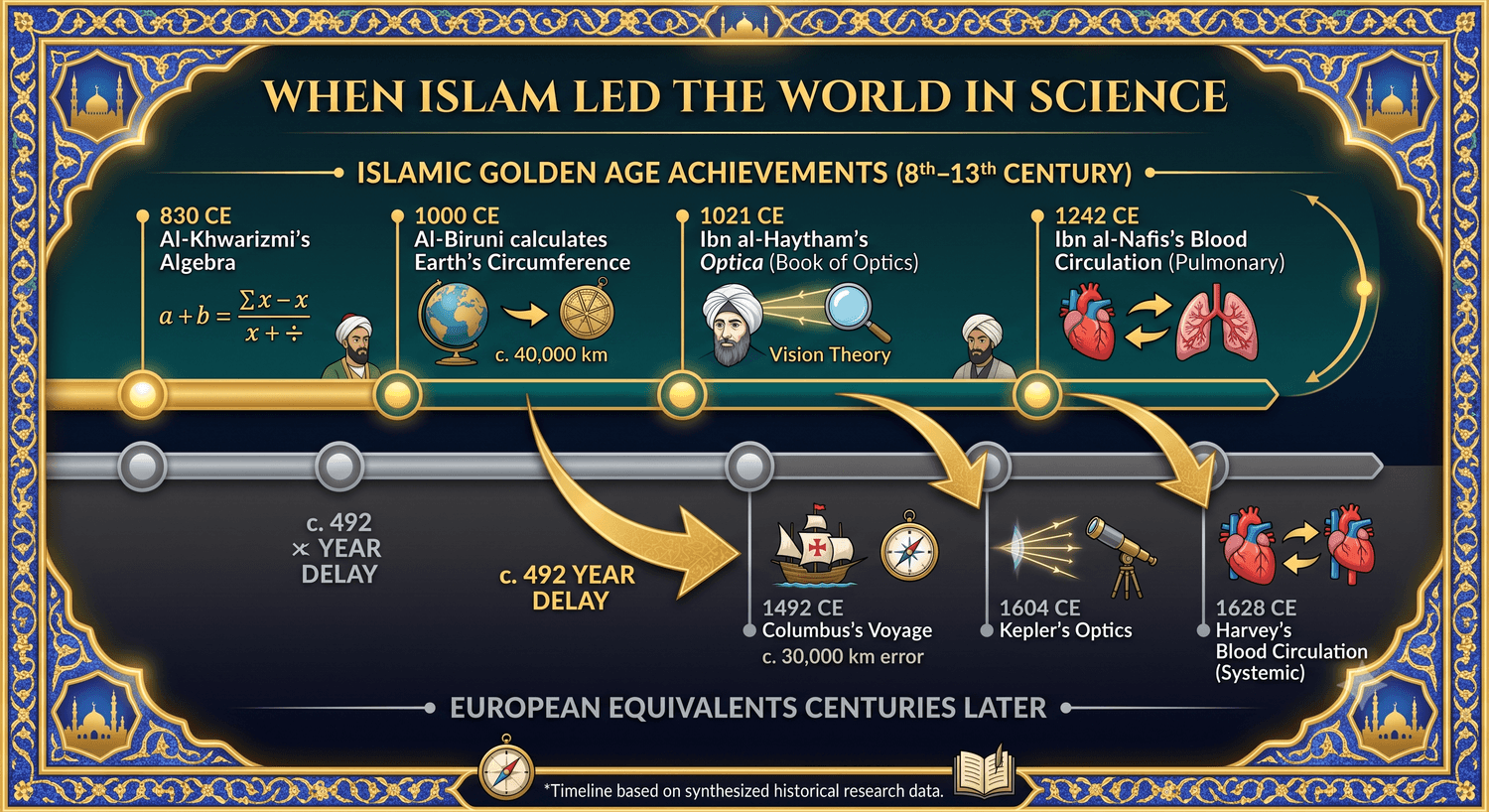
Al-Khwarizmi (780–850 CE) — whose name gave us the word "algorithm" — wrote Kitab al-Mukhtasar fi Hisab al-Jabr wal-Muqabala (The Compendious Book on Calculation by Completion and Balancing). This text founded algebra as a discipline. The word "algebra" comes directly from al-jabr in the book's title.
Al-Khwarizmi also introduced the Hindu-Arabic numeral system to the Western world — including the concept of zero. Modern mathematics, and therefore modern science and technology, is built on this foundation.
Omar Khayyam (1048–1131 CE) solved cubic equations geometrically and developed one of history's most accurate solar calendars — the Jalali calendar, more accurate than the Gregorian calendar used today.
Medicine
Ibn Sina (Avicenna) (980–1037 CE) wrote Al-Qanun fi al-Tibb (The Canon of Medicine) — a 14-volume medical encyclopedia that was the standard medical textbook in European universities until the 17th century. Ibn Sina described contagious diseases and quarantine procedures 800 years before the germ theory of disease.
Ibn al-Nafis (1213–1288 CE) described pulmonary blood circulation — the circulation of blood through the lungs — 300 years before William Harvey's discovery in Europe, which is typically credited as the origin of this knowledge.
Al-Razi (Rhazes) (854–925 CE) was the first physician to distinguish between smallpox and measles and wrote over 200 medical texts. His Comprehensive Book of Medicine was one of the largest medical encyclopedias in history.
Optics and Physics
Ibn al-Haytham (Alhazen) (965–1040 CE) wrote Kitab al-Manazir (Book of Optics) — the first scientific explanation of how vision works. He established that light travels in straight lines, enters the eye, and creates vision — overturning the ancient Greek theory that the eye emits rays. His work laid the foundation for the scientific method: systematic experimentation to test hypotheses. Roger Bacon and Johannes Kepler built directly on his work.
Astronomy
Muslim astronomers named most of the stars visible to the naked eye — names still used today in modern astronomy: Aldebaran, Betelgeuse, Rigel, Altair, Vega, Deneb. The astrolabe — used for celestial navigation for centuries — was developed and refined by Muslim astronomers.
Al-Biruni (973–1048 CE) calculated the circumference of the earth to within 1% accuracy, over 400 years before Columbus. He also proposed that the earth rotates on its axis.
Chemistry
Jabir ibn Hayyan (Geber) (721–815 CE) is considered the father of chemistry. He developed systematic experimental methods, discovered multiple mineral acids, and described dozens of chemical processes still used today. The word "alchemy" comes from the Arabic al-kimiya.
What the Quran Says About the Natural World
The Quran was revealed in 7th-century Arabia — to an illiterate prophet, in a pre-scientific culture. Several of its statements about the natural world contain descriptions that align with modern scientific understanding in ways that were not verifiable until centuries later.
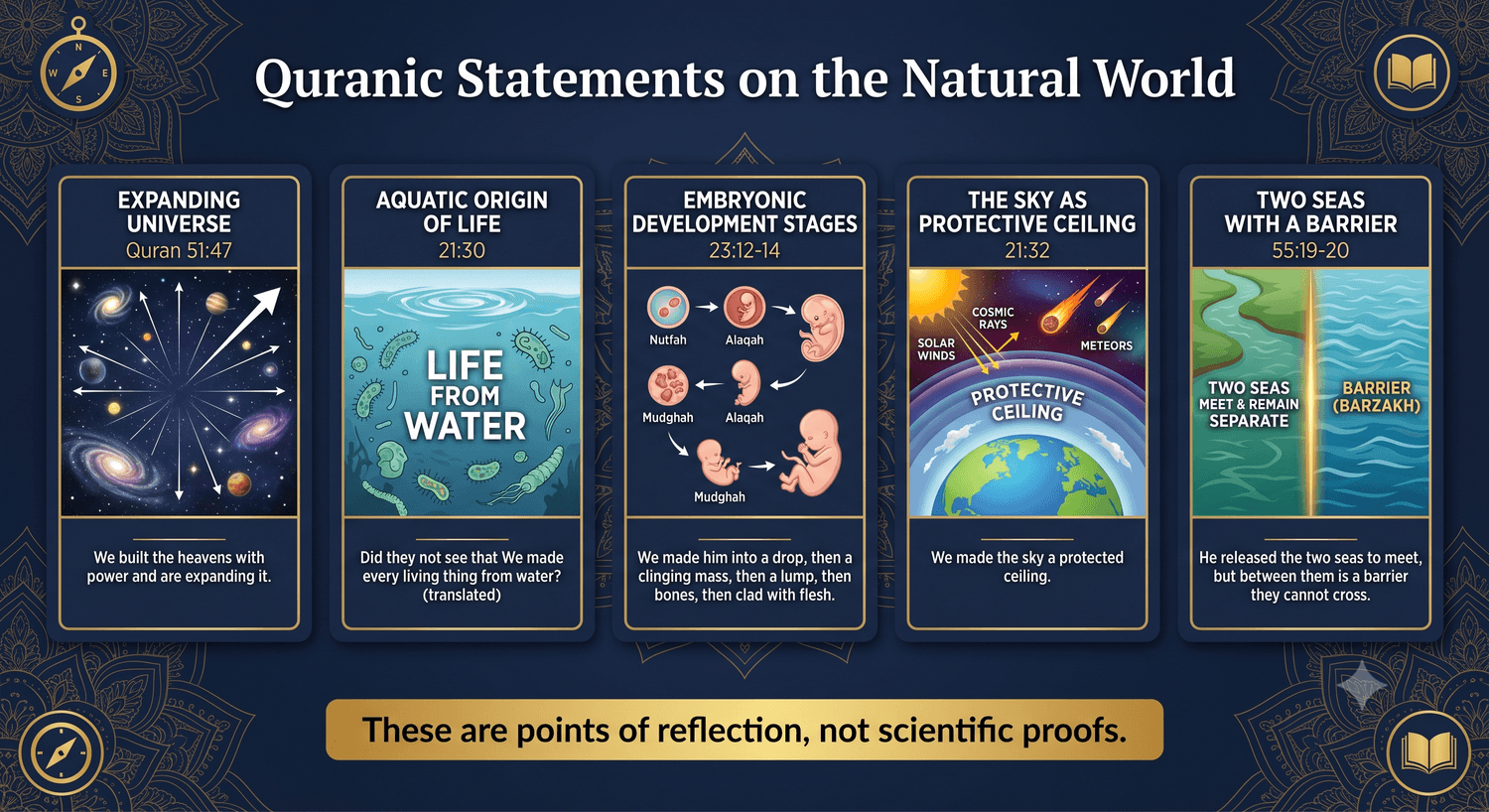
These are presented not as proof of anything, but as points of reflection — what the Quran invites its readers to do.
The Expanding Universe
"And the heaven We constructed with strength, and indeed, We are its expander." (Quran 51:47)
The Arabic word translated as "expander" is Musi'un — from the root wasi'a, to expand or widen. The expansion of the universe was not discovered until 1929, when Edwin Hubble observed that galaxies are moving away from each other in all directions. This is one of the most discussed Quranic verses in the context of science.
The Aquatic Origin of Life
"And We made from water every living thing." (Quran 21:30)
Modern biology confirms that all life on earth is water-based — that life originated in aquatic environments and that every living cell requires water to function. In 7th-century Arabia, this statement was not scientifically verifiable.
The Formation of the Universe
"Do the disbelievers not see that the heavens and earth were a joined entity, and We separated them?" (Quran 21:30)
The Big Bang theory describes the universe as originating from a single, unified state — a singularity — that expanded and differentiated into the observable universe. The verse describes the heavens and earth as originally "joined" and then "separated." Whether this constitutes a reference to the Big Bang is debated — but it is a striking statement for a 7th-century text.
Human Embryonic Development
"And certainly did We create man from an extract of clay. Then We placed him as a sperm-drop in a firm lodging. Then We made the sperm-drop into a clinging clot, and We made the clot into a lump of flesh, and We made the lump of flesh into bones, and We clothed the bones with flesh; then We developed him into another creation. So blessed is Allah, the best of creators." (Quran 23:12–14)
The stages described — sperm (nutfah), clinging clot ('alaqa), lump of flesh (mudghah), bones, then flesh covering bones — align with known stages of human embryonic development. The Canadian embryologist Dr. Keith Moore, one of the world's leading embryology textbook authors, stated that the Quranic description of embryonic development matches modern embryological knowledge in remarkable detail.
The word 'alaqa (clinging clot) also means "leech" — which modern embryologists note describes the early embryo's leech-like shape and attachment to the uterine wall.
The Two Bodies of Water That Don't Mix
"He released the two seas, meeting side by side; between them is a barrier so that neither may transgress." (Quran 55:19–20)
Oceanographers have documented the phenomenon of two bodies of water meeting — such as the Atlantic and Mediterranean in the Strait of Gibraltar, or the confluence of the Amazon River with the Atlantic Ocean — maintaining distinct temperatures, salinity levels, and densities. A thermocline (temperature barrier) prevents them from fully mixing despite meeting. The Quran describes this as a "barrier" between them.
The Protective Function of the Sky
"And We made the sky a protected ceiling." (Quran 21:32)
The earth's atmosphere serves multiple protective functions: blocking harmful ultraviolet radiation, burning up most meteors before they reach the surface, and trapping heat to maintain temperatures compatible with life. The Quran describes the sky as a "protected ceiling" — a remarkably apt description.
The Mountains as Stabilizers
"And We placed within the earth firmly set mountains, lest it should shift with them." (Quran 21:31)
Modern geology describes mountains as having deep roots that extend far below the surface — like pegs or stakes — providing geological stability. The Quran uses the analogy of mountains as stabilizers for the earth's surface, which aligns with the geological understanding of isostasy (how mountains balance the earth's crust).
A Clarification on Quranic Science
A balanced and honest presentation requires this clarification: the Quran is not a textbook of science. It is a book of guidance — theological, ethical, and spiritual guidance — that contains references to the natural world in service of its primary purpose: directing human beings toward God.
Interpreting every verse as a scientific prediction, or using the Quran as a science textbook, is a mistake. The Quran invites observation of the natural world — it does not replace it.
What these verses demonstrate is not that the Quran predicted modern science. They demonstrate that a 7th-century revelation contains no statements that contradict established science — and several that invite serious reflection.
Why the "Islam vs. Science" Narrative Is Wrong
The conflict narrative between religion and science is historically specific: it emerged from specific conflicts in European history — Galileo's trial, the church's resistance to heliocentrism and evolution — and was then generalized to "religion."
But Islam was not involved in those conflicts. The Catholic Church's institutional resistance to heliocentrism had nothing to do with Islam or the Quran. Muslim scholars were advancing astronomy at the time.
The narrative of inevitable religion-science conflict is a product of a particular historical and cultural context that does not apply to Islam.
In Islamic civilization:
Scientists were typically also theologians and scholars of Islamic law
Hospitals were attached to mosques
Scientific inquiry was funded by caliphs as a religious duty
The pursuit of knowledge in any field — mathematics, medicine, philosophy — was framed as a form of worship
The artificial separation of "religious" and "secular" knowledge is a post-Enlightenment Western construct that has never been native to Islamic civilization.
Frequently Asked Questions About Islam and Science
Does Islam believe in evolution?
Islam accepts the scientific evidence for common descent and evolutionary processes in the natural world. Where Islamic theology differs from purely materialist interpretations of evolution is on the origin of the human soul and the special creation of Adam and Hawwa (Eve). Islamic scholars have diverse positions on how to reconcile evolution with Quranic accounts — this is an active area of theological discussion, not a closed question.
What does Islam say about the Big Bang?
The Big Bang theory — that the universe originated from a single, unified state approximately 13.8 billion years ago — is not in conflict with Islamic theology. The Quran states that God created the heavens and earth; the Big Bang is a scientific description of the mechanism of that creation. Most Muslim scholars have no difficulty accepting the Big Bang as consistent with Islamic theology.
Did Islam contribute to modern science?
Significantly. The Islamic Golden Age (8th–13th centuries) produced foundational contributions to mathematics (algebra, algorithms, zero), medicine (germ theory precursors, encyclopedic medical texts), optics (the scientific method, the first correct theory of vision), astronomy (star names, celestial navigation), and chemistry (acid synthesis, the word "chemistry" itself). Modern science built directly on these foundations.
Why did Islamic scientific progress slow down?
The Mongol invasions of the 13th century devastated the centers of Islamic learning — the House of Wisdom in Baghdad was destroyed in 1258. Internal political fragmentation, colonial disruption, and the gradual prioritization of religious sciences over natural sciences also contributed. The decline of Islamic scientific leadership was historical and political — not inherent to Islam.
Can a scientist be a sincere Muslim?
Absolutely — and history is full of them. The founders of multiple scientific disciplines were sincere Muslims who understood their scientific work as fulfilling the Quranic command to seek knowledge. Today, Muslims work in every scientific field worldwide. Islam does not require a scientist to choose between their faith and their research.
Faith and Knowledge: Not Enemies, But Partners
The Quran does not ask you to stop thinking. It asks you to start thinking more carefully — to observe the world around you, to reflect on the signs within it, and to follow that reflection wherever it leads honestly.
For centuries, that is exactly what Muslim scholars did — and it produced some of the most remarkable scientific achievements in human history.
If science and intellectual inquiry are important to you, know this: you do not have to choose between your commitment to evidence and reason, and the faith that Islam offers. They have coexisted — productively, creatively, and faithfully — for over a thousand years.
For an evidence-based, intellectually honest exploration of Islam — written for curious, thinking people — download the free 109-page guide. [Get it delivered to your inbox in 60 seconds]


