Islamic Golden Age: How Muslims Changed Human History
Get the 109‑page guide delivered to your inbox
Discover the faith that 1.9 billion people live by — and why thousands of truth-seekers just like you are choosing it every single day. This free 109-page guide walks you from curiosity to clarity, step by step.
No pressure. No judgment. No strings attached. Just a clear, honest roadmap written for people who want real answers — whether you're skeptical, curious, confused, or quietly searching for something deeper.
There's a good chance you used the work of the Islamic Golden Age today and didn't know it. If you've ever solved for an unknown variable in an equation, you've used algebra — from the Arabic al-jabr, the name given to the method by the 9th-century mathematician Muhammad ibn Musa al-Khwarizmi. The word "algorithm" is a Latinized version of his own name. If you read the time using Arabic numerals — 0, 1, 2, 3 — rather than Roman ones, you're using a numerical system that Muslim scholars adopted from Indian mathematicians and transmitted to medieval Europe, where it replaced an older system that made complex calculation enormously difficult.
These are not obscure contributions. They are foundational. And they came out of a period that ran roughly from 750 CE to 1258 CE — the Islamic Golden Age — one of the most intellectually productive eras in human history.
What drove it is just as interesting as what it produced.
The City That Changed the World in the Islamic Golden Age
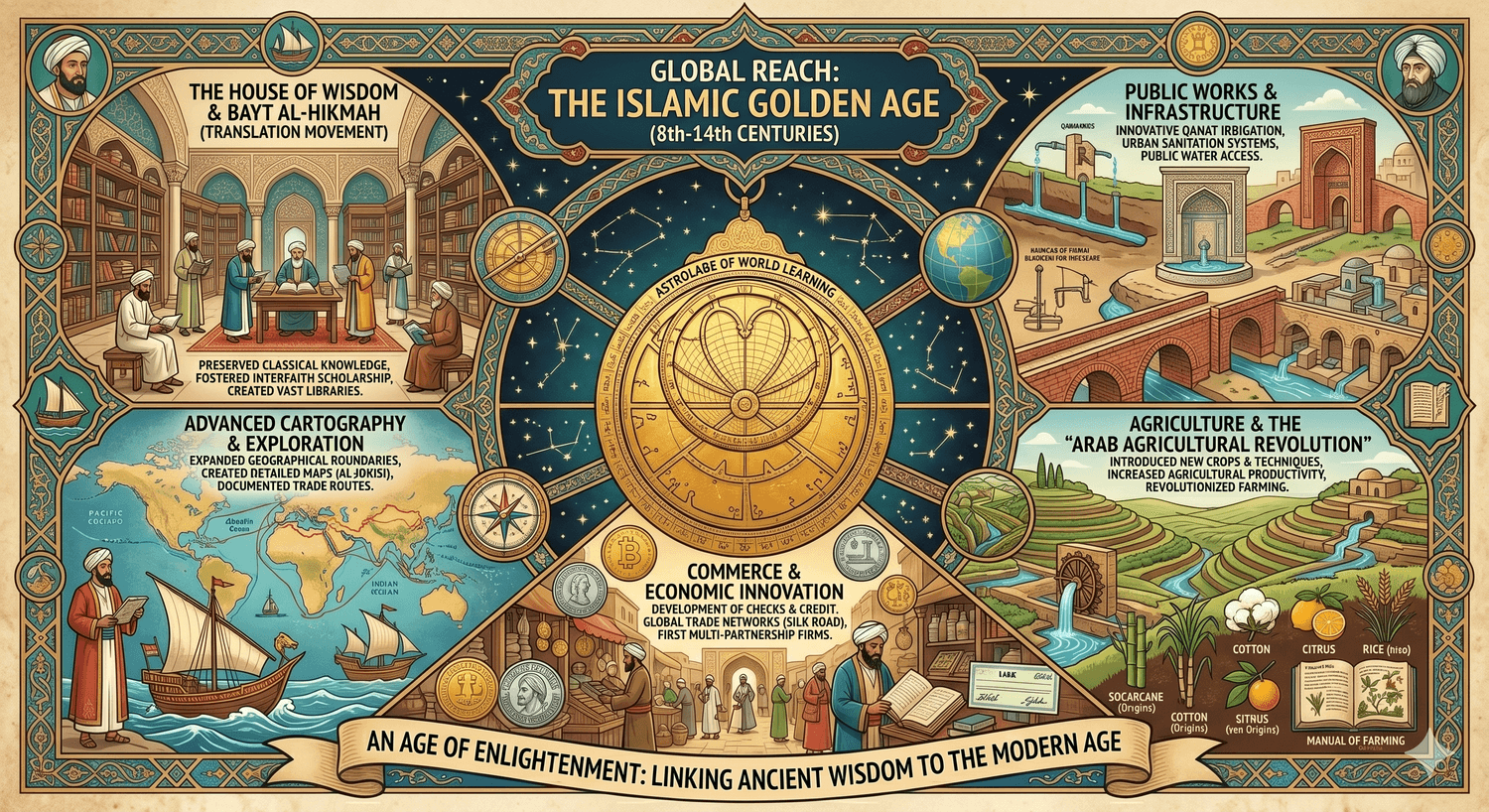
In the early 9th century, the Abbasid Caliph Harun al-Rashid and then his son al-Ma'mun established in Baghdad an institution they called the Bayt al-Hikma — the House of Wisdom. It was not a library or a university in the modern sense. It was something closer to a government-funded research institution that combined both. Scholars from across the known world — Arab, Persian, Christian, Jewish, Zoroastrian — were paid to translate existing knowledge from Greek, Syriac, Indian, and Persian sources into Arabic, and then to extend that knowledge through their own research.
This was extraordinary even by modern standards. The political leadership of a vast empire decided to fund the systematic acquisition and expansion of human knowledge across disciplines, without restriction by the religion or background of the scholars involved. The House of Wisdom became, for several centuries, the single most productive center of intellectual activity anywhere on earth.
Why did it happen in a Muslim empire? Because the religion made it necessary and honorable. The Quran's first revealed word is "Iqra" — Read. The Prophet Muhammad ﷺ said explicitly, "Seeking knowledge is an obligation upon every Muslim." (Ibn Majah). When a religion tells you that learning is an act of worship, scholars become a priority. The Abbasid caliphate invested in scholarship the way modern governments invest in defense — seriously and systematically.
Mathematics: The Language They Extended
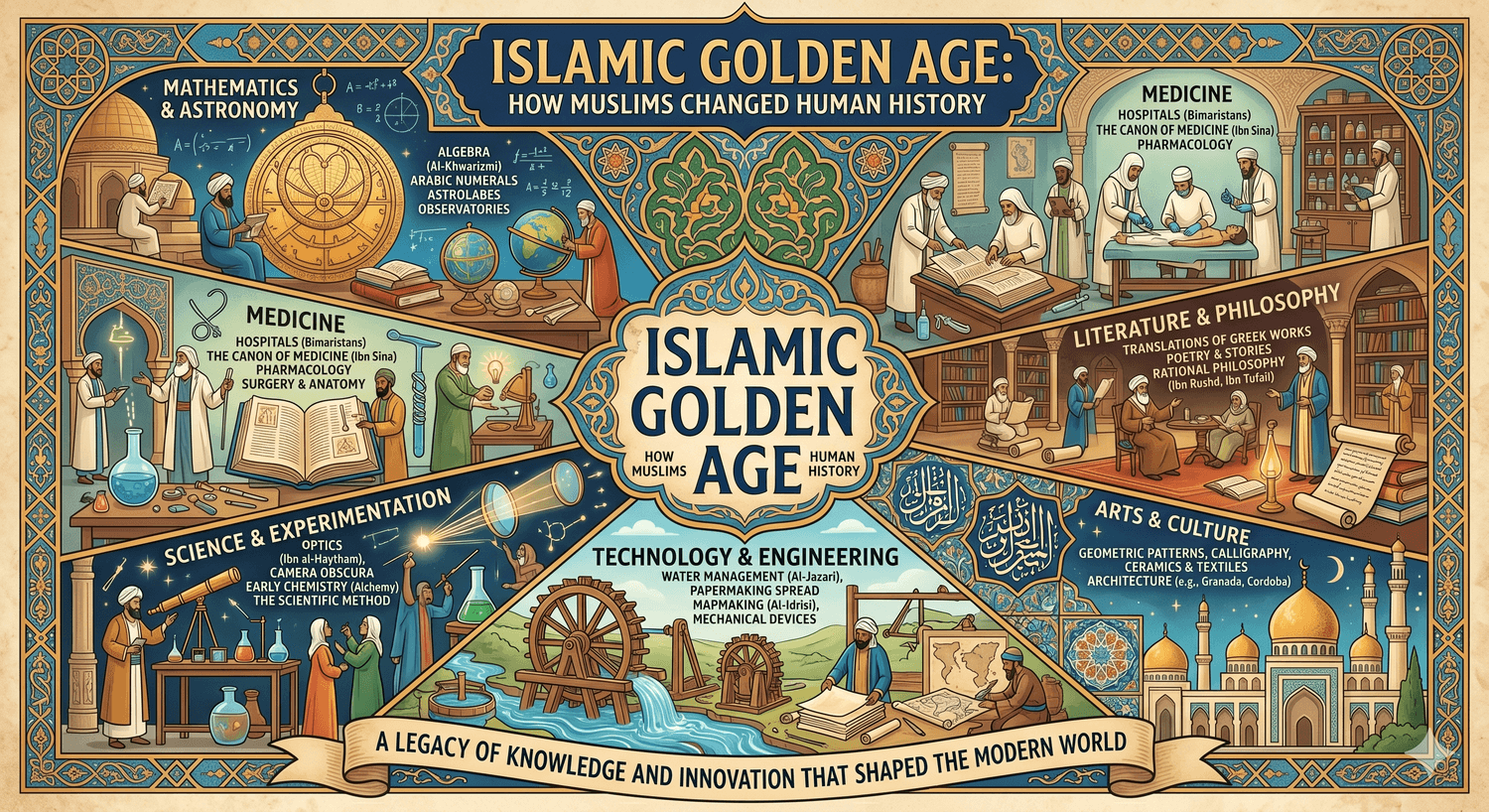
Al-Khwarizmi's 9th-century text, "Al-Kitab al-mukhtasar fi hisab al-jabr wa'l-muqabala" — The Compendious Book on Calculation by Completion and Balancing — introduced a systematic method for solving linear and quadratic equations. This is algebra. It was not a gradual refinement of an existing tradition. It was a new science, developed by a Muslim scholar in Baghdad, transmitted through Latin translations into European universities over the following centuries, and still taught in schools everywhere today.
Al-Khwarizmi also produced work on the Hindu-Arabic numeral system that made it accessible to scholars who could read Arabic. His text on Indian numerals was translated into Latin as "Algoritmi de Numero Indorum" — and the Latinized version of his name, Algoritmi, became the word algorithm.
Abu al-Wafa' al-Buzjani, working in the 10th century, developed the first table of sines and produced the first use of the tangent function. His work on spherical trigonometry was instrumental for astronomical calculations and for navigation — fields that had enormous practical importance for both commerce and religious practice. Muslims need precise calculations to determine prayer times, the direction of Mecca, and the beginnings of lunar months. The religious requirement drove the mathematics.
Omar Khayyam — known in Western literary tradition primarily as a poet — was also one of the foremost mathematicians of the 11th and 12th centuries. He produced a systematic classification of cubic equations and began the work on understanding the nature of parallel lines that would eventually, several centuries later, contribute to the development of non-Euclidean geometry. Ibn al-Haytham developed symbolism in algebraic reasoning. Al-Qalasadi introduced notation that anticipated modern algebraic symbolism.
The Islamic Golden Age didn't just transmit mathematics from one civilization to another. It extended the subject significantly and created new fields within it.
Medicine: The Canon That Ran a Continent
Ibn Sina — known in medieval Europe as Avicenna — was born in 980 CE in what is now Uzbekistan. He had memorized the Quran by age ten. By his early teens he had moved through the standard curriculum of Islamic learning. By his late teens, he had mastered medicine thoroughly enough that senior physicians came to him for consultation. By his death in 1037 CE, he had produced over 400 works across philosophy, logic, mathematics, and medicine.
His medical encyclopedia, "Al-Qanun fi al-Tibb" — The Canon of Medicine — runs to five volumes. It covers anatomy, physiology, diagnosis, pharmacology, the relationship between mental health and physical health, clinical examination methods, and the management of specific diseases. It was the primary medical textbook in European universities from the 12th century until the early 17th century. Not for a few years. For five hundred years.
Al-Razi — known to medieval Europeans as Rhazes — was a Persian physician of the 9th century who produced the first clinical differentiation of smallpox and measles, diseases that had previously been treated as one. This distinction had significant practical consequences for treatment and containment. He is also credited with early work in pediatrics as a distinct field and with developing an understanding of how infection spreads — work that anticipated germ theory by centuries. He introduced the use of quarantine procedures for contagious diseases based on an understanding of contagion that was not yet called by that name.
Al-Zahrawi, working in 10th-century Córdoba in Muslim Spain, wrote a 30-volume medical encyclopedia that included descriptions of over 200 surgical instruments, many of which he designed himself. His descriptions of techniques for controlling hemorrhage during surgery, his use of catgut sutures for internal wounds, his approach to lithotomy, and his work on dental surgery were still being referenced by European surgeons in the 18th century. He is considered the father of modern surgery.
Optics and the Scientific Method
Ibn al-Haytham, known in European scholarship as Alhazen, lived and worked in Cairo in the late 10th and early 11th centuries. His "Kitab al-Manazir" — the Book of Optics — was one of the most consequential scientific works ever produced.
Before Ibn al-Haytham, the dominant theories of vision held that the eye emits something that travels outward and enables seeing. He argued, through systematic experiment, that vision works in the opposite direction: light from external sources enters the eye. He designed controlled experiments to test his hypotheses, built on the results, modified his theories when results contradicted them, and documented his methods in detail so that others could replicate and extend his work.
This is the scientific method. Not as a philosophy discussed in academic contexts, but as a working practice applied to a specific problem and producing specific, replicable results. Ibn al-Haytham's approach preceded Francis Bacon's articulation of scientific method in Europe by six centuries. His work on optics was read by Roger Bacon, by Johannes Kepler, by René Descartes. The tradition of experimental science that we associate with the European scientific revolution was built, in part, on foundations that a Muslim scholar in Cairo had established.
Astronomy: Navigation and the Direction of Prayer
The Islamic Golden Age produced extraordinary work in astronomy for a combination of religious, commercial, and intellectual reasons. Muslims need to know the precise times of daily prayers, the direction of Mecca, and the beginnings of lunar months. These requirements demanded accurate astronomical knowledge, and scholars responded.
Al-Battani, working in Syria in the late 9th and early 10th centuries, refined the calculation of the length of the solar year to a degree of accuracy that Copernicus himself acknowledged and cited in his own work. Al-Battani measured the Earth's axial tilt with precision that would not be significantly improved for centuries. He calculated the precession of the equinoxes and corrected specific errors in Ptolemy's Almagest — errors that had been carried in the tradition for nearly a millennium.
Muslim astronomers built observatories across the empire. They invented and refined the astrolabe, a handheld instrument that could determine latitude, tell time by the sun or stars, locate celestial bodies, and solve numerous spherical trigonometry problems — an extraordinarily versatile tool that European sailors used for navigation well into the age of European maritime expansion.
What Made It End — and What Survived
The Islamic Golden Age is generally considered to have ended with the Mongol destruction of Baghdad in 1258 CE. The Mongols sacked the city, destroyed the House of Wisdom, and destroyed the libraries and book collections that had accumulated over centuries. Medieval accounts describe the Tigris River running black from the ink of thousands of books thrown into it. The institutional infrastructure of the Golden Age was shattered.
But the knowledge did not disappear. It had already been transmitted to Europe through Muslim Spain — through the translation movements in Toledo and Palermo in the 12th and 13th centuries, where Arabic works were rendered into Latin and made accessible to European scholars. The medical texts were already in European universities. The mathematical works were already being read. The astronomical tables were already in use.
The European Renaissance, which began roughly two centuries after the fall of Baghdad, drew directly and explicitly from the Arabic scholarly tradition. The Islamic Golden Age didn't end so much as transfer.
What the Golden Age Was Actually About
The Islamic Golden Age is sometimes presented today as simply a lucky period when the right institutions came together in the right place. But that account misses what actually drove it.
The House of Wisdom was not a secular institution that happened to operate in a Muslim context. It was explicitly motivated by Islamic theological commitments — the conviction that understanding creation is a way of knowing the Creator, that the pursuit of knowledge is an act of worship, that God's signs in the universe are meant to be read and understood. The physicians who studied anatomy believed they were studying the work of God. The astronomers who mapped the sky believed they were reading God's signs. The philosophers who examined Greek logic believed they were developing tools for understanding truth.
That is not a minor historical footnote. It is the explanation for why the Islamic Golden Age happened when and where it did. A civilization whose core text commands reading, whose prophet commands knowledge-seeking, and whose theology treats the study of the natural world as sacred — that civilization, when it has political stability and institutional support, produces exactly what the Islamic Golden Age produced.
Philosophy and the Integration of Knowledge
The Islamic Golden Age produced not just scientists and mathematicians but polymaths — scholars who moved fluidly across disciplines because the tradition did not separate them. Ibn Rushd, known in Europe as Averroes, produced commentaries on Aristotle that became standard reading in European universities and shaped the development of scholastic philosophy. Al-Kindi, one of the first great philosophers of the Islamic world, argued that philosophy and theology were not enemies but allies — that reason properly applied leads to the same truth that revelation declares.
This integration of disciplines was itself an intellectual achievement. The scholars of the Islamic Golden Age did not compartmentalize knowledge into subjects that couldn't talk to each other. A physician was expected to know philosophy. A mathematician was expected to know theology. The polymath — the hakim, the sage — was the ideal figure of the era, and the Islamic intellectual tradition produced an extraordinary number of them precisely because the boundaries between fields were permeable.
Ibn Khaldun, working in the 14th century as the Golden Age was winding down, produced "Al-Muqaddimah" — a theoretical introduction to his history of the world that many scholars consider the first work of systematic sociology and the philosophy of history. He developed theories about social cohesion, the rise and fall of civilizations, economic cycles, and the relationship between environment and culture that were largely without precedent in the literature before him and were not matched in Europe until several centuries later.
The Libraries That Made It Possible
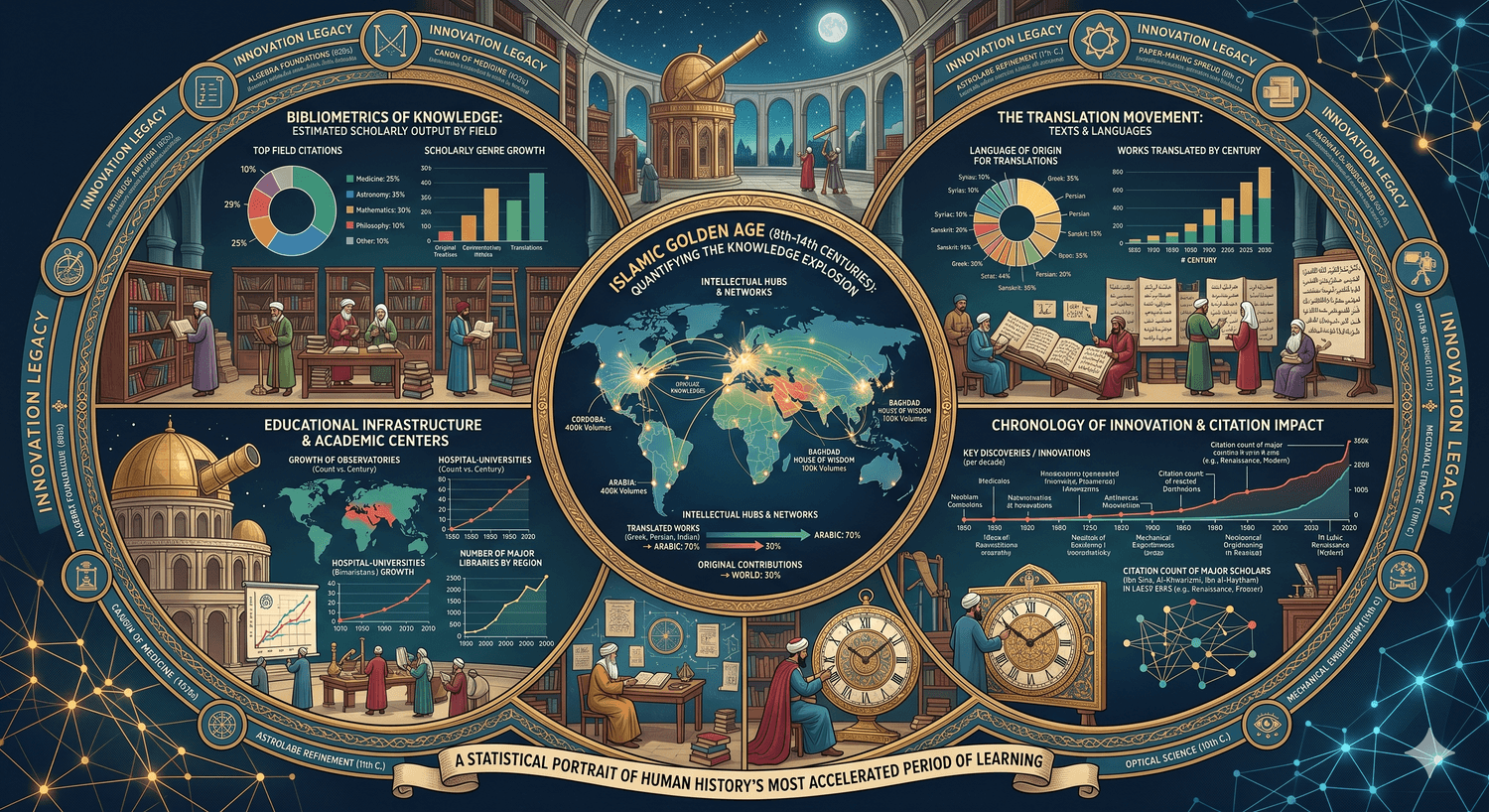
The Islamic Golden Age was also a golden age of libraries and literacy. Baghdad during the Abbasid period reportedly had over 36 public libraries. Córdoba in Muslim Spain — one of the largest cities in Europe at its height — had a library under Caliph al-Hakam II that is said to have contained 400,000 volumes at a time when most European monasteries had a few dozen. Whether or not these numbers are precisely accurate, they reflect a civilization in which books were valued, literacy was expected, and knowledge was understood as something that should be accessible rather than hoarded.
Public libraries in Baghdad were open to scholars of all backgrounds. The Abbasid caliphs paid for translations not because they wanted to possess knowledge but because they believed knowledge should circulate. This institutional culture of accessibility was itself an intellectual achievement — one that made the Golden Age possible by ensuring that the work being done in one place could be read and extended in another.
Curious about what Islam teaches about knowledge, science, and the life of the mind? Our courses at Start Islam Path explore these questions in depth.


