Counter-Terrorism Laws and Muslim Profiling: The Real Cost
Get the 109‑page guide delivered to your inbox
Discover the faith that 1.9 billion people live by — and why thousands of truth-seekers just like you are choosing it every single day. This free 109-page guide walks you from curiosity to clarity, step by step.
No pressure. No judgment. No strings attached. Just a clear, honest roadmap written for people who want real answers — whether you're skeptical, curious, confused, or quietly searching for something deeper.
In the months after September 11, 2001, the US government detained over 1,000 Muslim men in the United States. Not one of them was connected to the attacks. Not a single one. They were detained because of their religion, their names, their countries of origin — not because of evidence. This is documented in public records, reviewed by the ACLU and the Brennan Center for Justice, and has never been seriously disputed.
That's the opening fact. I want you to hold it while we discuss counter-terrorism laws and profiling — because any honest conversation about this subject has to begin with what actually happened, not with what was said to be necessary.
How Broad-Based Surveillance Became the Norm
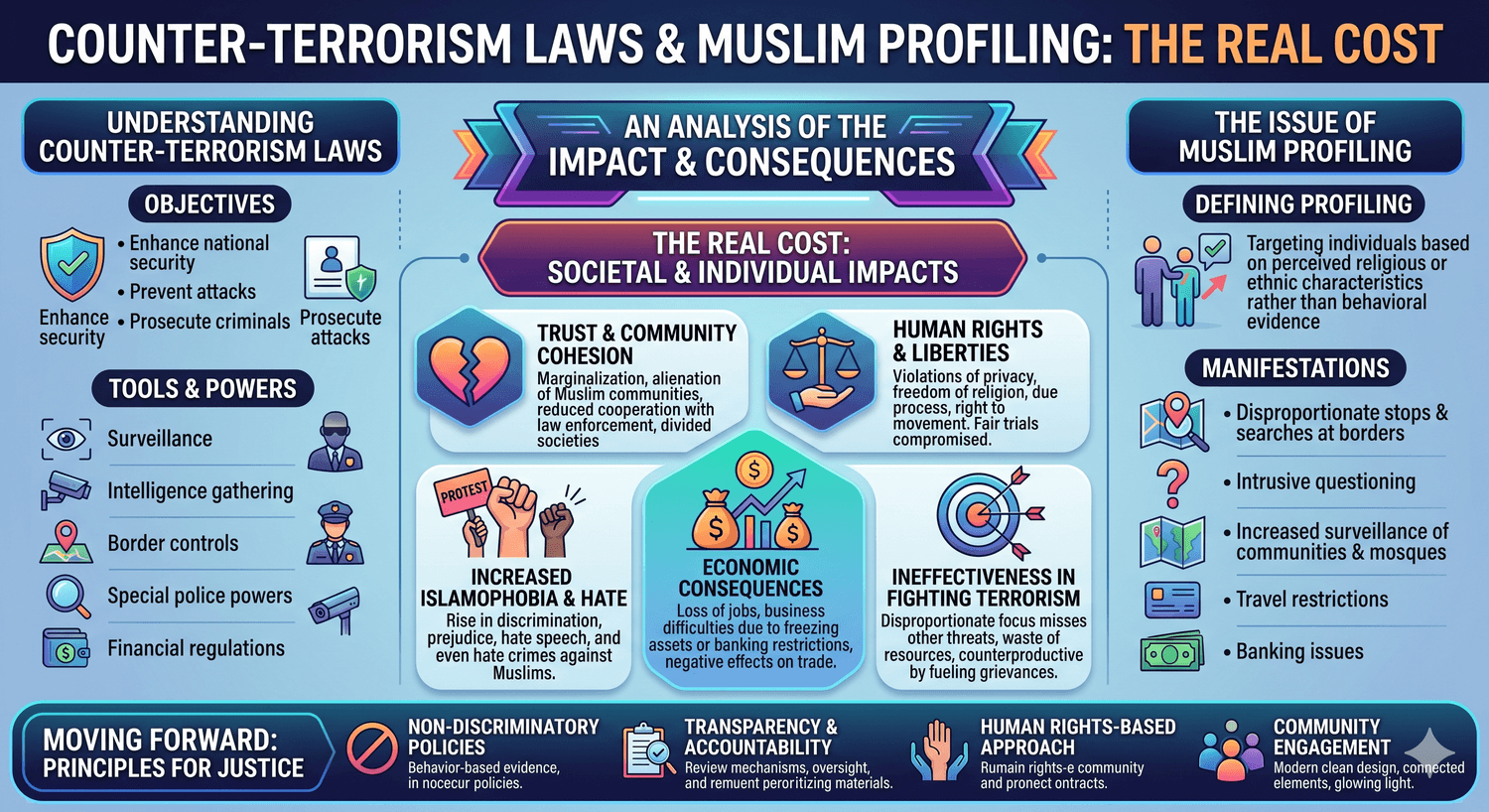
Counter-terrorism laws expanded rapidly after the 2001 attacks. The USA PATRIOT Act, passed 45 days after September 11, gave law enforcement sweeping new powers: expanded wiretapping authority, access to library and financial records, and the ability to conduct surveillance with minimal judicial oversight. These tools had legitimate purposes in specific, evidence-led investigations. What followed in practice, however, was frequently not that.
The New York City Police Department ran a program from 2002 onward that sent plainclothes officers into Muslim neighborhoods across several states. They mapped communities — noting where people ate, shopped, and prayed. They compiled dossiers on student organizations, mosques, and community groups. This was not triggered by any specific threat or tip. It was demographic mapping based on religious identity alone. The program ran for years and, according to the NYPD's own internal documents, produced zero leads to terrorist activity.
In the United Kingdom, the Prevent strategy — officially designed to identify and counter radicalization — became an instrument of broad-scope surveillance of Muslim communities. Research by Rights and Security International found that over 60 percent of Prevent referrals in its first two years of operation were flagged for "Islamist concerns." Muslim students in schools began self-censoring, avoiding discussions of politics or religion out of fear that a reference or question might trigger a referral. Children. Afraid to ask questions in class. In a democracy.
The pattern is consistent across countries: counter-terrorism frameworks built without precise targeting and adequate oversight tend to default to religious and ethnic profiling of Muslim communities. This is not accidental. It reflects the assumptions embedded in the frameworks themselves.
The Effectiveness Problem of Counter-Terrorism Laws
Here is the thing that rarely gets said plainly in political discussions: religious and ethnic profiling in counter-terrorism investigations does not work. It makes security worse, not better.
The US Department of Justice acknowledged this in its own guidelines on profiling, stating explicitly that race-based assumptions "perpetuate negative racial stereotypes that are harmful to our rich and diverse democracy, and materially impair our efforts to maintain a fair and just society." The same guidelines then exempted national security investigations from these protections — a contradiction that has never been satisfactorily explained or resolved.
The European Network Against Racism reached the same operational conclusion: ethnic and religious profiling "alienates the very communities whose support is necessary for fighting crime and terrorism." This is not ideological. It is practical. Communities that feel targeted by law enforcement become less willing to cooperate with law enforcement. The specific information that genuine counter-terrorism depends on — tips from people who know a neighborhood, who notice a change in behavior, who can distinguish between normal religious observance and something genuinely concerning — comes from trust. Surveillance-based profiling destroys that trust.
In Prevent, the UK government acknowledged that there is no reliable way to predict who will become a terrorist, but continued funding programs built on precisely such predictions. The programs have never been shown to identify a terrorist in the making. They have been shown, repeatedly, to alienate the communities they claim to protect.
Counter-terrorism laws and profiling, when applied to entire communities rather than specific, evidence-based targets, produce the exact conditions they claim to prevent. A young Muslim man who has been stopped, questioned, and treated as a suspect multiple times without cause does not walk away feeling protected by the state. He walks away feeling marked.
The Narrative Problem
Something worth understanding about counter-terrorism laws and profiling is the story that makes them seem logical. The story goes like this: terrorism is primarily a Muslim problem, and therefore counter-terrorism properly focuses on Muslim communities.
This story has two major factual problems.
First, the identification of "terrorist" with "Muslim" in media and political discourse does not match the distribution of actual terrorist attacks in Western countries. The Fordham Law Review published an extensive analysis of this gap. Right-wing extremists have carried out the majority of domestic terrorist incidents in the United States in most years since 2001 — a fact that receives substantially less coverage and produces substantially less policy response than attacks by individuals with Muslim backgrounds. The FBI and other agencies have consistently allocated disproportionate resources to "Islamist" threats while understating the domestic extremist threat, with predictable consequences for national security.
Second, the assumption that Muslim communities are the natural starting point for counter-terrorism investigations produces investigative blind spots. When security resources are concentrated on one demographic based on assumption rather than evidence, actual threats that originate elsewhere are more likely to be missed. The narrative that fuels profiling also undermines the investigation it claims to enable.
This is not a defense of political violence in any form. Islam is unambiguous and specific on this question. The Quran states: "Whoever kills a soul — it is as if he has killed all mankind. And whoever saves one — it is as if he has saved all mankind" (Quran 5:32). No qualification. No religious exception. No political carve-out. The sanctity of human life in Islamic teaching is unconditional. Muslim scholars across traditions have consistently condemned terrorism and political violence targeting civilians, often at considerable personal risk and against considerable social pressure.
The problem being discussed here is not whether terrorism should be countered. It should. The problem is when counter-terrorism becomes a mechanism for treating 1.8 billion people as a suspect class because of the actions of a fraction of a fraction of their number, and when that treatment is then encoded in law.
The Human Cost That Doesn't Make the Data
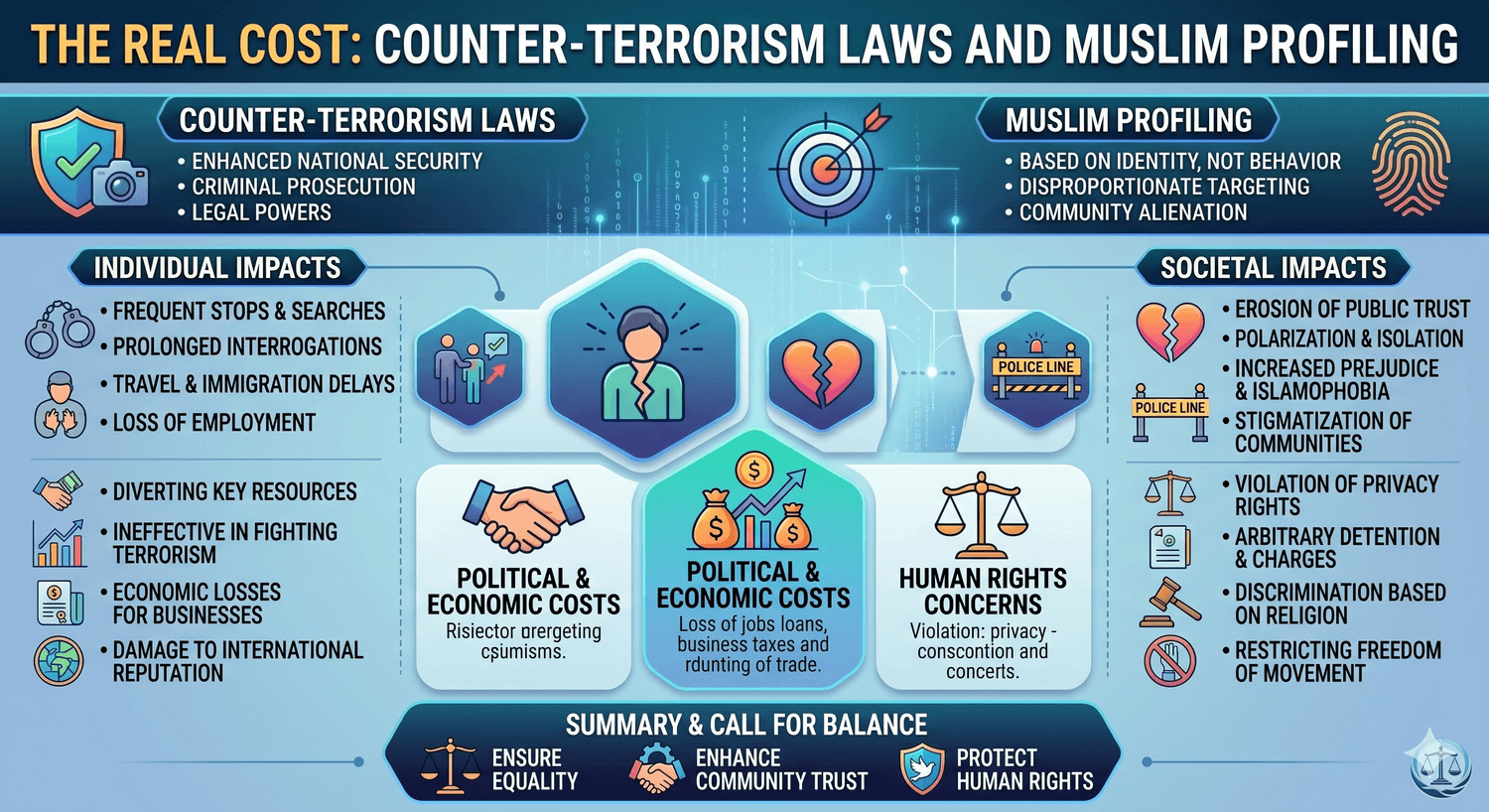
Counter-terrorism laws and profiling do not only affect people who are detained or placed on watchlists. Their effects are distributed more broadly and are harder to quantify.
Research by Ballard Brief found that 55 percent of American-Muslim students in primary or secondary school faced some form of discrimination connected to their religious identity, with verbal assault being the most common form. These students are not adult activists or public figures. They are children navigating school corridors. The environment that produces this — shaped partly by political rhetoric, partly by media framing, and partly by the official association of Islam with security threat — flows directly from the same assumptions embedded in counter-terrorism law.
In the UK, research found that Muslim communities were self-censoring across multiple domains: in classrooms, in medical consultations, in community organizations. People who had done nothing wrong were monitoring their own language, moderating their own religious expression, and limiting their civic participation because they had internalized the experience of being regarded as potentially dangerous.
The FBI placed Muslim citizens on the No-Fly List not because they had committed any crime, but because they refused to spy on their own communities when the Bureau requested it. Refusing an informal request by a law enforcement agency — something every citizen has the right to do — became grounds for travel restriction. The Center for Constitutional Rights litigated this directly. The cases are documented.
There is a cost to being perpetually suspect. It is measured in the academic performance of students who experience daily discrimination. It is measured in the civic withdrawal of communities that have learned their participation is unwelcome. It is measured in the lost trust that makes genuine security cooperation impossible. None of this is captured in the budget line of a surveillance program.
What Justice Looks Like in Islamic Teaching
Muslims living as minorities in Western countries are not, in the main, calling for the abolition of security infrastructure. They want to live safely. They want the same protections that all citizens are entitled to. What they ask is that security be based on evidence, that it be applied without religious or ethnic discrimination, and that they be treated as members of the communities that security is meant to protect.
Islam has a highly developed tradition of thought about justice and the treatment of people under governance. The Quran commands: "O you who believe, be persistently standing firm in justice, witnesses for Allah, even if it be against yourselves or parents and relatives" (Quran 4:135). Justice that carves out exceptions for familiar categories is not justice in the Islamic framework. It is recognized explicitly as self-serving.
The Prophet Muhammad ﷺ gave a specific warning about the treatment of those living under Muslim authority: "Whoever wrongs a person in covenant, or diminishes his right, or burdens him beyond his capacity, or takes from him something without his consent — I will be his adversary on the Day of Judgment." (Abu Dawud). The warning is addressed to those who hold power over others. The principle is that power must be constrained by accountability to something beyond itself.
This is not an abstract theological position. It is a precise description of the problem with surveillance programs that treat people as threats without evidence: the state has taken something — privacy, freedom of movement, freedom of association — without consent, and without cause.
A More Honest Conversation
The genuine tension in discussions about counter-terrorism laws and profiling is not between security and civil liberties. It is between effective security and ineffective security. The evidence strongly suggests that targeted, evidence-led investigations of specific threats produce better security outcomes than broad-gauge surveillance of religious communities. The communities that feel respected and included provide more useful information to law enforcement. The communities that feel surveilled and suspected withdraw.
The question that counter-terrorism laws and profiling ultimately raise is not whether terrorism should be countered. It should be, vigorously. The question is whether the methods being used actually accomplish what they claim to accomplish, and whether their costs — in trust, in community cohesion, in civil liberties, and in the dignity of millions of innocent people — are justified by those results.
The evidence says they are not. That is not a political position. It is what the data from decades of surveillance programs consistently shows.
Honest security policy requires taking both questions seriously: the reality of the threat and the reality of the methods being used to counter it. Blanket profiling fails both tests — it does not protect effectively, and it does not treat people justly.
The Wider Effect on Muslim Civic Participation
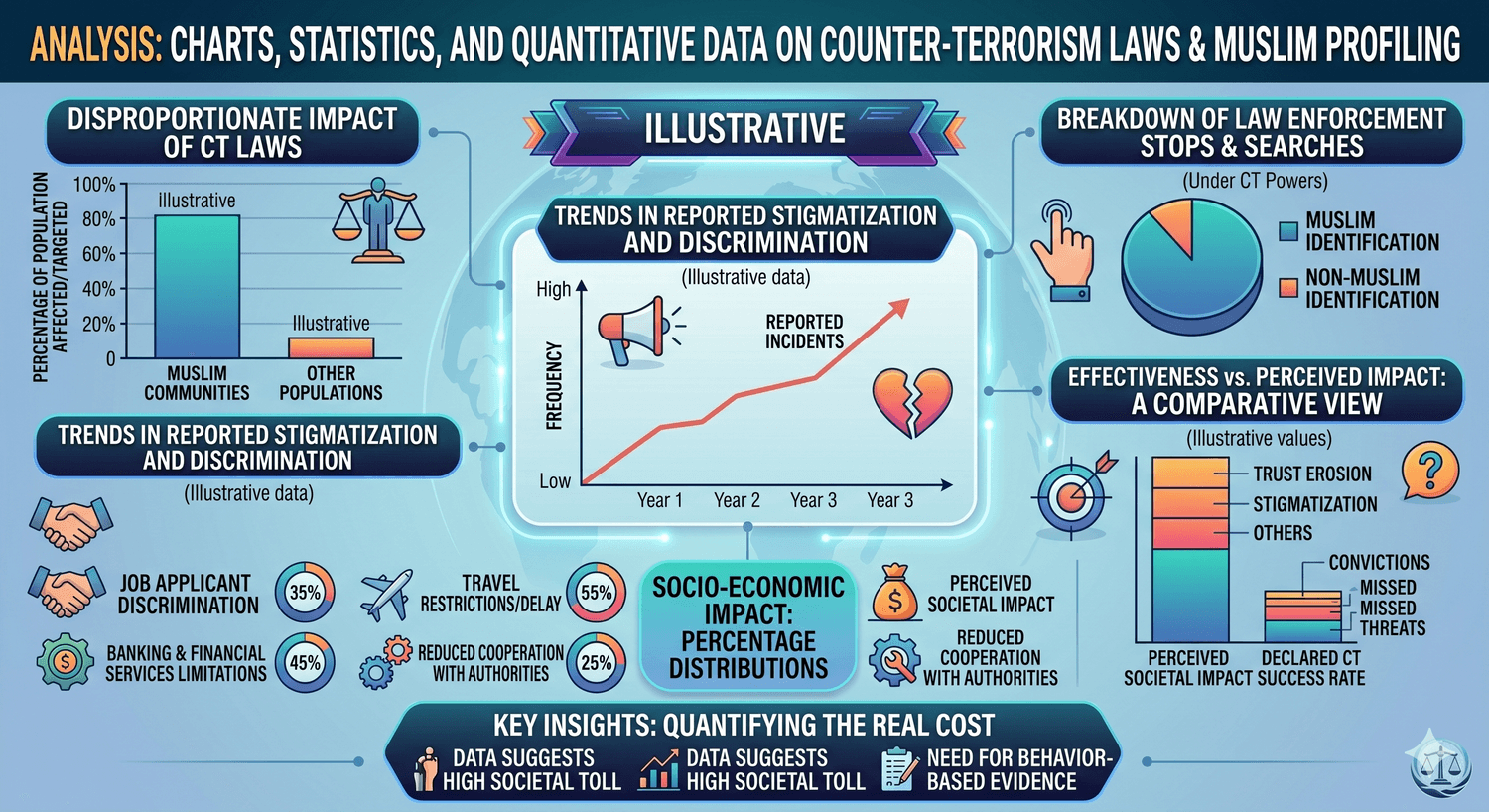
Counter-terrorism laws and profiling don't only touch people who are detained, surveilled, or placed on lists. Their effects spread through communities in ways that are harder to measure but no less real.
When mosques know their sermons are being monitored, imams adjust what they say. When Muslim community organizations know that grant applications may trigger scrutiny, they limit their work. When young Muslims grow up watching their parents pulled aside at airports, asked to remove head coverings, questioned about their travel, their associations, and their beliefs, they internalize a lesson about their standing in the society they live in. That lesson doesn't produce radicalization — the data doesn't support that connection — but it produces exactly what any reasonable person would predict: withdrawal, distrust, and reduced participation in civic life.
Research conducted across France, Germany, Hungary, Poland, and Spain by the European Network Against Racism found that Muslims in all five countries reported self-censoring their religious and political expression, limiting the use of Islamic phrases in public, and avoiding discussions that might draw official attention. People described feeling safe but living in fear — a combination that speaks to the specific cost of structural suspicion. Not the fear of physical violence, but the constant monitoring of one's own behavior to avoid being misread.
This is not a problem confined to any single country or any single legal framework. It is a predictable consequence of building counter-terrorism policy around demographic assumptions rather than specific evidence.
What Honest Policy Would Look Like
The alternative to counter-terrorism laws and profiling that target communities based on religion is not the absence of counter-terrorism policy. It is counter-terrorism policy that is actually designed to work — targeted at specific, credible, evidence-based threats, conducted with genuine legal oversight, and built in cooperation with the communities it claims to protect rather than against them.
Flagstaff, Arizona is not usually invoked in discussions of counter-terrorism. But the principle that a community and its residents can coexist productively, that inclusion produces better outcomes than exclusion — this applies to counter-terrorism as directly as it applies to anything else. Communities that feel trusted cooperate. Communities that feel surveilled withdraw. Law enforcement that builds trust accesses information it could not access through surveillance. These are not idealistic claims. They are documented operational realities in police departments that have studied the question.
The conversation about counter-terrorism laws and profiling deserves to be held at that operational level, not at the level of political messaging. What works? What produces the outcomes we actually want? The evidence says that blanket profiling of Muslim communities, measured against its stated goals of preventing terrorism, does not work. It produces significant costs, in dignity and in civil liberties, while delivering minimal or no security benefit.
To understand what Islam actually teaches about justice, dignity, and the rights of people — explore our courses at Start Islam Path, written for the genuinely curious.


