What Is Islam? A Complete Guide for Non-Muslims
Get the 109‑page guide delivered to your inbox
Discover the faith that 1.9 billion people live by — and why thousands of truth-seekers just like you are choosing it every single day. This free 109-page guide walks you from curiosity to clarity, step by step.
No pressure. No judgment. No strings attached. Just a clear, honest roadmap written for people who want real answers — whether you're skeptical, curious, confused, or quietly searching for something deeper.
Islam is the world's second-largest religion, with approximately 1.9 billion followers across every country on earth. At its core, Islam is a monotheistic faith centered on the belief in one God (Allah) and the acceptance of Muhammad ﷺ as His final prophet. It is not simply a religion in the Western sense — it is a complete way of life that governs belief, worship, ethics, relationships, and purpose. This guide explains what is Islam, and what it actually teaches, who Muslims are, and why nearly a quarter of humanity calls this faith their own.
What Is Islam? The Meaning of the Word "Islam"
The word Islam comes from the Arabic root s-l-m, which carries the meanings of peace, safety, and submission. Islam therefore means "submission to God" — specifically, the conscious, willing surrender of one's will to the will of the Creator.
A person who practices Islam is called a Muslim — one who submits. The word Muslim shares the same root as Islam and as salam, the Arabic word for peace.
This etymology matters because it immediately corrects one of the most common misconceptions: Islam is not a religion invented by Muhammad ﷺ, nor is it an Arab religion. In Islamic theology, Islam is the original and eternal religion of God — the same message delivered by every prophet in history, from Adam to Noah to Abraham to Moses to Jesus to Muhammad ﷺ — the final messenger.
The Core Belief of Islam: Tawhid
The single most important concept in Islam is Tawhid — the absolute oneness of God.
Islam is rigorously monotheistic. Allah (the Arabic word for God, used by Arab Christians and Jews as well) is:
One, without partners, equals, or associates
The Creator of everything that exists
Not born and does not give birth
Eternal, all-knowing, all-powerful, most merciful
Beyond human comprehension, yet closer to each person than their jugular vein (Quran 50:16)
Everything in Islamic theology flows from this single idea: there is only one God, and He alone deserves worship.
Who Is Muhammad ﷺ?
Muhammad ﷺ (peace be upon him) was born in Mecca, Arabia, in approximately 570 CE. He was a merchant known for his extraordinary honesty and character — so trusted that people called him Al-Amin: the Trustworthy.
At the age of 40, he received the first revelation of the Quran through the angel Jibreel (Gabriel). Over the next 23 years, the complete Quran was revealed to him in stages.
Muslims believe Muhammad ﷺ was the final prophet — the seal of all prophethood. He was not divine. He was human — a husband, father, community leader, and messenger. His life (sunnah) — his words, actions, and approvals — is the second primary source of Islamic guidance after the Quran.
The Holy Book of Islam: The Quran
The Quran is the direct, literal word of God as revealed to Muhammad ﷺ and preserved in its original Arabic form for over 1,400 years. Muslims believe it is the final and complete revelation — the uncorrupted word of God.
Key facts about the Quran:
114 chapters (surahs) of varying length
Approximately 6,236 verses (ayahs)
Revealed in Arabic, but translated into every major language
Memorized in its entirety by millions of Muslims worldwide (huffaz)
Covers theology, law, history, ethics, science, and the nature of existence
The Quran was not written by Muhammad ﷺ — he himself was illiterate. It was memorized and recorded by companions during his lifetime and compiled into a single manuscript shortly after his death. That original text has remained unchanged.
What Are the 5 Pillars of Islam?
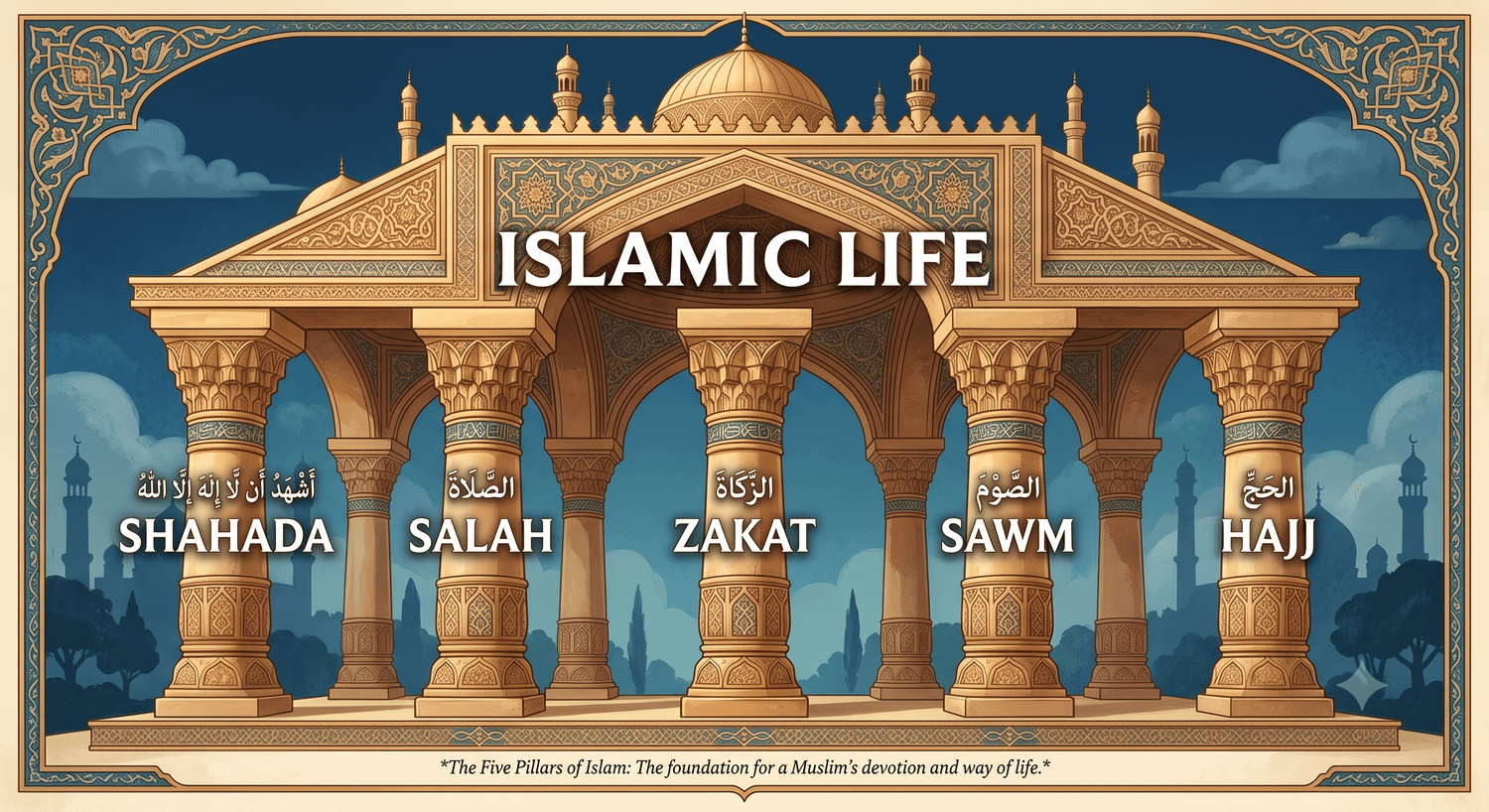
The 5 Pillars are the foundational practices of Islamic life. Every Muslim is required to observe them:
1. Shahada — The Declaration of Faith
"I bear witness that there is no god but Allah, and I bear witness that Muhammad is the messenger of Allah."
This statement is the entry point into Islam. Saying it sincerely, with full understanding, makes a person Muslim.
2. Salah — Prayer
Muslims pray five times daily: at dawn (Fajr), midday (Dhuhr), afternoon (Asr), sunset (Maghrib), and night (Isha). Each prayer involves specific words and physical movements — standing, bowing, and prostrating — and takes approximately 5–10 minutes. Prayer is performed facing Mecca and is preceded by ritual purification (wudu).
3. Zakat — Almsgiving
Muslims who possess wealth above a minimum threshold (nisab) for one full year are required to give 2.5% of that wealth annually to those in need. Zakat is not charity in the optional sense — it is an obligation, a purification of wealth, and a mechanism for economic justice.
4. Sawm — Fasting
During the month of Ramadan (the 9th month of the Islamic lunar calendar), Muslims fast from dawn to sunset — abstaining from food, drink, smoking, and sexual relations. Ramadan is a month of intensified worship, self-discipline, gratitude, and community.
5. Hajj — Pilgrimage
Every Muslim who is physically and financially able is required to perform Hajj — the pilgrimage to Mecca — at least once in their lifetime. Hajj is the largest annual human gathering on earth, drawing approximately 2–3 million Muslims from every country.
What Are the 6 Articles of Faith?
Beyond practice, Islam requires belief in six foundational truths:
Belief in Allah — One God, without partners or equals
Belief in Angels — Created from light, they carry out God's commands
Belief in Divine Books — Including the Torah, Psalms, Gospel, and Quran
Belief in Prophets — From Adam to Muhammad ﷺ, the final messenger
Belief in the Day of Judgment — Resurrection, accountability, paradise, and hellfire
Belief in Divine Decree (Qadar) — God's knowledge encompasses all things, past, present, and future
What Do Muslims Believe About Jesus?
This surprises many people: Muslims deeply revere Jesus (Isa in Arabic). He is considered one of the greatest prophets in Islam — born of a virgin, able to perform miracles by God's permission, and the Messiah. The Quran dedicates an entire chapter to his mother Mary (Maryam).
Where Islam differs from Christianity: Muslims do not believe Jesus was divine or the son of God. The Islamic understanding is that Jesus was a fully human prophet — and that the idea of God taking human form or having a son contradicts the absolute oneness of God (Tawhid).
Muslims believe Jesus was not crucified but was raised by God, and that he will return before the Day of Judgment.
Where Did Islam Come From? A Brief History
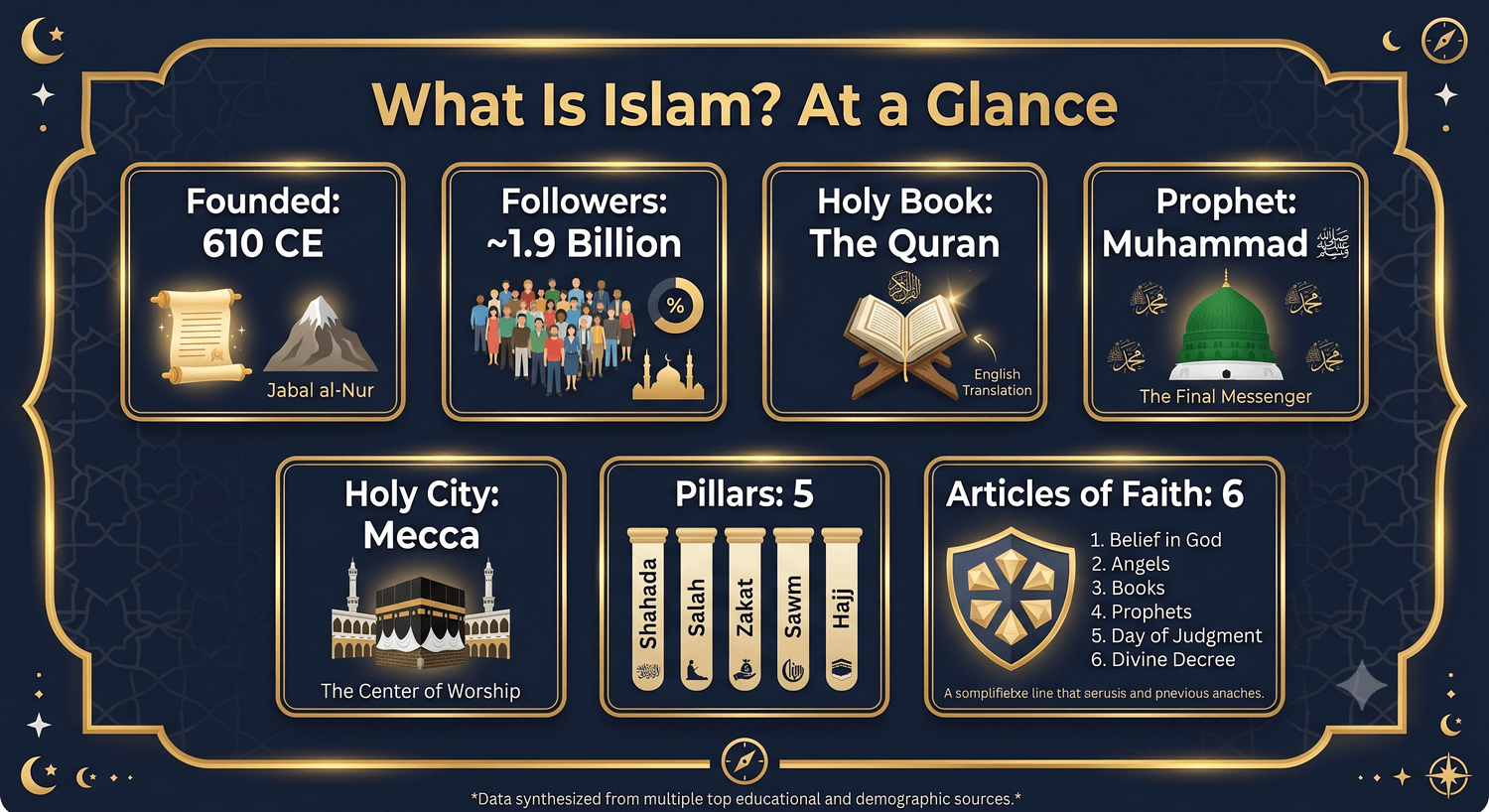
Islam, as a formal religious community, began in 610 CE with the first revelation to Muhammad ﷺ in a cave outside Mecca. But in Islamic theology, the message is eternal — the same monotheism taught by every prophet before him.
Key historical milestones:
610 CE — First revelation of the Quran to Muhammad ﷺ
622 CE — The Hijra: migration from Mecca to Medina, marking the beginning of the Islamic calendar
630 CE — Conquest of Mecca; Islam established across the Arabian Peninsula
632 CE — Death of the Prophet Muhammad ﷺ
632–750 CE — Rapid spread of Islam across the Middle East, North Africa, Persia, and into Spain and Central Asia
750–1258 CE — The Islamic Golden Age: a period of extraordinary advances in science, mathematics, medicine, philosophy, and art
Present — 1.9 billion Muslims in every country on earth, comprising approximately 25% of the global population
What Does Islam Teach About How to Live?
Islam provides comprehensive guidance across every dimension of human life:
Spirituality: Daily prayer, Quranic reflection, remembrance of God (dhikr), and the cultivation of God-consciousness (taqwa) throughout the day.
Ethics: Honesty, justice, humility, compassion, generosity, and respect for all people — Muslim and non-Muslim alike.
Family: Islam places immense importance on family. Marriage is strongly encouraged. Parents are to be honored, children are to be raised with care and education, and family ties are to be maintained even when strained.
Community: Islam creates a global brotherhood and sisterhood (ummah). Muslims are responsible for one another — in hardship, in celebration, and in moral accountability.
Justice: The Quran repeatedly commands Muslims to stand for justice, even against themselves or those closest to them (Quran 4:135). Economic exploitation, racism, and oppression are explicitly prohibited.
Knowledge: The first word revealed to the Prophet ﷺ was Iqra — "Read." Islam places seeking knowledge as a religious obligation. The Prophet ﷺ said: "Seeking knowledge is an obligation upon every Muslim."
What Does Islam Say About Other Religions?
Islam recognizes and respects the divine origin of all previous monotheistic faiths. The Quran refers to Jews and Christians as "People of the Book" — those who received earlier revelations from God.
On interfaith relations, the Quran is explicit: "There is no compulsion in religion" (Quran 2:256). Muslims are commanded to engage people of other faiths with wisdom and good conduct (Quran 16:125).
Islamic history includes centuries of coexistence between Muslims, Christians, and Jews in places like Andalusia, the Ottoman Empire, and the Abbasid Caliphate — periods that produced some of civilization's greatest intellectual achievements through interfaith collaboration.
Common Misconceptions About Islam
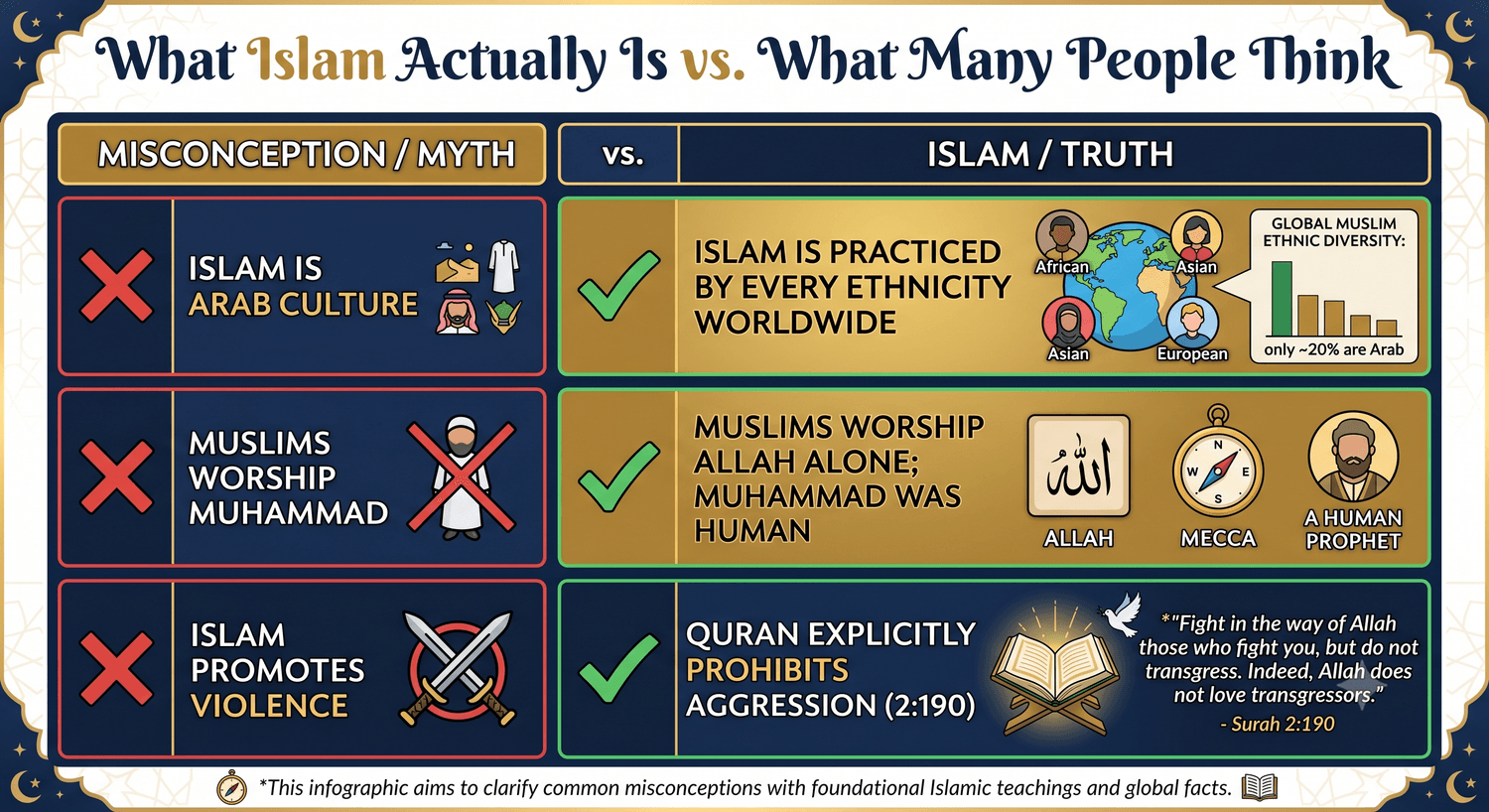
"Islam is a religion of violence." The Quran prohibits aggression explicitly: "Fight in the way of Allah those who fight you, but do not transgress limits" (Quran 2:190). The vast majority of the world's 1.9 billion Muslims live peaceful, ordinary lives. Terrorism is condemned by mainstream Islamic scholarship universally.
"Allah is a different God than the Christian or Jewish God." Allah is simply the Arabic word for God — the same God worshipped by Abraham, Moses, and Jesus. Arab Christians use the word "Allah" in their own Bibles. There is one God in Abrahamic theology.
"Islam oppresses women." Islam gave women property rights, the right to divorce, the right to inheritance, and the right to education — in the 7th century, centuries before most Western civilizations did. The Quran explicitly states that men and women are equal before God (Quran 33:35).
"Muslims worship Muhammad ﷺ." Muslims do not worship Muhammad ﷺ. He was a human being and a prophet. Worship belongs to God alone. This is so fundamental that when the Prophet ﷺ died, the first Caliph Abu Bakr told the people: "Whoever worshipped Muhammad, let him know that Muhammad is dead. Whoever worshipped Allah, let him know that Allah never dies."
Who Are Muslims?
Muslims are not a monolithic group. They are:
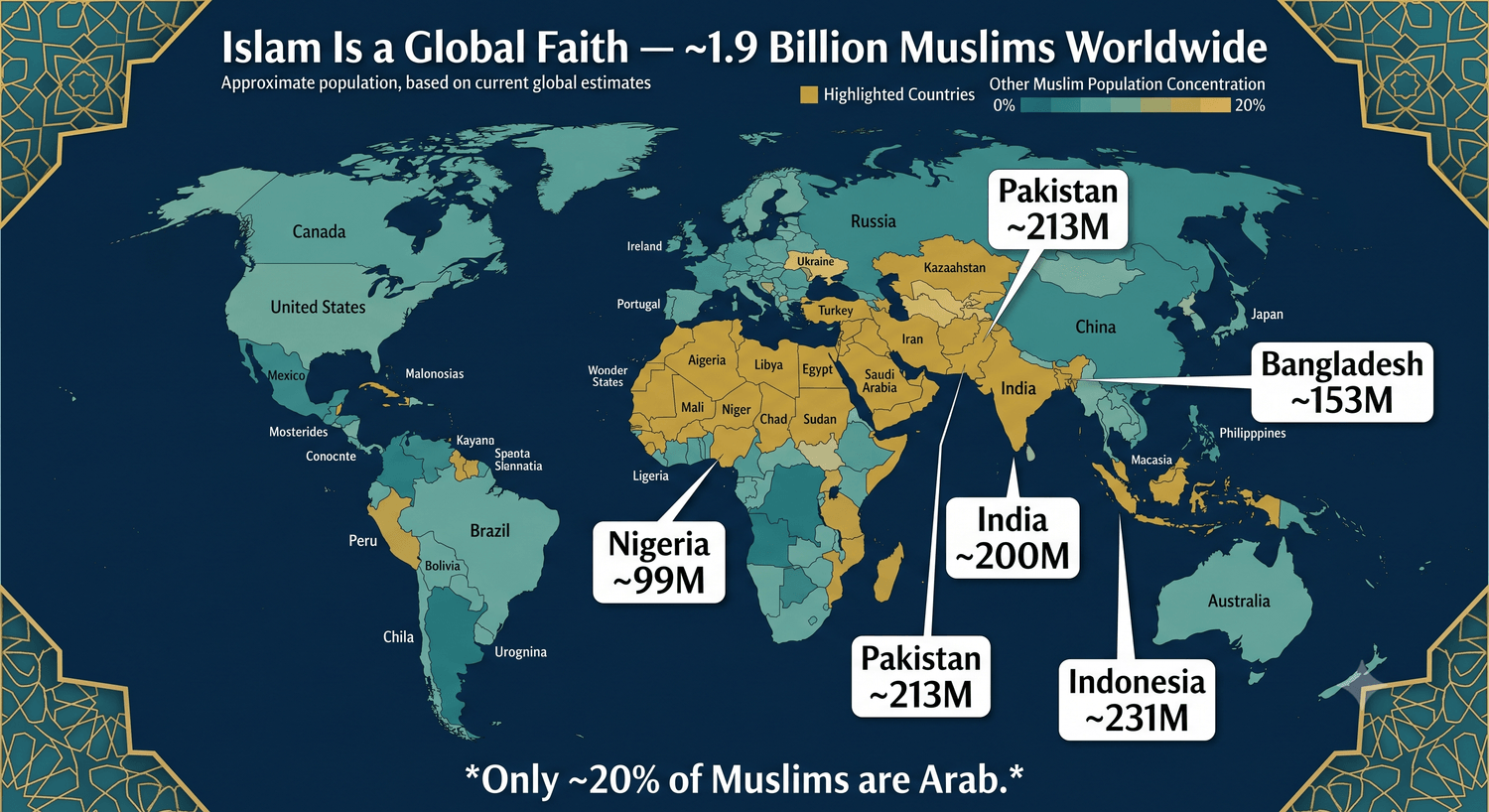
1.9 billion people across 195+ countries
Arab, South Asian, African, East Asian, European, American, and every other ethnic background
The majority are NOT Arab — only about 20% of Muslims are Arab
The largest Muslim populations are in Indonesia, Pakistan, Bangladesh, and India — not the Middle East
Doctors, engineers, teachers, artists, athletes, and leaders in every field worldwide
Islam is not a foreign religion. It is a global one.
Why Do People Choose Islam?
Across cultures and continents, people come to Islam through many different paths:
Intellectual conviction — finding the theological arguments for monotheism compelling
Spiritual hunger — seeking a direct, personal relationship with God
Moral framework — drawn to Islam's emphasis on justice, honesty, and community
Curiosity turned study — beginning with questions and finding answers
Marriage or relationships — learning Islam through a Muslim partner and choosing it independently
Whatever the path, Islam's invitation is consistent: look at the evidence, reflect honestly, and decide for yourself.
Frequently Asked Questions About Islam
Is Islam a religion or a way of life?
Islam is both. It encompasses personal faith, communal practice, ethical conduct, and comprehensive guidance for every aspect of life — from prayer to business ethics to family relations. It does not separate the spiritual from the practical.
Do Muslims believe in heaven and hell?
Yes. Islam teaches that every human being will be resurrected on the Day of Judgment and held accountable for their beliefs and actions. Those who believed sincerely and lived righteously will enter paradise (Jannah). Those who rejected truth and committed evil will face consequences. Mercy is central to Islamic theology — the Quran begins with "In the name of Allah, the Most Gracious, the Most Merciful."
Is the Quran really unchanged from the original?
Yes — this is historically verifiable. The Quran was memorized in full by thousands of companions during the Prophet's lifetime. Written manuscripts from within decades of his death match the text used today exactly. No other religious scripture has a comparable chain of preservation.
Can non-Muslims read the Quran?
Absolutely. The Quran is available in every major language and is freely accessible to anyone who wants to read it. Many people who later converted to Islam began simply by reading the Quran out of curiosity.
Does Islam allow questioning and doubt?
Yes. The Quran repeatedly calls on readers to reflect, observe, and reason. "Do they not look at the camels — how they are created?" (Quran 88:17). Islam is the only major religion that repeatedly challenges its followers to verify its truth through evidence and reflection.
What is the difference between Islam and Muslim?
Islam is the religion — the complete way of life revealed by God. Muslim is the person who follows it. Not every person born into a Muslim family is necessarily a practicing Muslim, just as not everyone born into a Christian family is a practicing Christian.
Your Starting Point
Islam is not a religion you need to accept blindly. It is a faith that invites scrutiny — that asks you to look, think, question, and decide based on evidence and honest reflection.
If what you've read here has raised more questions than it's answered, that is exactly as it should be. The questions are the beginning. And there is a place to take them.
The free 109-page guide — Steps for Converting to Islam and Maintaining Faith — was written for people exactly where you are. Curious. Searching. Not ready to commit to anything yet. Just wanting honest answers. [Download it free here]


