Anti-Muslim Discrimination: What It Is, Who It Affects, and What to Do
Get the 109‑page guide delivered to your inbox
Discover the faith that 1.9 billion people live by — and why thousands of truth-seekers just like you are choosing it every single day. This free 109-page guide walks you from curiosity to clarity, step by step.
No pressure. No judgment. No strings attached. Just a clear, honest roadmap written for people who want real answers — whether you're skeptical, curious, confused, or quietly searching for something deeper.
Anti-Muslim discrimination did not begin on September 11, 2001. What that day did was tear away a thin layer of tolerance that had kept certain sentiments quiet, and what followed was decades of policy, media, and public hostility that millions of Muslims have navigated every single day since.
If you are new to Islam, or simply trying to understand why so many Muslims carry a low-grade vigilance wherever they go, this is the piece that explains it. Anti-Muslim discrimination is not abstract. It happens in airports, job interviews, schools, mosques, hospitals, and neighborhood streets. It shapes the way Muslim families decide where to live, what to wear, and how openly to practice their faith.
What Anti-Muslim Discrimination Actually Looks Like
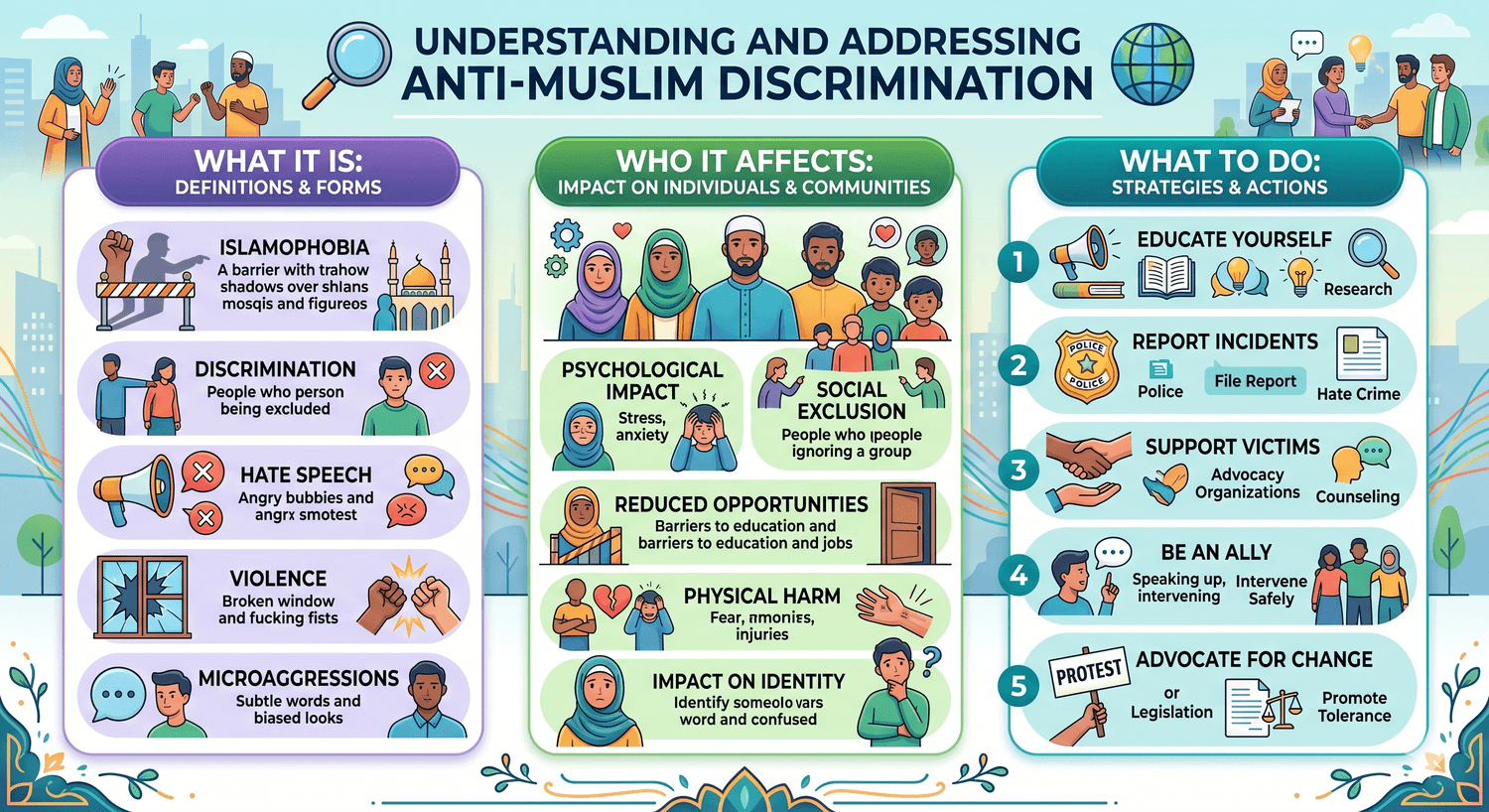
People often picture anti-Muslim discrimination as dramatic: a burning mosque, a violent attack, a slur shouted in public. Those things happen. In the years following September 11, the FBI recorded anti-Muslim hate crimes rising by roughly 1,600 percent from 2000 to 2001. That number has never truly returned to what it was before.
But most anti-Muslim discrimination is quieter. It looks like a job application that never gets a reply when the applicant is named Mohamed or Aisha. It looks like a woman in a hijab being pulled aside at airport security while her non-Muslim colleagues walk through. It looks like a child told he is a terrorist because he brought dates to share during Ramadan.
The U.S. Equal Employment Opportunity Commission is clear: discrimination based on religion, national origin, or race is illegal under Title VII of the Civil Rights Act of 1964. Employers must make reasonable accommodations for religious practices — prayer breaks, religious dress, dietary observance. And yet, employment discrimination consistently ranks among the highest categories of complaints filed with the Council on American-Islamic Relations (CAIR).
In 2024, CAIR received 8,658 complaints nationwide — the highest number ever recorded since the organization began tracking data in 1996. Employment discrimination made up 15.4 percent of those complaints. Immigration and asylum issues accounted for 14.8 percent. Education came in at 9.8 percent, and hate crimes at 7.5 percent. These are real cases. Real people.
The Role of Government Policy in Anti-Muslim Discrimination
One of the harder truths about anti-Muslim discrimination is that it has not only been practiced by individuals. It has been structurally embedded in government programs.
After 9/11, the FBI began mapping Muslim communities across the country based on broad assumptions about which groups pose security risks. The TSA implemented screening practices that subjected Muslim passengers to disproportionate secondary checks. The federal "Countering Violent Extremism" initiative effectively cast entire Muslim neighborhoods as suspect, turning teachers and religious leaders into informal informants — a practice Muslim communities across the country rejected, naming it for what it was: institutionalized suspicion.
The ACLU documented dozens of cases in which Muslim Americans were denied services, detained without cause, and profiled at borders and in their own cities. In one case, a Muslim U.S. Army reservist was denied service at an Oklahoma gun range that maintained an openly discriminatory "anti-Muslim" policy. The ACLU filed suit on his behalf.
These are not outliers. They reflect a climate in which being Muslim — or merely appearing to be Muslim, whether you are a Sikh, a South Asian Hindu, or an Arab Christian — places you in a category of heightened scrutiny. The United Nations General Assembly recognized the scale of the problem in 2022, formally designating March 15 as the International Day to Combat Islamophobia, noting that Muslims worldwide face verbal and physical attacks, religious profiling, and unequal access to jobs, housing, and healthcare.
Who Bears the Heaviest Burden
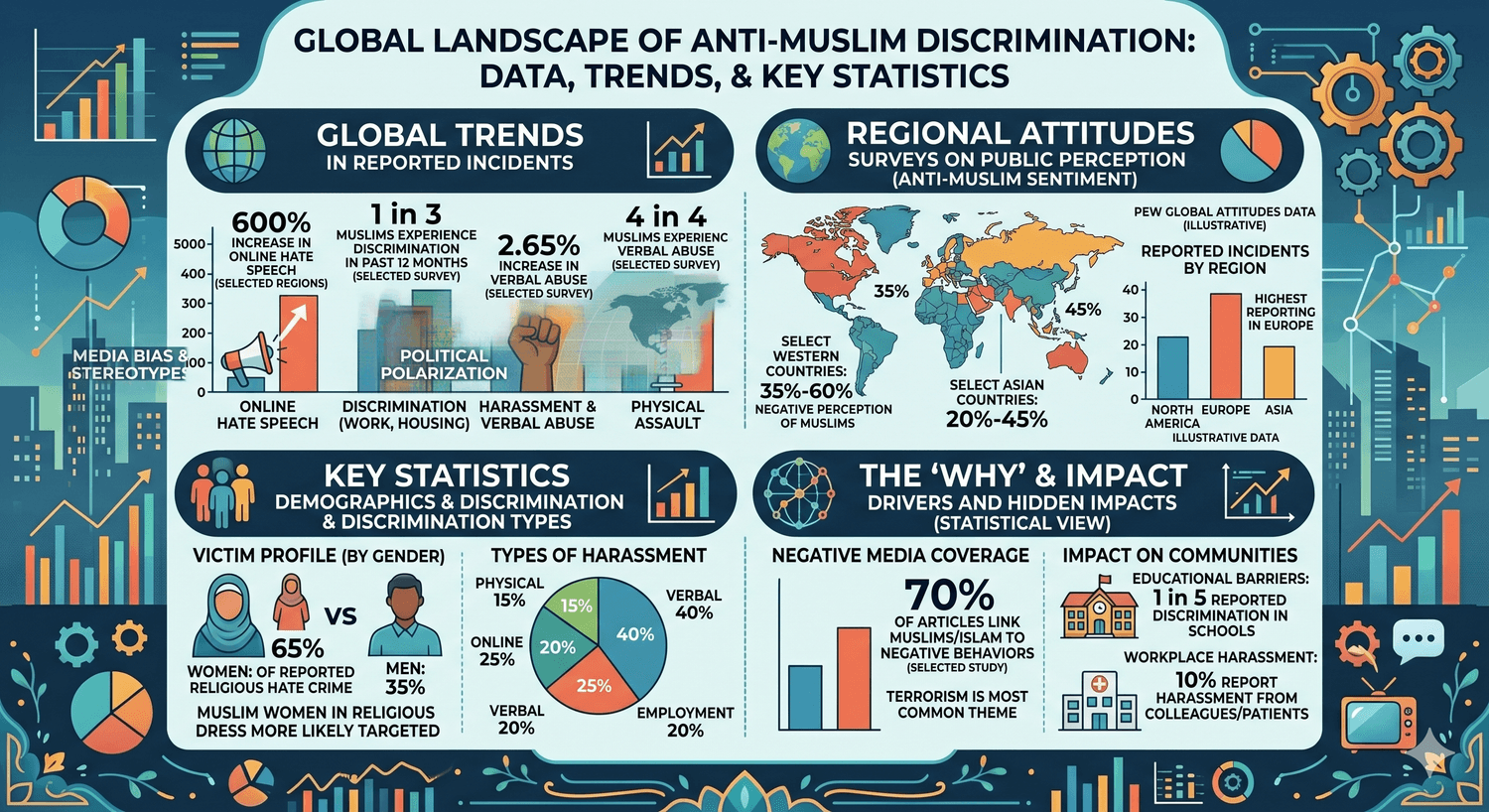
Not every Muslim experiences anti-Muslim discrimination the same way. Visibly Muslim women, particularly those who wear the hijab, face a unique combination of religious and gender-based targeting. Research from the Institute for Social Policy and Understanding shows that 68 percent of Muslim women report experiencing religious discrimination, compared to 55 percent of Muslim men.
Muslim children are not spared. Studies of Muslim students in California documented widespread bullying and exclusion tied to faith — children called terrorists, singled out after major political events, made to feel that their identity is a problem to be managed rather than a tradition to be respected.
Muslims who are Black carry an additional burden at the intersection of race and religion. White converts describe a different experience: erasure, where their faith is questioned or treated as a phase. Southeast Asian Muslims are sometimes mistaken for other groups and targeted anyway. Latino Muslims are invisible in most narratives about Islam in America, which is itself a form of discrimination.
The context matters too. Nearly 44 percent of Muslims who report discrimination say it happened at an airport. More than a third report it during job applications. About 27 percent say it occurred while receiving healthcare. These are not abstract statistics. They are moments that leave marks on a person's sense of safety and belonging — sometimes for years.
Why Anti-Muslim Discrimination Keeps Going
Understanding why anti-Muslim discrimination persists requires looking at a network of reinforcing forces.
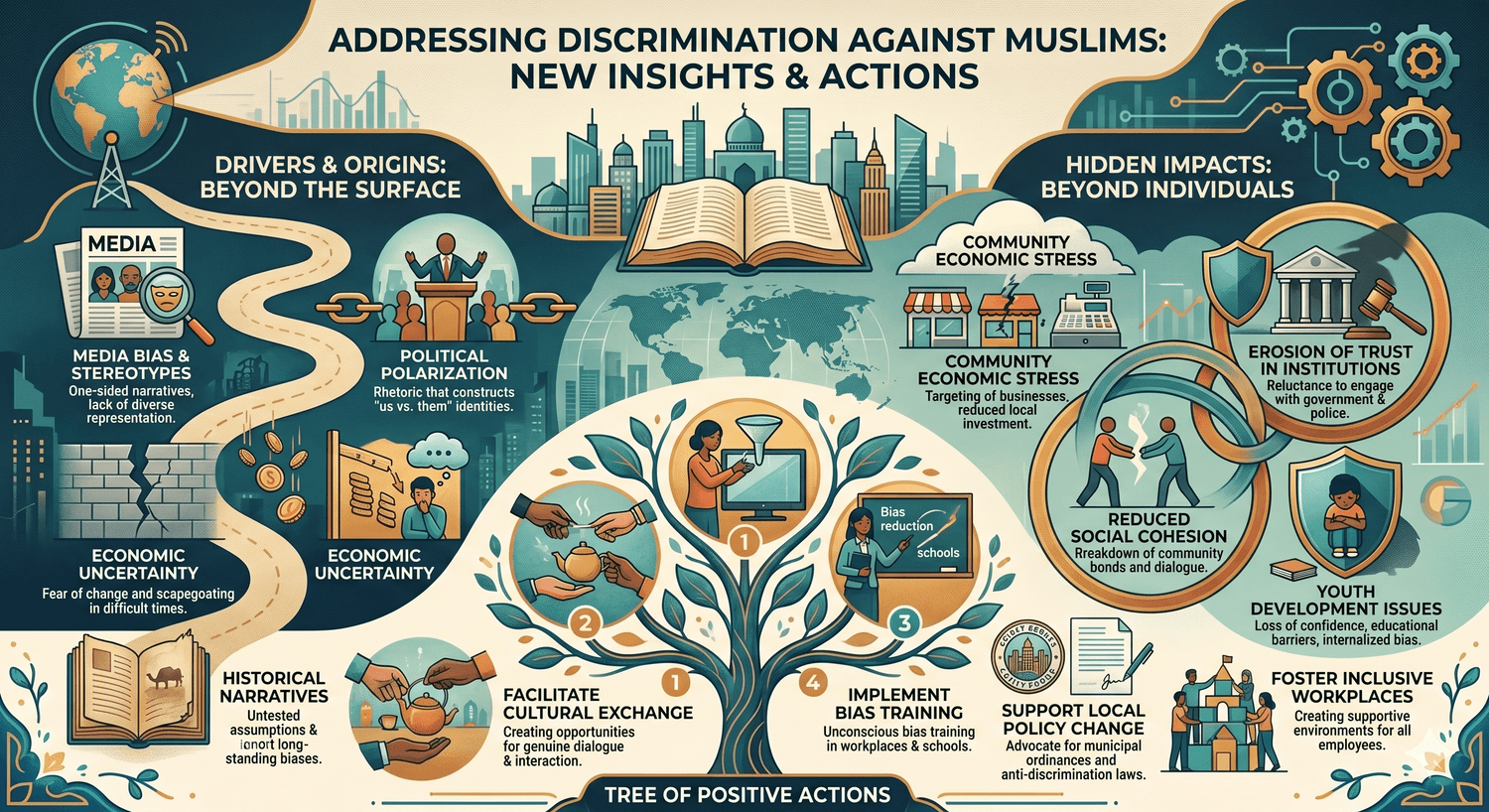
Media representation plays an outsized role. Decades of coverage that associates Islam primarily with violence and extremism have shaped public perception in ways that data and dialogue have struggled to correct. A survey by the Associated Press and the NORC Center for Public Affairs Research found that only 42 percent of Americans hold a favorable view of Islam. For a faith followed by nearly two billion people, that number reflects something beyond ignorance. It reflects a sustained, well-funded effort to keep Muslims in the category of threat.
Research from UC Berkeley and CAIR estimated that $206 million was funneled to 33 organizations whose primary purpose was promoting prejudice against Muslims in just five years between 2008 and 2013. That money funded think tanks, films, books, and political campaigns. It manufactured fear at industrial scale. And it worked. When politicians describe Islam as violent and legislators craft policies that target Muslim communities by name, anti-Muslim discrimination feels to many perpetrators like basic caution rather than bigotry.
It is not caution. It is prejudice. And the Qur'an identifies it clearly: "O you who believe, be persistently standing firm for Allah, witnesses in justice, and do not let the hatred of a people prevent you from being just. Be just; that is nearer to righteousness." (Qur'an 5:8)
What You Can Do When Anti-Muslim Discrimination Happens
If you or someone you know faces anti-Muslim discrimination, you are not without options.
In the workplace, document everything. Dates, witnesses, exact language used. File a complaint with the EEOC promptly — there are strict deadlines. If your employer refuses to accommodate prayer times, religious dress, or a dietary need, that may constitute a violation of federal law.
If you experience a hate crime or religiously motivated violence, report it to local law enforcement and to the FBI's civil rights division. CAIR offers free legal assistance through its network of regional offices. If the formal system feels inaccessible, start there.
For Muslim students or their parents, the Department of Justice handles cases of school-based religious harassment through its Educational Opportunities Section. A school that permits sustained bullying on the basis of religion may be in violation of federal civil rights law.
Beyond formal complaints, visibility matters. Community solidarity matters. When a Georgia city denied a mosque expansion based on anti-Muslim bias from city officials, the Department of Justice filed suit — and won. When Muslim parents show up at school board meetings and Muslim voters hold elected officials accountable, things change. Not quickly, and not without resistance. But they change.
What Islam Says About Facing Injustice
The Qur'an does not tell believers to absorb injustice without response. It calls believers to stand for what is right. "Good and evil deeds are not alike. Requite evil with good, and he who is your enemy will become your dearest friend. But none will attain this save those who endure with fortitude and are greatly favored by God." (Qur'an 41:34-35) This is not passivity. It is a strategy rooted in something more durable than anger.
The Prophet Muhammad, peace be upon him, was himself the sustained target of hostility — mocked, threatened, boycotted, driven from his home. His response was not silence, but clarity. He named oppression for what it was. He stood firm. He made du'a for those who harmed him. And he built, over twenty-three years, a community that changed the world.
For new Muslims especially, anti-Muslim discrimination can feel disorienting. You chose this path. You hold your faith in something real and good. And then the world tells you that your belief makes you dangerous. That dissonance deserves acknowledgment. It also deserves the perspective that comes from knowing you are part of a long line of people who held their faith under pressure and did not let it go.
Anti-Muslim Discrimination Will Not Be the Last Word
Anti-Muslim discrimination is, by the numbers, at historic highs in the United States. And yet Muslim communities are also more organized, more visible, and more legally resourceful than at any previous point. Muslim women serve in Congress. Muslims coach professional sports teams, run hospitals, and hold judgeships. Every one of those facts contradicts the narrative that anti-Muslim sentiment has spent decades trying to build.
That narrative is not harmless. It causes real damage to real people. But it is losing the argument with reality, and that matters. If you are new to Islam, you are entering a community that has been tested by exactly this kind of hostility and has chosen, again and again, to respond with knowledge, service, and faith.
That is worth holding onto.
If you want to learn more about Islam, understand your rights as a Muslim, or find a community that will support you through this journey, visit Start Islam Path. Our courses are built for exactly where you are right now.


