Islamophobia and the Hijab: What Muslim Women Face Daily
Get the 109‑page guide delivered to your inbox
Discover the faith that 1.9 billion people live by — and why thousands of truth-seekers just like you are choosing it every single day. This free 109-page guide walks you from curiosity to clarity, step by step.
No pressure. No judgment. No strings attached. Just a clear, honest roadmap written for people who want real answers — whether you're skeptical, curious, confused, or quietly searching for something deeper.
There is a piece of cloth at the center of one of the most charged political debates in the modern world. It covers the hair. It signals religious identity. And in country after country, it has become a target of legislation, workplace policy, courtroom argument, and street-level harassment.
Islamophobia and the hijab are bound together in a way that reveals something essential about how anti-Muslim discrimination operates. The hijab is visible. It marks a Muslim woman as Muslim before she has spoken a single word. That visibility makes her a target in a way that Muslim men, or Muslim women who do not cover, are not.
The discrimination Muslim women face because of the hijab is not incidental to Islamophobia. In many contexts, it is Islamophobia's most common and daily expression.
Islamophobia and the Hijab: Why the Hijab Became a Target
The hijab did not become politically controversial in the West because of anything Muslim women did. It became controversial because of what others decided it represented. Western media and political discourse constructed the hijab as a symbol of oppression, backwardness, and extremism. A woman wearing one was not exercising a religious choice; she was demonstrating, in this framing, her submission to a patriarchal system or her affiliation with a threatening ideology.
This framing has colonial roots. During French colonization of North Africa, French authorities ran explicit campaigns to unveil Muslim women, presenting the project as liberation. The argument was that Muslim women needed to be rescued from their own culture. The hijab, in this narrative, was the visible proof of that culture's inferiority. That campaign was not really about the dress. It was about dismantling cultural identity through the woman's body.
That narrative did not disappear when colonialism ended. It reappeared after September 11, 2001, when Muslim identity became synonymous in many Western contexts with a security threat. The visible markers of Muslim identity, including the hijab, became associated not just with backwardness but with danger. A woman in a headscarf was no longer simply a woman going about her life. She became, in the eyes of some, an emblem of everything threatening about Islam.
What the Hijab Actually Means in Islam
The Question of Choice
The Quran calls for modesty, and Muslim scholars across history have understood this to include head covering for women as part of religious practice. That is clear enough in the tradition. What gets lost in most Western coverage is that the vast majority of Muslim women in countries like the United States who wear the hijab do so by personal choice.
Research from the Institute for Social Policy and Understanding found that about half of Muslim women in the US wear the hijab and half do not. Both groups are practicing Muslims. The faith does not divide women into the pious and the impious along those lines.
The Quran states explicitly: "There is no compulsion in religion" (Quran 2:256). Governments like those of Saudi Arabia and Iran that have imposed the hijab by law are exercising political control through religious clothing. That is a different thing from the Islamic teaching on modesty, and conflating the two is a mistake that produces real harm. It frames every woman who covers voluntarily as someone who has been forced, which is both inaccurate and disrespectful.
A Muslim woman who chooses to wear the hijab is exercising agency, not surrendering it. Many describe it as a statement of identity, a source of daily spiritual grounding, and a way of insisting that they be known by their character rather than their appearance. In a research study in the UK, one woman described her niqab this way: "I choose what colors to wear, not just black and white. It is awesome. It is a beautiful, religious fashion statement." Her voice, and the voices of hundreds of thousands of women like her, rarely reach the media or the political stage.
The Data on Islamophobia and the Hijab
What Happens in Public Spaces
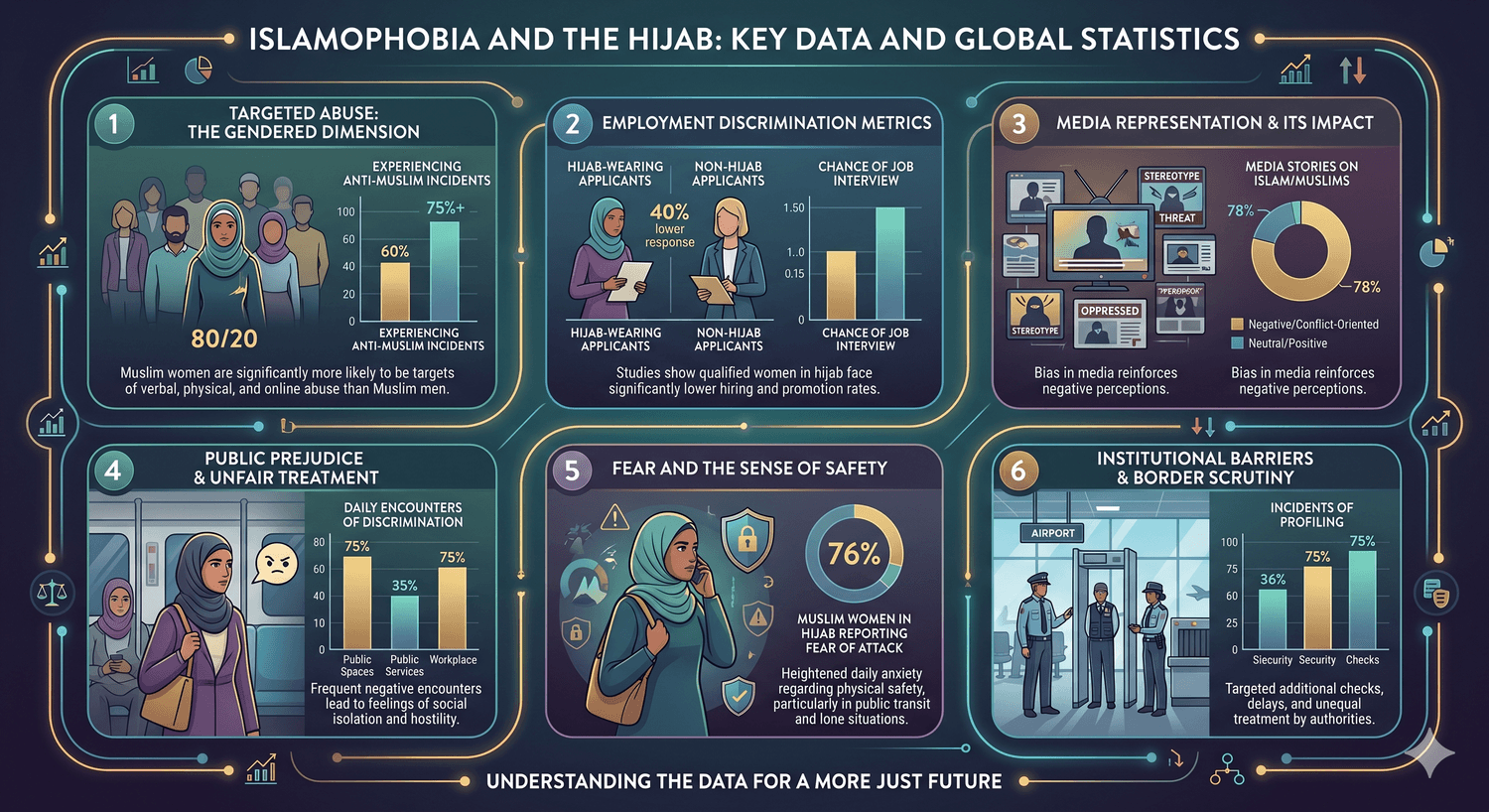
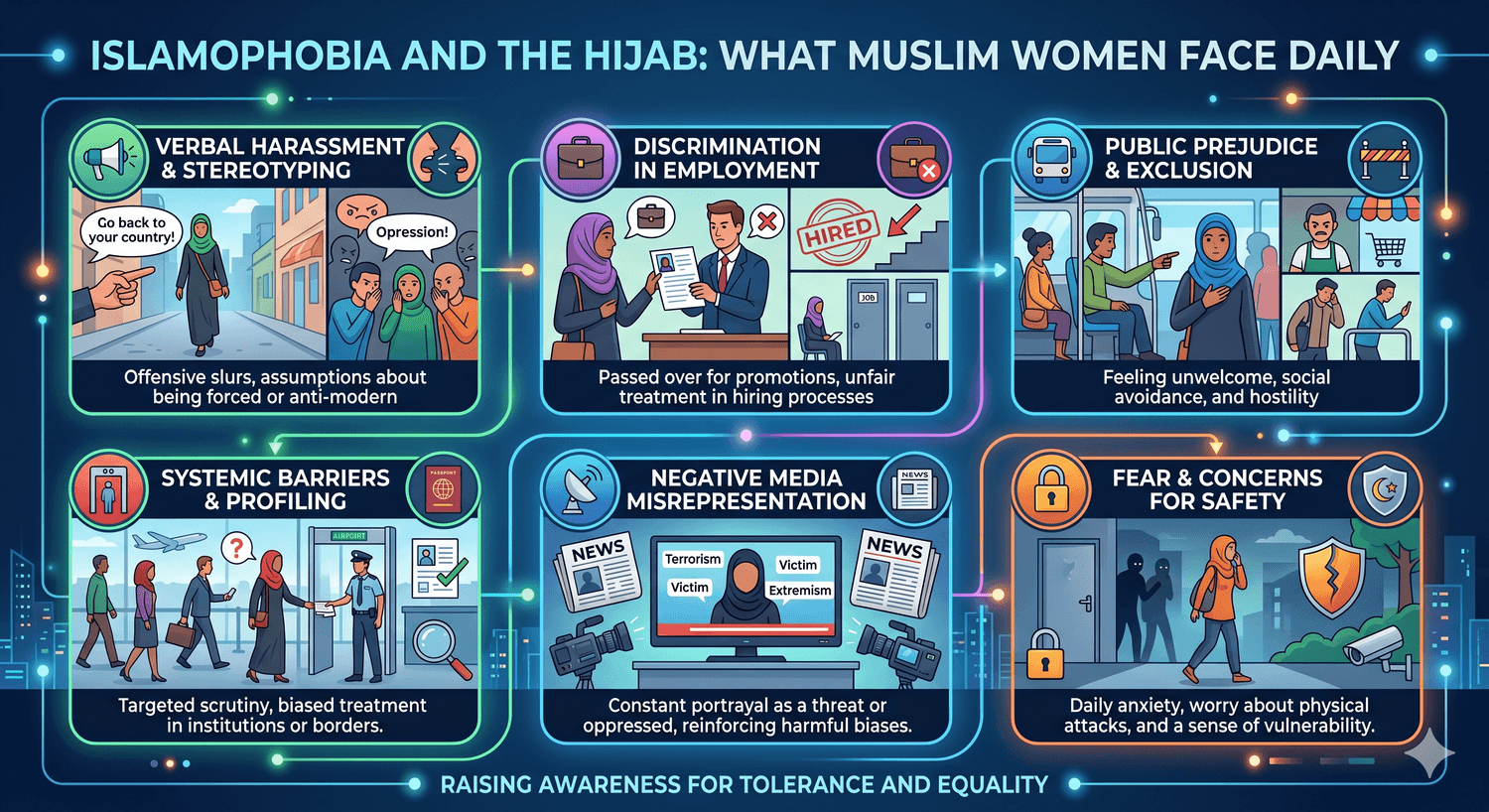
The data connecting Islamophobia and the hijab is consistent across multiple countries and years. The ACLU found that 69 percent of Muslim women who wore the hijab had experienced at least one incident of discrimination, compared to 29 percent of Muslim women who did not wear it. Tell MAMA in the UK reported that 61 percent of Islamophobic incidents in 2015 targeted women, and 75 percent of those targeted women were visibly Muslim. A 2013 study confirmed that Muslim women wearing headscarves or face veils are significantly more vulnerable to Islamophobic attacks than Muslim men.
The attacks range from verbal abuse to physical assault. Headscarves are pulled off on public transport. Women are spat at, shoved, and threatened in public parks and shopping centers. They are photographed without consent, followed, and subjected to unsolicited lectures about their own liberation. The message delivered across all of these encounters is consistent: your presence in this space is a problem.
What Happens in Workplaces
Employment discrimination connected to the hijab is well documented. A woman with a headscarf visible in a job application photograph receives fewer callbacks than an identical candidate without one. Employers cite brand neutrality policies and customer-facing concerns that, in practice, apply only to Muslim religious dress.
In 2001, a Muslim woman was fired from a car rental company in Phoenix, Arizona, for refusing to remove her headscarf during Ramadan. The Equal Employment Opportunity Commission brought a discrimination case on her behalf, and a jury awarded her $287,640. That case reached a courtroom. Most do not.
In 2017, the European Court of Justice ruled that employers could ban visible religious symbols, including the hijab. Two women, one in France and one in Belgium, were dismissed from their jobs that year under this ruling. Critics argued that the decision normalized workplace discrimination against Muslim women by dressing it up in the language of neutrality.
A 2019 study by the Institute of Labor Economics found that more girls with Muslim backgrounds in France graduated from high school after hijab bans were introduced in schools. The researchers suggested the bans forced girls out of the education system rather than liberating them from conservative practice. The policy produced the opposite of its stated intention.
How Governments Have Targeted the Hijab
France's Legislative History
France has been the most aggressive Western democracy in legislating against Muslim women's religious dress, and its history on this issue stretches back further than most people realize. In 1994, the French Ministry of Education recommended that teachers ban the Islamic veil in schools. In 2004, France passed a formal law prohibiting religious symbols in public schools, targeted primarily at the hijab. In 2011, it became the first European country to ban face coverings in all public spaces.
In 2021, the French National Assembly voted on legislation banning hijabs for women under 18 in public, provoking the hashtag #handsoffmyhijab across social media globally. During the 2024 Summer Olympics held in Paris, French athletes were barred from wearing hijabs. One player had to wear a cap in order to participate in the opening ceremony of the Games held in her own country.
France presents these measures as the enforcement of secular values applied equally to all. The application is not equal. A Sikh man's turban and a Jewish man's kippah do not attract the same legislative energy, the same political debate, or the same volume of legal challenges. The Islamophobia and hijab connection in France is not a perception. It is a legislative record.
What Muslim Women Say
When Muslim women are actually included in conversations about their own dress, the picture that emerges is more complex and far more human than the political debate suggests.
Some women describe the hijab as freedom from the relentless focus on women's bodies in Western culture. Some wear it as a daily act of remembrance, a way of keeping their relationship with God present throughout the day. Some feel pressure from family or community and carry genuine complexity about that. Some take it off; some put it on later in life as an act of deliberate personal conviction. Some face opposition from their own families when they choose to wear it in non-Muslim-majority settings.
The point is the diversity of these experiences. There is no single story. Treating Muslim women who wear the hijab as either victims of patriarchy or symbols of political Islam does something simple to something irreducibly human. That simplification, repeated across media, policy, and daily conversation, is itself a form of Islamophobia and hijab-related discrimination. It silences the actual women in favor of a political argument being made about them.
Moving Past the Stereotypes
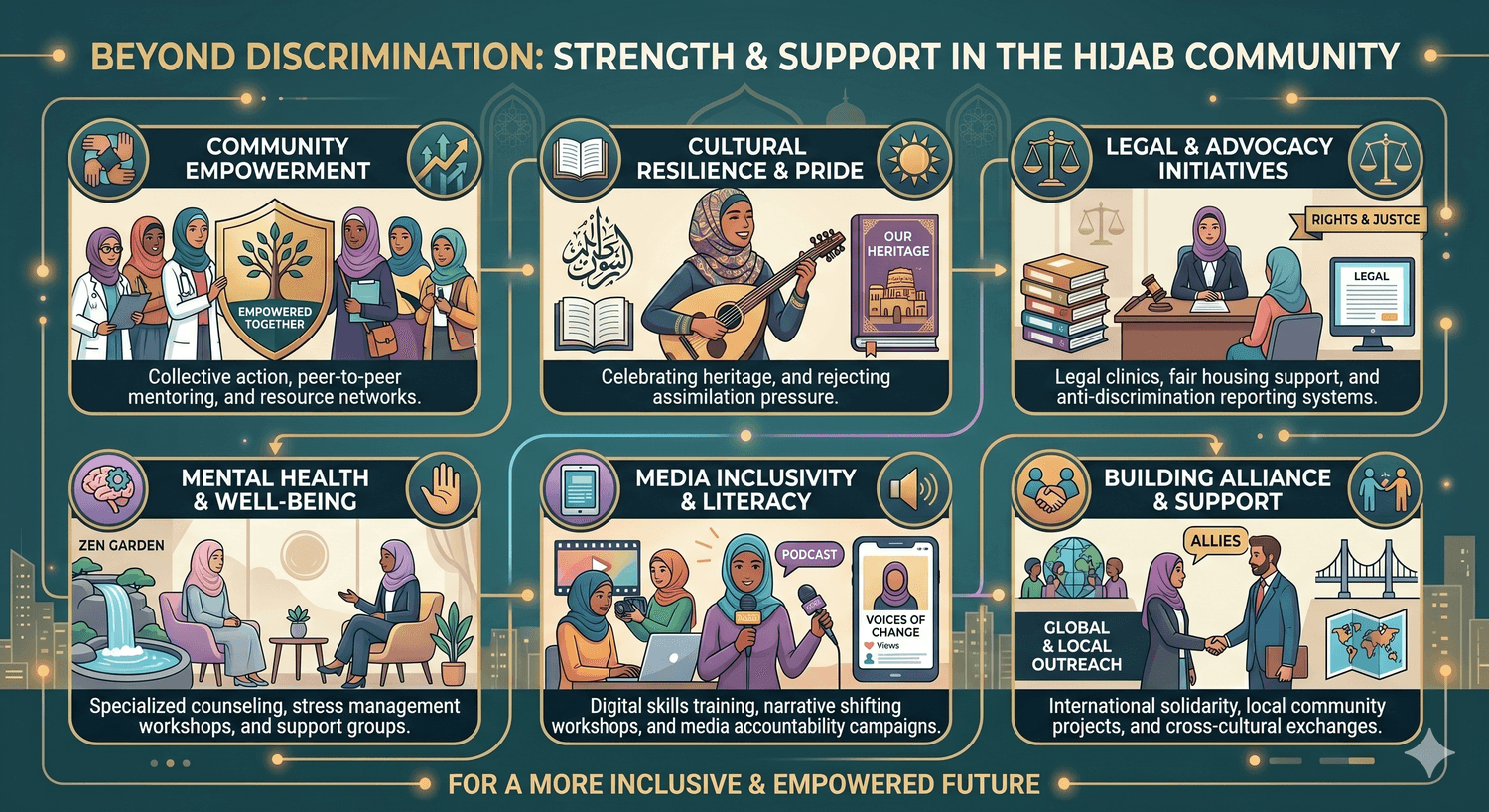
Islamophobia and the hijab will remain linked as long as the hijab is treated as a political symbol rather than a religious practice belonging to individual women. The way past that is not to stop the conversation. It is to let Muslim women lead it.
If you are curious about what the hijab means and why women wear it, ask a Muslim woman. Read what Muslim women scholars and thinkers have written on the subject. The Quran describes God as the All-Aware, and that awareness extends to the intention behind every act of worship. A woman who covers because of her relationship with God is engaged in a conversation that begins and ends with that relationship, not in a political speech or a newspaper headline.
For non-Muslims and people new to Islam alike, the hijab is one of the most visible entry points into understanding what Islam actually teaches about faith, identity, and the relationship between the individual and God. It is worth approaching with honesty rather than assumption.


