Clarifying Common Misconceptions About Islam
Get the 109‑page guide delivered to your inbox
Discover the faith that 1.9 billion people live by — and why thousands of truth-seekers just like you are choosing it every single day. This free 109-page guide walks you from curiosity to clarity, step by step.
No pressure. No judgment. No strings attached. Just a clear, honest roadmap written for people who want real answers — whether you're skeptical, curious, confused, or quietly searching for something deeper.
I've had hundreds of conversations with non-Muslims about Islam over the years. The same questions come up almost every time. Why do Muslim women cover their hair? Doesn't Islam promote violence? Isn't Allah a different God from the Christian or Jewish God? Is Islam incompatible with modern life?
These are fair questions. The problem is they're almost never answered from the actual sources. Most people get their understanding of Islam from political commentary, from media coverage that focuses on crisis, or from people who claim to speak for Islam while demonstrating almost none of its teachings.
Clarifying common misconceptions about Islam requires going to the primary sources: the Quran, authenticated Hadith, and the mainstream scholarly tradition. Not to defend Islam against all criticism. To tell you, accurately, what it actually says.
Common Misconceptions About Islam:
Misconception 1: Muslims Worship Muhammad
They don't. This needs to be clear before anything else.
The Quran is explicit: Muhammad is a human being. He is the final prophet. He is revered to a degree that can appear excessive to outsiders. But he is not worshipped, not prayed to, and not divine. The Quran states directly: "Muhammad is no more than a messenger; other messengers have passed away before him" (3:144).
When Muhammad died in 632 CE, his closest companion Abu Bakr walked out and addressed the people with these words: "Whoever worshipped Muhammad, Muhammad is dead. Whoever worships God, God is alive and never dies." That distinction was clarified within hours of Muhammad's death, by the people who knew him best, and it has remained a doctrinal cornerstone for 1,400 years.
There are no statues of Muhammad in any mosque. There are no images of him on the walls. Prayer goes to God exclusively and directly.
Misconception 2: "Allah" Is a Different God
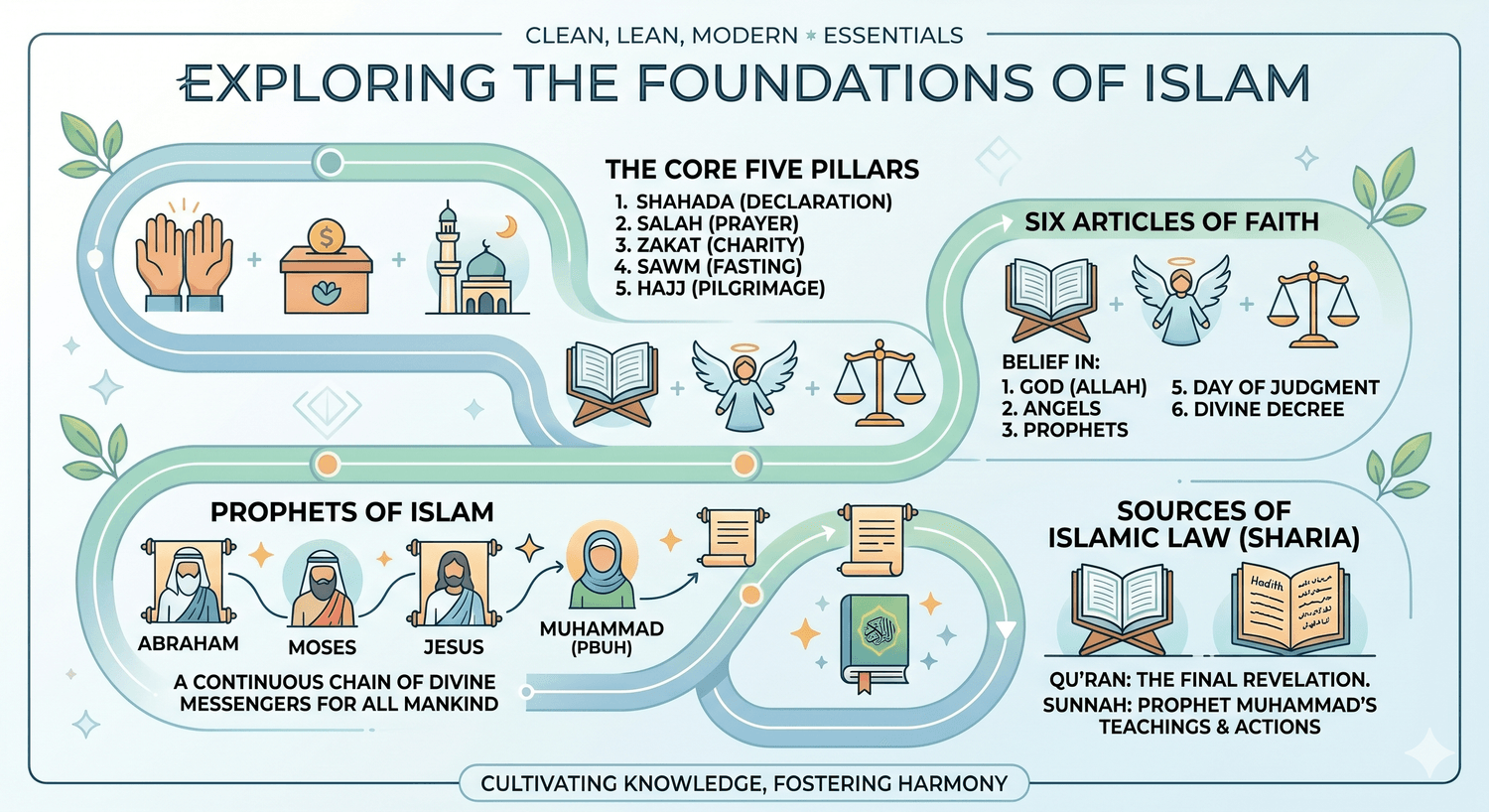
No. Allah is the Arabic word for God. The same God described by Abraham, Moses, and Jesus, as understood by Muslims. Arabic-speaking Christians use the word Allah for God. Arab Jews used it in earlier centuries too.
The Quran identifies the God of Islam as the God of Abraham, Moses, and Jesus (2:136). It says to the People of the Book, meaning Jews and Christians: "Our God and your God is one" (29:46). The theological disagreements between Islam, Christianity, and Judaism are real and substantive. But they are disagreements about the nature of God, not about which God is being discussed.
Misconception 3: Islam Promotes Violence
This is the misconception with the most political weight, so it requires the most careful attention.
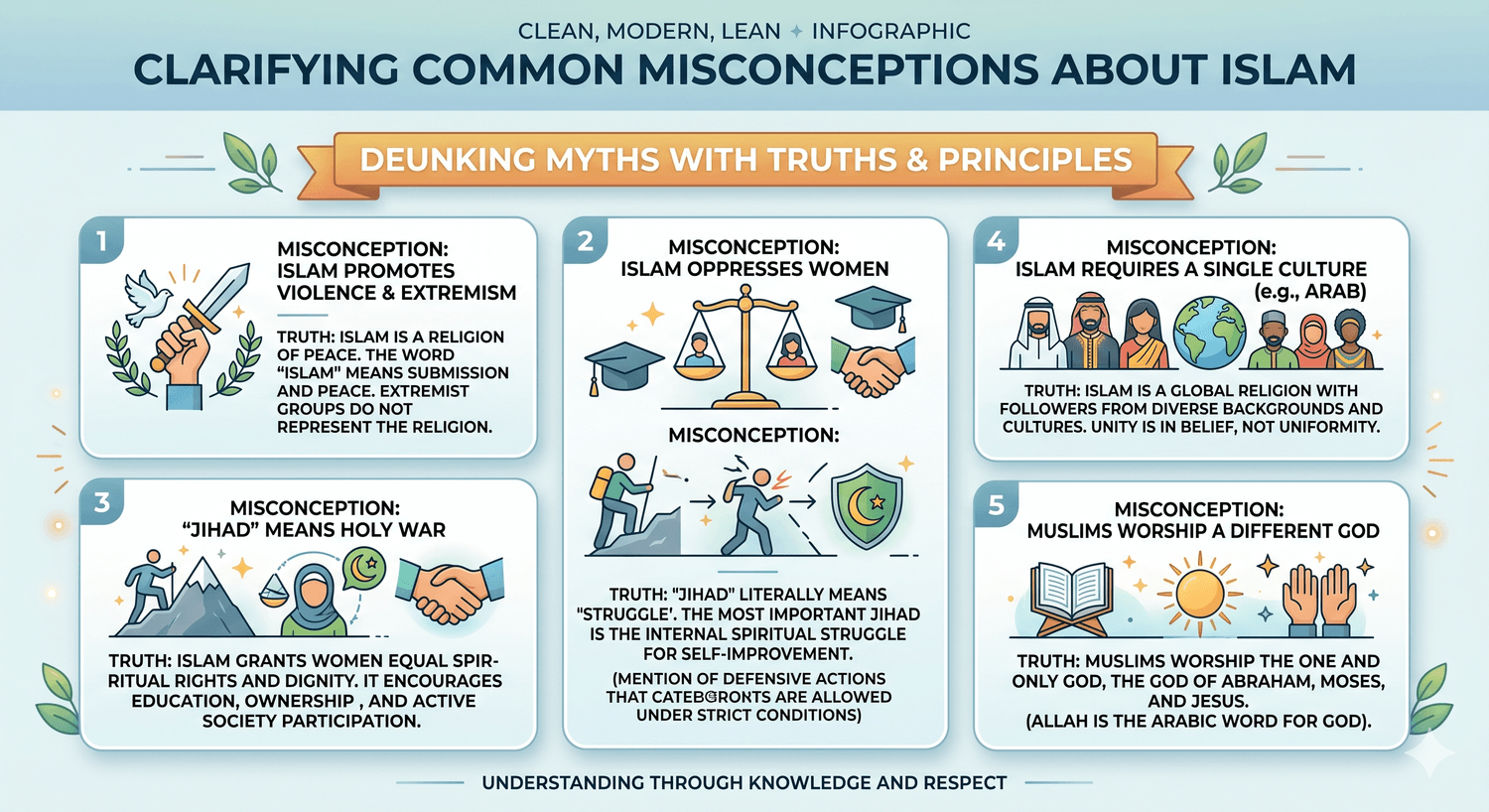
The Quran permits fighting in specific, constrained circumstances: legitimate self-defense, defense of the oppressed, and in response to aggression. It does not permit attacking civilians. It does not permit terrorism. It does not permit killing people who have not engaged in hostility.
The Quran says: "Whoever kills a soul unless for a soul, or for corruption done in the land, it is as if he had slaughtered all mankind. And whoever saves one, it is as if he had saved all mankind" (5:32). Killing an innocent person is equated to killing all of humanity. That's the weight the Quran places on a single innocent life.
Jihad, which media coverage almost exclusively associates with armed conflict, means "striving" or "struggle." In Islamic tradition, the greater jihad, as the Prophet described it, is the internal struggle against the ego. The lesser jihad is armed defense, permitted under strict conditions of defensive necessity and governed by explicit rules: no killing of non-combatants, no torture, no destruction of crops or places of worship, no forced conversion.
Groups that commit terrorism in the name of Islam are condemned by the overwhelming majority of Muslim scholars globally, by Islamic legal institutions, and by Muslims themselves. Their actions contradict explicit Quranic instructions. Labeling them "Islamic terrorism" gives them a religious legitimacy they don't possess under any serious reading of Islamic law.
Misconception 4: Women Are Oppressed by Islam
This requires separating Islamic teaching from cultural practice, a distinction that matters enormously and is almost never made in popular coverage.
The Quran grants women the right to own property, inherit, conduct independent business, and receive education. These rights were established in 7th-century Arabia, centuries before most Western legal systems recognized women as full legal persons. The Prophet's first wife, Khadijah, was a successful businesswoman who employed him before their marriage. His wife Aisha became one of the most prolific transmitters of Islamic knowledge in all of history. Thousands of scholars learned their religion directly from her.
The hijab, the head covering worn by many Muslim women, is a religious practice drawn from Quranic verses on modesty. It is an individual religious obligation that Muslim women observe voluntarily. It is not imposed on non-Muslim women anywhere in Islamic teaching. The Quran says plainly, "There is no compulsion in religion" (2:256).
There are Muslim-majority countries and communities where women are treated unjustly. That's true and documented. But those injustices trace to cultural traditions, tribal customs, and political systems that predate or contradict Islamic teaching, not to what the Quran actually commands. Conflating cultural practice with religious doctrine produces a false picture.
Misconception 5: Islam Is an Arab Religion
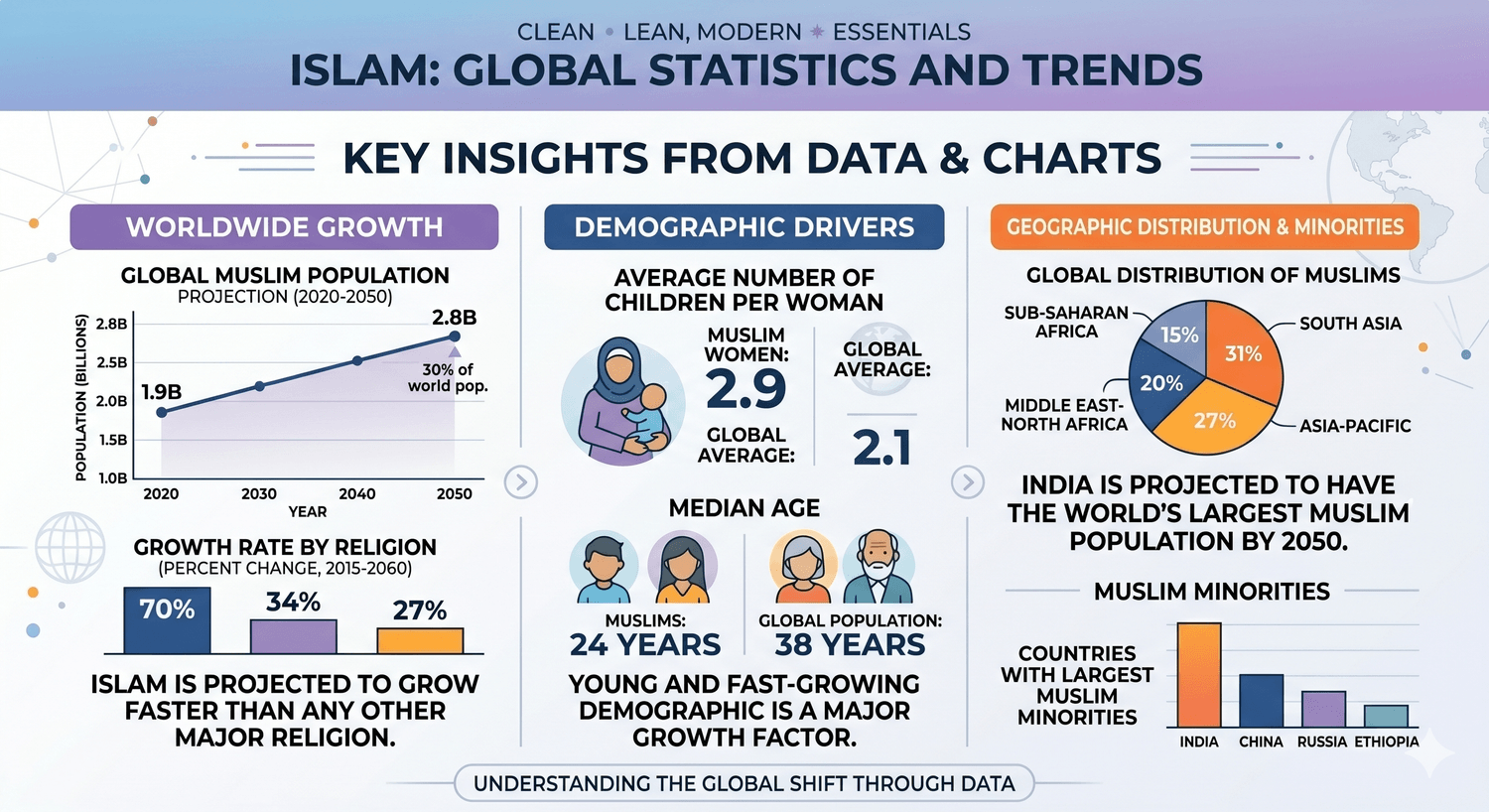
About 20% of Muslims are Arab. The remaining 80% are not.
Indonesia has the world's largest Muslim population, with over 220 million Muslims. India, Pakistan, Bangladesh, Nigeria, Turkey, and Iran each have hundreds of millions of Muslims. Significant Muslim communities exist in every European country, throughout sub-Saharan Africa, across Southeast Asia, and in the Americas.
Muhammad was Arab. The Quran was revealed in Arabic. But the message is addressed to "O mankind" dozens of times, not to any ethnic group. The Prophet's final sermon addressed all humanity. The first person to publicly call the Muslim prayer was Bilal, a formerly enslaved African man. Islam's universalism is built into its first generation.
Misconception 6: Islam Is Incompatible with Modern Life
Islamic jurisprudence has a 1,400-year tradition of engaging new circumstances through the principle of ijtihad, independent scholarly reasoning from primary sources. Islamic scholarship has addressed banking, medical ethics, environmental responsibility, governance, and technology. These are not recent accommodations. They are built into the method.
The medieval Islamic world produced mathematicians, astronomers, chemists, physicians, and philosophers whose work was foundational to what later became European scientific progress. The word algebra comes from the Arabic al-jabr. The scientific method was developed and refined by Muslim scholars like Ibn al-Haytham centuries before Bacon.
Muslims today are engineers, doctors, artists, professors, entrepreneurs, and athletes in every field. The claim that Islam requires choosing between faith and intellectual or professional engagement doesn't match the history or the present reality.
Misconception 7: Muslims Don't Believe in Jesus
Muslims believe in Jesus. This consistently surprises people who don't know Islamic teaching.
Jesus is mentioned by name in the Quran 25 times. Muslims believe he was born of a virgin. They believe he performed miracles. They believe he is the Messiah, al-Masih. They believe he will return before the Day of Judgment. Mary has an entire chapter of the Quran named after her, the only woman to have a chapter named after her in any major scripture.
The disagreement between Islam and Christianity is about the nature of Jesus, not his importance. To a Muslim, attributing divinity to Jesus contradicts Tawhid, the oneness of God. That is a genuine, deep theological difference. But it doesn't mean Muslims reject Jesus. It means they understand him differently.
Reading the Source, Not the Coverage
Clarifying common misconceptions about Islam comes down to one practical point: the gap between what Islam teaches and how it's represented in media and popular culture is enormous.
Every religious tradition has been practiced well and practiced badly. Every tradition has been used to justify things it condemns. The measure of a religion's teaching is not the worst person claiming its name. It's the primary sources.
Read the Quran. Not a critique of it. The Quran itself. What you find is different from what the headlines prepared you for.
Ready to engage with Islam's actual teachings? Our courses at Start Islam Path are built for exactly this: honest, source-based learning for people starting from the beginning, with no prior knowledge assumed.


