Tawhid vs. Shirk in Manifestation: What Islam Says About the Law of Attraction
Get the 109‑page guide delivered to your inbox
Discover the faith that 1.9 billion people live by — and why thousands of truth-seekers just like you are choosing it every single day. This free 109-page guide walks you from curiosity to clarity, step by step.
No pressure. No judgment. No strings attached. Just a clear, honest roadmap written for people who want real answers — whether you're skeptical, curious, confused, or quietly searching for something deeper.
Somewhere between the shelves of a bookstore and the algorithm of a social media feed, millions of people have encountered "manifestation." The premise sounds appealing: focus your mind intensely on what you want, believe you already have it, send out good vibrations to a receptive universe, and what you desire will come to you.
The book that launched this into mainstream culture — Rhonda Byrne's "The Secret," published in 2006 — has sold over 30 million copies globally. Many of its readers are Muslim. And many of those Muslim readers are genuinely confused about where this sits in relation to their faith.
The confusion is understandable. Some of what manifestation teachers say sounds, at first hearing, like it could be compatible with Islamic thought. Positive thinking, gratitude, focusing on good outcomes. But when you look more closely, a sharp theological fault line emerges — and it is exactly where tawhid vs. shirk in manifestation becomes the central question. This is not a minor issue of personal preference. It cuts to the core of what Islam is.
Tawhid vs. Shirk: What Is Tawhid, and Why Does It Change Everything?
Tawhid is the most fundamental concept in Islam. It means the absolute oneness of God. Not just that God exists, but that God alone is the source of power, provision, sustenance, and ultimate control over all outcomes in the universe. "Say: He is Allah, the One." (Quran 112:1)
Tawhid is not a slogan you repeat in the shahada and then forget. It is a worldview. It means that when you want something — a job, healing, a spouse, financial stability — there is exactly one place to direct that request: Allah. And there is exactly one power that determines whether it comes to you: Allah's will.
The Quran puts it plainly: "And with Him are the keys of the unseen; none knows them except Him." (Quran 6:59) The outcomes you are hoping to attract are already known, already written. Your role is effort (asbab) and supplication (du'a), not cosmic ordering.
What Manifestation Actually Claims
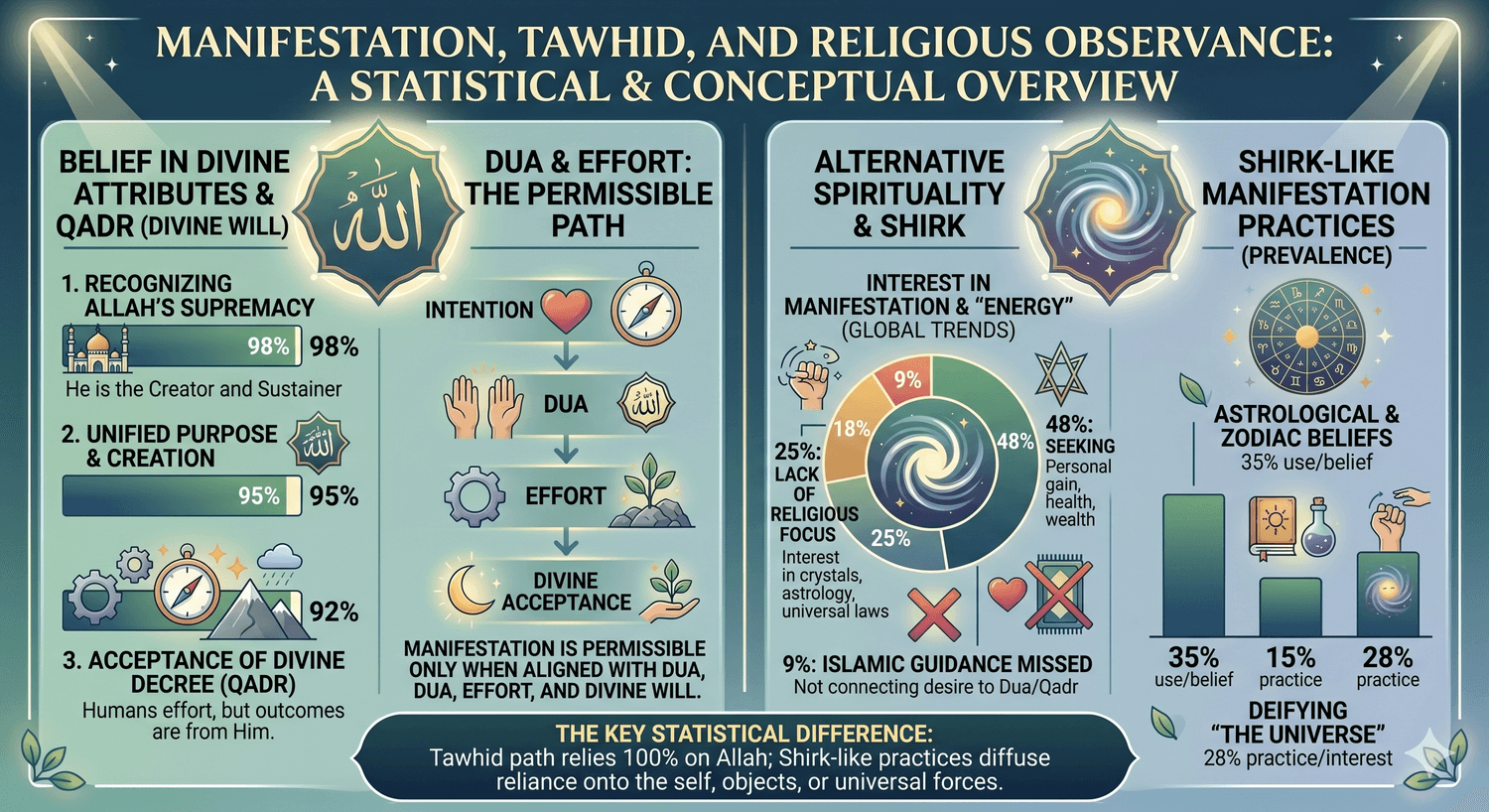
The law of attraction, as taught in "The Secret" and much of the manifestation industry, rests on several specific claims:
First, that the universe is a neutral, responsive mechanism — almost like a vending machine — that responds to the frequency of your thoughts. Second, that if something bad happens to you, it is because you attracted it with negative thoughts. Third, that you can achieve what you want by aligning your mental energy with the universe's energy, by believing you already possess what you desire, and by expressing gratitude to "the universe."
Notice what is absent from this framework. God does not appear. Not as decision-maker, not as provider, not even as a factor. "The universe" takes His place — treated as an impersonal force that humans can learn to operate. When you ask the universe for what you want, when you thank the universe for what you have, and when you believe that your mental state controls your outcomes, you are interacting with a substitute for God.
This is where tawhid vs. shirk in manifestation stops being a semantic debate. Shirk — associating partners with Allah — is not only about bowing to an idol. It is about directing divine acts (providing, granting, sustaining) toward anything other than Allah. The Islamic Fiqh Committee of the Islamic World League has addressed this directly: attributing the power of provision and outcome to an impersonal "universe" is a form of shirk.
The Deeper Problem: Who Suffers?
The law of attraction has a victim-blaming problem that most of its practitioners never examine. If thoughts attract outcomes, then the person who developed cancer attracted it. The child born into poverty attracted it. The woman who was assaulted attracted it with her negative vibrations.
This is not a minor inconsistency. It is a moral catastrophe. Islam's understanding of qadar — divine decree — is that tests, hardships, and suffering are not punishments for bad thinking. They are part of a design that includes wisdom humans cannot always see. The Prophet ﷺ said: "How wonderful is the affair of the believer. All of his affairs are good for him — if good comes to him, he is grateful, and if harm comes to him, he is patient."
The test of affliction is not evidence of your failure to manifest correctly. It is a door Allah opens toward something better, something deeper — if you walk through it with the right disposition.
What About Positive Thinking in Islam?
This is where the conversation gets more nuanced, and where many Muslims get stuck. Islam does not ask you to be pessimistic. The Prophet ﷺ loved good omens. He told us that Allah says: "I am as My servant expects Me to be." Expecting good from Allah — husn al-dhann billah — is not only permitted; it is encouraged. Optimism, in its Islamic form, is a spiritual discipline.
The concept of himma — strong intention and resolve — is also well established in Islamic thought. A powerful intention drives effort, focuses attention, and opens you to Allah's help. A weak intention produces weak effort. In this sense, intention and mental focus are spiritually meaningful.
But there is a decisive difference between directing your focus toward Allah and expecting His generosity, versus directing your focus toward "the universe" and expecting a mechanism to respond to your frequency. One is du'a in a different register. The other cuts God out entirely and replaces Him with an energy field.
You can visualize your goals. You can write down what you hope for. You can feel gratitude for the blessings you already have. Islam encourages all of this — as long as the source of those blessings is clearly, consciously Allah, and the person you are asking is clearly, consciously Allah. The moment "the universe" becomes your provider, tawhid has been compromised.
Tawhid vs. Shirk in Manifestation: The Hidden Version
There is a subtler version of this problem that is easy to miss. Some Muslims try to Islamize the law of attraction — to overlay Quranic language onto manifestation practices while keeping the underlying mechanics the same. They quote "I am as My servant expects Me to be" as if this were confirmation that the law of attraction is just Islamic prayer repackaged.
It is not. The hadith is about Allah's mercy responding to sincere expectation from a servant who already believes, already submits, and already asks through established channels of worship. It is not a recipe for cosmic ordering. It does not say that your mental frequency determines your outcomes independently of Allah's knowledge, will, and decree.
Scholars at islamqa.info and many major Islamic jurisprudence bodies have weighed in: the underlying cosmology of the law of attraction — the idea that thoughts emit frequencies that the universe responds to, independent of divine will — contradicts tawhid and contradicts the Islamic understanding of qadar. Using Islamic vocabulary on top of that cosmology does not purify it.
What Islam Offers Instead
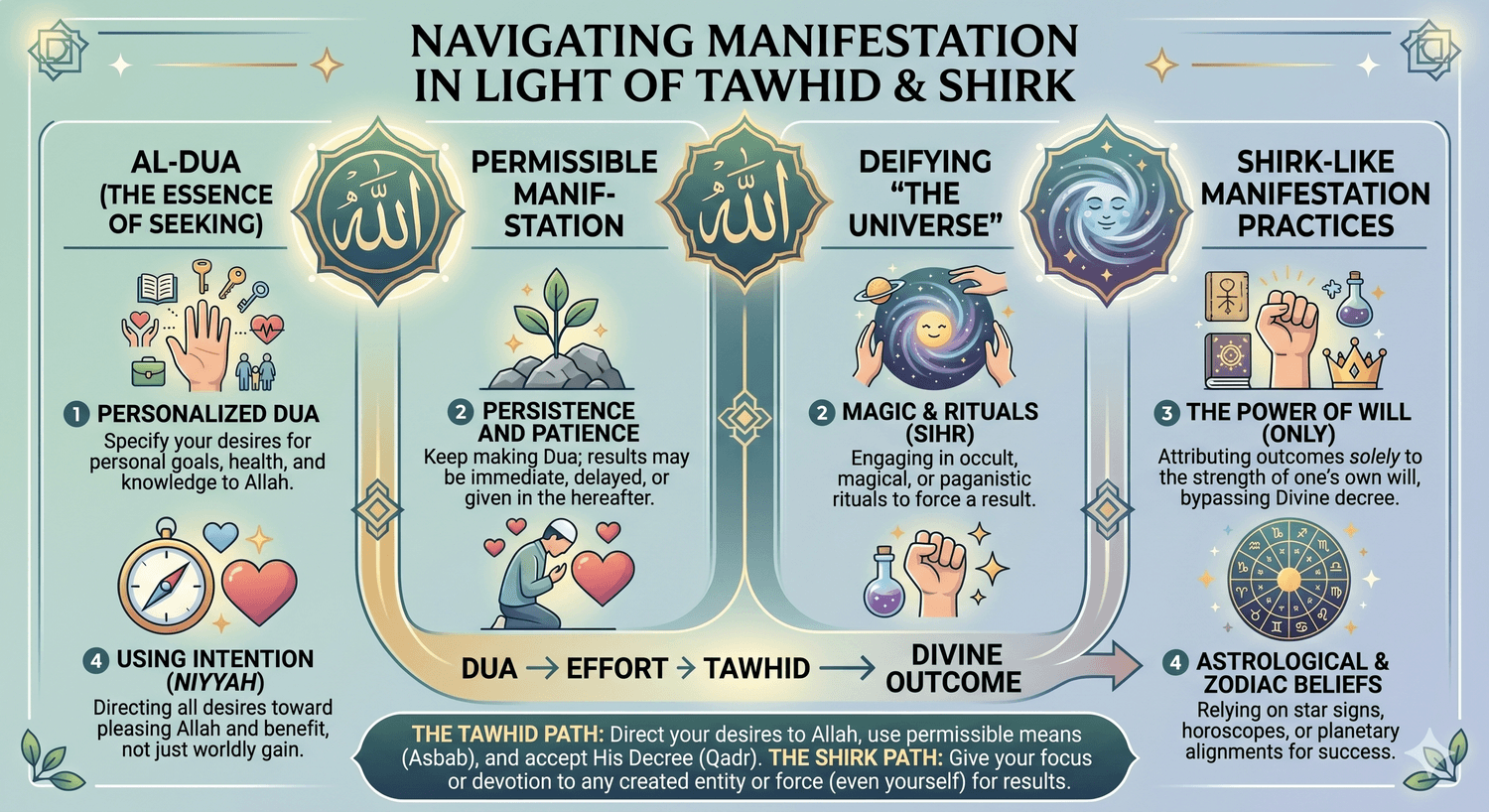
Here is the honest truth: Islam already has an extremely sophisticated system for asking, for hoping, for exerting effort, and for trusting outcomes. It has five daily prayers as anchors of intention. It has du'a — personal supplication — which the Prophet ﷺ called "the essence of worship." It has tawakkul — trust in Allah after doing what is in your power to do. And it has sabr — patience that is not passive resignation but active endurance with a clear eye.
This system does not promise you that the universe will hand you exactly what you visualized. It promises you something more honest: that Allah hears you, that effort is not wasted, that hardship carries meaning, and that the outcome, whatever it is, fits into a design larger than your current field of vision.
The Prophet ﷺ said: "Tie your camel, then put your trust in Allah." Effort plus surrender. That is the Islamic version of "manifesting." It keeps God in His place — which is everywhere — and keeps you in yours: a servant doing your part, then releasing the outcome.
Conclusion: Tawhid vs. Shirk in Manifestation Is Not About Judging Your Feelings
If you have practiced manifestation or the law of attraction, this is not an invitation to shame yourself. Many people come to these practices out of genuine need — they are looking for agency, for hope, for a sense that their life is not entirely beyond their influence. Islam hears that need. It just answers it differently.
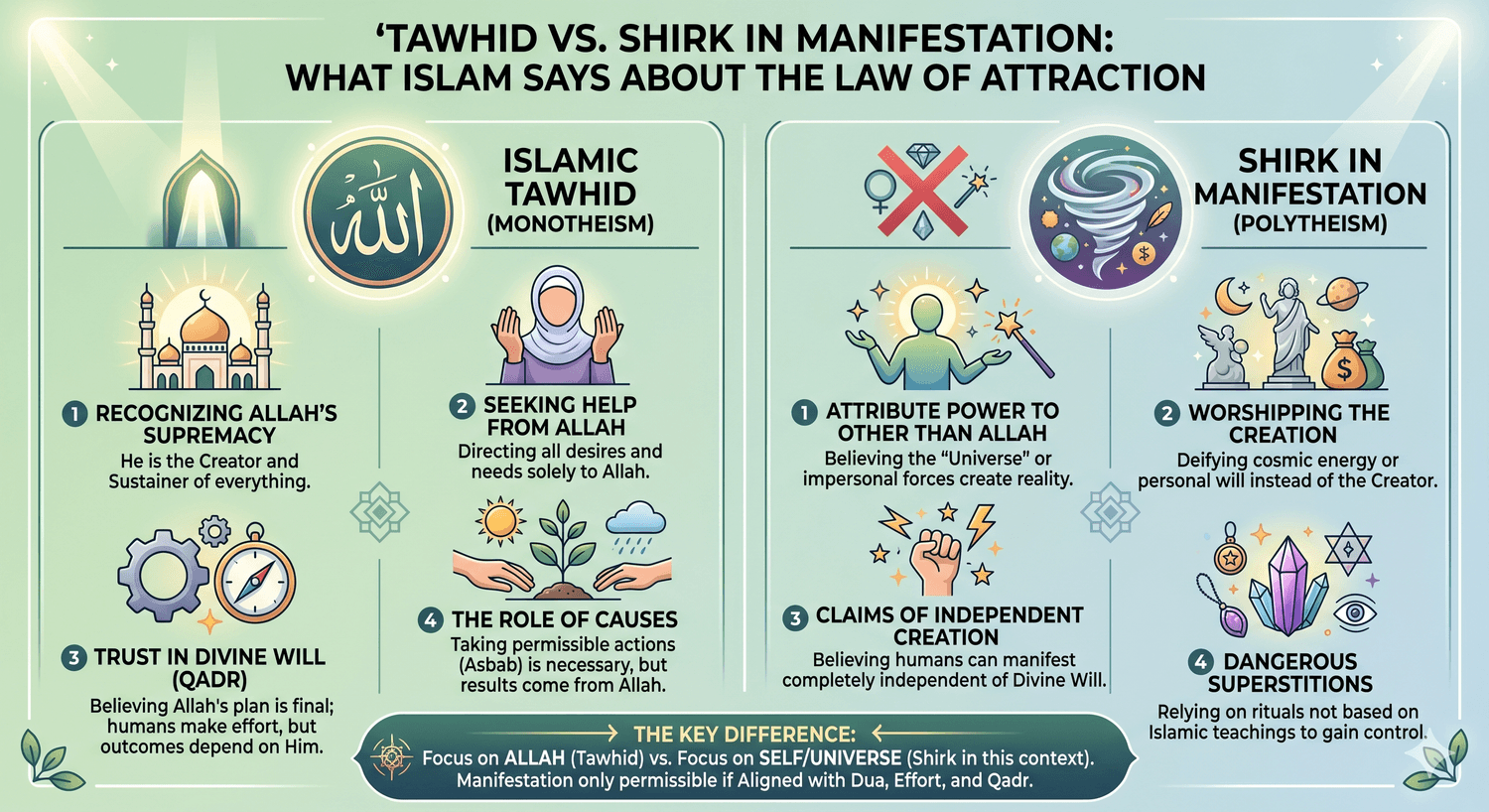
Tawhid vs. shirk in manifestation is ultimately about where your anchor sits. If your anchor is Allah — if He is the one you are talking to, trusting, and expecting good from — then positive intention, visualized goals, and grateful focus are part of your worship. If your anchor is "the universe," you have traded the Creator for the creation.
The Quran says: "And your Lord says: Call on Me, I will respond to you." (Quran 40:60) That is an open line. It does not go through vibrations or frequencies. It goes directly.
If you want to understand Islam's complete worldview on provision, trust, and the relationship between your effort and God's decree, explore Start Islam Path's courses. Built for people asking exactly these questions.


