How to Challenge Islamophobia: Changing Minds One Conversation at a Time
Get the 109‑page guide delivered to your inbox
Discover the faith that 1.9 billion people live by — and why thousands of truth-seekers just like you are choosing it every single day. This free 109-page guide walks you from curiosity to clarity, step by step.
No pressure. No judgment. No strings attached. Just a clear, honest roadmap written for people who want real answers — whether you're skeptical, curious, confused, or quietly searching for something deeper.
There is a difference between defending yourself from Islamophobia and actually challenging it. Defending yourself manages the immediate moment. Challenging Islamophobia works on the underlying beliefs and assumptions that make those moments possible. Both matter. But if you only ever address what is happening to you right now, you will be addressing the same things for the rest of your life.
This article is about the longer work — how to challenge Islamophobia at the level of narrative, relationship, and public discourse. It is written for Muslims who want to do more than survive a hostile environment, and for non-Muslims who want to be part of changing it.
How to Challenge Islamophobia: the Narrative Before the Incident
Most Islamophobia is not the product of personal malice. It is the product of a story people have absorbed about Islam and Muslims — a story that was constructed carefully, funded generously, and delivered repeatedly through media, political rhetoric, and entertainment. You cannot win an argument with a story. You can only replace it with a better one.
The most effective counter to Islamophobic narratives is not a list of corrections. It is contact. Research consistently shows that people who know a Muslim personally hold more accurate views of Islam than people who do not. Personal knowledge disrupts the abstraction that makes prejudice possible. When a Muslim colleague, neighbor, or friend becomes a real person to someone who previously only knew "Muslims" as a media category, the narrative gets complicated in productive ways.
This is why one of the most direct ways to challenge Islamophobia is visibility — showing up as a Muslim in spaces where Muslims are not expected, being excellent at work, being a good neighbor, and simply being present and three-dimensional. You cannot control what assumptions people bring with them. You can give them something specific and real to place alongside those assumptions.
Use Accurate Information as a Tool
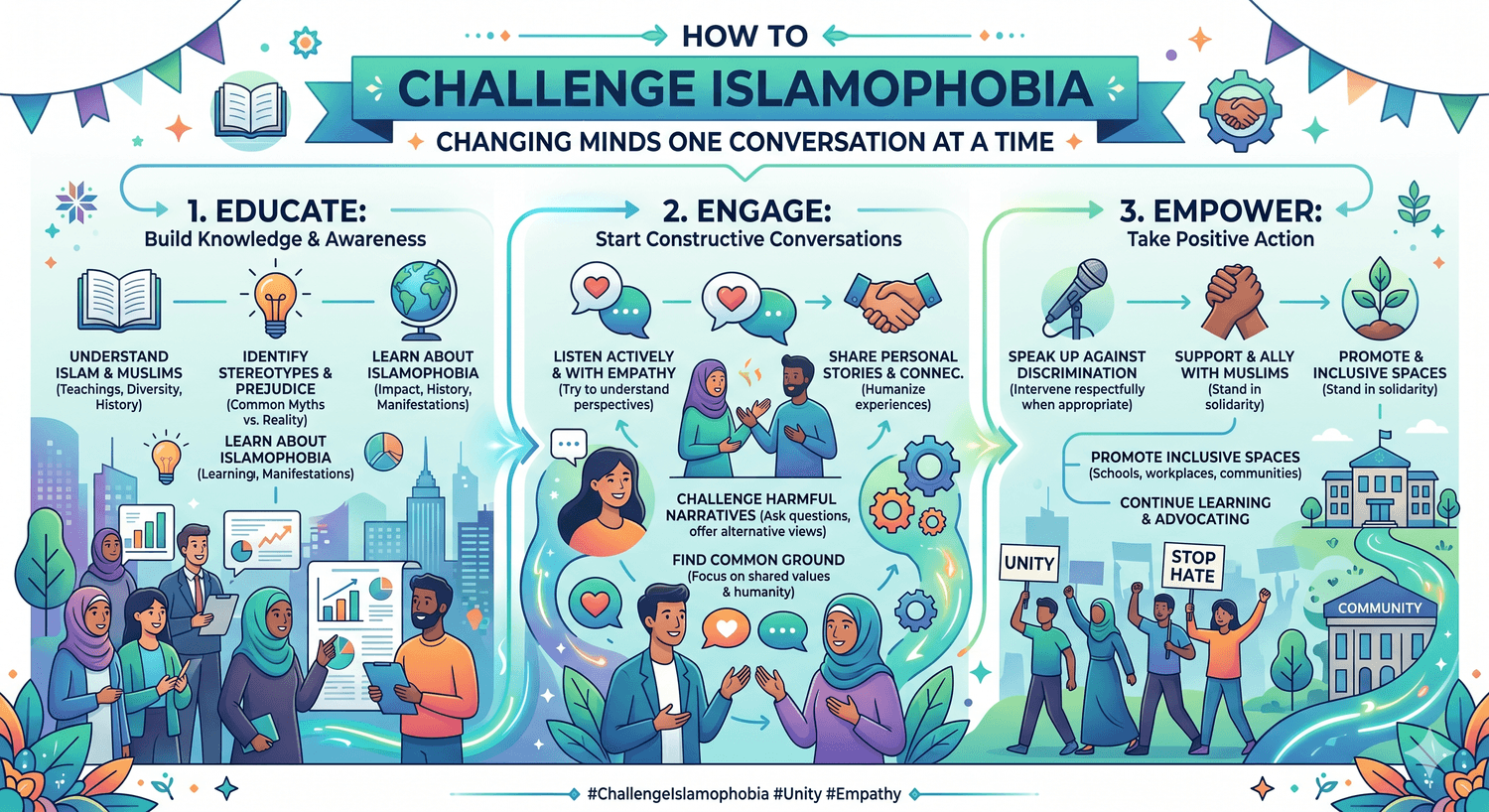
Islamophobia is built largely on misinformation. Challenging it requires accurate information delivered in ways that people can actually receive.
When a colleague repeats something incorrect about Islam — that it preaches violence, that Muslim women have no rights, that jihad means holy war against non-believers — the response that works best is usually not a lengthy rebuttal delivered with visible frustration. It is a calm, brief correction that offers one clear accurate piece of information and leaves space for the other person to receive it.
"That is actually a common misunderstanding. Jihad in Islamic tradition refers to any form of striving for good — including internal struggle against one's own shortcomings. The Qur'an describes the greater jihad as the effort to discipline oneself." And then you move on. You have planted something. Whether it grows depends on the other person, not on you.
You do not need a theology degree to challenge Islamophobia with information. You need a few well-understood facts and the willingness to share them calmly. If someone asks you something you cannot answer, say so: "I am not sure about the details of that. I'll find out and let you know." That honesty builds more credibility than a confident but incorrect response.
Challenge Islamophobia in Online Spaces
A significant amount of Islamophobic misinformation circulates online, and challenging it there matters because that is where many people first encounter it.
Reporting anti-Muslim hate speech to platforms is a start, but it does not replace counter-messaging. Creating and sharing accurate, specific content about Islam — not just defensive corrections but genuinely informative material about Islamic history, scholarship, practice, and everyday Muslim life — builds a competing information environment.
Supporting Muslim creators, scholars, and content producers who are doing this work already is one of the most direct contributions anyone can make. When Muslim writers, filmmakers, podcasters, and teachers have wider audiences, the story being told about Islam gets more complex, more accurate, and harder to reduce to a threat narrative.
If you engage in online discussion about Islam, prioritize specificity over abstraction. "Muslims are peaceful" is easy to dismiss. "In the tradition of Islamic ethics, the Qur'anic verse 5:32 states that killing one innocent person is as if killing all of humanity" is harder to ignore. Concrete, specific information challenges the vague generalizations that Islamophobic narratives depend on.
Engage in Interfaith Work
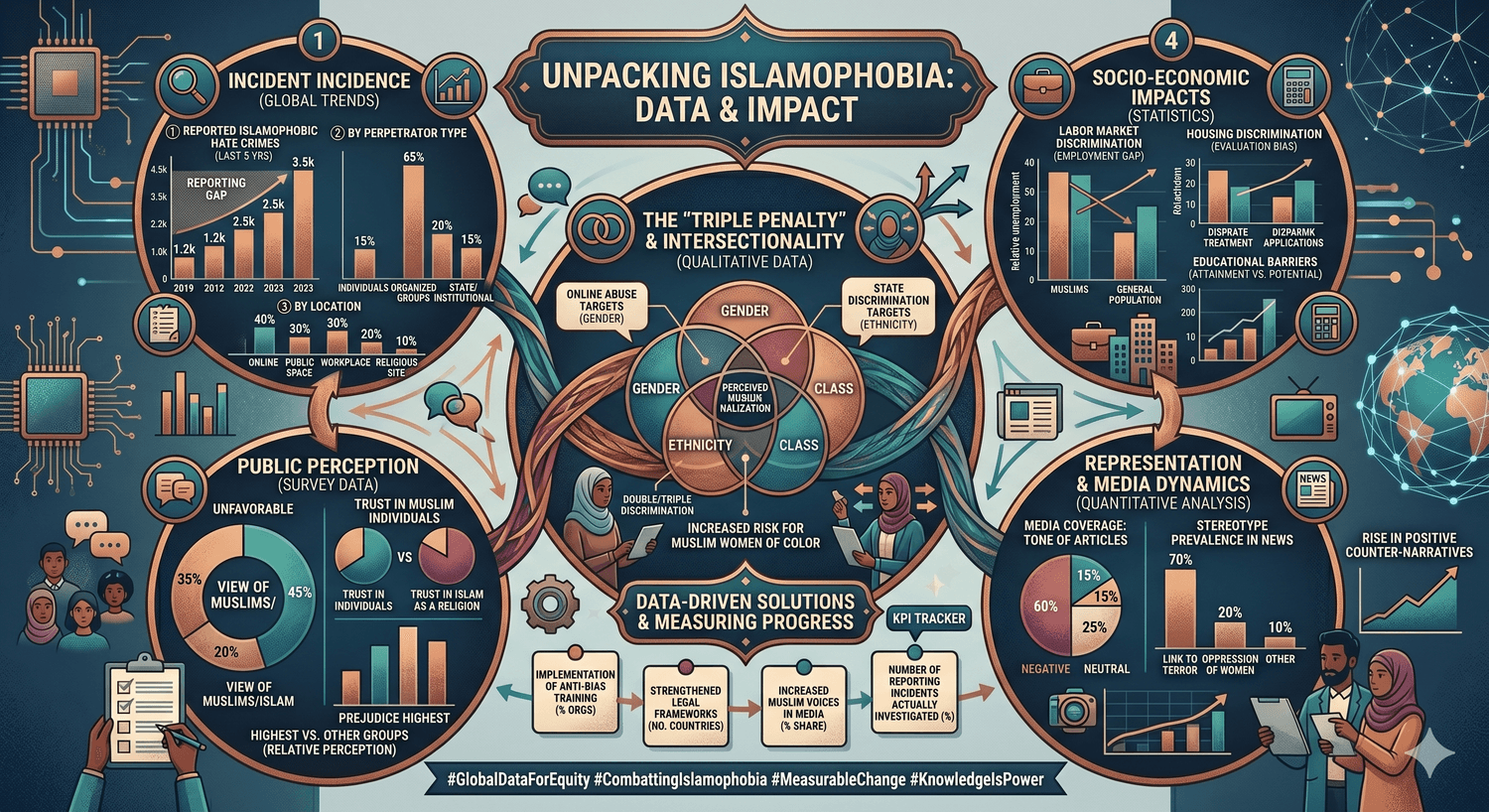
Interfaith dialogue and interfaith projects are among the most documented and effective strategies for challenging Islamophobia at the community level. Research from Germany found that interfaith projects that focused on shared values and everyday conviviality between Muslims and non-Muslims significantly reduced Islamophobic attitudes in participants.
This does not mean every interfaith conversation needs to be a formal dialogue event. It can be as simple as inviting non-Muslim neighbors to break fast during Ramadan, attending events hosted by other faith communities, or collaborating with a local church or synagogue on a shared community project.
When people of different faiths work together toward a shared goal, the religious differences that seemed so significant in the abstract become less defining than the practical work of the moment. And the Muslim who was previously "a Muslim" becomes someone specific — the person who organized the food drive, who stayed late to help, who brought excellent food to the potluck.
Challenge Islamophobia Through Political Engagement
Islamophobia has been sustained in part by political rhetoric and policy choices at the highest levels of government. Challenging it requires engagement at that level too.
This means voting. It means holding elected officials accountable for the language they use about Muslim communities and for the policies they support. It means supporting candidates who demonstrate genuine commitment to civil rights across religious lines — not just in election season, but in how they vote and what legislation they champion.
It means showing up to public comment periods, school board meetings, and city council sessions when decisions affecting Muslim communities are being made. It means writing to representatives. It means building relationships with elected officials before a crisis, not only during one.
The United Nations has called on governments to adopt national strategies against Islamophobia, establish anti-hate-crime legislation, and run public education campaigns that accurately represent Islam and Muslim communities. Pressing your government to act on these recommendations is a form of challenging Islamophobia with structural reach.
Challenge the Narrative Within Muslim Communities Too
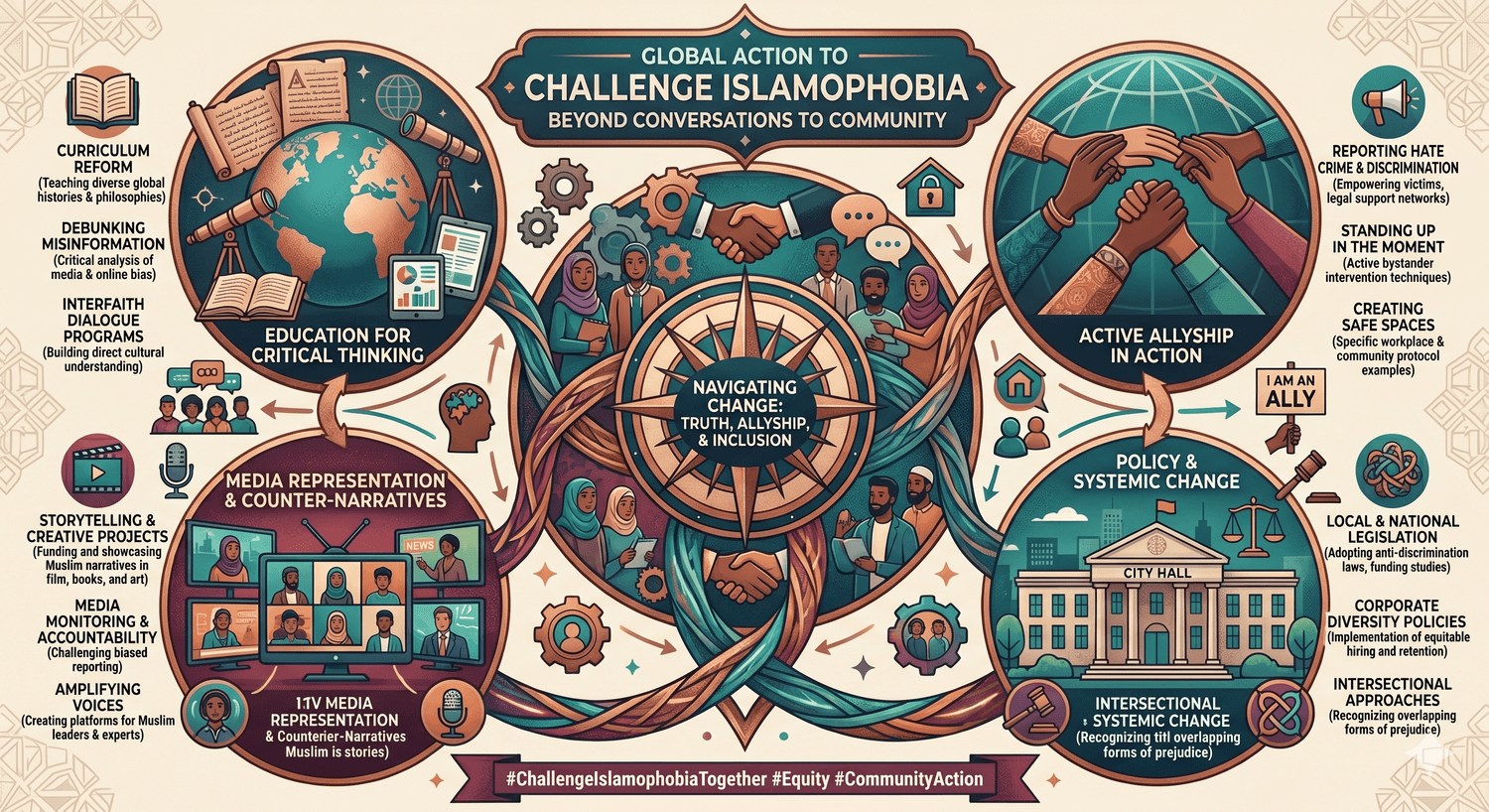
Part of challenging Islamophobia effectively requires honest conversation within Muslim communities about how we present ourselves, how we engage with public discourse, and how we support our most vulnerable members.
Women who face gendered Islamophobia need Muslim communities that center their experiences rather than treating those experiences as secondary to broader anti-discrimination efforts. Muslim youth who face hostility at school need communities that prepare them, support them, and believe them when they report what is happening. Black Muslims, LGBTQ Muslims, convert Muslims, and other groups who face specific forms of marginalization within Muslim communities as well as outside them need spaces where their full experience is recognized.
Challenging Islamophobia from the outside while reproducing internal hierarchies is incomplete work. The Muslim community that presents the strongest challenge to anti-Muslim prejudice is one that reflects, as fully as possible, the values it is asking the world to recognize: justice, dignity, inclusion, and care.
For New Muslims: Your Presence Is a Form of Challenge
If you are new to Islam, your decision to engage with this faith — to learn, to pray, to practice, to identify yourself as Muslim — is itself a form of challenging Islamophobia. Not because you owe that to anyone, but because visibility disrupts prejudice. When you are a Muslim who defies the stereotype, when you are thoughtful and present and willing to have conversations, you are contributing to a broader shift in what "Muslim" means in the minds of the people around you.
That is not a burden. It is a consequence of being a full person in public. The Prophet Muhammad, peace be upon him, said: "The most beloved of deeds to Allah is that which is most consistent, even if it is small." Consistency matters more than dramatic gestures. Showing up every day as yourself, grounded in your faith, is its own form of resistance.
Start Islam Path exists to help you build that foundation. Our courses are designed for people who are serious about understanding Islam deeply enough to live it with confidence. Start exploring today.


