Interfaith Solidarity vs Islamophobia: What Islam Actually Teaches About Standing Together
Get the 109‑page guide delivered to your inbox
Discover the faith that 1.9 billion people live by — and why thousands of truth-seekers just like you are choosing it every single day. This free 109-page guide walks you from curiosity to clarity, step by step.
No pressure. No judgment. No strings attached. Just a clear, honest roadmap written for people who want real answers — whether you're skeptical, curious, confused, or quietly searching for something deeper.
There is a tension that shows up again and again in our world. On one side, you have communities of different faiths choosing to stand together, share meals, defend each other's right to worship, and refuse to let fear write their story. On the other side, you have Islamophobia — the organized suspicion, hostility, and often outright hatred directed at Muslims and those perceived to be Muslim.
If you have ever wondered what Islam actually says about this tension, about how Muslims are supposed to relate to people of other faiths, or why interfaith solidarity vs Islamophobia even matters for someone trying to understand Islam, then this piece is for you. The answer is not abstract. It runs through the Quran, through the life of the Prophet Muhammad ﷺ, and through 1,400 years of history that most people have simply never been told about.
Interfaith Solidarity vs Islamophobia: What Is Islamophobia, and Why Does It Keep Growing?
Islamophobia is not just a feeling of unease. It is a pattern. Since the attacks of September 11, 2001, the number of anti-Muslim hate crimes, mosque vandalism incidents, and discriminatory policies in the United States and Europe has increased significantly. The Council on American-Islamic Relations (CAIR) documented a 14% increase in anti-Muslim bias incidents in a single year. In October 2023, after the outbreak of conflict in Gaza, Muslim communities across the US reported a spike in death threats, vandalism, and physical assaults.
The word "Islamophobia" was not invented to shut down criticism of ideas. It was coined to name a specific kind of prejudice — one that treats 1.8 billion people as a monolithic threat, that reads a woman's hijab as a political statement, and that converts entire neighborhoods of doctors, teachers, and farmers into suspects. It is, as the UN Secretary-General António Guterres put it, a form of institutional suspicion that has escalated to "epidemic proportions."
Why does it grow? Partly because of deliberate misinformation. Partly because people encounter Islam only through news headlines about wars and not through their actual Muslim neighbors. And partly because ignorance, when left unchallenged, takes root quickly.
What Islam Says About People of Other Faiths
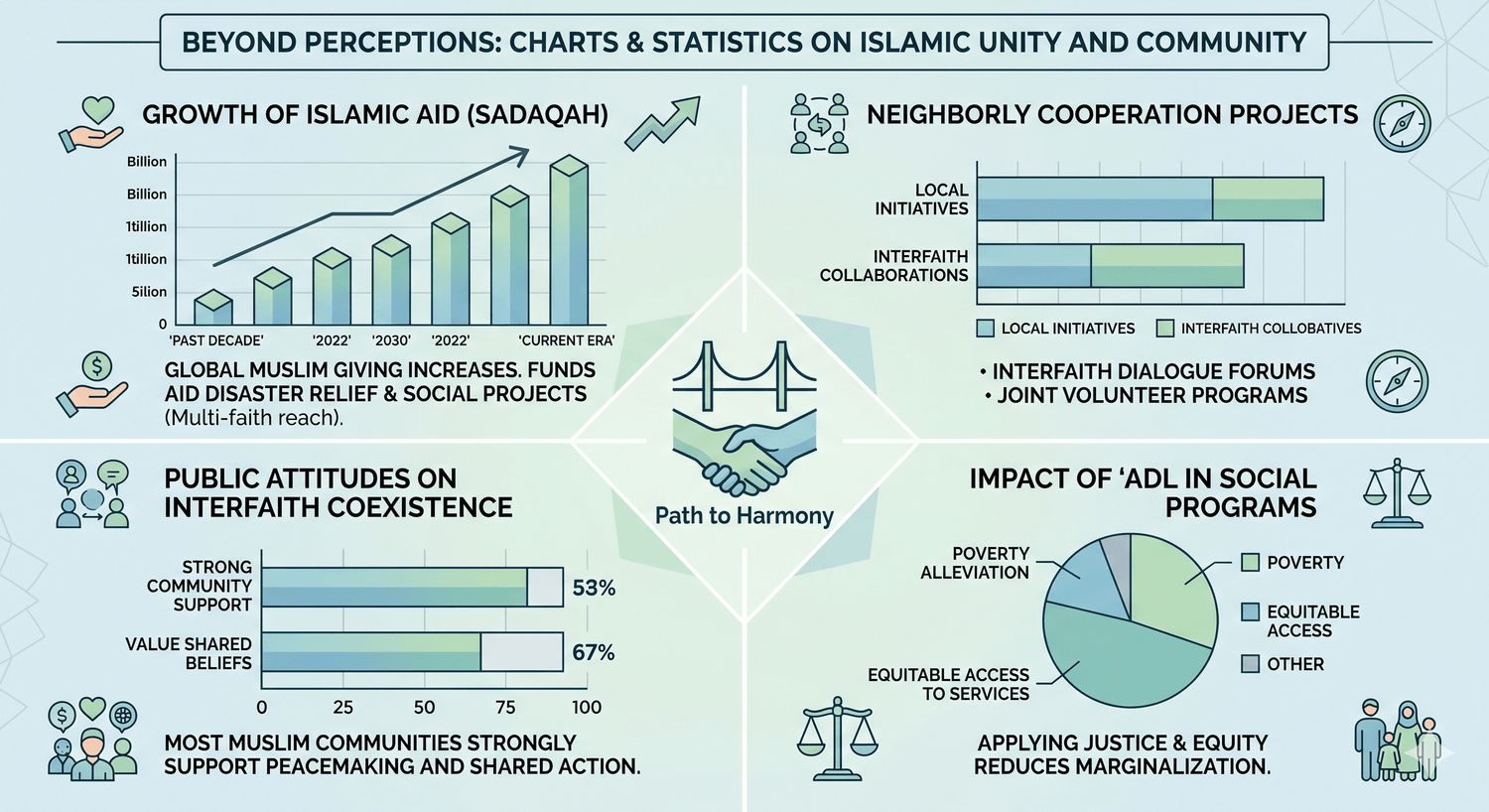
Here is something that surprises many people who come to Islam for the first time. The Quran does not ask Muslims to be suspicious of non-Muslims. It asks them to be just toward them.
"Allah does not forbid you from being kind and just to those who have neither fought you nor driven you from your homes. Allah loves those who are just." (Quran 60:8)
This is not a diplomatic footnote buried in a lengthy scripture. It is a direct instruction. The Arabic word used, qist, means fairness with full integrity — not tolerance in the watered-down, patronizing sense that means simply putting up with someone.
The Quran also acknowledges a shared lineage between Muslims, Jews, and Christians. It calls them Ahl al-Kitab — People of the Book — and instructs Muslims to find common ground with them: "Say: O People of the Book, let us come to a word that is fair between us and you — that we worship none but God." (Quran 3:64)
This is the posture Islam starts from. Not hostility. Not a competition over who is more right. An invitation to stand on shared ground.
The Prophet ﷺ and the First Model of Interfaith Solidarity
When the Prophet Muhammad ﷺ established the first Muslim community in Medina in the 7th century, he did something that political scientists still find remarkable. He drafted what became known as the Constitution of Medina — a written agreement that brought together Muslim and Jewish tribes, granting each community the right to practice its own religion, binding them to mutual defense, and making them one community (ummah) for shared civic purposes.
Jew and Muslim were to defend each other against outside attack. Each community would handle its own affairs internally. No one would be coerced in matters of faith.
This was not a tolerance-as-PR move. It was a functional, detailed civic document. And it worked — until political alliances during wartime fractured it, as alliances between nations often do. But the model itself was revolutionary. It said: you can share a city, defend a city together, and still believe different things about God.
When a delegation of Christian clergy from Najran visited Medina, the Prophet ﷺ allowed them to perform their Christian prayers inside his mosque. This is not a small detail. The mosque is the center of Muslim devotional life. To open it to the prayers of another faith is a statement about what sacred space can mean.
Interfaith Solidarity vs Islamophobia: The Real Dividing Line
The fight against Islamophobia is not, at its core, a Muslim fight. It is a human fight. And the strongest responses to anti-Muslim hatred in recent decades have come from interfaith coalitions — from Jewish communities standing outside mosques after attacks, from Christian churches offering their parking lots for Friday prayer when Muslim communities are displaced, from people of no particular faith at all who simply recognized that targeting a group for what they believe is wrong.
In 2015, when the Islamic Center of Louisville was vandalized with threatening graffiti, the mayor and faith leaders from every major tradition in the city organized a community clean-up day. Nearly 1,000 people showed up to paint over the hatred. That is interfaith solidarity. Not a conference. Not a resolution. People with brushes in their hands.
This is where interfaith solidarity vs Islamophobia stops being a theoretical debate and becomes something lived. The communities most effective at pushing back against Islamophobia are the ones where different faith groups already know each other before the crisis. Where neighbors have broken bread together. Where the imam and the rabbi and the pastor have had genuine, uncomfortable, honest conversations.
Islam's own tradition makes room for this. The Prophet ﷺ visited sick non-Muslim neighbors. He ﷺ stood in respect when the funeral procession of a Jewish man passed. His companions asked: "Was he not a Jew?" He replied: "Was he not a human soul?"
When Solidarity Becomes Difficult
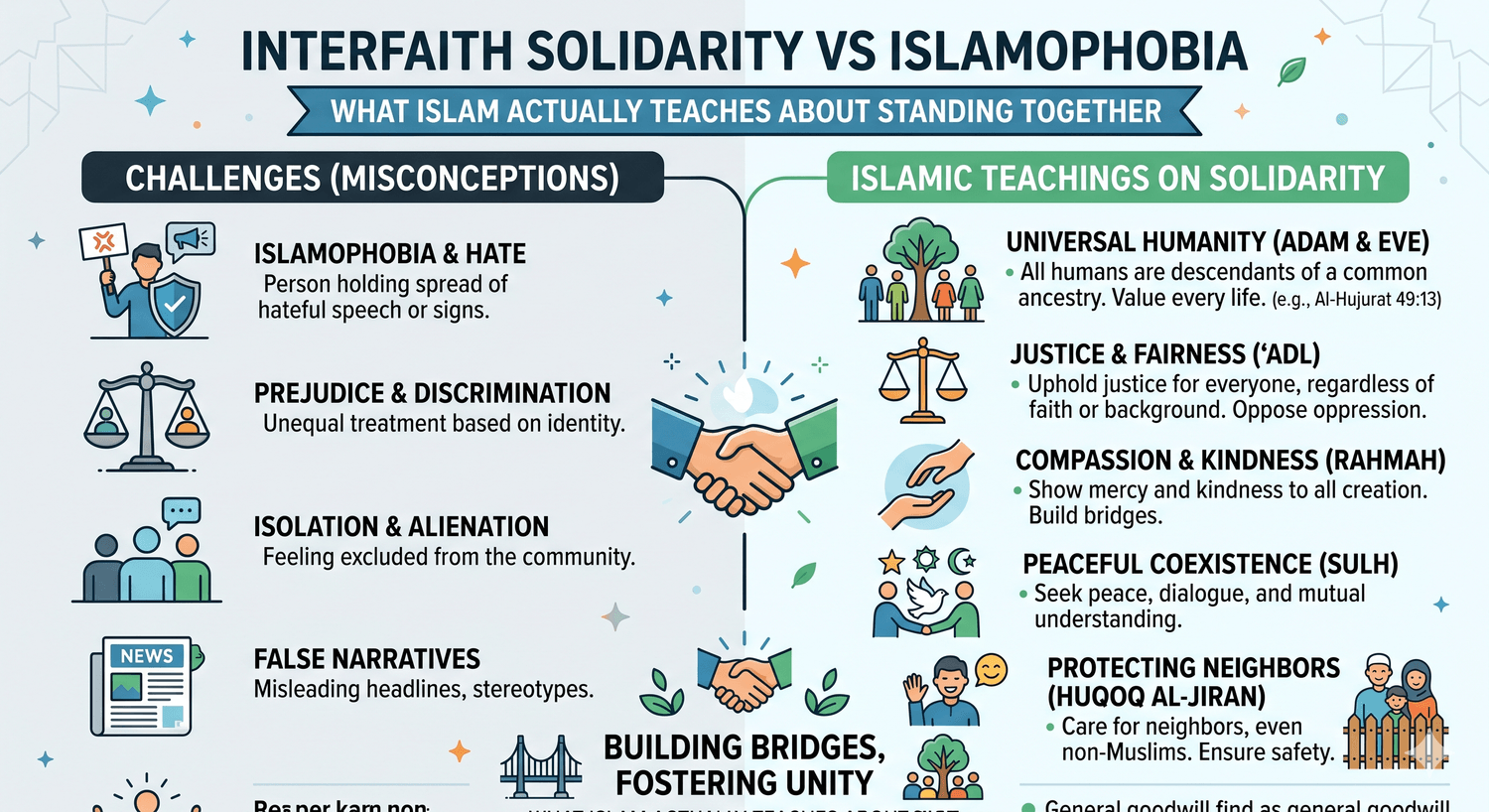
Interfaith solidarity vs Islamophobia is not always easy from the Muslim side either. Some Muslims worry that too much engagement with other faiths risks blurring theological lines — that standing side by side at a vigil somehow implies agreement on who God is, or that joining a coalition means endorsing beliefs you do not share.
This concern is real, and Islam addresses it directly. The Quran says clearly: "To you your religion, and to me mine." (Quran 109:6) That verse is not about indifference. It is about clarity. You can stand with someone, work with someone, defend someone's right to worship, without pretending that all religions say the same thing. The unity is not doctrinal. It is moral.
There is also the question of how to respond when Islamophobia comes not from the streets but from policy — from immigration restrictions targeting Muslim-majority countries, from surveillance programs that treat Muslim communities as suspects, from school curricula that omit or misrepresent Islamic history. Here, solidarity means advocacy. It means non-Muslim communities using their political access for their Muslim neighbors. And it means Muslims making the effort to be present — visible, vocal, and honest — in the civic spaces where decisions get made.
What New Muslims Often Discover First
If you are new to Islam, one of the first things you may notice is that the community you have joined has a complicated public image. People project onto you things you have never said or believed. Family members become anxious. Coworkers look at you differently.
This is the lived reality of Islamophobia for many people. Not a terror threat. Just the quiet social cost of being perceived as Muslim in a world that has been fed a very particular story about what that means.
What Islam offers in this moment is not a strategy for managing public relations. It offers the concept of da'wah — calling people to knowledge of God through your character. The Prophet ﷺ said: "Be gentle. Gentleness does not enter into anything without beautifying it." The most effective response to a false image is the long, patient work of making yourself known. Eating with your neighbors. Being the person who shows up. Being honest about what you believe and why.
How Interfaith Solidarity vs Islamophobia Reshapes Both Sides
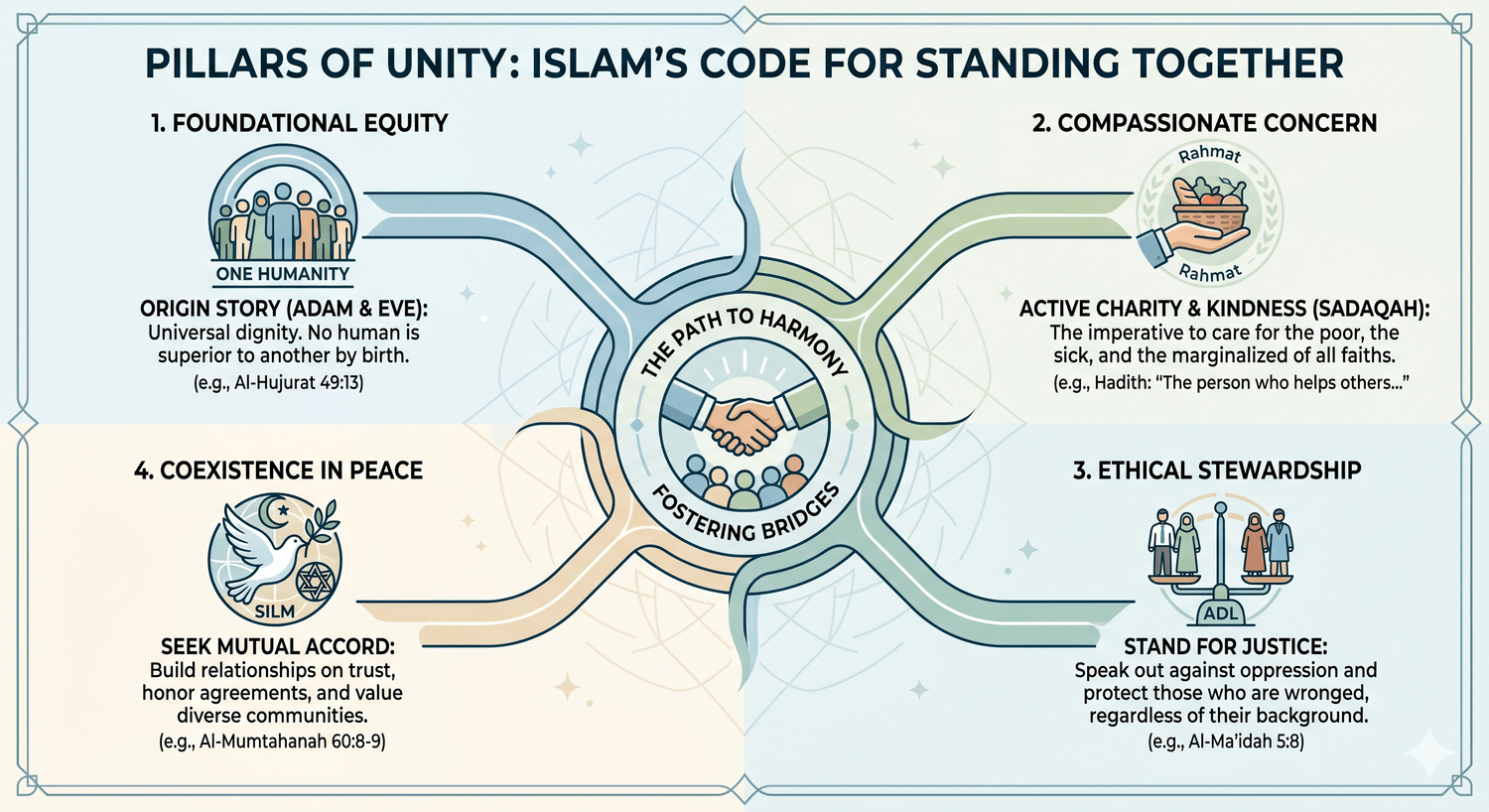
What happens when interfaith solidarity actually takes root? Both sides change.
Non-Muslim communities that develop real relationships with their Muslim neighbors stop encountering "Islam" as an abstraction and start encountering actual people — with the same anxieties about their children's futures, the same frustration with traffic, the same capacity for laughter and grief. The abstraction dissolves, and with it, much of the fear.
Muslim communities that engage seriously with interfaith work often find that articulating their faith to outsiders deepens their own understanding of it. When you have to explain why you fast in Ramadan to someone who has never heard of it, you think more carefully about why you fast. When you sit with someone from a different tradition who takes their faith seriously, you are reminded that seeking God is a human impulse — one that Islam shapes in a specific way, but does not monopolize.
Conclusion: Interfaith Solidarity vs Islamophobia Starts Close to Home
Interfaith solidarity vs Islamophobia is not a debate that ends with a winner. It is a practice that gets built, conversation by conversation, neighborhood by neighborhood, year by year. Islam does not promise that this work will be easy. It does promise that justice — qist — is worth the effort.
The Quran tells us: "O humanity, We created you from a single male and female and made you into peoples and tribes so that you might come to know one another." (Quran 49:13) Not to compete. Not to fear. To know.
If you are exploring Islam and wondering how your new faith positions you in a world full of difference, the answer is here. You are called to stand with justice. You are called to know your neighbor. And when someone is targeted for what they believe, you are called to remember that silence is also a choice.
Want to learn more about how Islam navigates the real challenges of life in a diverse world? Explore our courses at Start Islam Path, designed specifically for people exactly where you are right now.


