Islam Misconceptions: The Truth Behind the 20 Biggest Myths
Get the 109‑page guide delivered to your inbox
Discover the faith that 1.9 billion people live by — and why thousands of truth-seekers just like you are choosing it every single day. This free 109-page guide walks you from curiosity to clarity, step by step.
No pressure. No judgment. No strings attached. Just a clear, honest roadmap written for people who want real answers — whether you're skeptical, curious, confused, or quietly searching for something deeper.
Most people's understanding of Islam comes from three sources: news coverage of terrorism, political rhetoric, and social media outrage. None of these are reliable teachers of what Islam actually is. The result is a landscape of misconceptions so pervasive that many people have a completely inverted picture of a faith followed by 1.9 billion human beings. This article addresses the 20 most common Islam misconceptions directly, with evidence from the Quran, authentic hadith, and historical record.
We have an entire book where you can find 150 misconceptions, myths, debates, and arguments against Islam, and their related resposnse from Quran and Sunnah. [Download it here]
Why Islam Misconceptions Are So Widespread
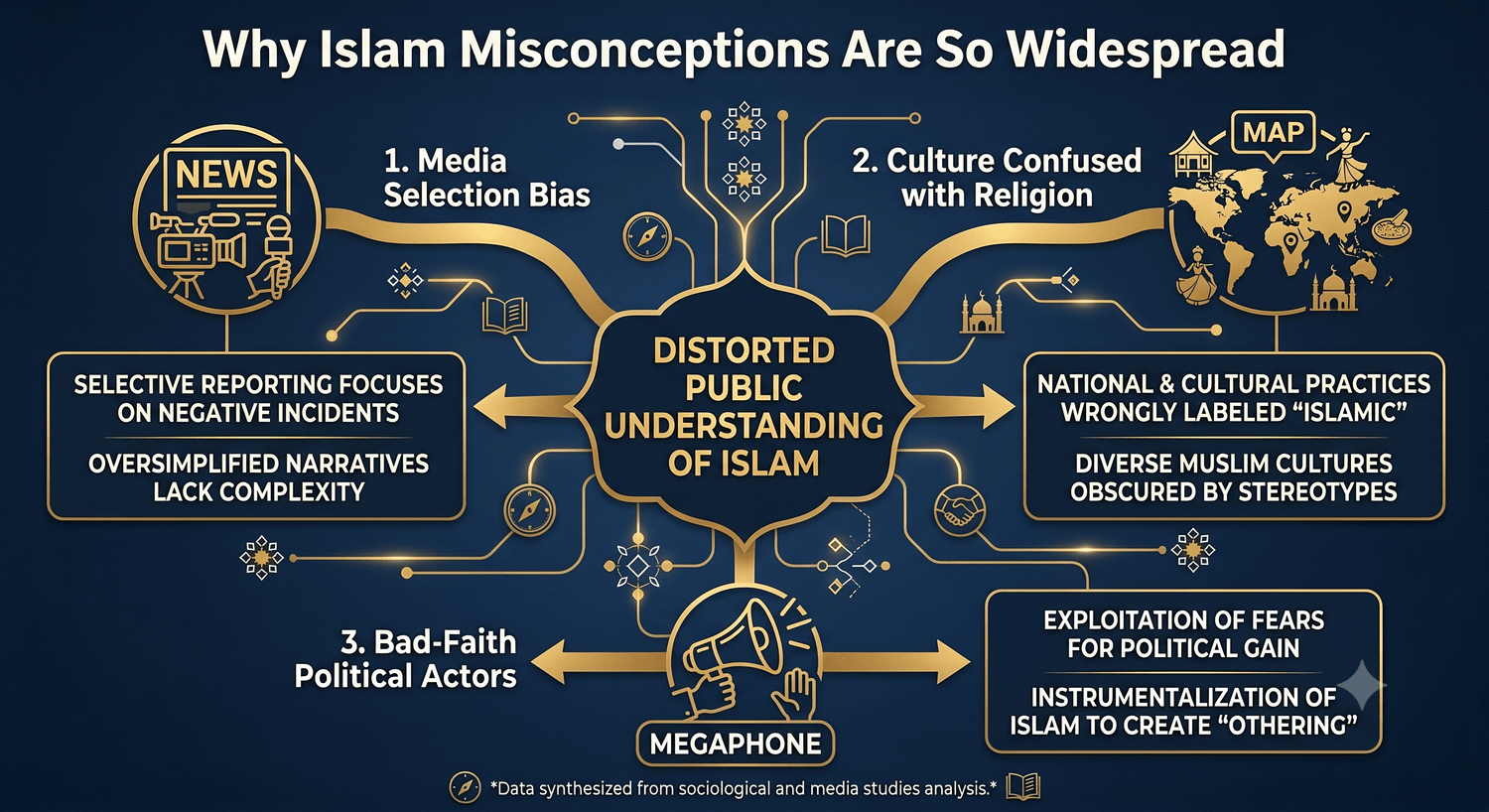
Before addressing the myths, it is worth asking: why are they so prevalent?
Three reasons:
1. Media selection bias. Violence is news. 1.9 billion Muslims living ordinary, peaceful lives is not. The result is a systematically distorted image of Islam in media coverage — not necessarily through malice, but through the mechanics of what gets attention.
2. Conflation of culture and religion. What Muslims in certain countries practice culturally is frequently presented as Islamic teaching. Honor killings, forced marriage, and female genital mutilation are cultural practices condemned by mainstream Islamic scholarship — but routinely attributed to Islam.
3. Bad-faith actors on both sides. Extremists who claim Islam as justification for violence, and Islamophobes who weaponize those extremists to condemn all Muslims — both distort Islam for their own purposes.
The only reliable antidote is primary sources: the Quran itself, and the authentic teachings of the Prophet Muhammad ﷺ.
Myth 1: Islam Is a Religion of Violence
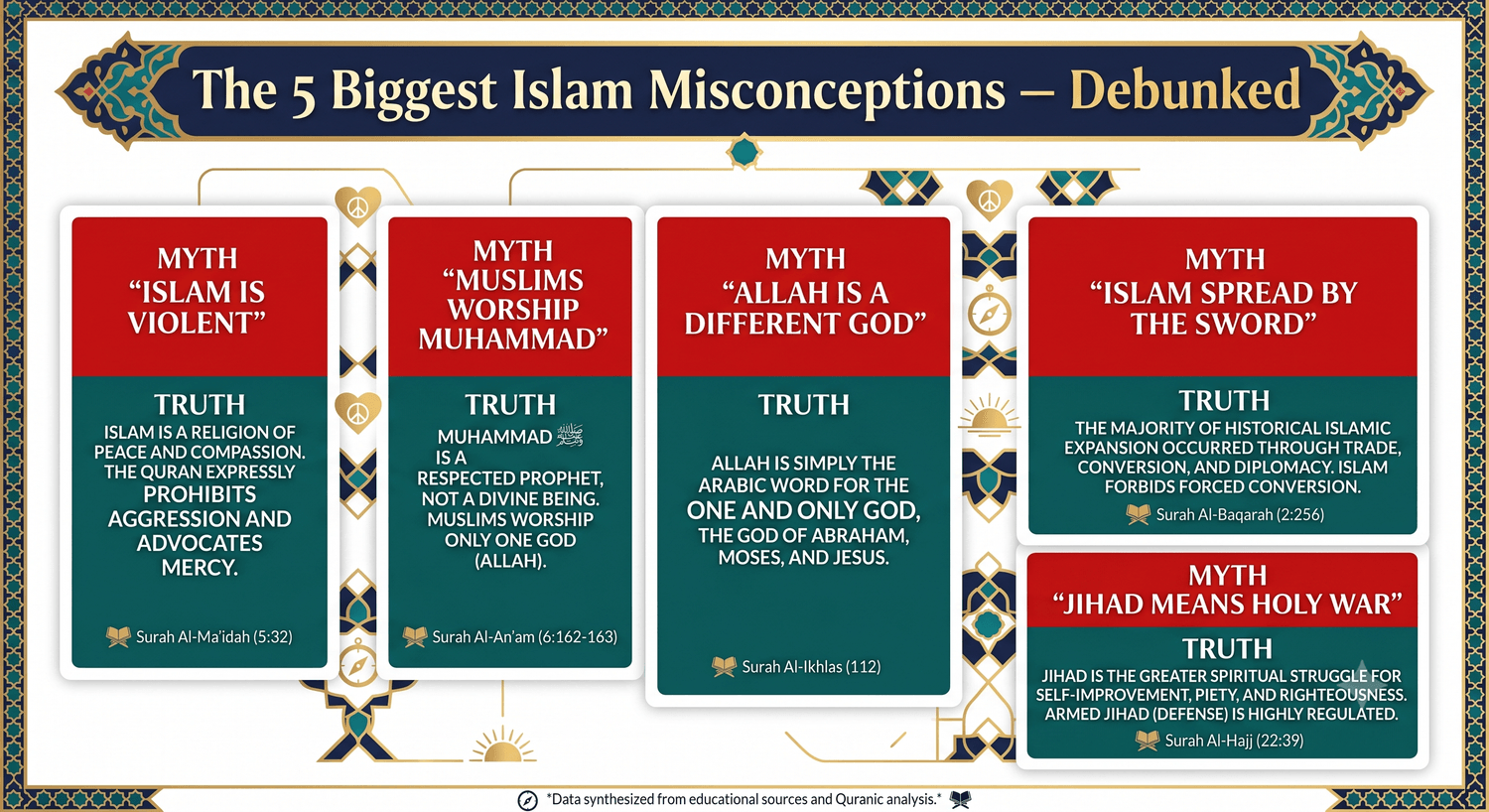
The truth: The Quran explicitly prohibits aggression and limits warfare to self-defense.
"Fight in the way of Allah those who fight you, but do not transgress limits. Indeed, Allah does not like transgressors." (Quran 2:190)
"Because of that, We decreed upon the Children of Israel that whoever kills a soul unless for a soul or for corruption in the land — it is as if he had slain mankind entirely. And whoever saves one — it is as if he had saved mankind entirely." (Quran 5:32)
The Prophet ﷺ explicitly prohibited killing civilians, women, children, monks, and the elderly even in times of war. Islamic law developed the most sophisticated rules of warfare in the ancient world — centuries before the Geneva Convention.
The vast majority of the world's 1.9 billion Muslims live peaceful, ordinary lives. Terrorism committed by people who claim Islamic justification is condemned by mainstream Muslim scholars universally. Al-Qaeda and ISIS have been declared heretical by leading Islamic institutions including Al-Azhar University.
Myth 2: Allah Is a Different God Than the God of Christians and Jews
The truth: Allah is the Arabic word for God — the same God worshipped by Abraham, Moses, and Jesus.
Arab Christians have used the word "Allah" in their Bibles for over a thousand years. The word "Allah" appears in the Arabic Bible as the name for God in Genesis 1:1. Arab Jews similarly use "Allah" in Arabic translations of the Torah.
Islam, Christianity, and Judaism are all Abrahamic monotheistic faiths — they trace their roots to the same patriarch, Abraham, and worship the same Creator. The theological differences between them concern the nature of God and the authenticity of various revelations — not whether they worship the same God.
Myth 3: Islam Oppresses Women
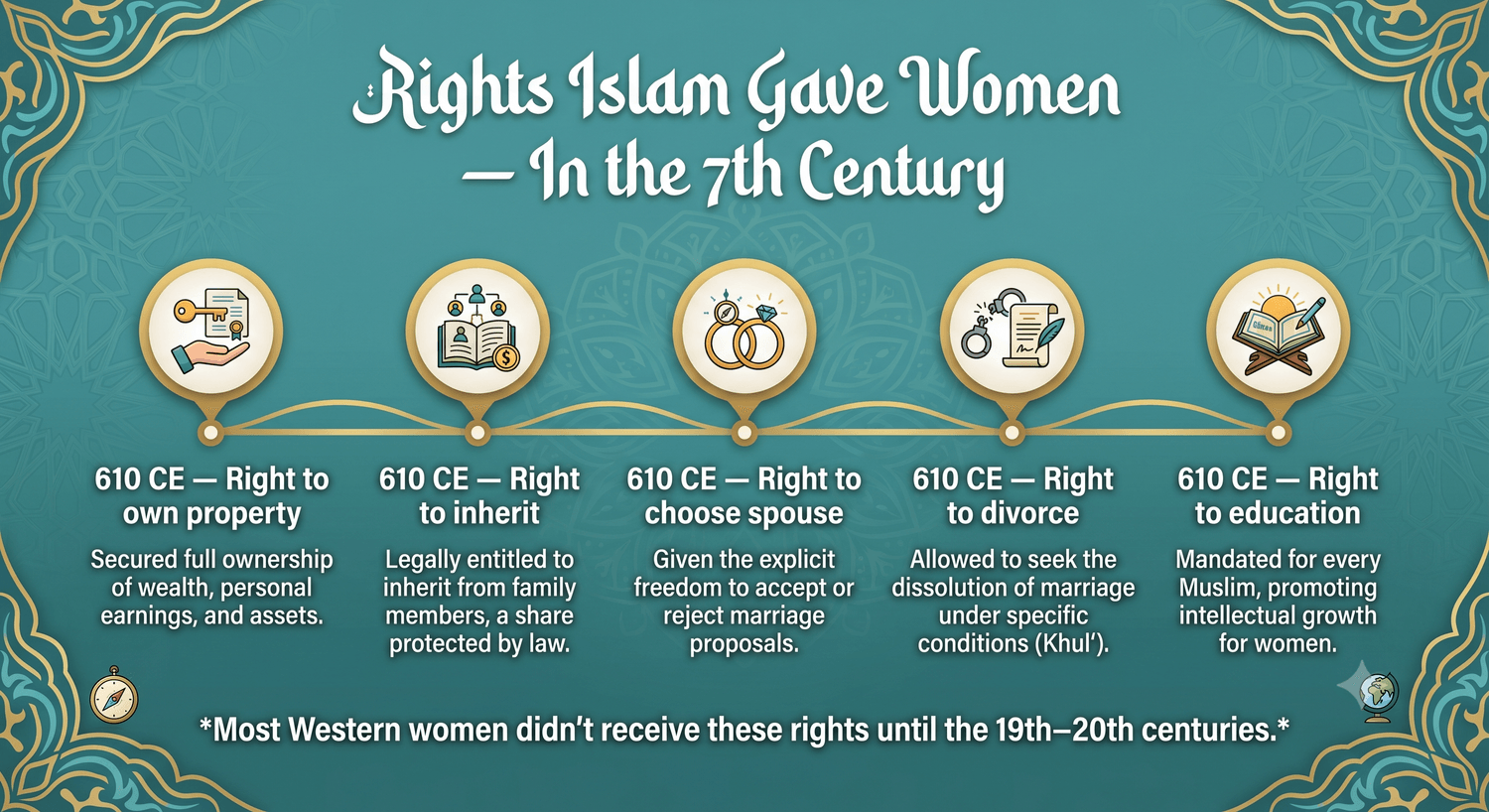
The truth: Islam gave women legal rights in the 7th century that most Western women did not receive until the 19th and 20th centuries.
In 7th-century Arabia — a society where female infanticide was common — Islam prohibited the practice, gave women:
The right to own property
The right to inherit
The right to divorce
The right to choose their spouse
The right to keep their earnings
The right to education
The Quran explicitly states that men and women are spiritually equal: "Verily, the Muslim men and women, the believing men and women... Allah has prepared for them forgiveness and a great reward." (Quran 33:35)
Cultural practices in some Muslim-majority countries that restrict women's rights contradict Islamic teaching. The Prophet Muhammad ﷺ said: "The best of you are those who are best to their wives." His wife Khadijah was a successful merchant who employed him before their marriage. His wife Aisha became one of the greatest scholars of Islamic law and hadith in history.
Myth 4: The Hijab Is Forced on Muslim Women
The truth: Hijab is a religious obligation for Muslim women — but obligation is not the same as force.
Muslim women who wear hijab do so as an act of worship — because they believe God has instructed it. The same logic applies to a Catholic nun wearing a habit, a Sikh man wearing a turban, or an Orthodox Jewish man wearing a kippah. Religious dress is practiced across all major faith traditions.
The claim that hijab is inherently oppressive assumes that Muslim women cannot make meaningful religious choices — an assumption that is itself disrespectful to the agency and intelligence of 1 billion Muslim women worldwide.
Forced hijab — imposed by governments like Iran or by families — is a different issue entirely, and is condemned by Islamic scholars who affirm that "there is no compulsion in religion" (Quran 2:256).
Myth 5: Jihad Means Holy War
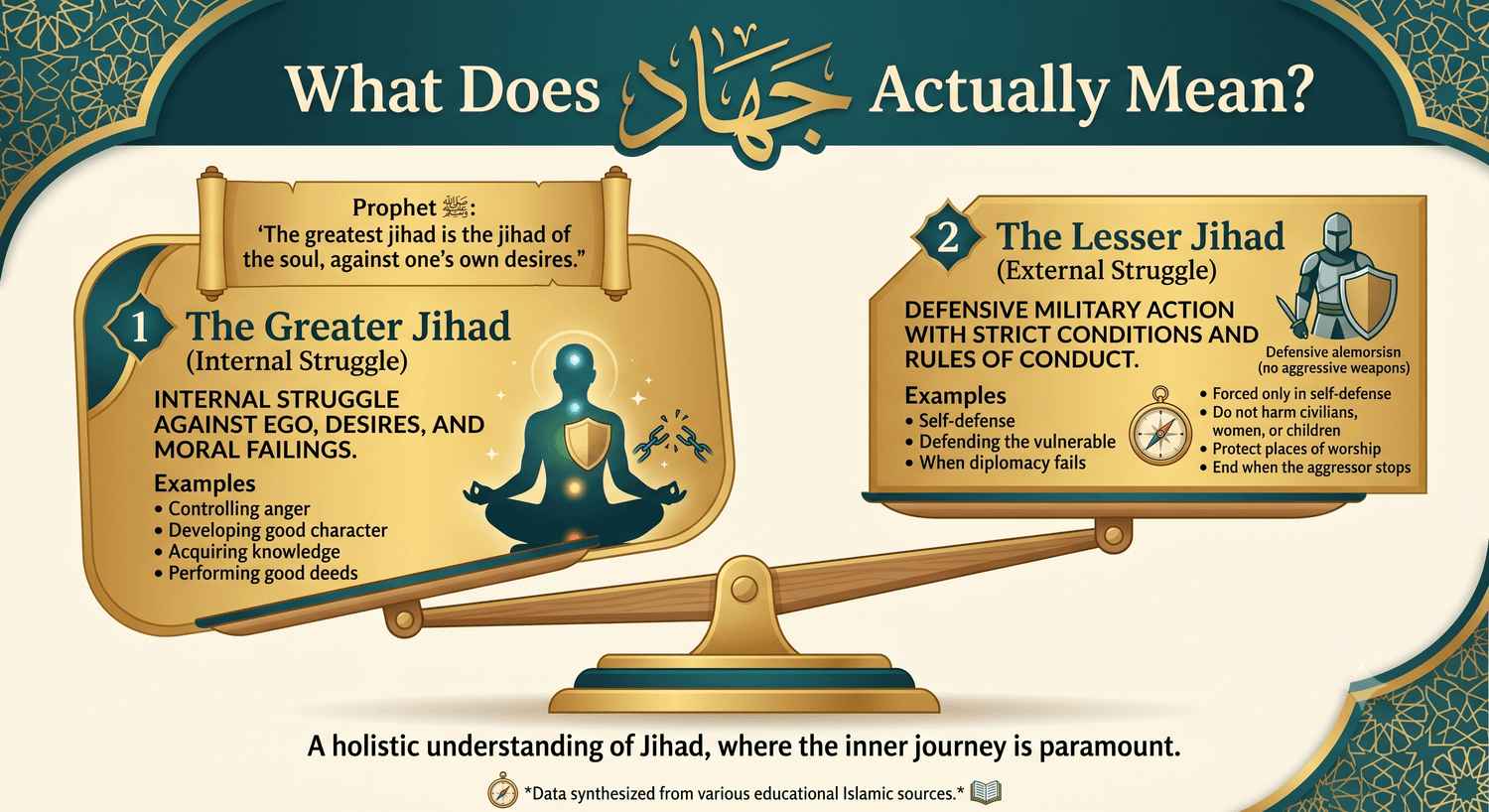
The truth: The word Jihad means "struggle" or "effort" — and the primary meaning in Islamic theology is the internal struggle against one's own ego, desires, and moral failings.
The Prophet Muhammad ﷺ, returning from a military campaign, told his companions: "We have returned from the lesser jihad to the greater jihad." When asked what the greater jihad was, he said: "The struggle against the self."
Military jihad does exist in Islamic law — as a defensive measure against aggression, with strict conditions and rules of conduct. It requires legitimate authority, a just cause, proportionality, and protection of civilians. It has nothing to do with terrorism or indiscriminate violence.
The word "Jihad" in 7th-century Arabic had no more violent connotation than the English phrase "fighting for a cause."
Myth 6: Muslims Worship Muhammad ﷺ
The truth: Muslims do not worship Muhammad ﷺ. Worship in Islam belongs to God alone.
Muhammad ﷺ was a human being — a husband, father, and prophet. When he died, the first Caliph Abu Bakr addressed the people: "Whoever worshipped Muhammad, let him know that Muhammad is dead. Whoever worshipped Allah, let him know that Allah never dies."
Muslims honor and love the Prophet ﷺ deeply — following his example and sending blessings upon him. But honor and love are not worship. The distinction is fundamental to Islamic monotheism.
Myth 7: Islam Spread by the Sword
The truth: The historical evidence contradicts this claim.
Islam spread most rapidly in regions where no military conquest occurred: Indonesia (the world's largest Muslim country), Malaysia, West Africa, and Bangladesh. These regions converted to Islam primarily through trade, scholarship, and the character of Muslim merchants and scholars.
The Quran explicitly states: "There is no compulsion in religion." (Quran 2:256)
Where Muslim armies did conquer — Persia, Egypt, North Africa — the conquered populations were not forced to convert. Non-Muslim communities (Jews, Christians, Zoroastrians) lived under Islamic governance with protected status (dhimmi) and their own legal systems. Many did not convert for generations or centuries.
The historical record of Islamic coexistence — in Andalusia, the Ottoman Empire, and the Abbasid Caliphate — is one of the most remarkable examples of multi-religious governance in human history.
Myth 8: Islam Bans Scientific Inquiry
The truth: Islam is the only major religion that explicitly commands its followers to seek knowledge as a religious duty.
The first word revealed in the Quran was Iqra — "Read." The Prophet ﷺ said: "Seeking knowledge is an obligation upon every Muslim."
The Islamic Golden Age (8th–13th centuries) was one of the most scientifically productive periods in human history. Muslim scholars made foundational contributions to:
Mathematics — algebra (Al-Khwarizmi), algorithms, trigonometry
Medicine — Ibn Sina's Canon of Medicine was used in European universities for 600 years
Astronomy — naming stars, developing celestial navigation
Chemistry — Jabir ibn Hayyan is considered the father of chemistry
Optics — Ibn al-Haytham's Book of Optics preceded European optics by centuries
The Quran repeatedly instructs believers to observe, reflect, and reason: "Do they not look at the camels — how they are created?" (Quran 88:17). Empirical observation of the natural world is framed as an act of faith.
Myth 9: All Muslims Are Arab
The truth: Only about 20% of the world's Muslims are Arab.
The five countries with the largest Muslim populations are:
Indonesia — 231 million Muslims
Pakistan — 213 million
Bangladesh — 153 million
India — 200 million
Nigeria — 99 million
Not one of these is an Arab country. Muslims are African, South Asian, East Asian, European, American, and every other demographic. The Arab world represents a minority of global Islam.
Myth 10: Islam Is Against Democracy and Human Rights
The truth: Islamic political thought has a sophisticated tradition of governance based on consultation (shura), justice, accountability of leaders, and the protection of human rights.
The Quran mandates: "And consult them in the matter." (Quran 3:159). The Prophet ﷺ led through consultation and consensus, not autocracy.
Islam's conception of human rights predates modern human rights frameworks. The Prophet's ﷺ Farewell Sermon (632 CE) declared: the sanctity of life, property, and honor; the elimination of racial hierarchy ("No Arab is superior to a non-Arab... except by piety"); the rights of women; and the prohibition of usury and oppression.
The compatibility of Islam with democratic governance is debated among scholars — but it is not resolved by claiming Islam is inherently anti-democratic. Many of the world's largest democracies have majority Muslim populations.
Myth 11: Honor Killings Are Islamic
The truth: Honor killings are a cultural practice that predates Islam and is explicitly condemned by Islamic law.
The Quran prohibits taking human life except by just cause (Quran 17:33). There is no verse in the Quran and no authentic hadith that sanctions killing a family member for perceived dishonor. Honor killings occur in communities across the Middle East, South Asia, and even Latin America — among Christian, Muslim, and Hindu communities alike. They are a product of patriarchal tribal culture, not Islamic teaching.
Mainstream Islamic scholars without exception condemn honor killings as murder — a major sin with severe consequences in Islamic law.
Myth 12: Islam Forbids Music and Art
The truth: This is a genuine area of scholarly debate within Islam — not a settled prohibition.
On music: Islamic scholars have differing opinions. Most agree that music with obscene lyrics or that leads to forbidden behavior is prohibited. Many scholars permit music without those elements. The total prohibition of all music is a minority scholarly position, not the dominant one.
On figurative art: Historically, Islamic art produced some of the world's most extraordinary visual traditions — architecture, geometric patterns, calligraphy, and miniature painting. The restriction in Islamic law applies primarily to three-dimensional idols (to prevent idol worship) and in certain scholarly interpretations, to figurative painting in specific contexts. Islamic civilization has never been artistically barren.
Myth 13: Muslims Believe in a Vengeful, Distant God
The truth: The Quran opens with and repeatedly emphasizes the mercy of God above all other attributes.
Every chapter of the Quran except one begins with: "In the name of Allah, the Most Gracious, the Most Merciful." The two names of God used most frequently in the Quran are Al-Rahman and Al-Rahim — both derived from the root word for mercy and womb.
The Quran states: "My mercy encompasses all things." (Quran 7:156)
The Prophet ﷺ said: "Allah has divided mercy into one hundred parts. He retained ninety-nine parts with Him and sent down one part to earth — and because of that one part, creation shows mercy to one another, even to the point that a horse lifts its hoof over its young for fear of hurting it."
Islamic theology describes God as closer to each person than their jugular vein (Quran 50:16) — a God of profound intimacy, not distant judgment.
Myth 14: Islam Forces Conversion
The truth: The Quran explicitly prohibits forced conversion.
"There is no compulsion in religion." (Quran 2:256)
"So remind, for you are only a reminder. You are not over them a controller." (Quran 88:21–22)
The Prophet ﷺ was commanded to deliver the message — not to coerce acceptance. Islamic history includes fourteen centuries of non-Muslim communities living within Islamic governance without being compelled to convert. Coerced conversion is considered invalid in Islamic law — only sincere, willing acceptance of faith counts.
Myth 15: Islam and Science Are Incompatible
The truth: The Quran contains numerous verses that speak to natural phenomena with striking precision for a 7th-century text.
The Quran describes the development of the human embryo in stages (Quran 23:12–14) — a description that aligns remarkably with modern embryology. It describes the expanding universe (Quran 51:47), the aquatic origin of life (Quran 21:30), and the barrier between bodies of water (Quran 55:19–20).
None of these constitute proof of Islamic truth by themselves — they are points of reflection. But they are evidence that Islam and scientific inquiry are not adversaries. The Islamic tradition has always framed the study of the natural world as a form of recognizing God's creation.
Myth 16: ISIS and Al-Qaeda Represent Islam
The truth: ISIS and Al-Qaeda have been condemned by mainstream Islamic scholars as heretical movements that have betrayed Islam.
Al-Azhar University in Cairo — the oldest and most prestigious Islamic university in the world — has declared ISIS's ideology incompatible with Islam. Over 120 senior Islamic scholars from around the world signed an open letter to ISIS leadership citing over 20 ways their actions violate Islamic law.
More Muslims have been killed by ISIS and Al-Qaeda than any other group. These movements are rejected overwhelmingly by the global Muslim community as a perversion of Islam, not an expression of it.
Myth 17: Islam Does Not Allow Friendship with Non-Muslims
The truth: This misconception comes from a misunderstanding of specific Quranic verses addressing political alliances during wartime — not general friendship.
The Quran commands Muslims to treat non-Muslims with kindness and justice: "Allah does not forbid you from those who do not fight you because of religion and do not expel you from your homes — from being righteous toward them and acting justly toward them." (Quran 60:8)
The Prophet ﷺ maintained respectful relations with non-Muslims throughout his life. He honoured agreements, attended the funerals of non-Muslims, accepted gifts from them, and commanded his followers to be just with all people regardless of faith.
Myth 18: Muslim Men Can Have Up to Four Wives and Abuse Them
The truth: Quranic polygamy is limited, conditional, and historically contextual. And domestic abuse is prohibited.
The Quran permits up to four wives under strict conditions — including the requirement to treat each wife with absolute equality and justice: "If you fear that you will not be just, then marry only one." (Quran 4:3). Most Muslim scholars acknowledge that the condition of perfect equality between wives is nearly impossible to achieve — making monogamy the Quranic ideal.
The Prophet ﷺ explicitly prohibited harm to women: "Do not harm those who cannot harm you." He asked in his Farewell Sermon: "What rights do you have over your women? You have the right to reasonable obedience. And they have rights over you — that you treat them with kindness and provide for them well."
Myth 19: Islam Is Only for Arabs or for People Born Muslim
The truth: Islam has never been ethnically or culturally exclusive.
Islam is a universal religion — explicitly stated in the Quran: "We have sent you as a mercy to all the worlds." (Quran 21:107). The Prophet's ﷺ community included Arab, Persian, African (Bilal — the first muezzin was an Ethiopian freed slave), and Byzantine companions.
Today, converts to Islam are one of the fastest-growing demographics in the Western Muslim community. In the United States alone, approximately 20,000–25,000 people convert to Islam annually. Every convert is a full Muslim — with no ethnic requirement, no cultural adoption required, and no lesser status than someone born into a Muslim family.
Myth 20: The Quran Was Written by Muhammad ﷺ
The truth: Muhammad ﷺ was illiterate — he could not read or write.
The Quran was received by Muhammad ﷺ through revelation from God via the angel Jibreel (Gabriel). It was memorized by his companions in real time, written down on available materials, and compiled into a single manuscript within two years of his death. The manuscript was then copied and distributed to every major city of the early Islamic empire.
The consistency of the Quranic text across 1,400 years — across thousands of handwritten manuscripts from different centuries and continents, all matching the memorized text held by millions of huffaz (Quran memorizers) — is one of the most remarkable preservation records in human history.
Frequently Asked Questions About Islam Misconceptions
Why do so many people have wrong ideas about Islam?
Misconceptions about Islam are primarily driven by media coverage that focuses on extremist violence, political rhetoric that conflates Muslims with terrorism, and a general unfamiliarity with Islamic texts and history. The solution is primary sources — reading the Quran and Islamic scholarship directly rather than relying on secondhand characterizations.
Is Islam compatible with Western values?
This depends on which "Western values" are meant. Islam's emphasis on justice, knowledge, community welfare, human dignity, and accountability aligns with many Western enlightenment values. Where conflicts exist — around issues like sexuality and religious authority — they reflect genuine theological differences, not proof that Islam is primitive or incompatible with modern life.
Are all Muslims required to follow Sharia?
Sharia is not a fixed legal code — it is a body of Islamic jurisprudence developed by scholars over centuries. It covers everything from prayer and fasting to family law and finance. What it means in practice varies enormously across different Muslim communities, countries, and scholarly traditions. The image of Sharia as a single, violent legal system is a gross oversimplification.
Do Muslims hate non-Muslims?
No. Islam commands Muslims to treat all people — Muslim and non-Muslim — with justice and kindness. The Quran does not teach hatred of non-Muslims. It teaches that all human beings are descended from the same parents (Adam and Eve) and are equally honored in God's sight regardless of faith (Quran 17:70).
The Antidote to Misconception Is Direct Encounter
The most effective counter to every misconception on this list is the same: direct encounter with Islam's primary sources — the Quran and the authentic teachings of the Prophet Muhammad ﷺ — and with the actual lives of Muslims.
Every person who reads the Quran with an open mind and meets Muslims as human beings rather than as news headlines discovers the same thing: the Islam they thought they knew was not Islam.
The free 109-page guide — Steps for Converting to Islam and Maintaining Faith — gives you a clear, honest introduction to what Islam actually teaches. No agenda. No pressure. Just the truth. [Download it free here]


