Islamic Micro-Habits for Spiritual Growth That Stick
Get the 109‑page guide delivered to your inbox
Discover the faith that 1.9 billion people live by — and why thousands of truth-seekers just like you are choosing it every single day. This free 109-page guide walks you from curiosity to clarity, step by step.
No pressure. No judgment. No strings attached. Just a clear, honest roadmap written for people who want real answers — whether you're skeptical, curious, confused, or quietly searching for something deeper.
There's a hadith that stops you when you first encounter it. The Prophet ﷺ said: "The most beloved deeds to Allah are those done regularly, even if they are small" (Sahih Bukhari). Read it again slowly. Even if they are small. Not the biggest, not the most impressive, not the ones that take the most effort. The ones that are consistent.
This is not a concession for beginners. This is a core principle of spiritual growth in Islam. And it's something the tradition has understood for 1,400 years that behavioral science is only recently catching up to.
Islamic micro-habits for spiritual growth are not a productivity hack. They're the architecture of a life lived close to God. They work because they're small enough to actually do every day, and because the tradition behind them was designed to embed the divine into the ordinary.
Why Small Islamic Micro-Habits Build Deeper Faith
The commanding ego-self — what classical Islamic scholars call the nafs al-ammara — loves grand gestures. It loves the Ramadan burst of worship that collapses by mid-Shawwal. It loves the passionate moment of recommitment that fades in two weeks. What the nafs can't handle is the quiet, daily discipline of showing up for small things consistently.
The Prophet ﷺ warned against taking on more than you can sustain. He said: "Do not let your nafs mislead you" and he himself would sometimes shorten his prayers when he sensed the congregation was tired — not because prayer wasn't important, but because sustainability matters. A practice you abandon after a month serves you less than a simpler practice you maintain for a lifetime.
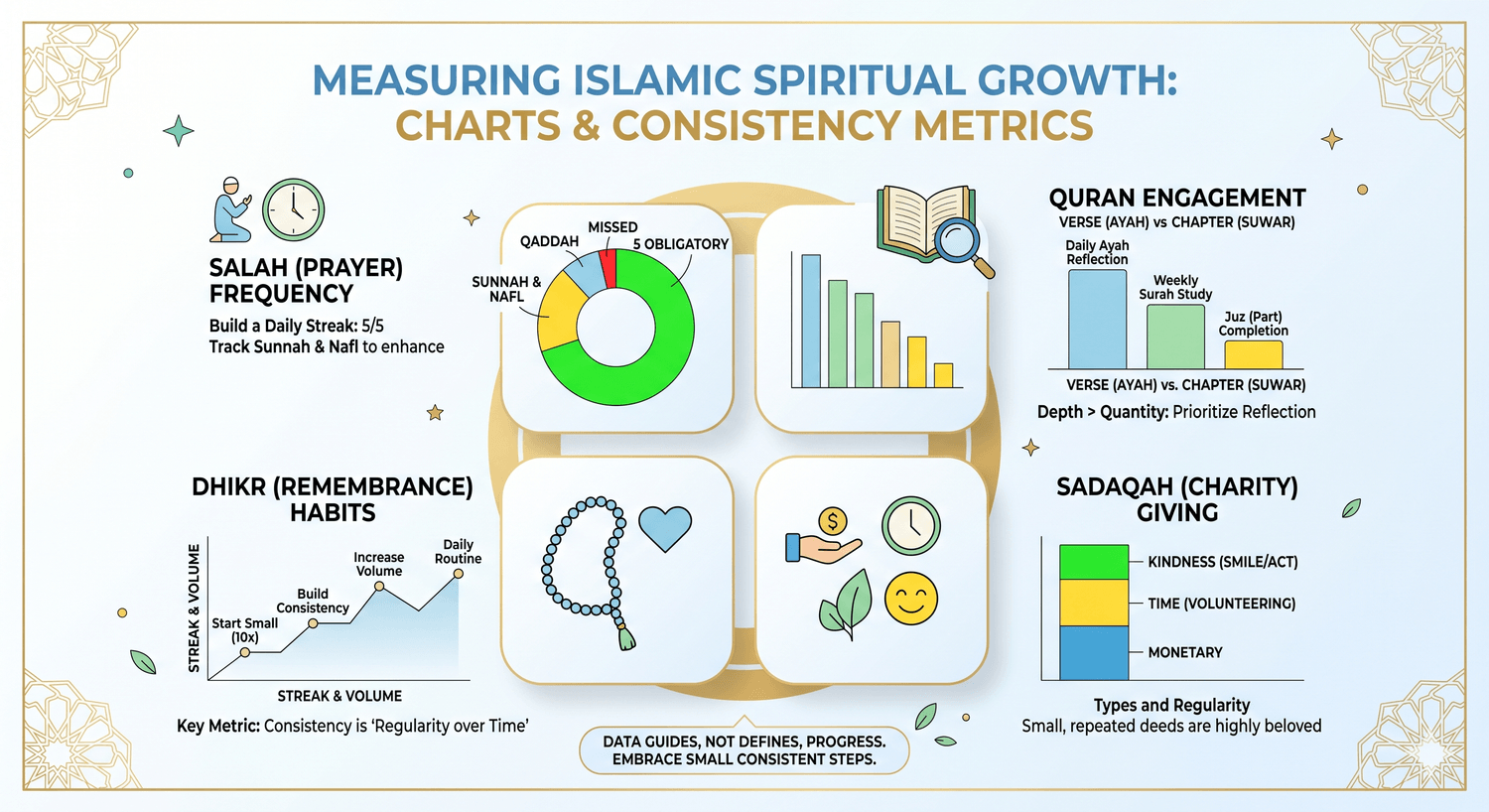
The Islamic micro-habits for spiritual growth below are chosen for exactly that reason: they're grounded in the Sunnah, they take minutes rather than hours, and they compound over time in ways that are hard to measure but impossible to miss.
Start With Bismillah
The smallest Islamic micro-habit is also one of the most constant: saying "Bismillah" — in the name of God — before beginning any action.
Before eating, before drinking, before driving, before opening a document to begin work, before walking into a difficult meeting. The Prophet ﷺ taught that saying Bismillah before eating prevents Shaytan from sharing in your food. More broadly, the habit of saying Bismillah is a continuous reminder that nothing you do is purely secular. Every action is taken in God's name. Every moment becomes an opportunity for remembrance.
It takes less than a second. It costs nothing. And if you do it consistently, you'll notice that it changes the texture of your day. You stop running on autopilot. You slow down, just slightly, before beginning things. That slight pause is where consciousness lives.
Morning and Evening Adhkar
The Prophet ﷺ taught specific formulas of remembrance and supplication for the morning and evening. These are called the morning and evening adhkar, and they are one of the most consistently recommended Islamic micro-habits for spiritual growth across the entire scholarly tradition.
The morning adhkar are typically recited after Fajr prayer. The evening adhkar after Asr or Maghrib. A complete set might take 10 to 15 minutes, though shorter versions can be done in five. The adhkar include phrases like "Subhan Allah wa bihamdihi" (Glory be to God and His praise) a hundred times, Ayatul Kursi, the three Quls (short chapters of the Quran), and specific supplications for protection, gratitude, and placing oneself in God's care.
The Quran itself points to this practice: "And remember your Lord by name morning and evening" (Quran 76:25). These aren't vague intentions. They're specific formulas, given by the Prophet ﷺ himself, tested across centuries of Muslim spiritual life.
If you do nothing else, this single micro-habit — the morning and evening adhkar, consistently — will change how you move through your day.
The Two Rak'ahs Before Every Commitment
There is a prayer called Salat al-Istikhara — the prayer of seeking God's guidance — that most Muslims know about but fewer practice regularly. When you face a decision, you pray two rak'ahs and ask God to guide you toward what is good.
What fewer people practice is the broader Sunnah of offering two rak'ahs of voluntary prayer at moments of transition or need. The Prophet ﷺ prayed two rak'ahs before every significant action. His companion Bilal RA used to make wudu and immediately pray two rak'ahs whenever he did so, and the Prophet ﷺ heard the sound of his footsteps in paradise and asked him what he did.
Two voluntary rak'ahs. Not a full tahajjud. Not an hour of worship. Two rak'ahs.
You're about to make a difficult phone call. Two rak'ahs first. You're beginning a new project at work. Two rak'ahs. Your day is spinning out of control and you can't find your footing. Two rak'ahs.
The physical act of stopping, facing the qibla, and bowing before God does something to you that simply thinking about God doesn't. The body follows the mind, but the mind also follows the body. Prostration produces humility. That's not metaphor, it's the lived experience of millions of Muslims across centuries.
One Ayah with Intention
There's a powerful difference between reading the Quran and reading the Quran with intention.
Most of us are familiar with the goal of completing the Quran. What gets forgotten is that the Quran addresses you. Directly. "O you who believe" is not a historical address to 7th-century Arabs. It's speaking to you, now, today, in your specific situation.
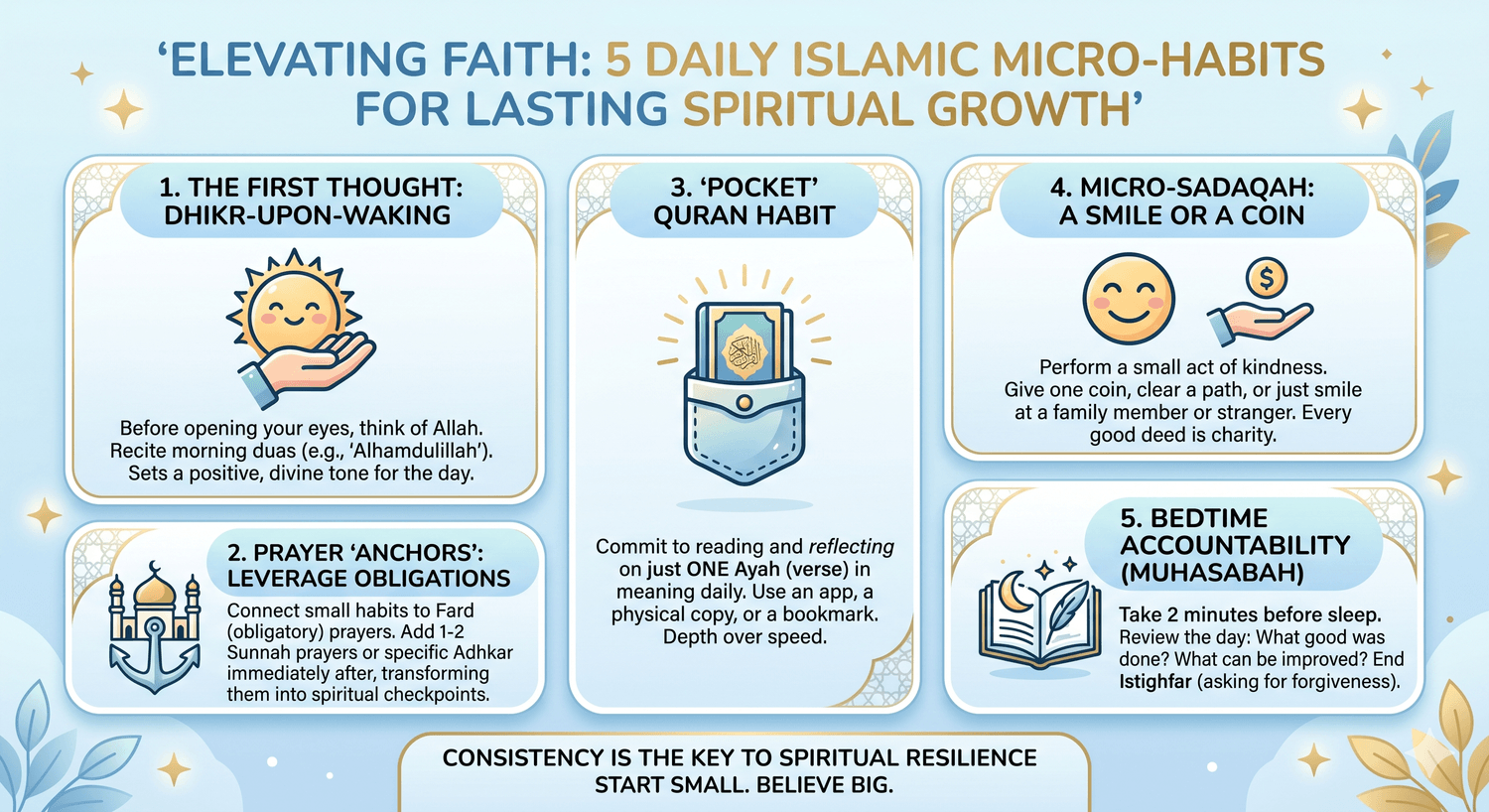
One of the most sustainable Islamic micro-habits for spiritual growth is reading a single ayah (verse) each day — not a full page, not a juz, just one ayah — and sitting with it. What is God saying? What does this mean for how I'm going to live today? What am I doing in my life that this verse affirms or challenges?
Ibn al-Qayyim, the great 14th-century scholar, described the Quran as medicine. You don't take medicine by rushing through the bottle. You take the right dose, at the right time, and let it work.
One ayah. Every day. With attention.
Istighfar: The Two-Minute Reset
Istighfar means seeking forgiveness. The most basic form is saying "Astaghfirullah" — I seek forgiveness from God. The Prophet ﷺ himself said he sought forgiveness from God more than seventy times a day (Sahih Bukhari). The man who had no sins, who was guaranteed paradise, who the Quran described as having an "exalted character" — he sought forgiveness constantly.
What does that tell you?
It tells you that istighfar is not about guilt. Or rather, it's not only about guilt. It's about maintaining a posture of humility before God. It's a recognition that you are not sufficient, that you don't know everything, that you could have done better, and that God's mercy is always available.
Two minutes of sincere istighfar — in the car, while walking, while waiting for water to boil — is one of the most accessible Islamic micro-habits for spiritual growth there is. The Prophet ﷺ promised that whoever maintains it consistently will find that God opens up for them a way out of every difficulty, a relief from every anxiety, and a provision from where they didn't expect it (Sunan Abu Dawud).
Giving Something Small Every Day
Sadaqa, voluntary charity, does not have to be large. The Prophet ﷺ said: "Protect yourselves from the fire, even if with half a date" (Sahih Bukhari). Half a date. That's less than you'd spend on a piece of gum.
The micro-habit here is not financial generosity at scale. It's the daily discipline of giving something — money, time, a kind word, a smile, removing something harmful from the path of others. The Prophet ﷺ said: "Every good deed is charity" (Sahih Bukhari).
When giving becomes a daily habit rather than an occasional event, it restructures your relationship with what you own. You stop seeing your money as only yours. You develop a looseness with resources that the Prophet ﷺ described as one of the signs of a believer's character. And you interrupt, constantly and deliberately, the nafs's tendency to accumulate and hold.
Muhasabah: The Five-Minute Evening Account
Umar ibn al-Khattab, the second Caliph, said: "Call yourselves to account before you are called to account." This is the practice of muhasabah — self-examination. It is one of the oldest Islamic micro-habits for spiritual growth and one of the most neglected.
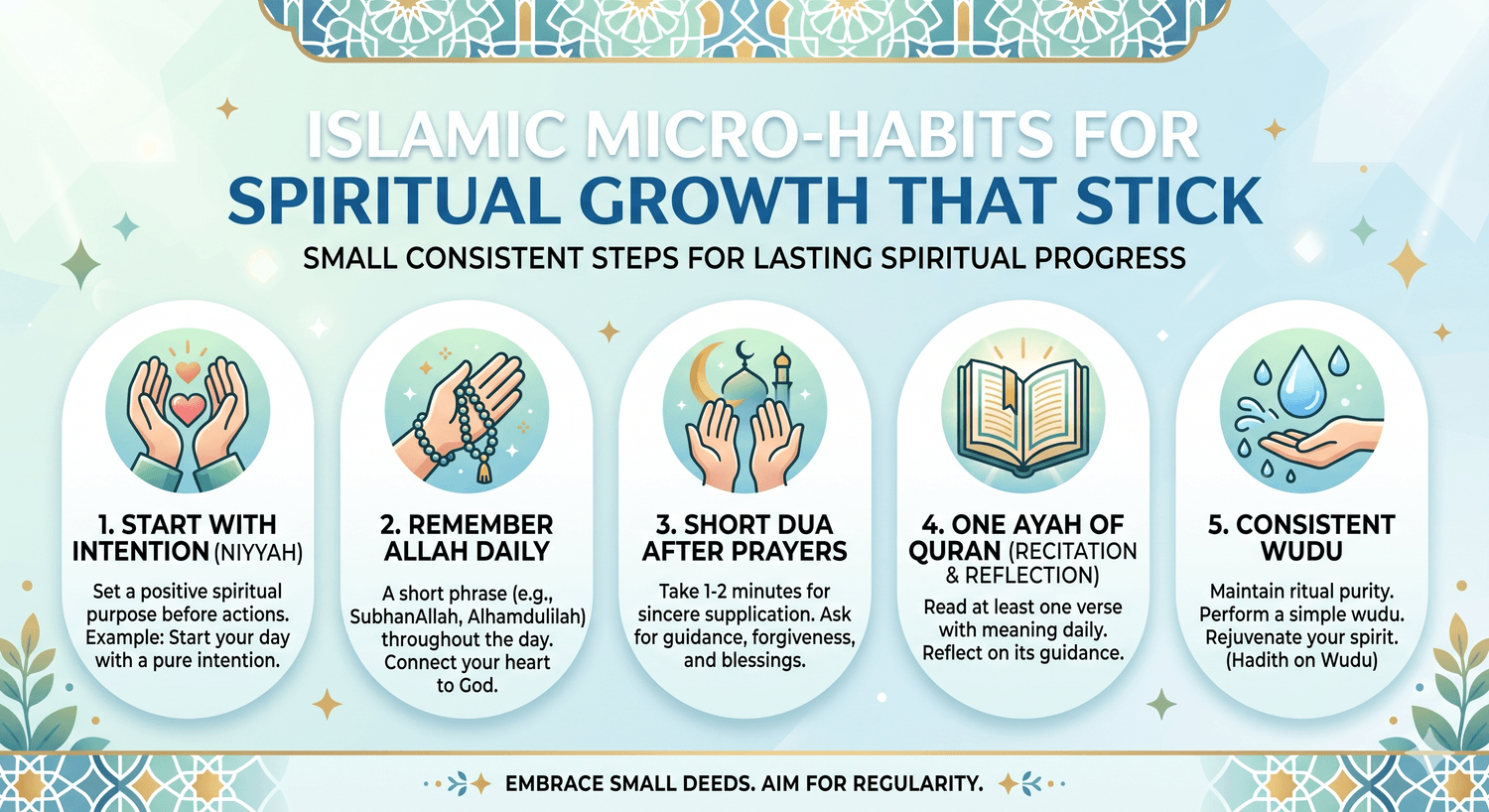
It doesn't require a journal, though a journal helps. It doesn't require a long block of time. Five minutes before sleep, lying in the dark, asking yourself three questions: What did I do today that I'm grateful for? What did I do today that I need to seek forgiveness for? What do I want to do differently tomorrow?
That's it. No elaborate framework. Just honest attention.
The tradition teaches that the believer who accounts for themselves daily is the one who least needs to be accounted for harshly at the final reckoning. What you tend to daily does not pile up into an overwhelming debt.
Consistency Over Intensity
If you take one thing from this, take this: Islamic micro-habits for spiritual growth are not about doing everything listed above starting tomorrow. Pick one. Do it for 30 days without missing. Let it become as automatic as brushing your teeth. Then add another.
The Prophet ﷺ did not ask his companions to sprint. He asked them to walk steadily toward God. The Quran says: "So remember Me; I will remember you" (Quran 2:152). That reciprocity — you turn toward God, God turns toward you — does not require grand gestures. It requires presence, consistency, and the humility to begin where you are.
Small things, consistently. That's the Islamic tradition's answer to spiritual growth. It has been, for 1,400 years.
Looking for structured guidance on building your Islamic practice from the ground up? Start Islam Path offers courses for non-Muslims and new Muslims that take you step by step through the fundamentals of faith and daily practice.


