What Non-Muslims Need to Know About Islamic Beliefs
Get the 109‑page guide delivered to your inbox
Discover the faith that 1.9 billion people live by — and why thousands of truth-seekers just like you are choosing it every single day. This free 109-page guide walks you from curiosity to clarity, step by step.
No pressure. No judgment. No strings attached. Just a clear, honest roadmap written for people who want real answers — whether you're skeptical, curious, confused, or quietly searching for something deeper.
There's a version of this conversation happening constantly. Someone learns that their neighbor, colleague, or friend is Muslim and realizes they don't actually know what that means. Not in any real sense. They know some surface details, maybe the word "Allah," maybe that Muslims fast during Ramadan, maybe that prayer involves facing Mecca. But the inner logic of the belief? The actual content of what a practicing Muslim believes and why?
Most people never get that far. And the information gap gets filled by media coverage, political commentary, and the accounts of people with specific agendas.
This is for the person who wants accurate information. What non-Muslims need to know about Islamic beliefs, explained directly, without preaching, and without expecting prior knowledge.
Non-Muslims Need to Know The Core: One God Without Partners
Everything in Islamic belief rests on a single foundation: there is one God, and nothing shares in God's divinity. This principle is called Tawhid, and it's not just a theological position. It's the organizing principle of all Islamic ethics, worship, and social structure.
To understand why Muslims pray the way they do, why they avoid idolatry so completely, why the Prophet Muhammad is honored but never worshipped, you need to understand Tawhid. Everything else flows from it.
God in Islamic teaching has 99 names and attributes described in the Quran and Hadith. Among them: Al-Rahman, the Most Gracious. Al-Rahim, the Most Merciful. Al-Alim, the All-Knowing. Al-Hakim, the Most Wise. Al-Adl, the Just. These are not poetic titles. They describe who God actually is, as far as human language can reach.
God is personal and aware. God is not an abstract principle or a clockmaker who wound up the universe and stepped away. God knows every thought. God hears every prayer. God responds. The Quran says: "Call upon Me; I will respond to you" (40:60). That's not a metaphor. Muslims take it as a direct promise.
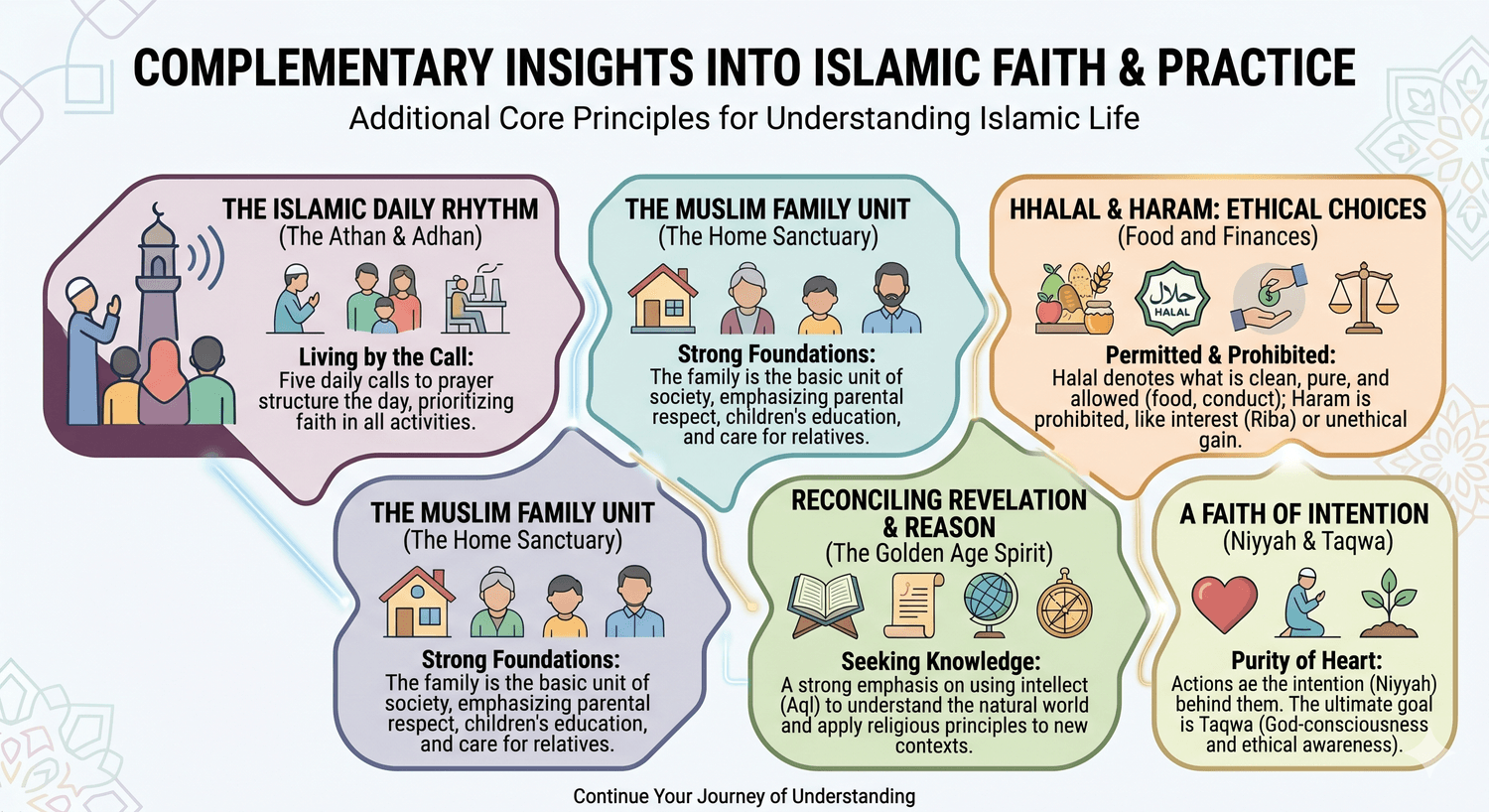
The Six Articles of Islamic Faith
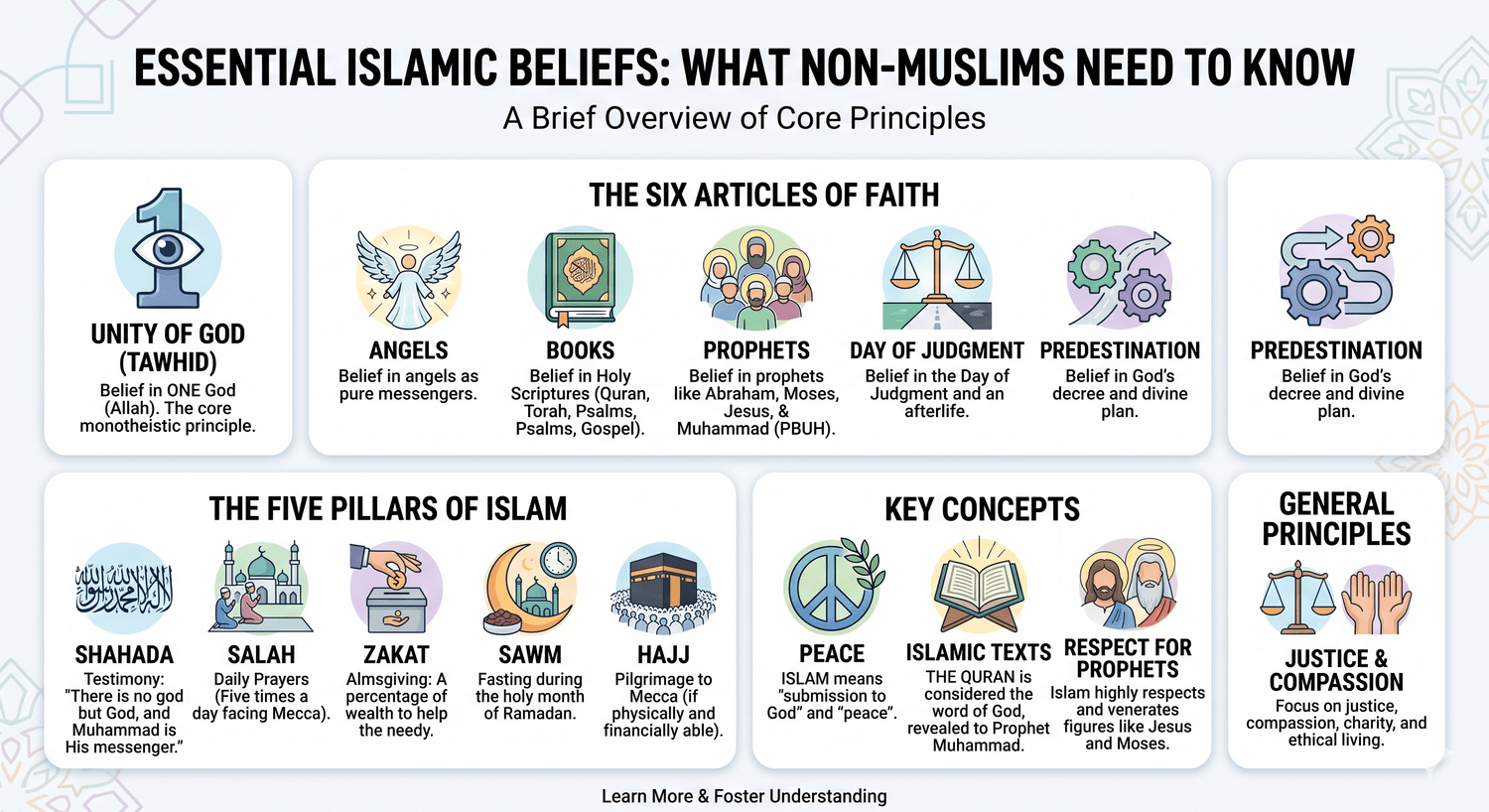
Islamic belief has a structured creed. The Prophet Muhammad described six things that every Muslim must believe.
Belief in God: one, without partners, as described above. This is the absolute foundation.
Belief in the angels: spiritual beings created from light, described in the Quran as devoted servants of God carrying specific functions. Gabriel delivers revelation to prophets. Other angels record human deeds. Angels don't eat, sleep, or have free will in the way humans do. They execute God's commands.
Belief in the revealed books: God has sent scriptures to humanity throughout history. The Torah was given to Moses. The Psalms to David. The Gospel to Jesus. The Quran to Muhammad. Muslims believe the earlier scriptures were originally authentic but were altered over centuries by human hands. The Quran is believed to be God's final word, preserved unchanged in its original Arabic.
Belief in the prophets: God sent messengers to every people throughout history. Twenty-five are named in the Quran, including Adam, Noah, Abraham, Moses, David, Solomon, Jesus, and Muhammad. Muslims believe all of them carried the same essential message in different languages and contexts. Muhammad is the last. No prophet comes after him.
Belief in the Last Day: every human being who has ever lived will be resurrected. Every action will be weighed on a perfectly just scale. Paradise and Hell follow judgment. The Quran describes this in detail across many chapters.
Belief in divine decree: everything that happens in the created universe happens within God's knowledge and will. This doesn't eliminate human free will in Islamic theology. It situates human choices within a frame that God ultimately controls and knows.
What Muslims Believe About Jesus
Islamic belief about Jesus is not dismissive. It's the opposite.
Jesus is described in the Quran as the Messiah, as the Word of God, as a Spirit from God, born of a virgin, capable of extraordinary miracles: healing the blind, healing lepers, giving life to clay birds, raising the dead. Mary has an entire chapter of the Quran named after her, the only woman in any major scripture to have a chapter named for her.
Muslims believe Jesus will return before the Day of Judgment, that he will rule justly, and that he is among the five greatest prophets in all of human history, alongside Noah, Abraham, Moses, and Muhammad.
What non-Muslims need to know about Islamic beliefs regarding Jesus: the disagreement between Islam and Christianity is about the nature of Jesus, not his importance. To a Muslim, calling Jesus the son of God contradicts Tawhid. That's a real theological difference. But Jesus is not marginal in Islamic teaching. He's one of the most mentioned figures in the Quran.
The Day of Judgment: How It Shapes Daily Life
Of all the Islamic beliefs that shape daily Muslim behavior, the Day of Judgment may be the most practically influential. It's not a distant, abstract doctrine. For a practicing Muslim, it's a present reality that influences what they do when no one is watching.
The Quran describes two angels accompanying every person through life, one recording good deeds, one recording bad ones. On the Day of Judgment, each person's complete record is given to them. Everything they said, did, intended, and felt is accounted for. The scale is perfectly just: "Whoever does an atom's weight of good will see it. Whoever does an atom's weight of evil will see it" (99:7-8).
Nothing disappears. The person who was cheated and had no legal recourse gets their hearing. The one who suffered quietly and was never acknowledged receives recognition. The oppressor who escaped human courts stands before a court with perfect information.
This shapes how a Muslim thinks about private behavior. If the ultimate witness never looks away, then the person who performs virtue only when observed is living a kind of fiction. The goal is consistency between the public and the private self, because the audience that ultimately matters is always present.
The Prophet Muhammad's Role in Muslim Life
For Muslims, Muhammad is not just a historical figure studied in books. His example, called the Sunnah, is actively consulted and followed. He embodied the Quran in human behavior. When his wife Aisha was asked about his character, she said simply: "His character was the Quran."
This means Muslims look to reports of how he treated his family to understand how to treat theirs. They look to his business dealings to understand honest commerce. They look to how he responded to enemies, to how he handled authority, to his generosity, his patience under tremendous difficulty, his humor with his companions. All of this is recorded in detail and consulted regularly.
He was also fully human. He grieved when those he loved died. He made decisions and revised them when new information came. He sought the counsel of others. He apologized. The tradition records his humanity as carefully as it records his prophethood, because the example he set is meant to be followed by human beings, not idealized into impossibility.
The Quran's Relationship to Other Scriptures
Islam does not simply discard the Torah or the Gospel. It describes them as originally divine revelations that were altered by human hands over centuries.
The Quran says Muslims believe in "what was revealed to us and what was revealed to Abraham, Ishmael, Isaac, Jacob, and the descendants, and what was given to Moses, Jesus, and the prophets from their Lord" (3:84). The belief in prior revelations is built into the Islamic creed. Rejecting any prophet's message is a failure of Islamic faith.
The practical consequence is that Muslims and people of other Abrahamic traditions share a common frame on many fundamental questions: the existence of God, the prophetic tradition, the reality of revelation, the moral weight of human choices, and accountability after death. The differences within that shared frame are real and significant. But the frame itself is shared.
Prayer: What Actually Happens Five Times a Day
Many non-Muslims have seen Muslims pray without knowing what's happening during those minutes. Five times between dawn and night, a Muslim performs a structured sequence of standing, bowing, prostrating, and sitting, while reciting specific passages from the Quran in Arabic.
Before praying, the Muslim performs wudu: ritual washing of the hands, face, arms, and feet. This isn't just physical hygiene. It's a preparation, a transition from ordinary activity to the presence of God.
The prayer begins with "Allahu Akbar," God is greater. It ends with "As-salamu alaykum wa rahmatullah," peace and God's mercy be upon you, spoken to both sides. Every prayer opens with the first chapter of the Quran: "In the name of God, the Most Gracious, the Most Merciful. Praise is for God, Lord of all worlds..." This chapter is recited at least seventeen times every day by a practicing Muslim.
What non-Muslims need to know about Islamic beliefs isn't just a list of doctrines. It's that these doctrines are lived out five times a day, every day, across 2 billion lives simultaneously, in every time zone and climate, in every language and culture. The belief and the practice are inseparable.
If you want to understand Islamic beliefs more deeply, start with a reliable source. At Start Islam Path, our courses are designed specifically for people approaching Islam from the outside, with clear explanations and no assumption of prior knowledge.


