Islamic Teachings for Non-Muslims: A Beginner's Guide
Get the 109‑page guide delivered to your inbox
Discover the faith that 1.9 billion people live by — and why thousands of truth-seekers just like you are choosing it every single day. This free 109-page guide walks you from curiosity to clarity, step by step.
No pressure. No judgment. No strings attached. Just a clear, honest roadmap written for people who want real answers — whether you're skeptical, curious, confused, or quietly searching for something deeper.
Most people's first exposure to Islam comes through the news. Which means most people's first understanding of Islam is filtered through conflict, politics, and crisis. That's a bad filter.
This guide exists for a different reason. If you're curious about what Muslims actually believe, what they practice, and how their faith shapes daily life, this is a starting point designed for you. Written honestly, with no assumption that you know anything about Islam yet, and with no intention of pressuring you toward any conclusion.
Islamic teachings for non-Muslims don't require a theology degree or a prior commitment to understand. They require curiosity and a willingness to engage something on its own terms before judging it.
Islamic Teachings for Non-Muslims: What Islam Claims to Be
Islam presents itself as a continuation, not a new religion. Muslims believe God has always communicated with humanity through prophets. Adam was the first. A long line followed: Noah, Abraham, Moses, David, Solomon, Jesus. Each carried the same core message in different languages to different peoples: there is one God, worship Him, and live righteously.
What went wrong, according to Islamic teaching, is that the messages were altered over time. Scribes changed texts. Communities added beliefs that weren't original. Political powers reshaped doctrines to serve their interests. By the 7th century CE, God's original message had become obscured in various traditions.
Muhammad was sent to restore it. Not to create something new, but to bring the original message back in its complete and final form. The Quran, as Muslims understand it, is that final message, preserved intact in the original Arabic from the day it was revealed.
This is why Muslims greet the prophets of every tradition with respect. You cannot be Muslim and reject Moses. You cannot be Muslim and reject Jesus. They are part of the same prophetic chain.
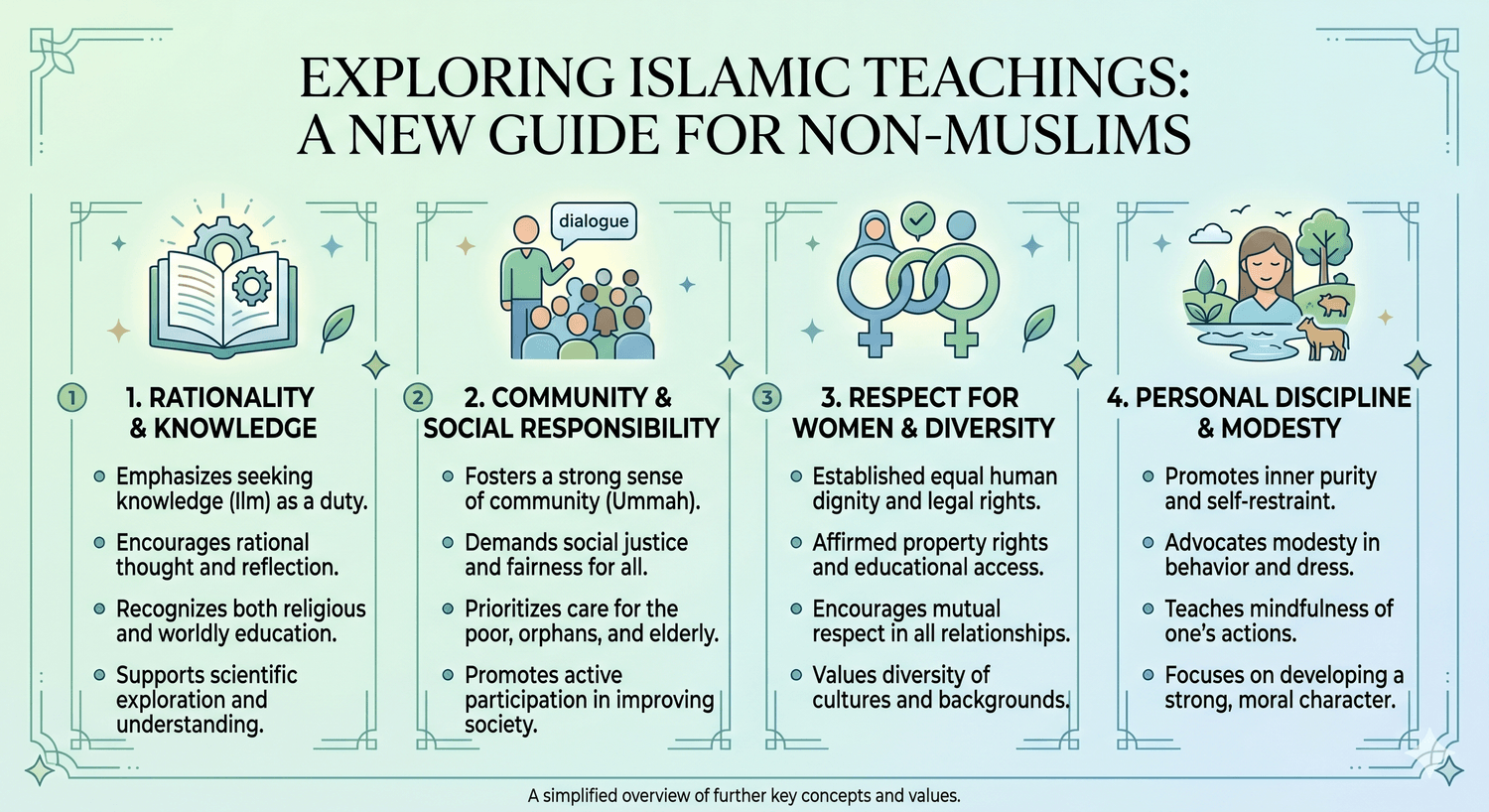
The God of Islam
Islamic teachings for non-Muslims begin with the most basic question: who is God in Islam?
God has no beginning and no end. God created everything that exists. God is not part of creation; God is entirely separate from and prior to what He made. God is the only being whose existence is self-necessary. Everything else exists because God brought it into being and continues to sustain it.
God knows everything. Every thought, every whisper, every private feeling you've never expressed. The Quran says God knows "the secret and what is even more hidden" (20:7). Not just your words. The interior of your consciousness.
God is not passive. He sends prophets. He sends scripture. He responds to prayer. The Quran instructs directly: "Call upon Me; I will respond to you" (40:60). God is personal, aware, and present to every situation.
God is not a human being. God does not have children in any literal sense. God does not share any category with created things. The Quran says "there is nothing like unto Him" (42:11). This absolute uniqueness is central to Islamic theology.
And the most repeated description of God in the Quran: the Most Gracious, the Most Merciful. Rahman and Rahim in Arabic. Both words come from the root word for womb, rahm. God's mercy has that quality of deep, encompassing care. The Quran describes God as having inscribed mercy upon Himself (6:12). It's not a policy. It's who God is.
The Quran: God Speaking Directly to You
The Quran is unlike any other book. It isn't a narrative of events told by a narrator. It isn't a biography of Muhammad. It is God speaking directly to humanity, in first person.
"O mankind." "O you who believe." "Say." Commands, questions, warnings, invitations, comfort, correction: all of it addressed directly to you, the reader. When you read the Quran, the text is not describing someone else's encounter with God. It is addressing you.
It was revealed to the Prophet Muhammad over 23 years, beginning in 610 CE. The Prophet was illiterate. The revelations came through the angel Gabriel and were immediately memorized by the Prophet's companions, then written down. The full Quran was compiled into a physical manuscript within two years of Muhammad's death.
Today, millions of Muslims have memorized the Quran in its entirety in the original Arabic. This tradition of memorization has been continuous since the first generation. The Quran has not been altered.
In English translation, it can feel abrupt, non-linear, and dense. That's partly because it isn't meant to be read once like a novel. It's meant to be returned to, recited aloud, and absorbed over a lifetime. Reading a good translation is a worthwhile starting point.
The Prophet Muhammad: Trustworthy Before He Was a Prophet
Muhammad was born in Mecca, Arabia, in 570 CE. He was orphaned early. He worked as a merchant. Before any revelation came to him, his community knew him for one quality above all others: honesty. They called him Al-Amin, the trustworthy one.
At age 40, he received the first Quranic revelation. The angel Gabriel came to him and commanded him to "Read." He said he could not read. The revelation came anyway. For three years, he shared the message privately. Then publicly. The opposition came quickly. Tribal leaders who controlled Mecca's economy had no interest in a message declaring all humans equal before God.
He was mocked, boycotted, and had followers who were tortured. He continued. In 622 CE, he and his community migrated to Medina, where he established the first organized Muslim community. By the end of his life, he had unified most of the Arabian Peninsula through a combination of principled governance, consistent character, and a message that people found coherent and true.
He died in 632 CE. He is not worshipped. He is deeply followed.
The Five Pillars in Practical Terms
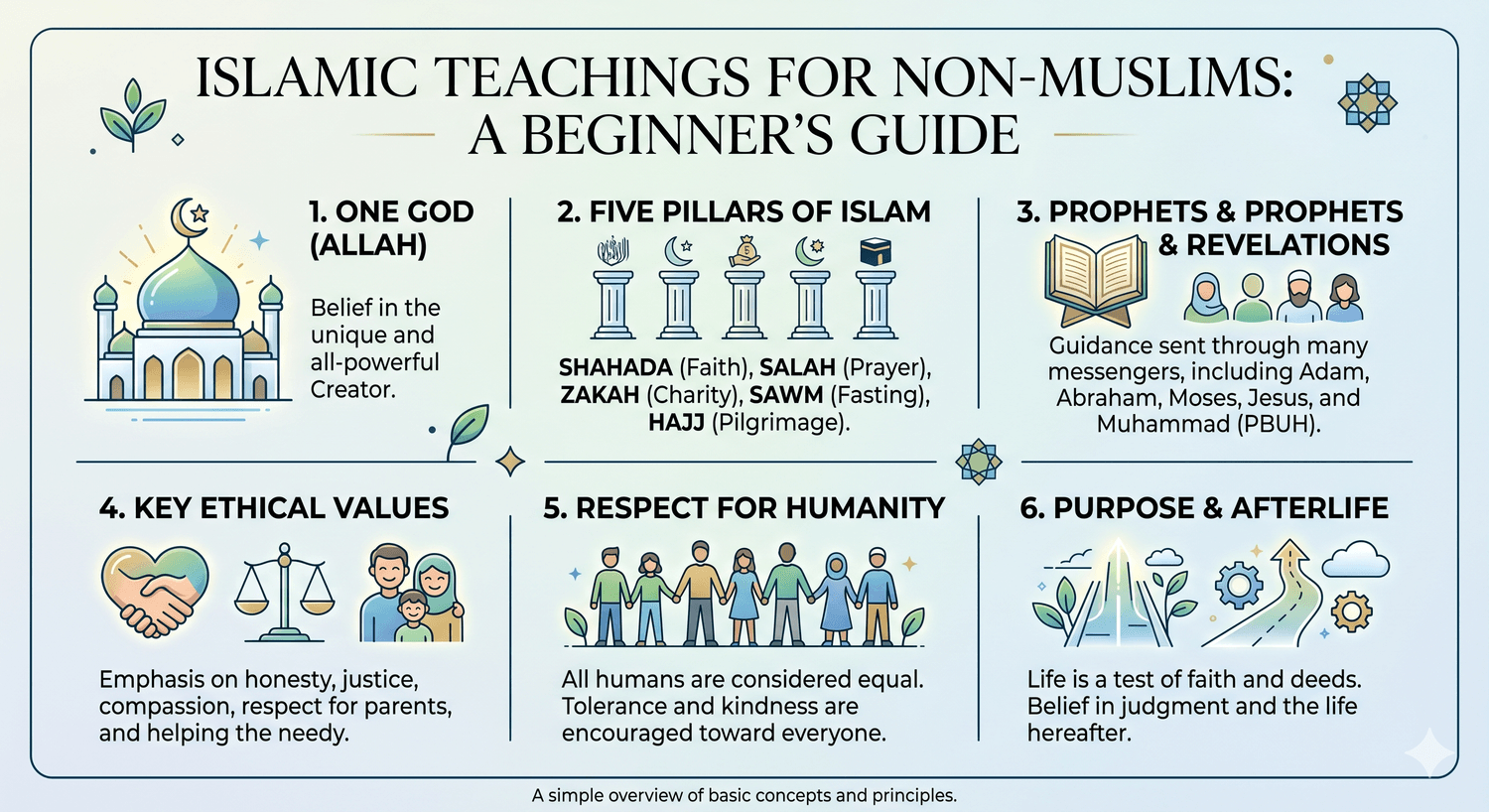
These are the five practices that structure a Muslim's life.
The Shahada is the declaration: "There is no god but God, and Muhammad is His messenger." Said sincerely, it makes you Muslim. Repeated in prayer, it reorients your day. It's the most common sentence a Muslim says.
The five daily prayers, Salah, are the architecture of the Muslim day. Each takes between five and fifteen minutes. Each requires ritual washing beforehand. Each is a physical act of submission performed facing Mecca. The prayer times are tied to the sun: dawn, midday, afternoon, sunset, night.
Zakat is the annual 2.5% of accumulated savings given to specific categories of people in need. It's a legal obligation, not optional charity. The calculation applies to savings held for a full lunar year above a minimum threshold. It is one of the most concrete economic justice mechanisms in any religious tradition.
The Ramadan fast runs for a full lunar month each year. From before sunrise to after sunset: no food, no water, no smoking, no sexual intimacy. The evenings break the fast with community, prayer, and Quran recitation.
Hajj is the annual pilgrimage to Mecca, required once for every Muslim who is physically and financially able. Pilgrims wear identical white garments. They circle the Kaaba. They walk between the hills of Safa and Marwa. They pray on the plain of Arafat. They return home.
Islamic Ethics: What You Owe to Others
You cannot be a good Muslim and mistreat people. The Prophet said, "None of you truly believes until he wants for his brother what he wants for himself." The Quran describes those who push the orphan away and don't feed the poor as giving the lie to religion itself (107:1-7).
Honesty in transactions. Protection of neighbors. Kindness to family. Patience in conflict. Generosity beyond the legal minimum. These aren't optional additions to Islamic practice. They are the practice.
The Prophet said he was sent to complete good character. After 23 years of prophethood, that's what he identified as the mission. Not ritual expertise. Character.
What Islam Says About Non-Muslims
The Quran's own position on how Muslims should treat people who don't share their faith is explicit: "God does not forbid you from being kind and just to those who have not fought you over religion or expelled you from your homes. Indeed, God loves those who act justly" (60:8).
Kindness and justice toward peaceful non-Muslims is a Quranic instruction. It's described as something God loves. The Prophet's own example includes his treatment of Jewish and Christian neighbors in Medina, with whom his community lived in a formal arrangement of mutual protection.
A Living Global Tradition
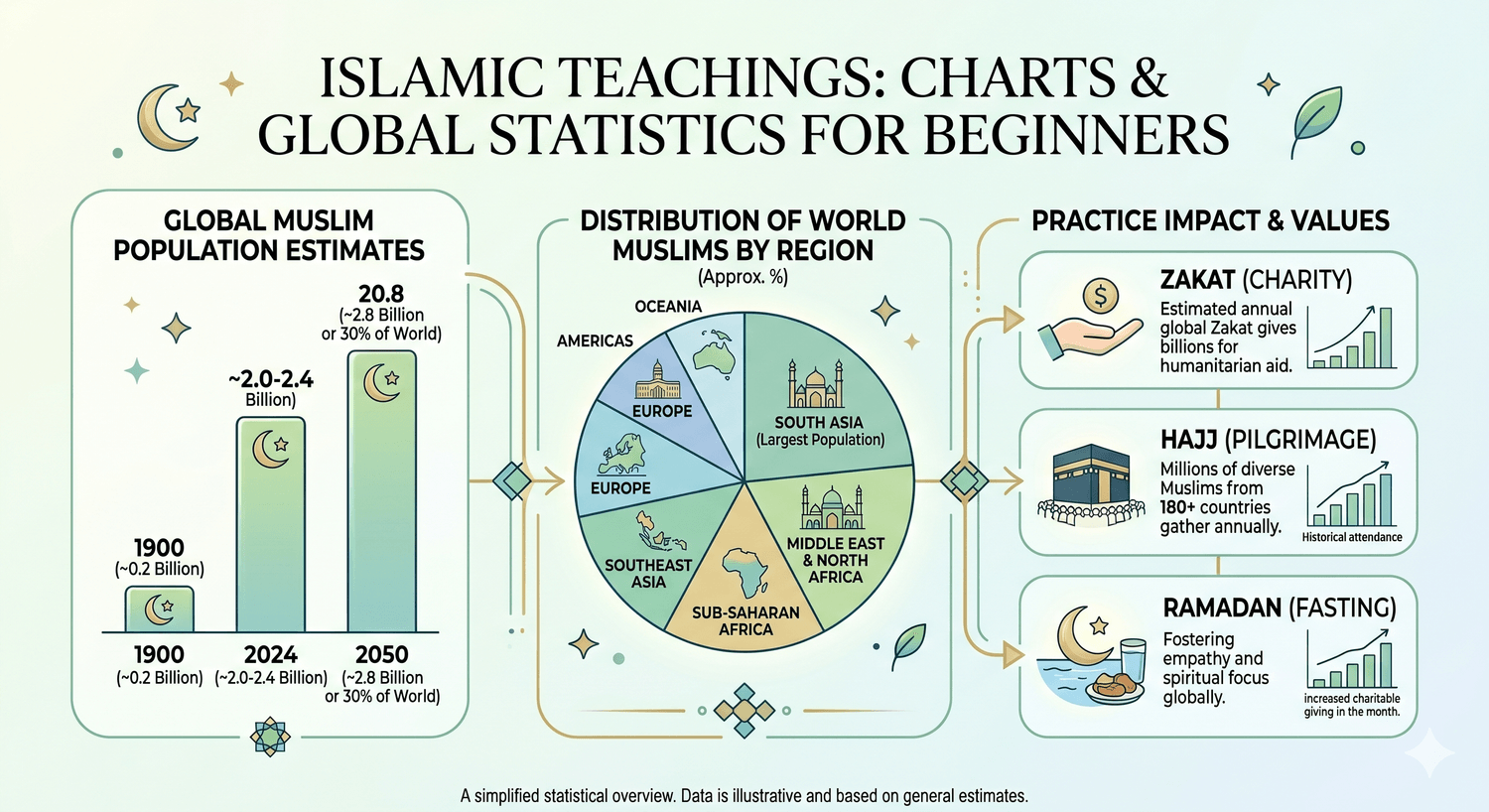
Islam today is practiced by 2 billion people across every continent, in dozens of languages, across enormous cultural diversity. Indonesian Islam looks different from West African Islam, which looks different from American Islam. The practices vary in cultural expression. The core beliefs do not.
This is the tradition. Not a closed community with a no-entry sign. A global conversation 1,400 years old that's still actively happening, still drawing in new voices, still wrestling seriously with what it means to live well.
Take the next step with structured, beginner-friendly courses at Start Islam Path. We've built a learning path specifically for people starting from scratch, at their own pace, with no background required.


