Why Does Islamophobia Exist? The Real Causes Explained
Get the 109‑page guide delivered to your inbox
Discover the faith that 1.9 billion people live by — and why thousands of truth-seekers just like you are choosing it every single day. This free 109-page guide walks you from curiosity to clarity, step by step.
No pressure. No judgment. No strings attached. Just a clear, honest roadmap written for people who want real answers — whether you're skeptical, curious, confused, or quietly searching for something deeper.
When people encounter anti-Muslim discrimination for the first time and ask why, the most common answer they receive is September 11, 2001. And it is true that the years after the attacks saw a measurable explosion of anti-Muslim sentiment, government surveillance of Muslim communities, and a spike in hate crimes against Muslims in the United States and Europe. Something changed after that day.
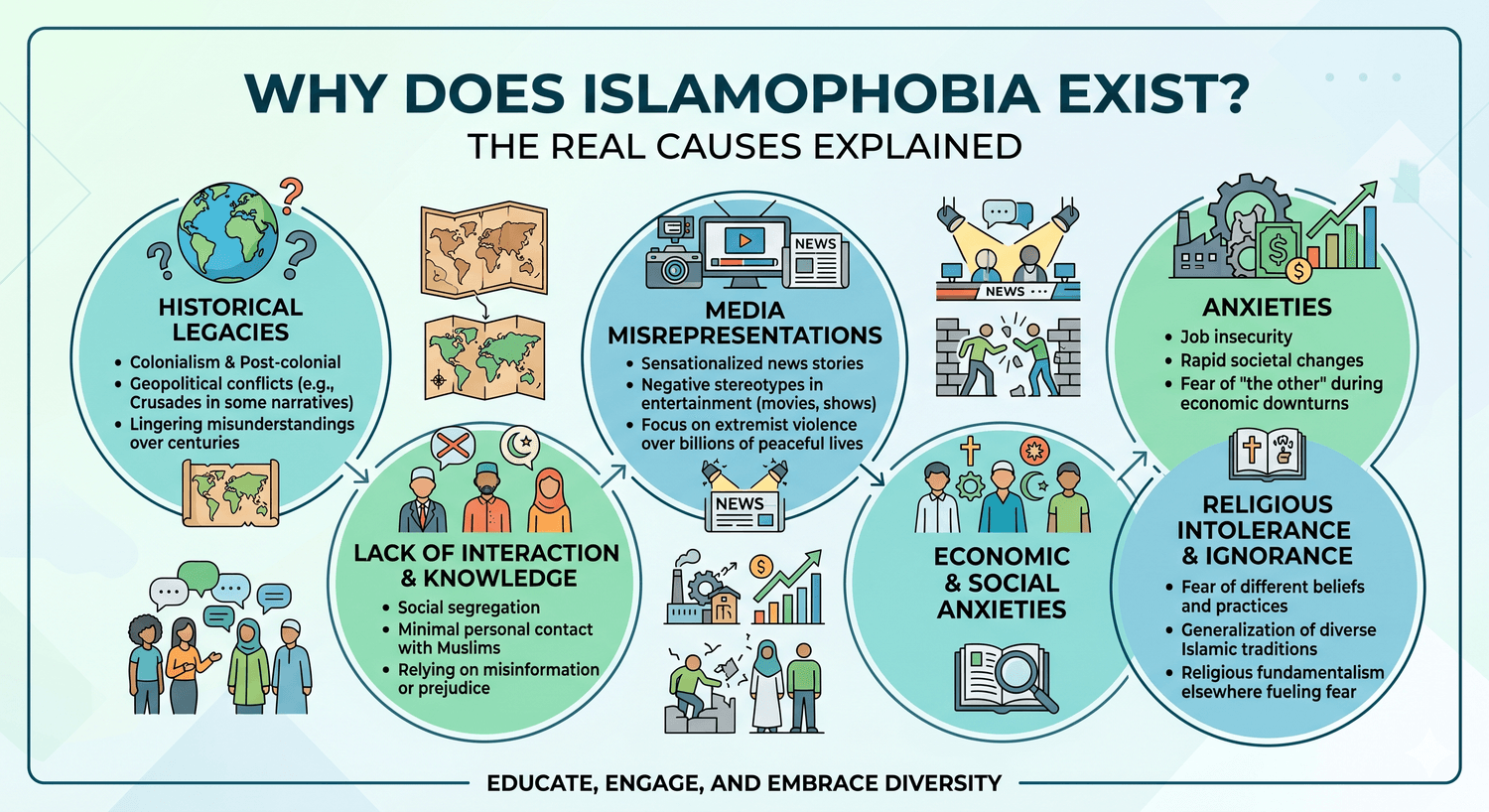
But September 11 does not answer the question of why does Islamophobia exist. It explains an acceleration. The anti-Muslim hostility that exploded in 2001 did not form in a vacuum. It assembled itself from materials that had been accumulating for centuries: in medieval theology, in colonial literature, in Hollywood films, in political rhetoric, and in deliberate campaigns funded by people with interests in keeping the fear alive.
Understanding why Islamophobia exists does not excuse it. It explains it. And explanation is where an honest response begins.
Why Does Islamophobia Exist: Islamophobia Did Not Start With 9/11
The word Islamophobie appeared in French literature as early as 1910, describing what the author called "a prejudice against Islam widespread among peoples of Western and Christian civilization." That was ninety-one years before the World Trade Center fell. The French colonial administration had been using anti-Muslim sentiment to justify policies in North Africa for decades before that.
Researchers tracing the modern trajectory of Islamophobia identify three distinct phases. The first began in the 1970s, driven by geopolitics: the Arab oil embargo, the Iranian Revolution of 1979, and the 444-day Iran hostage crisis. The second was the post-9/11 security phase, during which anti-Muslim sentiment was channeled into government policy at scale. The third phase, beginning around 2014, shifted toward social anxieties about Muslim immigration and demographics within European societies. Each phase built its foundations on what came before it.
The Crusades and the Medieval Roots of Anti-Muslim Hostility
Present-day Islamophobia has medieval roots more direct than most people recognize. When Islam expanded rapidly across North Africa, the Middle East, and into parts of Europe in the 7th and 8th centuries, it encountered Christian Europe as both a rival civilization and an alternative religious claim. The Crusades, beginning in 1096 and continuing for nearly two centuries, were military campaigns framed religiously but driven also by land, trade, and political power.
The Church needed to mobilize armies. To do that, it needed enemies. And it needed those enemies to be morally and spiritually inferior, which required the active construction of that inferiority. The texts produced in this period, the sermons, chronicles, and theological arguments, painted Islam as a perversion and Muslims as its willing agents. The image of the violent, lustful, barbaric Muslim was not an observation. It was a tool.
The Spanish Inquisition took this further with the concept of limpieza de sangre, or purity of blood, which discriminated against anyone with Muslim or Jewish ancestry regardless of whether they had converted to Christianity. The idea that Muslim identity was hereditary and indelible planted the seed of the racial dimension that Islamophobia carries in contemporary form. A person could change their religion. They could not, in this view, change what they were.
Colonialism and the Construction of the Muslim Other
Orientalism and Its Legacy
From the 16th century onward, European colonial expansion brought Christian-majority powers into sustained contact, and conflict, with Muslim-majority societies across North Africa, the Middle East, South Asia, and Southeast Asia. The intellectual framework that developed to manage this encounter is what Palestinian American scholar Edward Said called Orientalism: a body of academic, literary, and artistic work that depicted Muslim and Middle Eastern societies as exotic, backward, irrational, and in need of European management.
Orientalism was not neutral scholarship produced by curious academics. It was knowledge produced in service of empire. By portraying Muslim societies as incapable of self-governance, it provided moral cover for conquest. By treating Islamic civilization as static and inferior, it erased the reality of Muslim contributions to mathematics, astronomy, medicine, philosophy, and literature that had in fact shaped European intellectual life during the medieval period.
These portrayals did not remain in academic journals. They fed into literature, painting, theater, opera, and eventually film, creating a cultural archive of images of Muslims as the threatening, primitive, or pitiable other. That archive became the raw material from which 20th and 21st century media assembled its own representations. The question of why does Islamophobia exist runs directly through this history.
How Modern Media Built the Muslim Terrorist Stereotype
Hollywood and News Coverage
The Muslim terrorist as a recognizable type in Western popular culture was not created by September 11. It was assembled piece by piece over decades. When the Iranian Revolution occurred in 1979 and American hostages were held for 444 days, US television networks broadcast images of Ayatollah Khomeini and his followers continuously. Those images, of bearded men and black turbans, became the face of Islam for an entire generation of Americans who had no other reference point.
The Iranian revolutionaries were Shia and Persian. Most of the world's Muslims are neither. But the merging of disparate Muslim identities into a single threatening figure had already begun. By the time Osama Bin Laden appeared on American screens in 2001, he fit a template that had been constructed over two decades.
The 1986 film Delta Force described its Muslim antagonists in promotional material as "the enemy that doesn't care how young, how innocent, how helpless." True Lies in 1994. Black Hawk Down in 2001. Hundreds of smaller productions throughout the 1980s and 1990s trained Western audiences to read certain faces, names, and types of dress as signals of danger. Research across those decades consistently found that Arabs and Muslims were the most persistently and negatively stereotyped ethnic and religious group in American film.
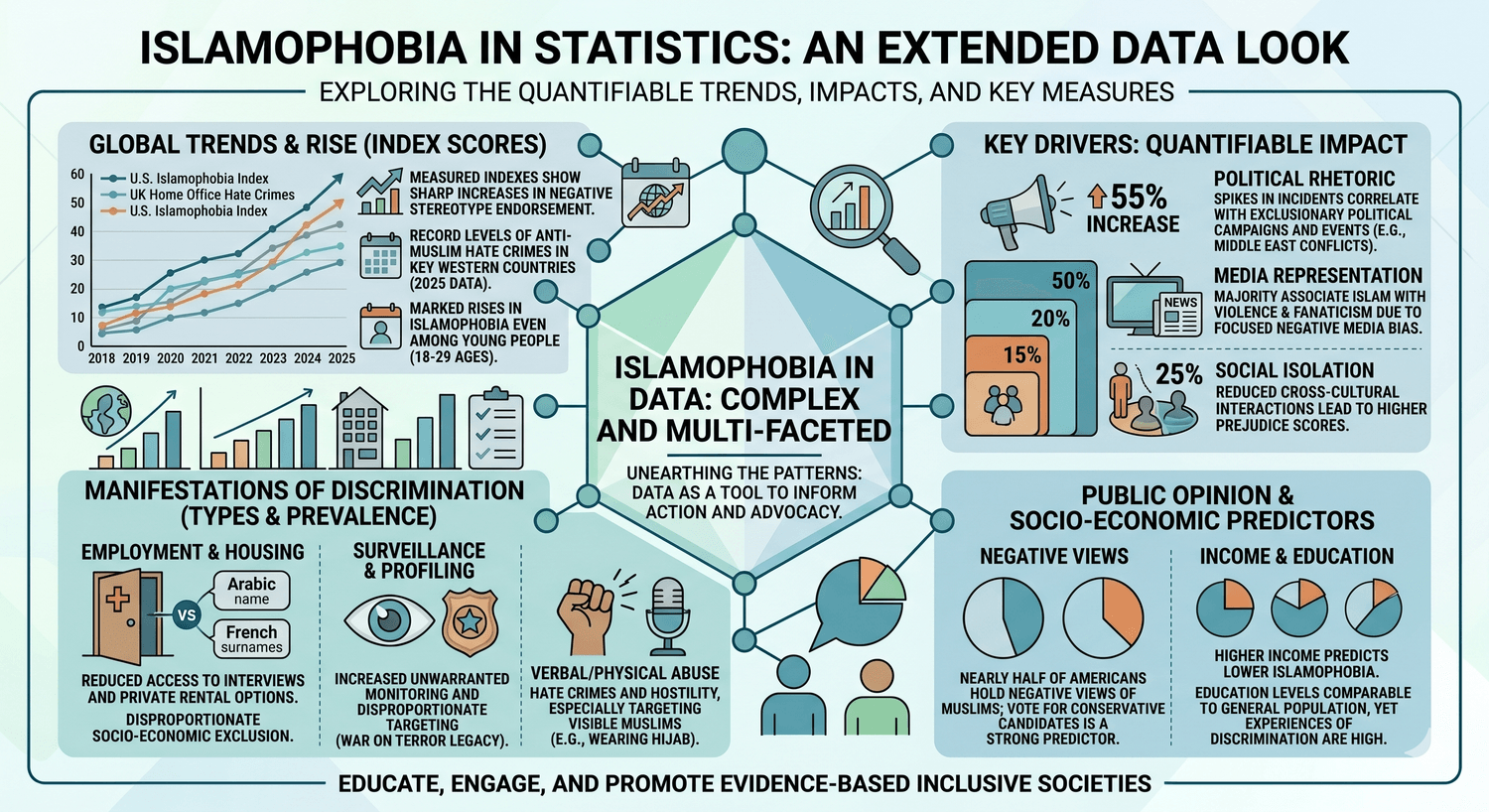
News coverage amplified what entertainment established. A study based on 35 years of New York Times and Washington Post reporting found that journalists were more likely to report on Muslim and Middle Eastern societies when rights violations occurred, and more likely to report on non-Muslim societies when rights were protected. The asymmetry produced a systematic association between Muslim identity and human rights abuse in the minds of regular readers.
Political Power and the Uses of Islamophobia
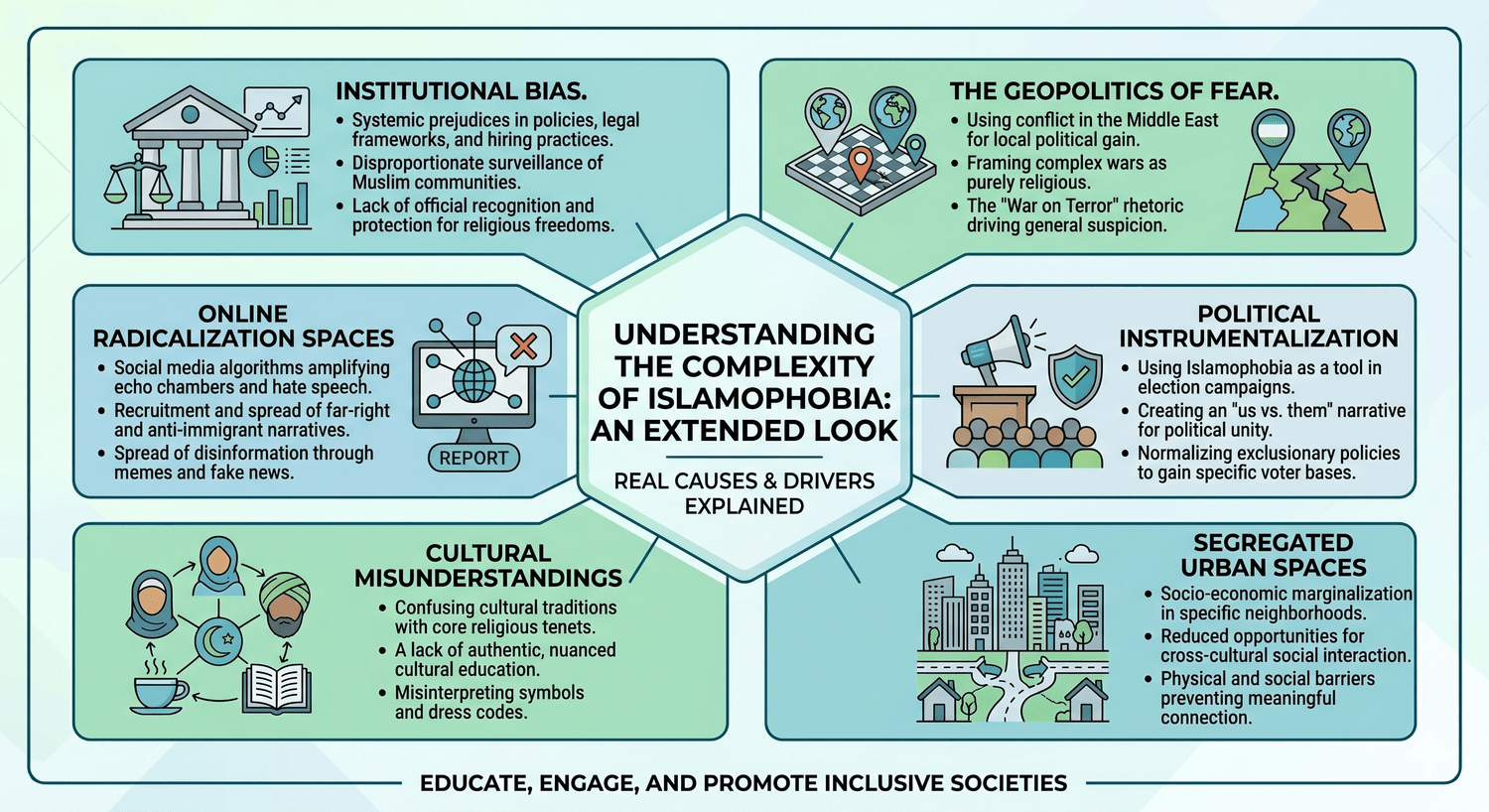
Why does Islamophobia exist is also a question with a political economy answer. Islamophobia is useful. It serves specific interests.
After September 11, organizations dedicated to anti-Muslim advocacy received substantial funding from major conservative foundations. Research by the Center for American Progress documented a network of foundations, think tanks, grassroots organizations, media personalities, and political figures that functioned as a coordinated infrastructure for producing and distributing anti-Muslim content. This was not spontaneous public sentiment. It was manufactured and optimized.
Islamophobia has been a reliable tool for electoral mobilization. Research by Dalia Mogahed, director of research at the Institute for Social Policy and Understanding, showed that anti-Muslim sentiment spiked not primarily after actual terrorist attacks but during the run-up to the Iraq War and during election cycles in 2008 and 2012. The data suggest that Islamophobia functions as what Mogahed described as "a tool of public manipulation," used to move public opinion toward specific foreign and domestic policy goals. It works because it taps into existing anxieties, gives them a target, and offers the emotional satisfaction of a clear enemy.
What Keeps Islamophobia Going Today
Why does Islamophobia exist in 2026? Because the historical, media, and political structures that built it are largely still in place.
Muslim characters in mainstream Western media still appear primarily through a short list of roles. Anti-Muslim organizations still produce content and build audiences. Politicians across multiple countries continue to gain support by framing Muslim immigration and Muslim identity as civilizational threats. The Islamophobia infrastructure documented by the Center for American Progress did not dissolve. It adapted.
There is also the simpler problem of ignorance. In countries with small Muslim populations, many people form their entire understanding of Islam from coverage of crises. A person who has never had a genuine conversation with a Muslim is working entirely from constructed images. They may not be consciously hostile. They simply occupy a space that anti-Muslim content fills because nothing more accurate has been offered.
The UN Secretary-General has said that combating Islamophobia requires governments to protect religious freedom, platforms to address hate speech, and individuals to actively oppose bigotry in their own communities. That three-part response maps to the three sources of the problem: structural, media-based, and interpersonal. None of the three can be addressed without addressing the others.
What Understanding the Roots of Islamophobia Changes
When you understand why Islamophobia exists, you stop treating it as a natural response to something Muslims have done. You see it as what it is: a constructed hostility with a traceable history, built over centuries, and maintained through specific institutions and deliberate choices.
That does not mean every person who holds anti-Muslim views is consciously participating in a program of discrimination. Most are not. They have inherited a set of images and assumptions from the culture around them and never had occasion to examine them carefully. The question is whether, once you understand where those images came from, you are willing to do that examination.
The Quran says: "O you who believe, if a defiantly disobedient person comes to you with information, investigate, lest you harm a people out of ignorance and become, over what you have done, regretful" (Quran 49:6). This verse was revealed in a specific context, but its principle extends across time. Anti-Muslim bias spreads because false information, delivered by voices that sound authoritative, is accepted without examination by people who have no reason to question it.
If you are discovering Islam for the first time, or if you are a new Muslim trying to understand the hostility your faith sometimes attracts, know this: what many people are hostile toward is not the Islam you encounter when you read the Quran or speak with Muslims living their faith. It is a cartoon version assembled over centuries for political and cultural purposes. The real thing, the lived, diverse, historically rich tradition, is worth encountering on its own terms.
Why does Islamophobia exist? Because fear is easier to manufacture than understanding. But understanding is available, and it changes things.


