Islamophobia Targeting Women: Why Muslim Women Carry a Double Burden
Get the 109‑page guide delivered to your inbox
Discover the faith that 1.9 billion people live by — and why thousands of truth-seekers just like you are choosing it every single day. This free 109-page guide walks you from curiosity to clarity, step by step.
No pressure. No judgment. No strings attached. Just a clear, honest roadmap written for people who want real answers — whether you're skeptical, curious, confused, or quietly searching for something deeper.
If you want to understand Islamophobia in its most concentrated form, look at what happens to women who wear the hijab in public. Not women who simply identify as Muslim — but women whose faith is visible. Because something specific happens when religion can be seen, and in most countries, it can be seen most easily on women.
Islamophobia targeting women is not a subset of Islamophobia. It is often its sharpest expression. Muslim women face discrimination from two directions simultaneously: from those who view them as a religious threat because they are Muslim, and from those who claim to liberate them from their faith because they are women. Neither group tends to ask what the women themselves think.
Islamophobia Targeting Women at Higher Rates
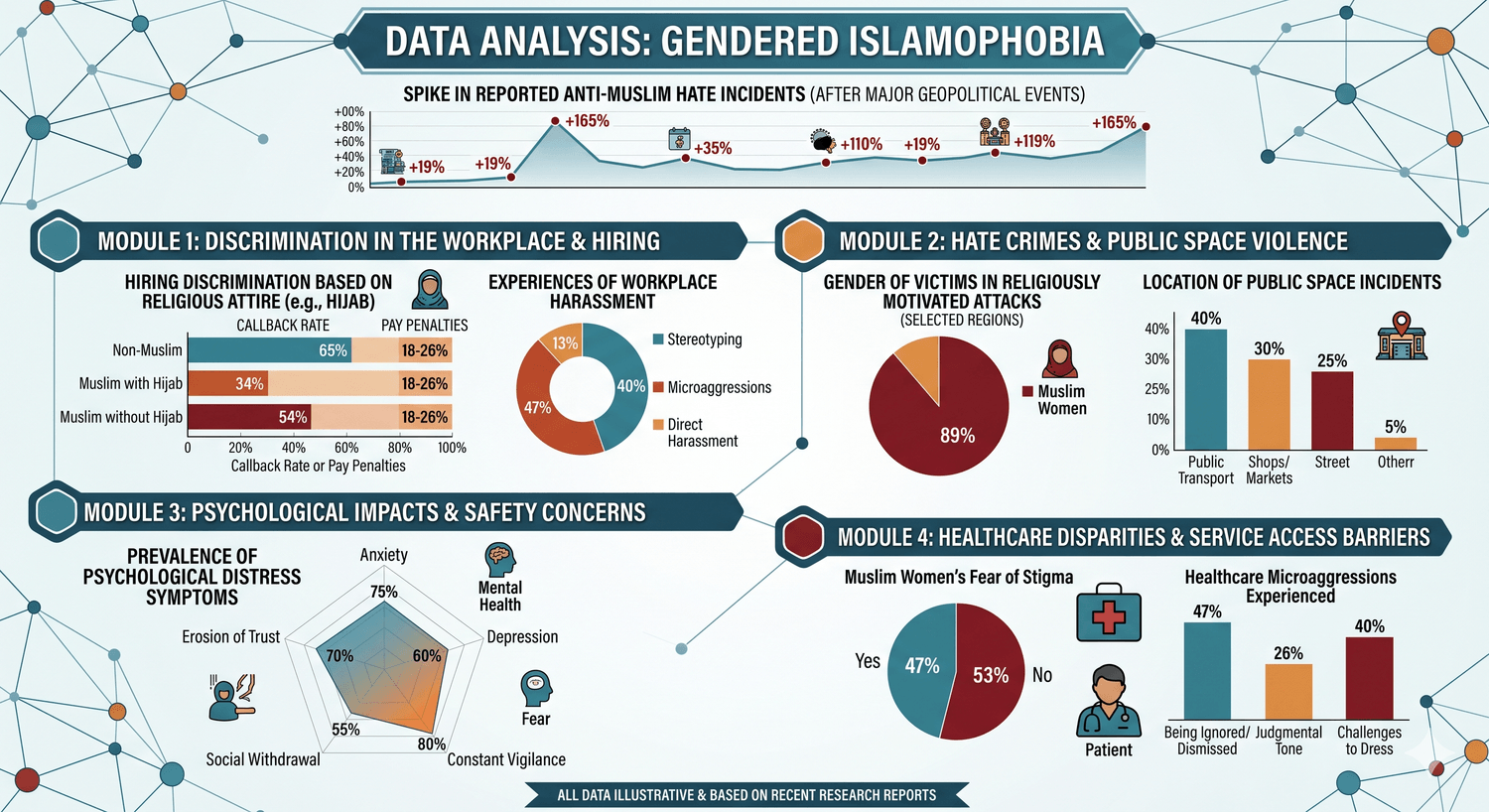
The data on this is consistent across multiple countries and research contexts. A 2013 study found that Muslim women, particularly those wearing hijabs or face veils, are more vulnerable to Islamophobic attacks than Muslim men. Research from the Tell MAMA project in the UK found that in its first year of operation, 70 percent of physical Islamophobic incidents were perpetrated against women wearing the hijab or niqab. The ACLU found that 69 percent of hijab-wearing women reported at least one incident of discrimination, compared to 29 percent of Muslim women who did not wear the hijab.
According to ISPU, 68 percent of Muslim women in the United States report experiencing religious discrimination in a given year — compared to 55 percent of Muslim men. That 13-percentage-point gap is not random. It reflects what happens when religious identity is visible in a way that cannot easily be hidden.
The reason for this targeting is not mysterious. The hijab functions as what researchers call a "religious signifier" — an immediate, visible marker of Muslim identity. In environments where negative assumptions about Islam are widespread, that visibility creates opportunity for hostility. Muslim women become the most accessible targets of a prejudice that is really directed at the religion.
This is what scholars describe as "gendered Islamophobia" — discrimination that is simultaneously about religion and about gender, operating at their intersection in ways that neither anti-discrimination framework adequately addresses on its own.
What Islamophobia Targeting Women Looks Like in Practice
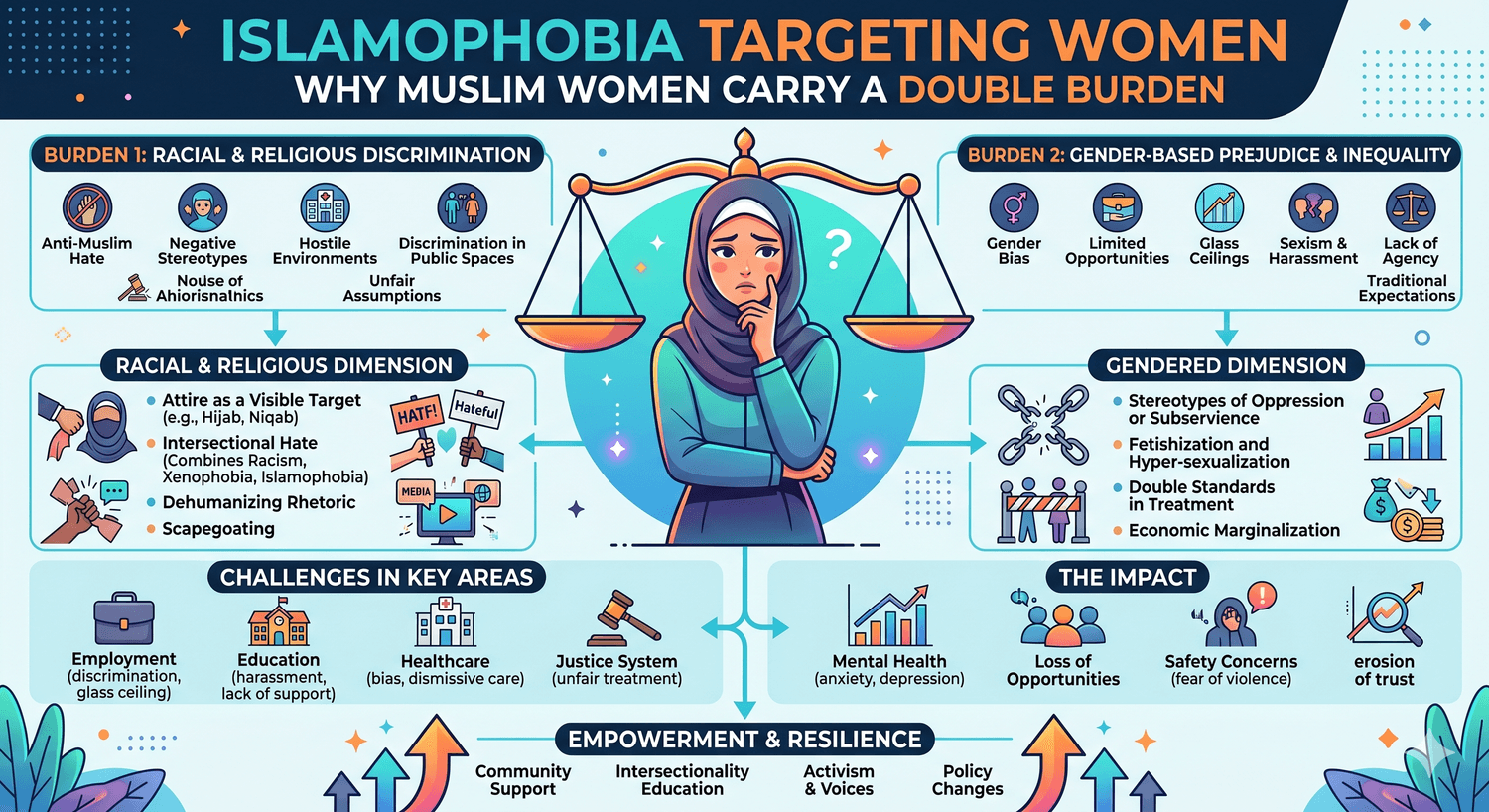
Islamophobia targeting women takes forms that range from daily micro-aggressions to life-altering legal discrimination.
In the workplace, Muslim women in hijabs face documented disadvantages in hiring. Resume studies and CV testing across multiple European countries found that women with visible Muslim identity were significantly less likely to receive callbacks than identical candidates without visible markers of faith. In the Netherlands, Muslim women wearing hijabs reported employment discrimination at rates nearly five times higher than Muslim women who did not wear them. In the UK, half of hijab-wearing women said they believed their religious dress cost them career advancement opportunities.
In public spaces, Muslim women describe a range of experiences: being stared at, followed, verbally abused, and physically attacked. The verbal abuse often centers on the hijab itself — commands to "go back to your country," questions about whether they are hot, accusations that their dress is oppressive. The irony that these comments are delivered by people claiming to be concerned about women's freedom is not lost on the women receiving them.
In legal and institutional settings, Islamophobia targeting women has taken the form of government bans and restrictions. France has some of the most extensive restrictions on Muslim dress in the Western world, with laws targeting the hijab in schools, the niqab in public spaces, and the burkini at beaches. The European Court of Justice ruled in 2017 that employers could ban visible religious symbols, including the hijab — a decision widely condemned by Muslim communities as legal sanction for workplace discrimination. During the 2024 Paris Olympics, French athletes were barred from wearing hijabs in competition.
These legal restrictions carry a distinctive logic: they present themselves as protecting women from religious coercion while simultaneously coercing women to remove their religious dress. The women themselves are rarely centered in the conversation.
The Double Bind: Oppressed by Islamophobia and "Rescued" by Islamophobes
Muslim women who wear the hijab occupy a peculiar position in Western public discourse. They are simultaneously described as oppressed by their faith and as a threat to the values of the societies they live in. They need to be liberated from Islam, according to one narrative, while also being feared as symbols of Islam's encroachment, according to another. Both narratives treat the women as objects of concern rather than subjects with their own perspectives.
Research in the medical journal CMAJ described how this works in healthcare: Muslim women in medical professions reported being treated as a "paradox of being hypervisible and invisible" — standing out from their colleagues physically while having no voice in debates about their own religious practice. Muslim women physicians reported fewer teaching and learning opportunities, alienation from colleagues, and feelings of burnout directly connected to the discrimination they experienced.
A study in the Georgetown Immigration Law Journal noted that Islamophobia and the discourse around Muslim women's dress have colonial roots — that the narrative of "saving" Muslim women from their religion was used to justify imperial intervention in Muslim-majority countries for over a century, and that this same narrative is now deployed in domestic political contexts to justify discrimination and exclusion.
The women themselves understand this. Scholars, activists, and ordinary Muslim women have written at length about how the hijab, far from being a symbol of oppression, is often an act of resistance — a refusal to define their value by their appearance, a statement of identity in the face of pressure to conceal it, a connection to a tradition that gave women legal rights, property rights, and marital rights in the seventh century, centuries before Western legal systems recognized them.
The Specific Experiences of Converts and Non-Arab Muslim Women
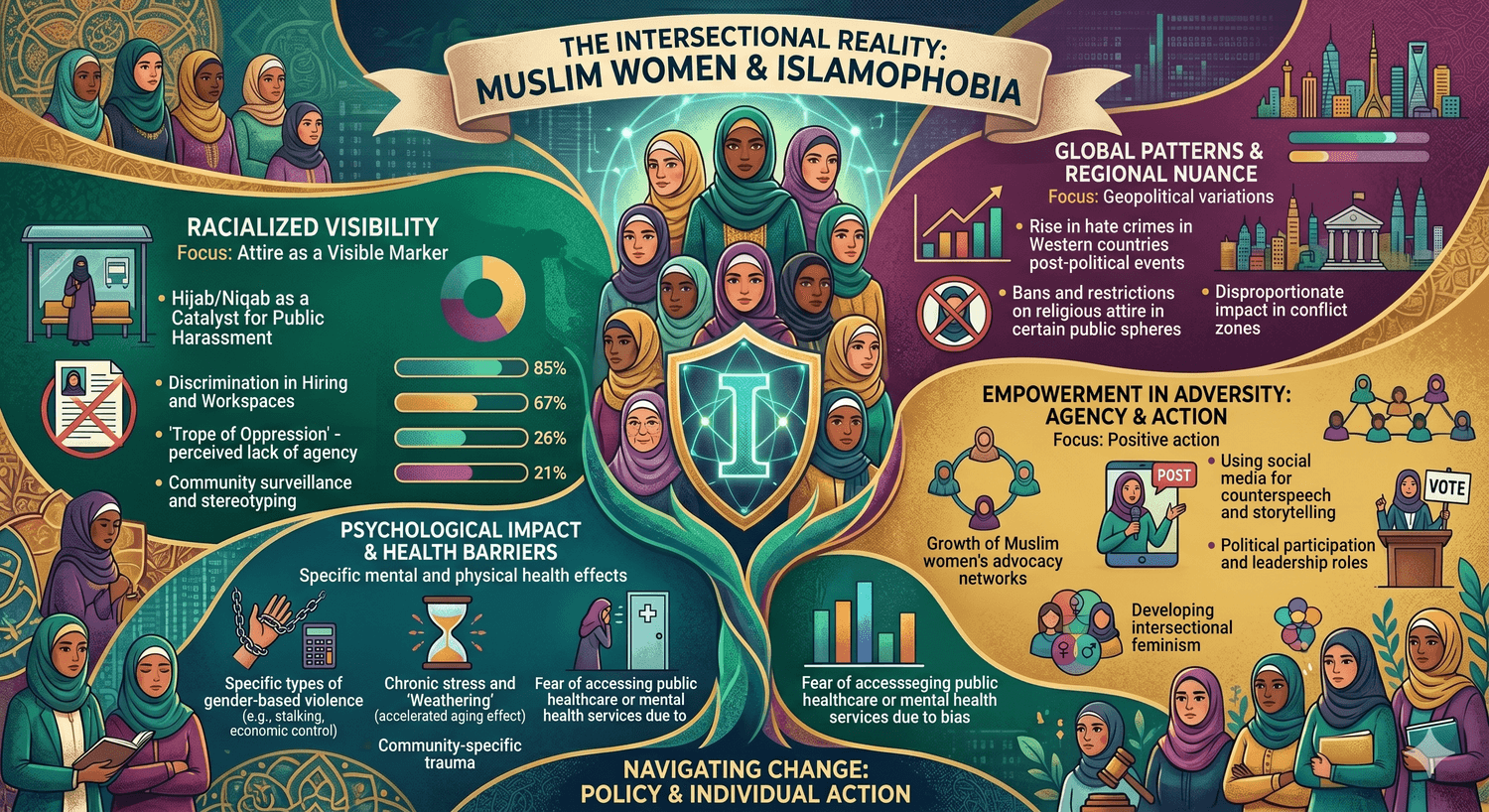
Islamophobia targeting women is not limited to women from Muslim-majority countries of origin. White converts who wear the hijab describe a particular form of hostility: disbelief. They are told they do not look Muslim, asked what religion they converted from, accused of being brainwashed. Their decision to wear hijab is treated as inherently irrational in a way that does not apply to women born into the faith.
Non-Arab Muslim women — including Black American Muslim women, Southeast Asian Muslim women, and South Asian Muslim women — navigate both Islamophobia and the specific racism that accompanies their ethnic and racial identity. Black Muslim women have described being invisible in Muslim community conversations about discrimination while simultaneously being hypervisible to Islamophobic actors. Southeast Asian Muslim women are sometimes mistaken for women of other faiths and targeted anyway.
In healthcare settings particularly, Muslim women describe having their religious identity used against them — being pressured to remove the hijab for medical examinations without appropriate reason, having healthcare providers make assumptions about their autonomy or their family relationships based on their dress, and feeling that their religious identity shapes the quality of care they receive.
Islam's Actual View of Muslim Women
The narrative that Islamic dress oppresses Muslim women is contradicted by the faith's own articulation of its values and by the testimony of the millions of women who choose to wear the hijab without coercion.
The Qur'anic verse most cited in discussions of Islamic dress is Surah An-Nur, 24:31, which instructs believing women to lower their gaze, guard their modesty, and not display their adornment except that which is apparent. The verse also instructs men to lower their gaze and guard their modesty — a detail that rarely appears in Western media coverage. Modesty in Islam is a concept with application to both genders, even if its visible expression differs.
Many Islamic scholars point out that the concept of hijab in the Qur'an is broader than a headscarf — it encompasses an entire orientation toward modesty in behavior, speech, and appearance, for men and women alike. The headscarf is one expression of that orientation, not the sum total of it.
Muslim women across the world wear the hijab for different reasons: religious obligation, cultural identity, personal choice, spiritual practice, family tradition, and solidarity with Muslim communities under pressure. These reasons are diverse and complex, and they resist the simple narrative that reduces all hijab-wearing to victimhood.
The fact that some women in some countries have been forced to wear hijab does not change the reality that the vast majority of hijab-wearing women globally choose to do so. Treating all Muslim women as victims of their own religion is not a form of solidarity. It is a form of Islamophobia targeting women.
What Needs to Change
Addressing Islamophobia targeting women requires both legal and cultural change. At the legal level, anti-discrimination laws need to be applied clearly and consistently to religious dress, with employers and institutions held accountable when they discriminate against hijab-wearing women. International human rights frameworks need to recognize that banning religious dress imposes a cost that falls almost entirely on Muslim women.
At the cultural level, the narrative about Muslim women needs to include Muslim women's own voices — not the voices of politicians, opinion writers, or activists speaking on their behalf. When Muslim women describe their experiences of discrimination, they should be believed. When they describe their experience of wearing hijab as empowering, they should be believed too.
For new Muslims, particularly women considering whether to wear hijab, the pressures described in this article are real and worth acknowledging. They are not a reason to make any particular choice about religious dress. They are context. Knowing that the path includes this kind of resistance is part of being fully informed, and being fully informed is part of making a real decision.
If you are navigating these questions and want a community to think through them with, Start Islam Path offers resources, courses, and connection for new Muslims at every stage of their journey.


