Islamophobia Statistics That Every Truth-Seeker Needs to Know
Get the 109‑page guide delivered to your inbox
Discover the faith that 1.9 billion people live by — and why thousands of truth-seekers just like you are choosing it every single day. This free 109-page guide walks you from curiosity to clarity, step by step.
No pressure. No judgment. No strings attached. Just a clear, honest roadmap written for people who want real answers — whether you're skeptical, curious, confused, or quietly searching for something deeper.
Numbers rarely tell the full story. But they do insist on being heard, especially when they point to a pattern too consistent to dismiss as coincidence. The Islamophobia statistics compiled over the past three decades tell a story of rising hostility — one that has tracked alongside political events, media cycles, and foreign policy shifts with uncomfortable precision.
If you are new to Islam, these numbers may feel like a warning. They are also, in a different way, a form of solidarity. When you see that 60 percent of American Muslims reported experiencing discrimination in the previous year, you understand that what you might occasionally feel is not imagined. It is documented. It is systematic. And understanding it clearly is the first step toward responding to it well.
Where the Numbers of Islamophobia Statistics Come From
The most comprehensive annual data on anti-Muslim discrimination in the United States comes from CAIR, the Council on American-Islamic Relations, which has published civil rights reports since 1996. The Institute for Social Policy and Understanding (ISPU) conducts the American Muslim Poll, which tracks Muslim experiences with discrimination alongside broader measures of political engagement and civic life. The FBI tracks hate crimes by religion, race, and ethnicity. And the Pew Research Center periodically measures American public attitudes toward Islam and Muslims.
Each source has limitations. CAIR only captures incidents reported to its offices, and many Muslims — particularly immigrants, those without legal status, and those who distrust law enforcement — do not report what happens to them. Hate crime data depends on local police departments choosing to classify incidents correctly, which many do not. Public opinion surveys capture stated beliefs, not behavior. With all those caveats noted, the data is still striking.
The 2024 Numbers
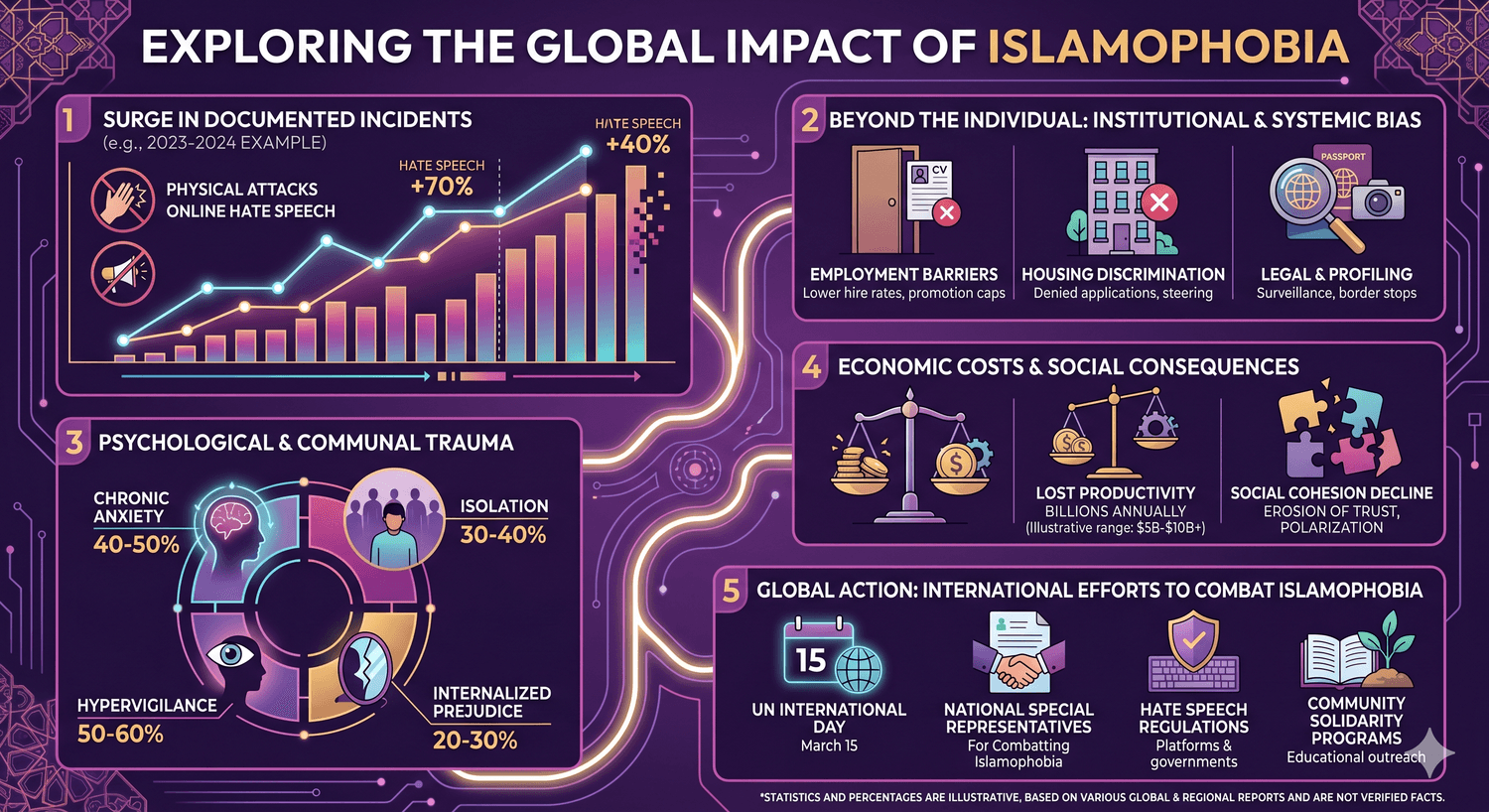
In 2024, CAIR received 8,658 complaints related to anti-Muslim and anti-Arab discrimination — the highest total in the organization's nearly 30-year history. That represented a 7.4 percent increase from the 8,061 complaints filed in 2023, which had itself been a record year. Employment discrimination was the largest single category, making up 15.4 percent of all complaints — the first time in CAIR's history that employment topped the list.
Law enforcement encounters surged by 71.5 percent, rising from 295 reported incidents in 2023 to 506 in 2024. CAIR identified 40 incidents in 2024 that explicitly targeted mosques or Islamic worship spaces.
According to a 2024 survey, 91.7 percent of Muslims in Washington State reported experiencing Islamophobic discrimination at some point in their lives. That number would be extraordinary if it referred to any other religious community. For Muslims in America, it was not surprising.
In the first half of 2024 alone, anti-Muslim incidents rose approximately 70 percent compared to the same period the previous year, driven significantly by the conflict in Gaza and the associated political climate.
What the Islamophobia Statistics Show Over Time
The pattern of anti-Muslim discrimination data follows a consistent rhythm. Spikes correlate with specific events: the September 11 attacks, the wars in Iraq and Afghanistan, the 2016 U.S. presidential election, the 2017 travel ban targeting Muslim-majority countries, and the ongoing conflict in Gaza.
After September 11, anti-Muslim hate crimes multiplied by 16 from 2000 to 2001, according to FBI data. Before the attacks, there were 12 recorded victims of anti-Muslim assault in the United States. By the end of 2001, that number had risen to 93. From 2002 to 2014, the numbers remained elevated but somewhat stable. Then came 2016, which saw 127 recorded assaults against Muslims — a spike that correlated directly with the political rhetoric of that election year.
This pattern reveals something important: Islamophobia is not simply the spontaneous behavior of a few bad actors. It is a social phenomenon that rises and falls in response to political leadership, media framing, and public permission. When politicians use anti-Muslim language, hate incidents go up. When the news cycle centers on Muslim violence without corresponding coverage of Muslim everyday life, public attitudes become more negative. The numbers are not random. They reflect choices made at scale.
What Islamophobia Statistics Show About Where It Happens
People tend to imagine discrimination as something that happens in dark alleys or online comment sections. The data paints a different picture.
Nearly 44 percent of Muslims who report discrimination say it occurred at an airport — making air travel one of the most consistently hostile environments for Muslim Americans. Muslim passengers are more than twice as likely to face secondary screening when entering the United States compared to members of other faith groups. According to ISPU, 67 percent of Muslims who are stopped and identified by law enforcement say their appearance made it obvious they were Muslim.
At work, 37 percent of Muslims who report discrimination say it happened during a job application. At school, Muslim children report discrimination at higher rates than any other religious group studied by ISPU. In healthcare settings, 27 percent of Muslim discrimination complaints involve medical appointments — a number with real consequences for health outcomes in communities that already face systemic barriers to care.
On social media, 46 percent of Muslims report experiencing discrimination on digital platforms, including account suspensions, content removal, and coordinated harassment. Muslim men are more likely to report social media discrimination than Muslim women, though both experience it at rates significantly higher than other religious groups.
The Islamophobia Statistics on Public Perception
Anti-Muslim discrimination does not happen in a vacuum. It grows in soil cultivated by public attitudes.
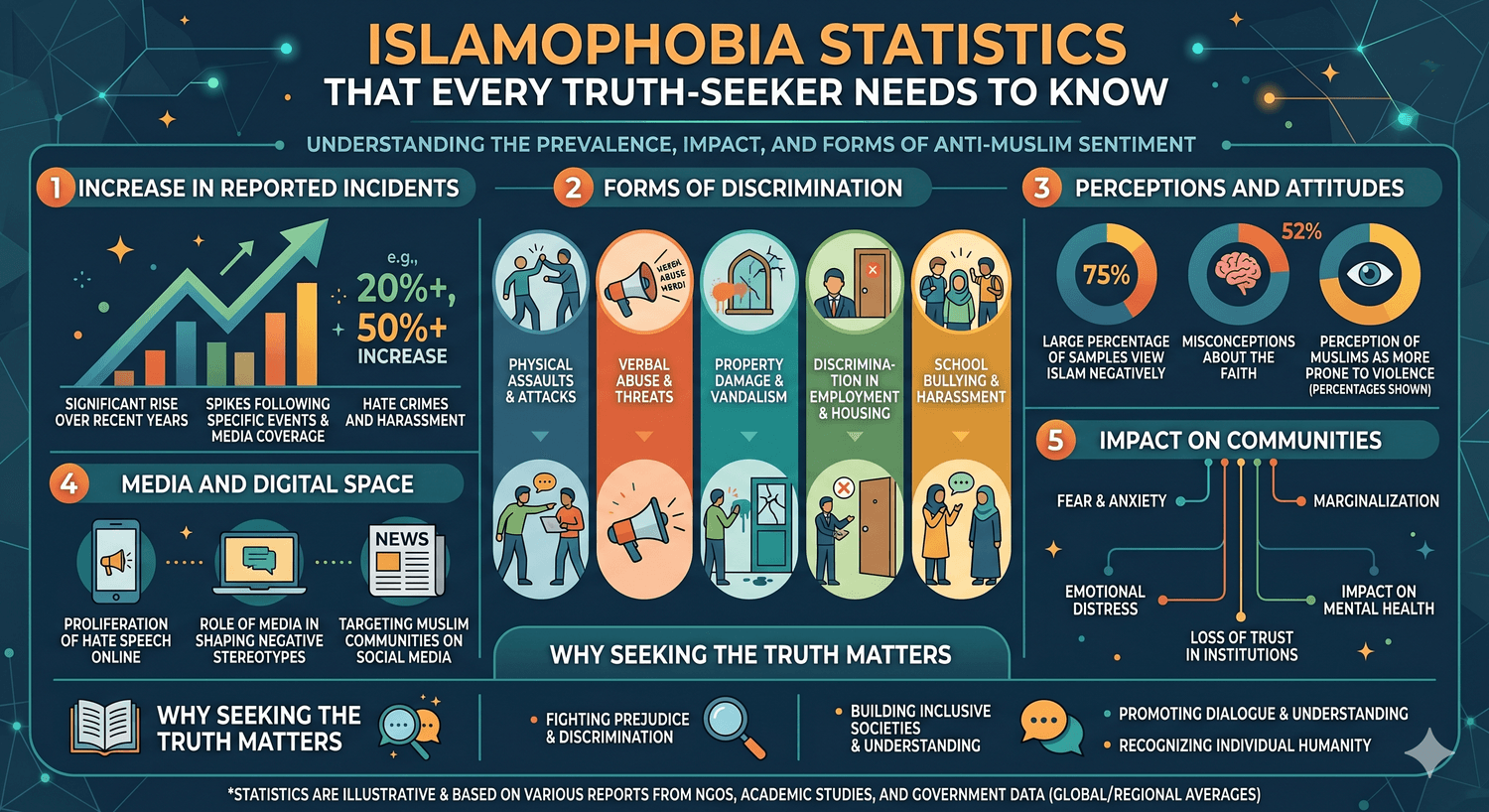
Pew Research Center data shows that the American public's view of Muslims has been trending more negative since at least 2009. A 2021 Associated Press/NORC survey found that Islam is now one of the most stigmatized religions in the country, with only atheists viewed similarly. At least 49 percent of Americans have reported believing that some U.S. Muslims are anti-American. About 11 percent believe American Muslims have significant support for extremism.
These beliefs are not based on data. The FBI's own records show that the vast majority of domestic terrorism plots since 9/11 were initiated by non-Muslims. The association between Islam and violence is a narrative construction, not a statistical reality. But narratives shape behavior, and that is what the Islamophobia statistics ultimately reveal: a gap between what Islam actually is and what a significant portion of the population has been led to believe about it.
What About Muslims Who Don't Report?
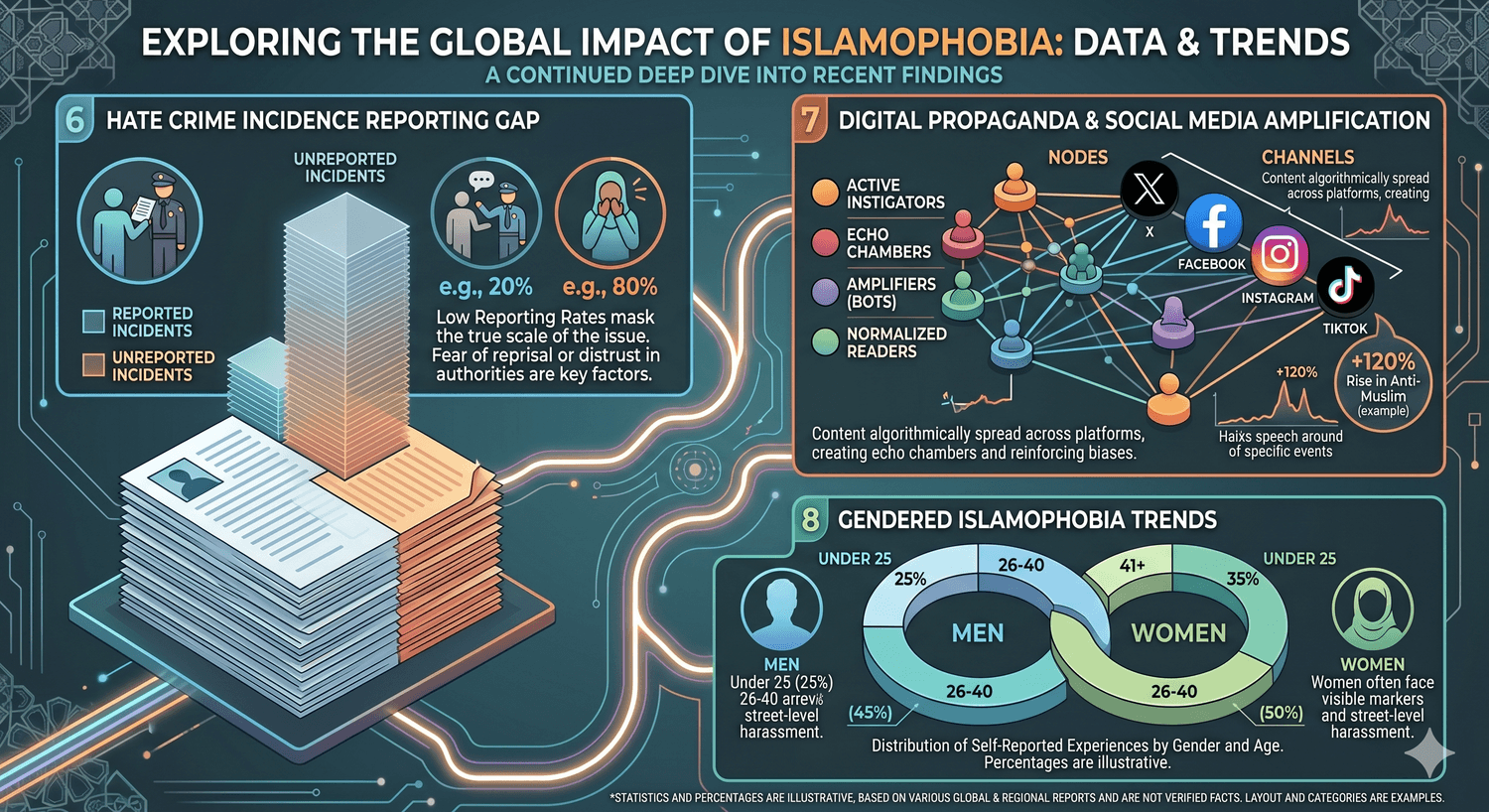
Every expert who works with Islamophobia data will tell you the same thing: the numbers undercount the real scale of the problem significantly.
Muslims who are undocumented immigrants are unlikely to contact law enforcement. Muslims from communities with historical reasons to distrust government agencies — including many Black American Muslims — are often reluctant to engage formal reporting systems. Language barriers, unfamiliarity with legal processes, fear of retaliation, and the simple belief that nothing will be done all suppress reporting.
The most honest thing we can say about the Islamophobia statistics is that they show a floor, not a ceiling. The true number of Muslims who have experienced discrimination in any given year is higher than what the data captures. Probably much higher.
What the Numbers Mean for New Muslims
If you have recently come to Islam, or are seriously considering it, these statistics deserve your attention. Not because they should frighten you — though they might — but because they are part of the full picture of what it means to be Muslim in today's world.
The faith you are exploring is practiced by nearly two billion people on earth. It has produced mathematicians, philosophers, physicians, poets, and legal scholars whose work forms the bedrock of modern civilization. It is a tradition of extraordinary depth, beauty, and coherence. It is also a tradition that, in the current political climate of much of the Western world, is subject to suspicion, hostility, and organized defamation.
Knowing that is not a reason to turn away. It is a reason to be clear-eyed about the world you are entering. The Qur'an does not promise believers an easy path. It promises something more durable: clarity of purpose, community, and the knowledge that they are seen by Allah regardless of how they are seen by the world.
"Do people think that they will be left alone because they say: 'We believe,' and will not be tested? We tested those before them." (Qur'an 29:2-3)
The Islamophobia Statistics Tell Only Part of the Story
Behind every statistic is a person. A teacher who was refused a religious accommodation and had to choose between prayer and employment. A teenager who stopped sitting with her Muslim friends at lunch to avoid the comments. A father who changed his son's name on his resume because the interviews stopped coming after people saw it.
Their experiences are not captured fully by any database. But the data at least insists that their experiences are real, that they form a pattern, and that the pattern demands a response — from policymakers, from communities, and from individuals who care about fairness and human dignity.
If you want to understand Islam beyond the headlines and stereotypes that these statistics reflect, Start Islam Path offers courses built for curious minds at every stage of their journey. Start with what you actually want to know.


