What Is Ramadan? A Complete Guide for Non-Muslims
Get the 109‑page guide delivered to your inbox
Discover the faith that 1.9 billion people live by — and why thousands of truth-seekers just like you are choosing it every single day. This free 109-page guide walks you from curiosity to clarity, step by step.
No pressure. No judgment. No strings attached. Just a clear, honest roadmap written for people who want real answers — whether you're skeptical, curious, confused, or quietly searching for something deeper.
You've probably heard the word before. A coworker mentioned they were skipping lunch. A neighbor's lights are on at 4 AM for weeks straight. A friend texts you: "I can't make dinner, it's Ramadan." You nod. You maybe smile. But if you're honest, you're not entirely sure what they mean, or what's actually happening inside the month that matters so much to them.
So what is Ramadan for non-Muslims to understand, and why does it carry the weight it does for 1.8 billion people worldwide? Let me try to answer that honestly.
What Is Ramadan? The Basics Every Non-Muslim Should Know
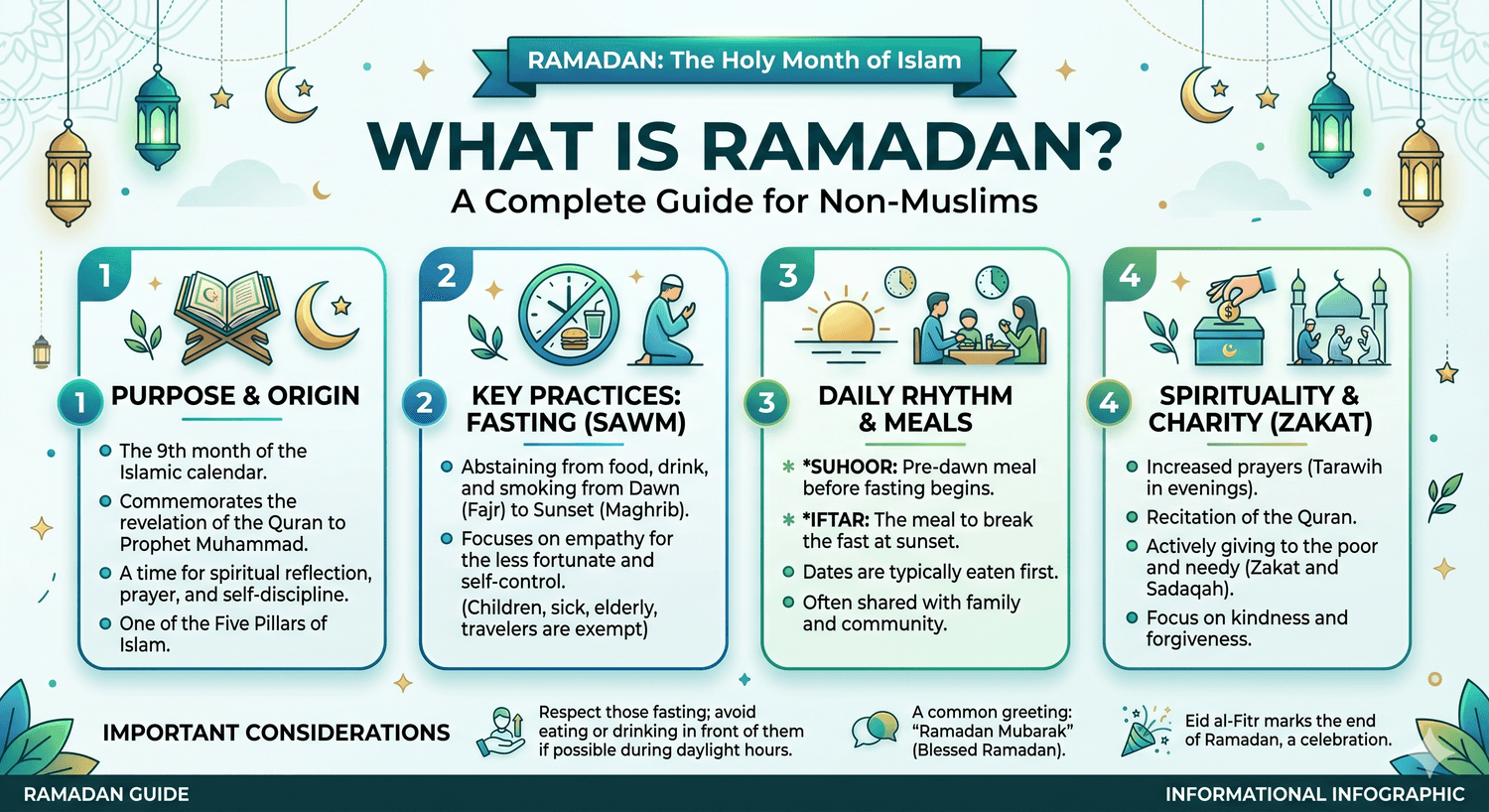
Ramadan is the ninth month of the Islamic lunar calendar, and it is the holiest month in the Islamic year. During this month, Muslims around the world fast every day from the first light of dawn until the moment the sun disappears at the horizon. No food. No water. No smoking. And more than that — no anger, no lying, no behavior that damages the soul.
But describing Ramadan only as a fast is like describing a wedding by mentioning the food. The mechanics are real, but they miss the point entirely.
The word sawm, the Arabic term for fasting, carries the meaning of restraint. Not just physical restraint, but a deliberate pulling back from everything that normally distracts a person from what is real. Each day of Ramadan is a question: Can you step away from the things that feel necessary long enough to remember what actually is?
There is also a historical reason for the timing of this month that non-Muslims rarely hear. Muslims believe the Quran, their sacred scripture, began to be revealed to the Prophet Muhammad, peace be upon him, during Ramadan. God says in the Quran, "It was in the month of Ramadan that the Quran was revealed as guidance for mankind, clear messages giving guidance and distinguishing between right and wrong" (Quran 2:185). This makes the month more than a discipline. It is, for Muslims, an anniversary of the moment the world received direction from God.
Why Do Muslims Fast During Ramadan?
The question I hear most from non-Muslims is simply: why? Why not eat? Why especially not drink water? It seems, to many people, like unnecessary suffering.
The answer begins with a concept called taqwa. In Arabic, taqwa describes a state of heightened God-consciousness. An awareness that what you do is seen and what you feel is known. You cannot manufacture taqwa with willpower alone. But you can create the conditions where it becomes possible, and hunger creates those conditions.
When you feel hungry at noon and reach for nothing, you are reminded in a very physical way that you are not in control. You did not earn your last meal. You cannot guarantee the next one. Your body, which you carry around as though it belongs to you, is actually on loan. That awareness changes how you walk through the rest of the day. It makes you more patient, more generous, more careful with your words.
The Prophet Muhammad, peace be upon him, said, "Whoever does not give up lying speech and acting on lies during fasting, Allah has no need of his giving up food and drink." This is the key to understanding what Ramadan is really asking. The fast is the door. What lies behind it is the character that emerges when habits are interrupted and the ego is quieted.
The Daily Rhythm of Ramadan: From Before Dawn to After Sunset
Most non-Muslims don't realize how specific and structured the daily rhythm of Ramadan actually is.
The fast begins with suhoor, a meal eaten in the hour or two before the first light of dawn. Families wake in the early hours, eat something nourishing, drink water, then perform Fajr, the first of five daily prayers. When the thin white line appears at the horizon, the fast begins.
From that moment until sunset, nothing passes the lips. Not water. Not gum. Not a half-absent sip of coffee while opening emails. The day continues normally — work, school, errands, the full weight of ordinary life — all while fasting. Many people report sharper focus once the body adjusts, not the sluggishness you might expect.
At sunset, the fast is broken with iftar. The Prophet, peace be upon him, recommended starting with dates and water before anything else, and this tradition is followed across the Muslim world from Morocco to Indonesia, from Detroit to Kuala Lumpur. After the Maghrib prayer, the meal begins. In Muslim homes and communities, iftar is the social heart of the day. Long tables. Open doors. People who wouldn't ordinarily share a meal seated side by side.
After iftar, many Muslims go to the mosque for Tarawih, extra night prayers specific to Ramadan. In these prayers, the imam recites long portions of the Quran aloud, with the goal of completing the entire scripture over the 30 days. A single Tarawih session can last between one and two hours. People stand, bow, prostrate, and stand again, night after night for a month.
The Last Ten Nights and the Night of Power
If the first twenty days of Ramadan represent spiritual preparation, the last ten are the destination.
Among the odd-numbered nights of this final stretch falls Laylat al-Qadr, the Night of Power. The Quran describes it plainly: "The Night of Power is better than a thousand months" (Quran 97:3). Muslims believe that sincere worship on this single night carries more weight than 83 years of worship on any ordinary night.
No one knows with certainty which night it is. The ambiguity is intentional. You cannot calculate the right night and coast through the others. You have to work through all of them. Muslims stay awake through the last ten nights in prayer and supplication, asking for whatever they need most. Forgiveness for what they've done. Guidance for what comes next. Healing, peace, clarity.
The Prophet, peace be upon him, was described as tightening his belt during these nights — meaning he gave up sleep entirely and devoted himself to worship. His companions did the same. This is the part of Ramadan that people outside the faith rarely see, because it happens at 2 and 3 in the morning, in mosques and in homes, in the dark and the quiet.
Who Is Exempt from Fasting During Ramadan?
Islam is very clear about this, and it matters.
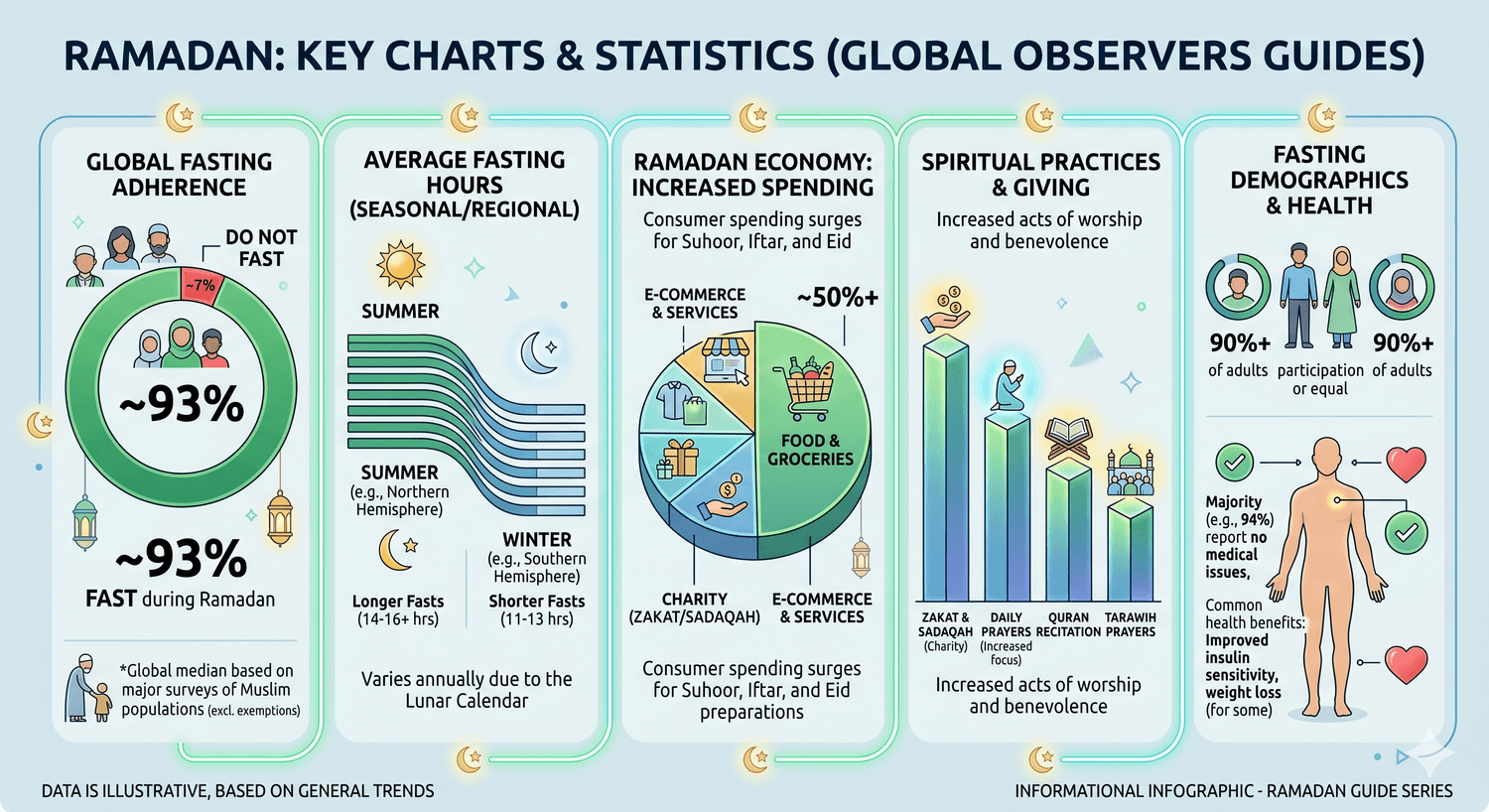
Children before puberty are not required to fast. The elderly are exempt. Those who are seriously ill, pregnant, breastfeeding, or traveling have valid permission not to fast, with missed days made up later at a time that is manageable. A person whose health would genuinely be harmed by fasting does not fast.
God says directly in the Quran, "He wants ease for you, not hardship" (Quran 2:185). Ramadan is not a competition in suffering. The exemptions exist because the purpose of the month is to draw closer to God, not to damage the body He gave you. A pregnant woman who cannot fast is no less a Muslim for it.
This is worth saying to non-Muslims who sometimes wonder if fasting causes harm: Islam does not ask you to break yourself for God.
Charity: The Other Dimension of Ramadan
Fasting gets most of the attention when people ask what Ramadan is. But the emphasis on giving is equally central.
At the end of the month, before the Eid prayer, every Muslim who can afford to does so pays Zakat al-Fitr, a small obligatory charity ensuring that people who are poor can also eat and celebrate Eid with dignity. The Prophet, peace be upon him, was described by those around him as more generous during Ramadan than at any other time of year — and he was already known for remarkable generosity.
This spirit spreads through communities. Mosques organize nightly communal iftars open to anyone. Organizations raise funds for the poor. Families sponsor food for neighbors they barely know. The idea running through all of it is this: what you have is not entirely yours, and someone nearby may have nothing at all. Ramadan makes that impossible to forget.
What Eid al-Fitr Looks Like
Ramadan ends when the new moon of the following month is sighted, and the very next day is Eid al-Fitr — the Festival of Breaking the Fast. This is one of the two major celebrations in Islam, and it is genuinely joyful in the fullest sense of the word.
The day begins with a communal prayer in the morning, held outdoors or in a large hall. Then the festivities begin. New clothes are worn. Families visit each other. Children receive gifts. Food is shared generously. The greeting "Eid Mubarak" means "Blessed Eid," and if you know a Muslim, saying it costs nothing and means a great deal to hear.
The celebration after Ramadan is not ironic. People are not celebrating that the hard part is over. They are celebrating what the month did to them. The gratitude, the connection to God, the generosity they practiced — Eid marks all of that.
Practical Things Non-Muslims Should Know During Ramadan
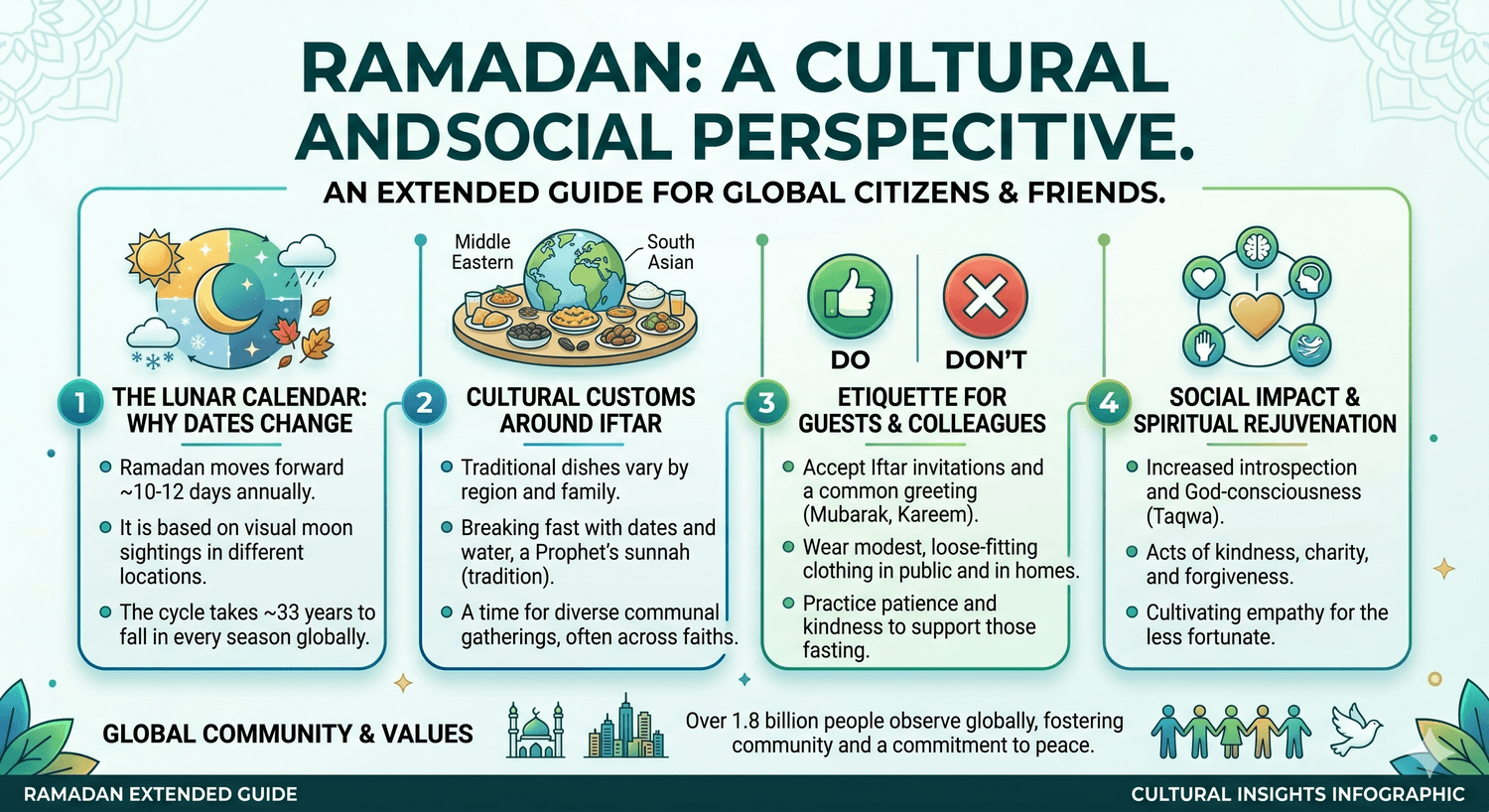
You don't need to walk carefully around a fasting Muslim. Eating in front of them is generally fine. Most Muslims prefer you don't make a production of it, but they will not be offended by your lunch. Accidentally offering them a snack is not a crisis. They'll simply decline.
If you work with a Muslim during Ramadan, know that they may be tired, especially in the first week as their body adjusts. Adjusting early morning or very late-night meeting times when possible is a thoughtful gesture. It is not required, but it is noticed.
Genuine curiosity is always welcome. If you ask a Muslim friend what Ramadan means to them personally, you will likely hear something honest and specific. The month touches people differently. For some, it is the one time of year they feel truly connected to their faith. For others, it is their most difficult month and their most rewarding. For most people who practice it sincerely, it is both at once.
What Ramadan Asks of the World
Every religion asks something of its followers. What is Ramadan asking of the 1.8 billion people who observe it?
It is asking them to remember they are not the center. It is asking them to feel, for thirty days, what it is like to be genuinely dependent, and to sit with that feeling long enough to let it change something. It is asking them to slow down in a world that rewards speed. It is asking them to give in a world that rewards accumulation. It is asking them to wake before dawn, to stand in the dark, and to acknowledge something larger than their own wants.
The Quran says, "O you who believe, fasting is prescribed for you as it was prescribed for those before you, so that you may attain God-consciousness" (Quran 2:183). The same practice was given to earlier communities before Islam. Different forms, same need. Human beings have always needed a season in which they stop long enough to ask what they are actually doing with the time they have been given.
Whether you are Muslim or not, there is something worth sitting with in that.
Ramadan and What It Tells the Rest of Us
Non-Muslims often assume Ramadan must be miserable. A month without food, without water, with prayers at 2 AM. And yet the overwhelming experience reported by Muslims during this month is not suffering but clarity. The absence of the ordinary reveals what was hidden underneath it.
What is Ramadan for non-Muslims to take away, then? Perhaps this: here is a practice of deliberate restraint in a world that actively discourages any form of restraint. A month-long pause in the endless demand to consume, to produce, to be entertaining and productive at all times. The fast says, quietly, that you are more than your appetite. The prayer says there is something worth organizing your life around. The charity says that what you have was never entirely yours to keep.
You don't have to be Muslim to find something worth respecting there.
If you have a Muslim friend going through Ramadan, ask them how it's going. Ask what they hope to get from this month. Ask what the hardest hour of the day is for them, and what the most meaningful one is. Most of them will be glad you asked. Not because they want to convince you of anything, but because Ramadan is a month that invites real conversation, and genuine curiosity is one of the most respectful things one person can offer another.
Interested in learning more about Islam? Explore our courses at Start Islam Path and discover what this faith has to offer — for those who are new to it and those who are just beginning to ask questions.


