Why Is Mecca Important to Muslims? History & Meaning
Get the 109‑page guide delivered to your inbox
Discover the faith that 1.9 billion people live by — and why thousands of truth-seekers just like you are choosing it every single day. This free 109-page guide walks you from curiosity to clarity, step by step.
No pressure. No judgment. No strings attached. Just a clear, honest roadmap written for people who want real answers — whether you're skeptical, curious, confused, or quietly searching for something deeper.
Every day, five times a day, 1.9 billion people turn in the same direction to pray. They face a city in western Saudi Arabia called Mecca. A Muslim in Jakarta and a Muslim in New York and a Muslim in Lagos all orient toward the same point on the globe. That's not a coincidence, and it's not merely symbolic. It reflects something deep about why Mecca is important to Muslims — and that importance stretches back thousands of years, long before the Prophet Muhammad ﷺ was born.
If you've ever wondered Why Is Mecca Important, what this city means, why non-Muslims can't enter it, why millions of people travel there every year at tremendous personal cost, and why it sits at the spiritual center of the fastest-growing religion on earth, here is the real story.
Mecca Before Islam
The significance of Mecca to Muslims is inseparable from the story of Ibrahim (Abraham) and his son Ismail (Ishmael).
According to Islamic tradition, God commanded Ibrahim to bring his wife Hajar and their infant son Ismail to a barren valley in the Arabian Peninsula and leave them there. No water. No shade. No other people. It seemed, by any human measure, like abandonment. But Ibrahim, who had already proven he would follow God's command even when he couldn't see the reason, obeyed.
When their water ran out, Hajar ran desperately between two small hills — Al-Safa and Al-Marwa — searching for water. On her seventh pass, water burst from the earth near where Ismail lay. This spring, called Zamzam, still flows today. Millions of pilgrims drink from it every year.
Years later, God commanded Ibrahim to return. Together, Ibrahim and Ismail rebuilt a sanctuary that, according to the Quran, had first been established as a place of worship since before their time: "Indeed, the first House established for mankind was that at Mecca — blessed and a guidance for the worlds" (Quran 3:96). That sanctuary is the Kaaba.
Why is Mecca important to Muslims? Because it connects them to one of the most defining acts of obedience in human history.
The Kaaba: The Center of the Muslim World
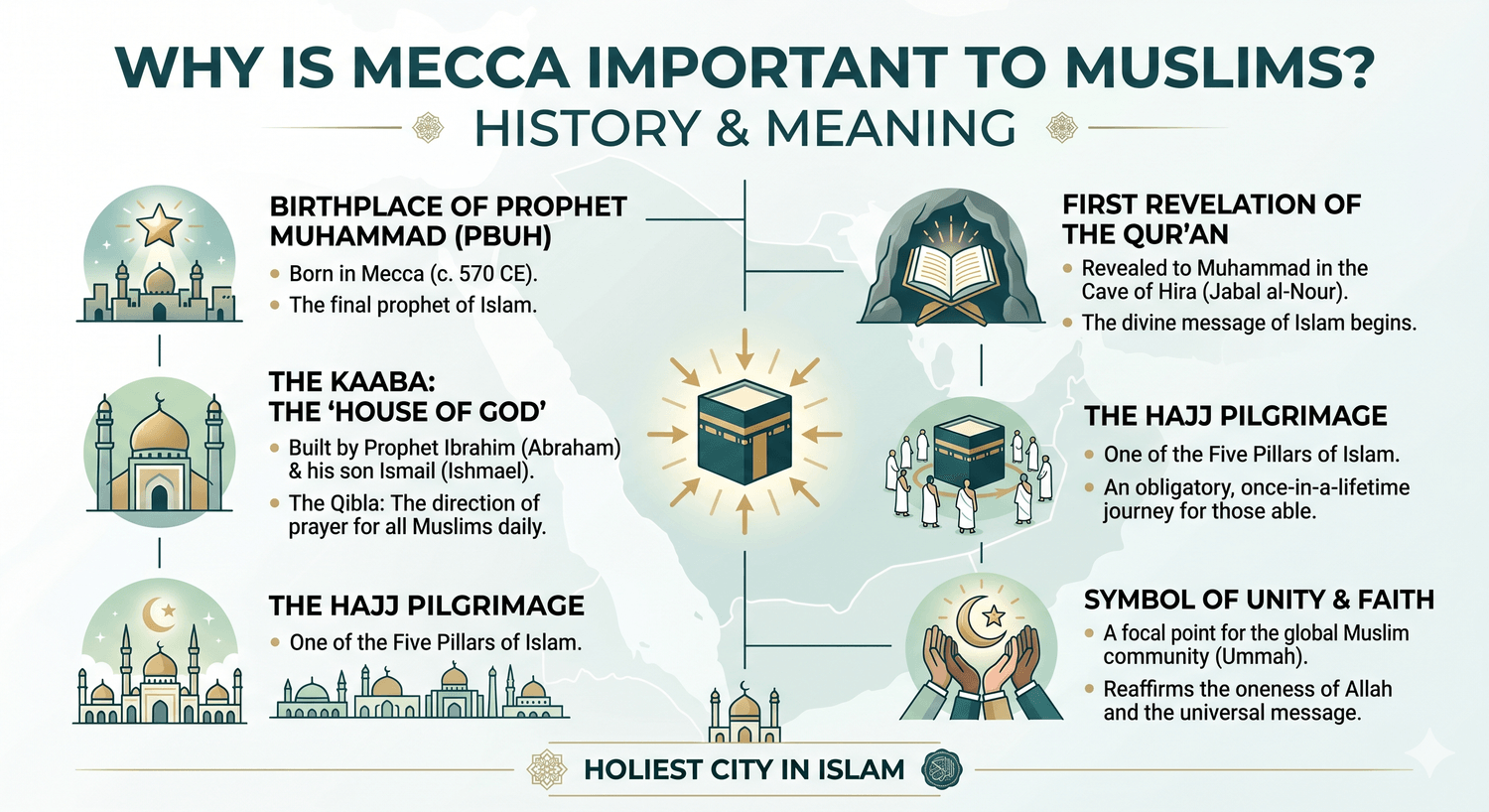
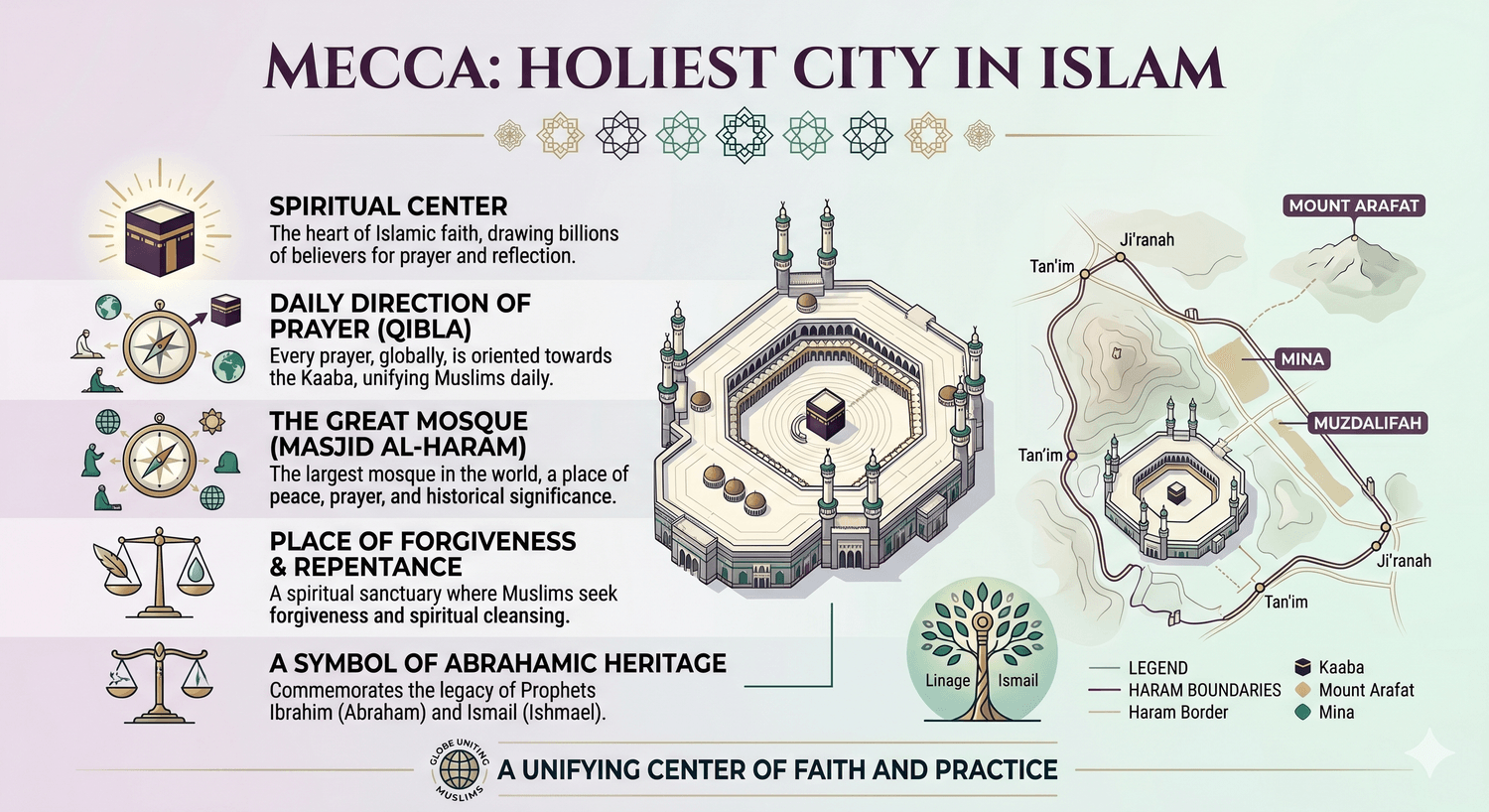
The Kaaba is a cube-shaped structure located at the heart of the Grand Mosque, Al-Masjid Al-Haram, in Mecca. It's roughly 43 feet high and draped in black silk embroidered with gold — a covering called the kiswah, which is replaced annually with a new one hand-sewn by craftsmen in Mecca.
Muslims do not worship the Kaaba. This misunderstanding comes up often, and it's worth addressing directly. The Kaaba is the direction of prayer, not an object of worship. When Muslims pray, they are worshipping God alone. The Kaaba simply provides a single focal point for that worship — a visible symbol of unity. The Prophet ﷺ himself clarified this when the companion Umar ibn al-Khattab kissed the Black Stone embedded in the Kaaba's eastern corner and said: "I know that you are a stone and that you can neither harm nor benefit anyone."
The Black Stone itself is believed to have been placed in the Kaaba's wall by Ibrahim and Ismail. The Prophet ﷺ restored it to its place after a dispute among the Quraysh tribe, who were quarreling over who had the honor of lifting it. Pilgrims try to kiss or touch the Black Stone during Hajj as a Sunnah of the Prophet ﷺ, not as an act of worship directed at the stone.
Why Is Mecca Important: Birthplace of the Prophet
Why is Mecca important to Muslims? Because it's where the Prophet Muhammad ﷺ was born in 570 CE.
The Prophet ﷺ was born into the Quraysh tribe, the custodians of the Kaaba in pre-Islamic Arabia. He lived in Mecca for 53 of his 63 years. It was in Mecca's Cave of Hira, on the mountain now called Jabal al-Nour, that he received the first revelation of the Quran from the angel Gabriel. That night — described in Surah Al-Alaq as beginning with the command "Read!" — changed history.
For 13 years after the first revelation, the Prophet ﷺ preached in Mecca. He faced rejection, mockery, boycotts, and persecution. His companions were tortured for their faith. Eventually, he and his followers were forced to emigrate to Medina in 622 CE — an event called the Hijra that marks the beginning of the Islamic calendar.
Eight years later, he returned to Mecca with an army of 10,000 Muslims and entered it without bloodshed. He went directly to the Kaaba, circled it seven times, and then stood at its door and declared: "There is no god but God alone, who has no partner. He has fulfilled His promise, given victory to His servant, and defeated the factions alone." Then he turned to the people and said: "Go, for you are free."
That Conquest of Mecca in 630 CE established the city as the spiritual center of Islam for all time.
The Direction of Prayer: Qibla
Five times a day, every Muslim on earth faces Mecca. This direction is called the qibla.
Before the second year of the Islamic calendar, the direction of prayer was Jerusalem. Then God revealed a change: "Turn your face toward the Sacred Mosque. Wherever you are, turn your faces toward it" (Quran 2:144). From that point on, Mecca became the qibla.
The significance of this cannot be overstated. When you watch a Muslim pray — whether they're in a hotel room in Tokyo, a mosque in Berlin, a house in Lagos, or on a prayer mat on a prayer break at work in Chicago — they are all facing the same point. The direction of prayer connects 1.9 billion people in a single orientation toward a single city, five times every day. That kind of unity is genuinely remarkable.
The Hajj: A Once-in-a-Lifetime Journey
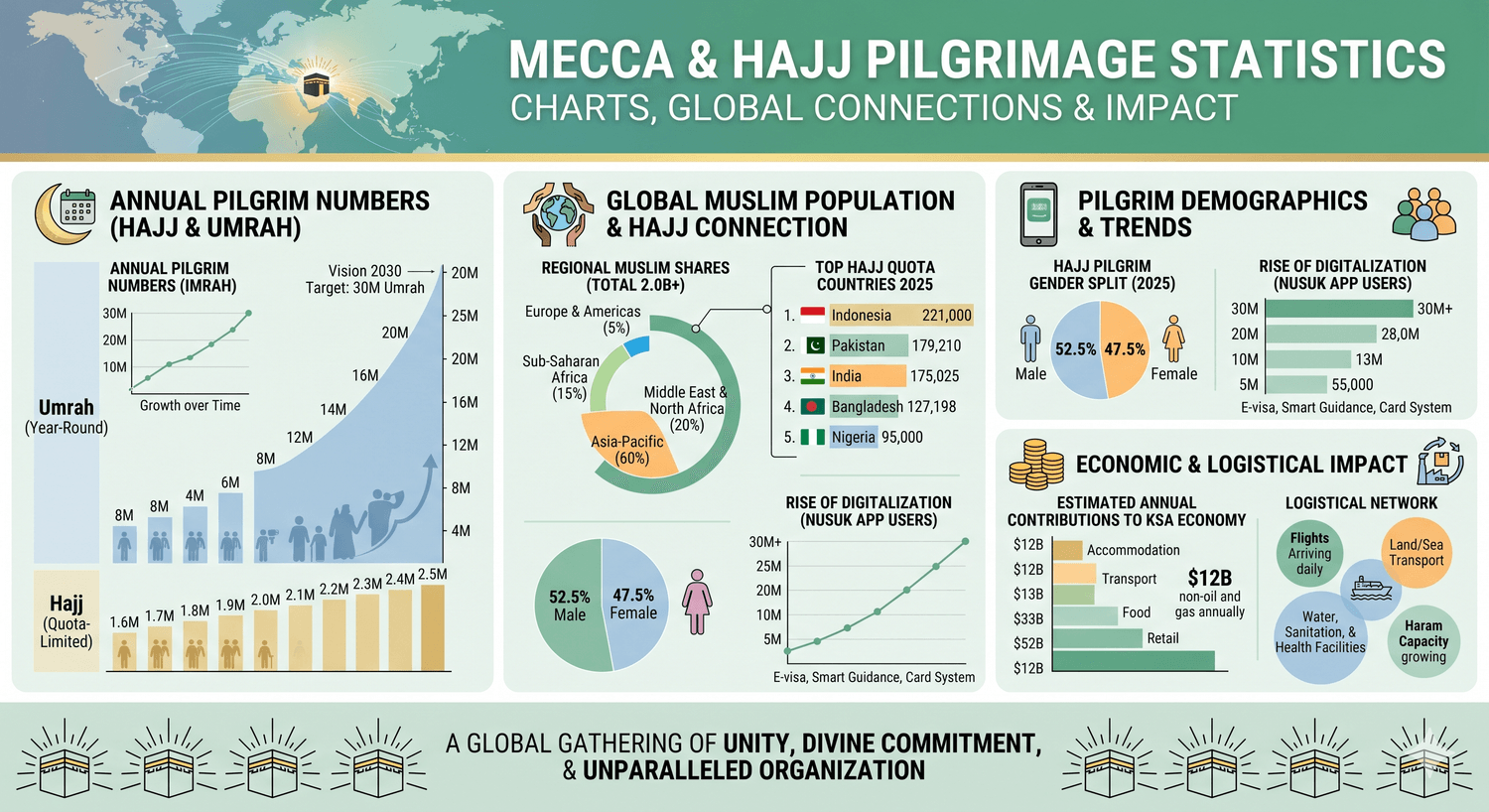
The Hajj pilgrimage is one of the five pillars of Islam. Every Muslim who is physically and financially able must perform Hajj at least once in their lifetime. It takes place during the Islamic month of Dhul Hijjah, and it draws more people in one place than any other annual gathering on earth.
In a typical year, about 2 million Muslims converge on Mecca for Hajj. In 2024, estimates put the number even higher, though the extreme summer heat — reaching 50 degrees Celsius (122°F) — led to more than 1,300 deaths, a tragedy that prompted serious conversations about safety and climate change.
The rituals of Hajj are not arbitrary. They re-enact sacred history. Pilgrims circle the Kaaba seven times (tawaf), walk between the hills of Al-Safa and Al-Marwa seven times as Hajar once did, stand on the plain of Arafat in prayer and supplication, and symbolically stone three pillars representing the rejection of evil as Ibrahim rejected the devil's temptations. Every ritual has a story, and every story connects the pilgrim to their prophetic inheritance.
Men performing Hajj wear two pieces of plain white unsewn cloth — the ihram garments — that make every man look identical. No status symbols. No country markers. A king and a laborer wear exactly the same thing. This deliberate erasure of worldly rank is one of the most powerful features of the Hajj.
The Zamzam Well
The Zamzam well, which burst forth from the earth under the feet of Ismail as his mother Hajar searched for water, sits within the Grand Mosque today. It has been flowing continuously for thousands of years. Every Hajj pilgrim drinks from it. Muslims around the world receive bottles of Zamzam water as gifts from those who have made the pilgrimage.
Islamically, Zamzam water is regarded as blessed. There is a hadith where the Prophet ﷺ said that Zamzam water is for whatever it is drunk with the intention for. Muslims drink it while making dua, asking God for what they need most.
Why Non-Muslims Cannot Enter Mecca
The entry of non-Muslims into Mecca is prohibited by the Saudi government, based on the Quranic verse: "O you who have believed, indeed the polytheists are unclean, so let them not approach al-Masjid al-Haram after this, their [final] year" (Quran 9:28).
This restriction is sometimes received as exclusionary. It's worth understanding it on its own terms. Mecca is not simply a historic city or a tourist destination. It is the holiest sanctuary in Islam, a place maintained specifically for Muslim worship. The restriction is not about hostility toward non-Muslims — it's about the sanctity of a space that Muslims regard as God's house on earth.
Why Mecca Is Important to Muslims
Why is Mecca important to Muslims? Because it is where Abraham stood in obedience. Because Hagar ran and God answered. Because a spring burst from the earth in the middle of a desert. Because a man received the first words of the Quran in a cave on a dark night in 610 CE. Because 1.9 billion people face the same direction every single day. Because millions of people in white cloth stand on a plain in the desert and cry out to God together, and for a moment the whole world seems to hold still.
Mecca is not just a city. It is the intersection of human submission and divine response, the physical center of the world's second-largest faith. That's what's in the direction every Muslim faces when they pray.
Want to understand the geography of Islamic faith — from Mecca to the five pillars? Explore the courses at Start Islam Path, designed for non-Muslims and new Muslims who want to learn the real story.


